

A resident of a gas-producing district in Sindh asks her elected representative a question. How much did the province receive from the gas that left our district last year? The representative opens the federal budget and finds Rs. 3.94 billion against Sindh’s name for excise duty on natural gas. It is a plausible figure and the wrong answer. It covers the whole province, concerns only one charge and estimates what Sindh will receive in fiscal year (FY) 2026–27. The resident asked about her district, the year just ended and money actually received. A hearing of the kind proposed in Part III earns its keep when the chair allows her to ask again.¹
The Constitution gives her a place to begin. Article 161(1)(a) directs the net proceeds of federal excise on natural gas levied at the wellhead, and of the royalty collected by the federation, to the province where the wellhead lies. The money stays outside the Federal Consolidated Fund.
A family in Balochistan need not persuade Punjab that its population is large enough to warrant a share of the excise collected at a Balochistan well. The location of the well settles which province is to receive the proceeds. The amount still has to be established from production, the applicable charge and the collection record.²
The federal budget puts Rs. 213.28 billion under straight transfers to the four provinces for FY 2026–27. Sindh accounts for Rs. 123.83 billion, Khyber Pakhtunkhwa Rs. 53.60 billion, Balochistan Rs. 23.74 billion and Punjab Rs. 12.11 billion. Those amounts bring together receipts with different legal origins, including the gas development surcharge and crude-oil royalty. Gas excise accounts for Rs. 6.19 billion of the national total.
The original estimate for the preceding year was Rs. 10.41 billion, subsequently revised to Rs. 6.26 billion. An assembly member who calls the difference unpaid dues has gone one step beyond the evidence. A lower volume, a change in the calculation, a collection delay or a late transfer would each require a different remedy. The two estimates alone cannot tell a legislature which explanation to pursue.³
Crude oil presents a question for Parliament itself. Article 161(1)(b) assigns the net proceeds of federal excise levied at the oil wellhead and collected by the federation to the producing province. The budget identifies Rs. 44.59 billion in crude-oil royalty. Where, then, is the corresponding account for oil wellhead excise?
No separate entry appears in the straight-transfer table. The constitutional provision directs where proceeds must go when a duty is levied and collected. It supplies neither a charging rate nor a sum that can simply be entered as arrears. The Finance Minister could give Parliament a precise answer by identifying the charging provision and rate, any exemption, the amount collected and the head under which each province was credited. If the policy choice is to leave the wellhead outside the charge, let Parliament hear the reasons and the estimated cost to each producing province.² ³
Joint ownership raises a related but separate issue. Article 172(3), subject to existing commitments and obligations, vests mineral oil and natural gas within a province or its adjacent territorial waters jointly and equally in that province and the federation. In these pages, Open the books on oil and gas examined the consequences for public scrutiny of resource agreements. Ownership, royalty and excise answer different questions.
A province can receive the correct excise transfer and still have a legitimate grievance about an agreement concluded without its proper participation. Equally, a proposal to share corporate earnings does not discharge a single rupee of wellhead excise already collected and due. Adding the two claims together before examining their legal bases would weaken the case for both.² ⁴
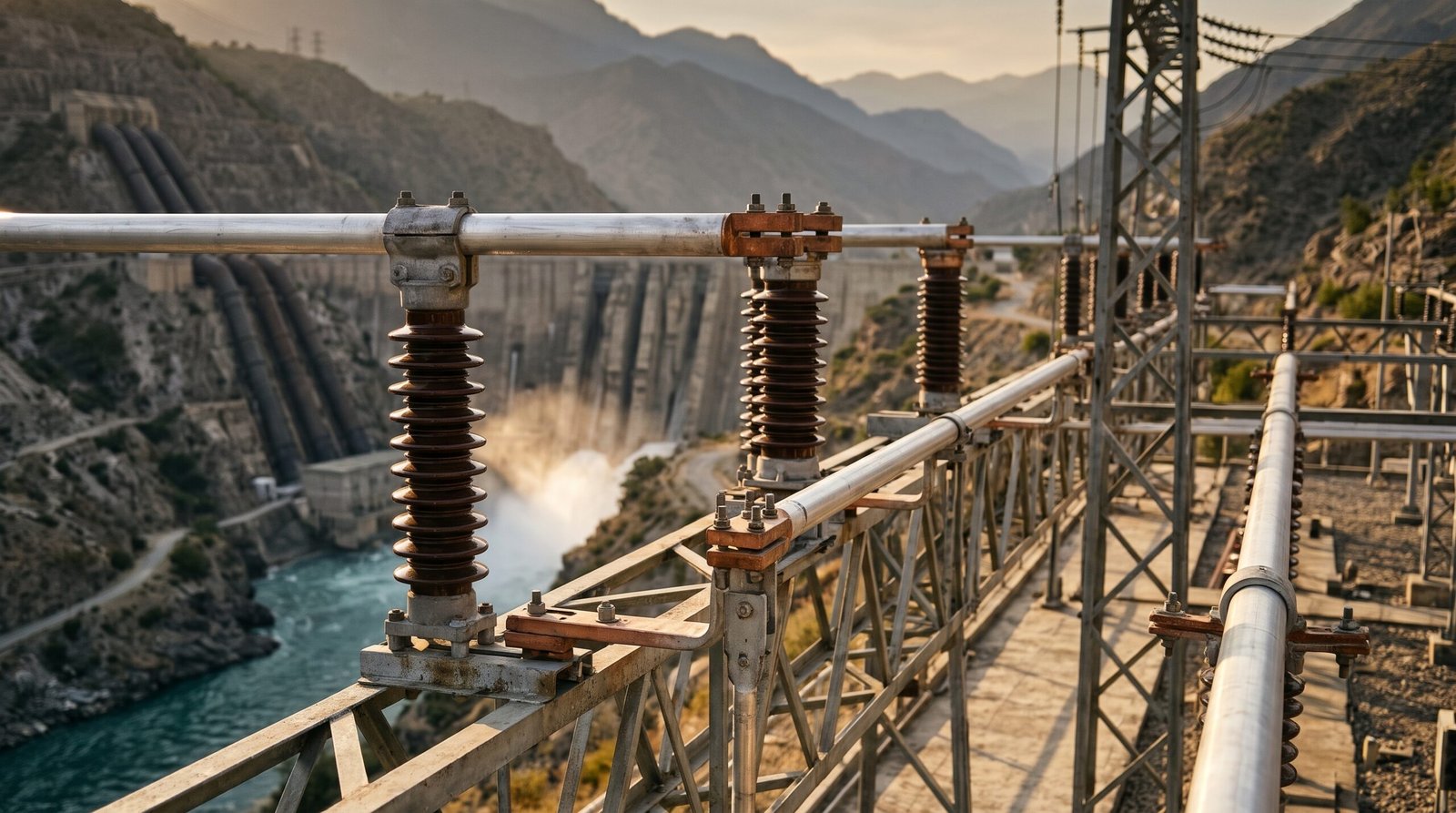
At a hydroelectric station the inquiry starts with a meter. Article 161(2) entitles the province where the station is situated to the net profits earned by the federation, or by an undertaking it established or administers, from bulk generation there. The bus-bars are the point at the station from which bulk supply is valued.
The Council of Common Interests determines the rate. Against the resulting revenue, the constitutional calculation allows station expenses, including specified taxes and duties, interest or return on investment, depreciation, overheads and provision for reserves. A household electricity bill cannot supply the missing rate. Nor would collecting a new excise at the bus-bars, whatever its merits as a separate legislative proposal, settle the profit already payable under Article 161(2).²
Khyber Pakhtunkhwa’s estimates show why those distinctions matter. For FY 2026–27 the province budgets Rs. 116.73 billion under net hydel profit. Of that amount, Rs. 38.28 billion is regular profit, Rs. 22.31 billion is arrears of profit and Rs. 56.14 billion is indexation arrears. The estimates also carry a nominal Rs. 100,000 entry for the A.G.N. Kazi methodology. Thus, roughly two out of every three rupees budgeted under this head depend on recovering amounts attributed to earlier years.
For FY 2025–26, the province’s original estimate of Rs. 105.99 billion was revised to Rs. 36 billion. A revised estimate is still an estimate. A finance committee needs the dated receipts and the years against which the payer and recipient booked them before it can certify an outstanding balance.⁵
Consider the consequences of a single payment. If the payer records it against this year’s generation while the province credits it against an earlier year, both treasuries can truthfully report the same cash transfer and still produce different arrears figures. A public argument about the grand total would get them nowhere. For each station, the Council of Common Interests could publish the units supplied, its applicable rate and the date that rate took effect. The generating undertaking could show its deductions.
The two finance departments could then reconcile the opening balance, entitlement for the period, payments and closing balance, identifying any item on which they disagree. An elected committee could ask about the disputed cost or year instead of inviting two officials to repeat rival totals.
The same discipline should extend beyond the provincial capital. Article 161 names the province as recipient. A producing district’s claim on its provincial government must be traced to the applicable provincial law, allocation or undertaking.
The elected representative in Sindh could table two short statements. The first would show what the federation collected against the district’s fields and transferred to the province. The second would identify what the provincial assembly authorised for the district, what the treasury released and what the local authority spent.
Residents could then ask the official who made the relevant decision why a water scheme remains unfinished. Islamabad, Karachi and the district office would each have an account to defend.
Before asking citizens to agree to new provincial boundaries, Pakistan could give them this elementary experience of the federation working under the present ones. Punjab has as much interest in an intelligible account of its oil receipts as Khyber Pakhtunkhwa has in the proceeds of its hydel stations.
By 2047, the resident who asks what became of her district’s gas should be able to take the figures home, check them and return to an elected assembly with a better question. Whether redrawing Punjab would bring that assembly any closer to her fellow citizens is the subject of Part V.
Next: Punjab and the future of the federation.
Notes
- Dr Ikramul Haq, Pakistan at 100—III, The Scoop. The district hearing is illustrative. The Sindh estimate is from the Finance Division memorandum in note 3.
- National Assembly of Pakistan, Constitution of the Islamic Republic of Pakistan, Articles 161 and 172(3).
- Finance Division, Federal Budget 2026–27, Budget in Brief, transfers to provinces, and Explanatory Memorandum on Federal Receipts, provincial shares and straight transfers. Figures in the text are rounded independently.
- Dr Ikramul Haq, Open the books on oil and gas, The Scoop, November 24, 2026.
- Government of Khyber Pakhtunkhwa, Finance Department, Estimates of Receipts 2026–27, object-wise receipt breakup for net hydel profit, and provincial budget white paper, discussion of regular profit and arrears.
Disclaimer: The views and opinions expressed in this article are solely those of the author(s) and do not necessarily reflect the editorial position, values or beliefs of The Scoop or its management.
The Scoop firmly believes in freedom of speech, intellectual diversity and the open exchange of ideas. As an independent media platform, we remain committed to providing space for differing perspectives, including those that may challenge or contradict our own views.
Publication does not constitute endorsement. Our commitment to freedom of expression and independent journalism extends beyond opinions with which we agree.