

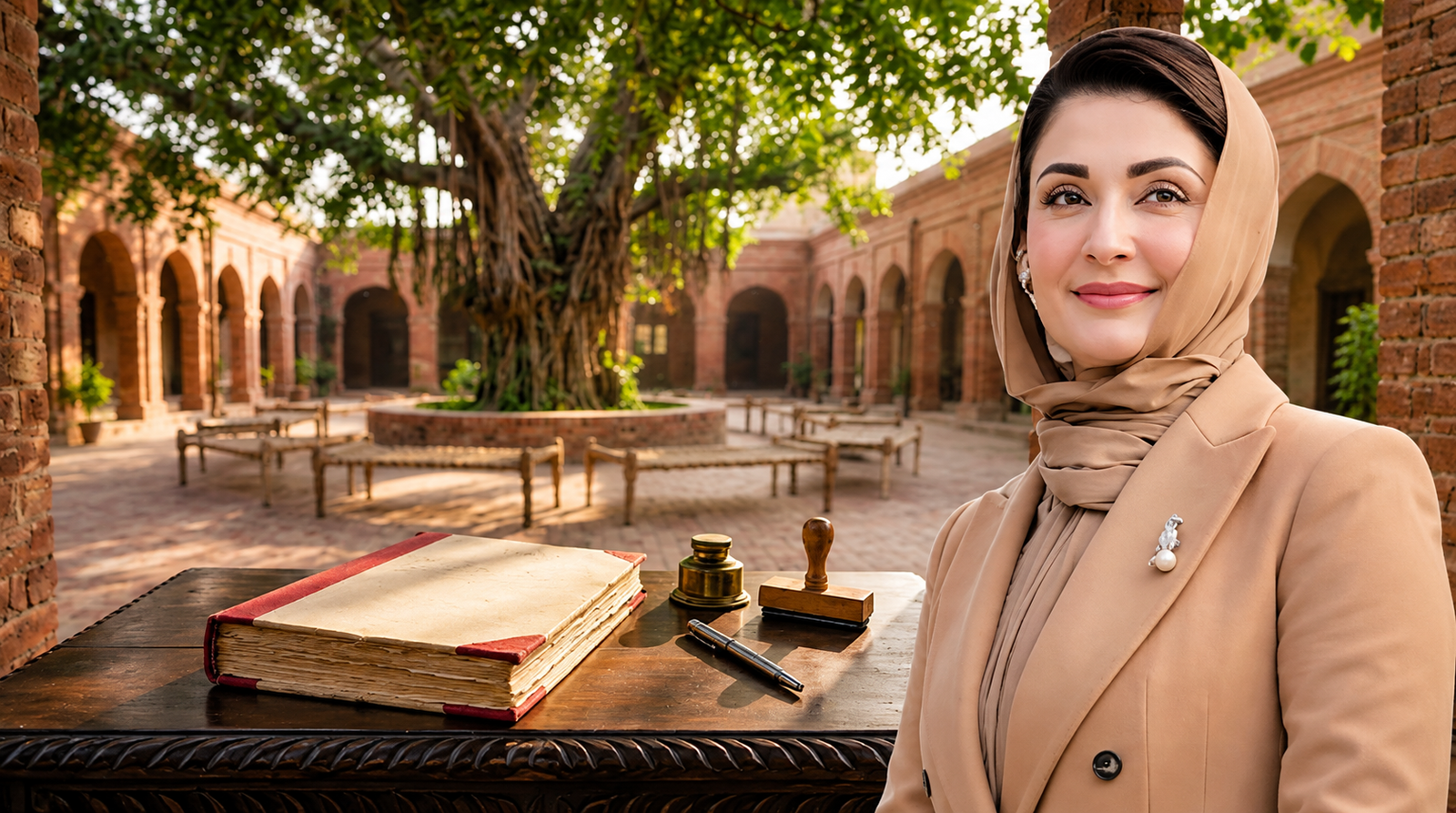
LAHORE: The Punjab government has unveiled an ambitious legislative framework to revive the traditional panchayat system across the province, proposing community-based dispute resolution under the supervision of deputy commissioners, with a 15-day target for amicable settlements and legal safeguards designed to prevent the misuse of informal justice mechanisms.
The proposed Punjab Panchayat Act, 2026, approved in draft form by Chief Minister Maryam Nawaz Sharif, seeks to establish a legally regulated system for resolving civil, family, neighbourhood, property and commercial disputes without requiring citizens to immediately resort to conventional litigation.
The 13-page draft legislation, examined by The Scoop, contains 24 sections covering the appointment, eligibility, disqualification, supervision and removal of panchayat mediators, alongside restrictions intended to protect fundamental rights.
The government has invited public suggestions on the proposed legislation until December 15, 2026, indicating that the framework remains subject to consultation before its possible enactment.
The initiative represents a significant attempt to institutionalise community mediation in Punjab, but it also raises important questions about the concentration of administrative authority, the independence of mediators and the relationship between the proposed mechanism and Pakistan’s existing judicial and alternative dispute resolution systems.
Panchayats to Operate Across Punjab
Under Section 3 of the proposed law, deputy commissioners would be authorised to appoint one or more individuals designated as Panchayati for specified areas within their respective districts.
These areas may include union councils, villages, mauzas, localities and other territorial units designated by the deputy commissioner.
Although the government’s broader announcement refers to panchayat committees, the actual draft provides for the appointment of one or more individual mediators rather than prescribing a fixed committee structure.
The appointed Panchayati would function as a mediator, conciliator or facilitator, helping disputing parties reach mutually acceptable agreements.
The proposed system would not establish separate judicial courts or confer judicial powers upon community mediators.
Instead, its principal objective would be to settle disputes through dialogue, reconciliation and voluntary compromise, potentially reducing litigation costs and unnecessary proceedings before civil courts.
Chief Minister Maryam Nawaz has presented the initiative as an attempt to revive Punjab’s longstanding tradition of community-based dispute resolution while bringing it within a clearly defined legal framework.
The government maintains that many routine disagreements can be settled through mutual understanding without requiring prolonged courtroom proceedings.
Who Can Become a Panchayati?
One of the most consequential provisions concerns the selection of individuals authorised to mediate disputes.
Under Section 5, a person must be a permanent resident of the relevant area and possess a reputation for integrity, impartiality and good character.
The draft specifically identifies several categories of potential appointees, including:
- Retired civil judges and district judges
- Retired teachers, lecturers and professors
- Islamic scholars and mosque imams
- High Court advocates
- Retired army officers
- Lambardars
- Retired civil servants
- Other individuals considered suitable by the deputy commissioner
The inclusion of retired judges and legal professionals could introduce judicial experience into the mediation process, while teachers, religious scholars and community representatives may provide familiarity with local social dynamics.
However, the legislation gives deputy commissioners considerable discretion to determine which individuals possess the necessary standing, wisdom, experience and public confidence.
This discretionary authority could become a critical issue in ensuring that appointments are based on merit rather than political influence, personal relationships or local power structures.
Every appointed Panchayati would be required to take an oath before the relevant assistant commissioner.
Appointments would be made for three years, with the possibility of reappointment subject to satisfactory performance and continued eligibility.
Importantly, Section 3 requires Panchayatis to perform their responsibilities on a pro bono basis, meaning they would not receive remuneration for their mediation services.
While this provision could help make dispute resolution affordable, the absence of a detailed financial and operational framework raises questions about how the system would be administered consistently across Punjab.
Disputes to Be Resolved Within 15 Days
Section 15 envisages a relatively short timeframe for dispute resolution.
Under the proposed arrangement, a Panchayati would attempt to facilitate a settlement within 15 days.
The timeframe is a target rather than an absolute statutory deadline, as the draft requires the mediator to try to achieve a settlement within that period.
The mechanism would cover a broad range of disputes, including disagreements between neighbours, property boundaries, possession, pathways, irrigation rights, easements and other matters capable of lawful settlement.
Contractual, commercial and monetary disputes would also fall within the proposed framework.
Family and domestic disputes could be referred for mediation, subject to strict limitations designed to prevent panchayats from deciding matters reserved for legally competent courts.
Crucially, Section 11 establishes that a dispute may be entertained only when all parties jointly and voluntarily agree to refer the matter to a Panchayati.
No individual could unilaterally compel another party to participate in proceedings.
The mediator would have no authority to take up a dispute independently or impose a settlement without the parties’ consent.
This distinction is fundamental because traditional informal justice mechanisms have historically faced criticism over decisions imposed upon individuals without genuine consent.
Under the proposed law, a settlement would have to be recorded in writing, with its terms and conditions documented and authenticated through the signatures or thumb impressions of the parties.
Also Read: SMEDA Launches Reimbursement Grant Programme With Alibaba.com To Boost AI-Driven SME Exports
Strict Ban on Honour Crimes, Forced Marriages and Violence Against Women
Perhaps the most significant safeguards are contained in Section 13, which explicitly excludes several sensitive and serious matters from the jurisdiction of Panchayatis.
The legislation prohibits mediation or settlement of cases involving rape, sexual assault, sexual abuse and harassment.
Offences committed in the name or on the pretext of honour would also remain outside the proposed system.
Similarly, Panchayatis would be prohibited from handling offences involving violence against women or children.
The draft expressly outlaws the use of practices such as wanni, swara and badla-e-sulh, through which women or girls are given in marriage as compensation for disputes.
Child marriages and forced marriages would also be excluded.
The legislation further prevents Panchayatis from determining the validity or dissolution of marriages or deciding matters concerning the legitimacy, custody or guardianship of minors.
Offences relating to religion under Chapter XV of the Pakistan Penal Code would remain outside their jurisdiction.
Disputes involving government departments, public institutions, state land, waqf property and other government-controlled properties are also excluded.
Additionally, offences that are not legally compoundable under Section 345 of the Code of Criminal Procedure, 1898, or other applicable laws cannot be handled by Panchayatis.
Any settlement concerning a prohibited matter would be void from the outset and would carry no legal effect.
If a prohibited issue emerges during proceedings, the mediator would be required to discontinue the relevant proceedings, record the reasons and report the matter to the assistant commissioner.
These restrictions appear designed to prevent the proposed institution from reproducing some of the unlawful practices historically associated with traditional jirgas and panchayats.
Courts to Retain Final Judicial Authority
The draft attempts to draw a clear distinction between mediation and formal adjudication.
Section 14 expressly states that Panchayatis would not possess the judicial powers of civil, criminal or family courts.
A mediator would also be prohibited from taking up a dispute already pending before a competent court or tribunal unless that forum refers the matter for lawful mediation.
Under Section 18, parties who voluntarily reach a settlement may jointly request that their agreement be given legal effect through a competent civil court.
The Panchayati may then transmit the original settlement and the record of proceedings to the court.
The court would examine whether the settlement was voluntary, lawful and consistent with public policy.
Where satisfied, it may pass a decree or order incorporating the settlement within 30 days of receiving the application.
However, a court would remain empowered to refuse judicial recognition if the agreement had been obtained through coercion, fraud, misrepresentation or undue influence.
Section 19 further provides that a settlement recorded by a Panchayati would be admissible as evidence before a competent court, tribunal or other authority.
These provisions are intended to ensure that community settlements can acquire legal recognition without allowing mediators to exercise independent judicial authority.
Deputy Commissioners to Exercise Extensive Control
A defining feature of the proposed legislation is the extensive authority assigned to district administrations.
Deputy commissioners would control the appointment, supervision, suspension and removal of Panchayatis.
They would also be responsible for ensuring that mediators complied with statutory requirements and maintained records of proceedings.
Under Section 10, a deputy commissioner could suspend or remove an appointed mediator for misconduct, corruption, abuse of authority, conflict of interest, persistent failure to perform duties or loss of public confidence.
A mediator accepting illegal gratification or otherwise acting contrary to the public interest could also face removal.
Although the legislation requires written reasons and an opportunity to be heard, it permits immediate suspension pending proceedings where urgent action is considered necessary in the public interest.
Section 23 would further allow deputy commissioners, with prior government approval, to formulate rules governing appointments, procedures, records, supervision and other operational matters.
Section 24 would require Panchayatis to comply with relevant government and district-level administrative directions.
Taken together, these provisions would place the proposed system firmly within the provincial administrative hierarchy.
While centralised oversight could strengthen accountability, the proposed concentration of appointment, regulatory and disciplinary powers in the offices of deputy commissioners may invite debate over the institutional independence of local mediators.
Supreme Court’s 2019 Judgment Remains a Critical Legal Benchmark
The revival of panchayats must also be examined against the backdrop of the Supreme Court’s landmark judgment of January 16, 2019, in the National Commission on the Status of Women case, reported as PLD 2019 SC 218.
The apex court ruled that jirgas and panchayats could not assume the jurisdiction of civil or criminal courts or issue decisions purporting to exercise judicial authority.
The judgment distinguished unlawful parallel adjudication from voluntary mediation, allowing traditional forums to facilitate consensual settlements of civil disputes within the limits of the law.
The court also emphasised the protection of women and the responsibility of law enforcement agencies to act against crimes arising from illegal jirga decisions.
Punjab’s new proposal appears structured around this fundamental distinction.
Its provisions denying judicial powers to mediators, requiring voluntary consent and prohibiting settlements that violate women’s rights are particularly relevant to the constitutional concerns identified by the Supreme Court.
Nevertheless, the draft’s treatment of criminal matters requires careful legal examination.
By expressly excluding non-compoundable offences, Section 13 leaves open the question of whether legally compoundable criminal disputes could be referred to Panchayatis.
The legislature may therefore need to clarify how such referrals would operate under the Code of Criminal Procedure and existing judicial precedents, particularly where a matter has not already been referred by a court.
Punjab Already Has an Alternative Dispute Resolution Law
The proposed legislation would not be Punjab’s first statutory attempt to encourage mediation.
The province already has the Punjab Alternate Dispute Resolution Act, 2019, subsequently amended, which provides a legal framework for the settlement of specified civil and criminal disputes through alternative dispute resolution procedures.
That framework includes court referrals, accredited ADR service providers and mechanisms for incorporating lawful settlements into judicial proceedings.
The proposed Panchayat Act, however, would introduce a separate community-level mechanism operating under district administration supervision.
The distinction is particularly important because the existing ADR framework is closely connected with judicial proceedings and accredited service providers, whereas the proposed panchayat mechanism would allow parties to voluntarily approach locally appointed mediators before initiating litigation.
The government will consequently need to clarify how the two frameworks would interact, especially in matters involving overlapping jurisdiction, pending litigation, confidentiality and the legal recognition of settlements.
Without clear operational rules, overlapping dispute resolution structures could create uncertainty rather than simplifying access to justice.
Questions Over Women’s Representation and Consent
Although the proposed legislation contains extensive safeguards for women, children, religious minorities, transgender persons, senior citizens and persons with disabilities, some important operational questions remain unanswered.
Section 16 expressly prohibits discrimination based on gender, religion, caste, tribe, disability, age or economic status.
It also requires Panchayatis to protect vulnerable groups.
However, the draft does not prescribe mandatory representation for women, minorities or other vulnerable communities among appointed mediators.
The legislation identifies categories of eligible appointees but leaves their actual selection to deputy commissioners.
This may become an important issue during public consultation, particularly in areas where traditional community power structures are dominated by influential families, landlords or other established local figures.
Another concern involves the practical meaning of voluntary consent.
Although the proposed law requires agreement from every party, its effectiveness will depend on safeguards ensuring that economically weaker individuals, women and socially marginalised citizens are not pressured into accepting settlements.
The draft also does not expressly establish a dedicated independent complaints mechanism for parties alleging coercion or misconduct by a Panchayati.
Nor does it set out detailed procedures governing withdrawal from mediation after proceedings have begun.
Such matters may require further clarification through legislation or subordinate rules.
Conflict of Interest and Confidentiality Safeguards
The draft introduces restrictions designed to prevent mediators from handling disputes in which their neutrality could reasonably be questioned.
A Panchayati would be required to withdraw from proceedings if related to a party, financially interested in the outcome or affected by circumstances giving rise to reasonable apprehension of bias.
In such cases, the deputy commissioner would appoint a replacement.
The legislation also requires confidentiality regarding statements, documents, admissions and negotiations exchanged during mediation.
Disclosure would be permitted only with the written consent of all parties, where required by law or pursuant to a competent court’s order.
Section 21 introduces an additional administrative reporting obligation.
Where mediation reveals a legal or administrative issue requiring government action, the Panchayati must report the matter to the deputy commissioner, who would be responsible for taking it up with the relevant authority.
This mechanism could potentially help address underlying administrative problems that contribute to local disputes.
However, its practical effectiveness would depend on how promptly the relevant authorities respond.
Can the New System Reduce Litigation?
The statement of objects and reasons accompanying the draft identifies increasing litigation, the cost of accessing formal justice and the need for expeditious dispute resolution as principal justifications for reviving panchayats.
The government believes a properly regulated community mediation system could promote social harmony and reduce unnecessary litigation.
If implemented effectively, disputes over property boundaries, irrigation channels, neighbourhood disagreements and minor financial claims could potentially be resolved without lengthy and expensive court proceedings.
For residents of rural areas and lower-income communities, the availability of local mediation may offer a more accessible first avenue for resolving disagreements.
Yet the proposed framework’s success will depend on more than its statutory language.
Transparent appointments, impartial mediators, protection against intimidation, adequate record-keeping and effective judicial supervision will be essential.
A particularly important challenge will be ensuring that influential individuals cannot use the institutional legitimacy of government-appointed Panchayatis to pressure weaker parties into unfavourable settlements.
The distinction between genuine mediation and coercive informal adjudication will ultimately determine whether the initiative strengthens access to justice or reproduces existing inequalities.
Public Suggestions Invited Until December 15
According to the draft approved by Chief Minister Maryam Nawaz Sharif, public suggestions may be submitted until December 15, 2026.
The document identifies Advocate General Punjab Zafarullah Khan as the recipient of public feedback through the email address adv.gen@punjab.gov.pk.
The consultation period provides an opportunity for legal practitioners, civil society organisations, women’s rights groups, local government representatives and other stakeholders to examine the proposed framework.
Among the questions likely to require attention are the independence of appointments, representation of women, safeguards against coercion, coordination with existing ADR legislation and the proper boundaries of administrative supervision.
The Punjab Panchayat Act, 2026, remains a proposal rather than an enacted law.
Its eventual impact will depend on the final legislation, implementing rules and the ability of provincial authorities to maintain a clear distinction between voluntary reconciliation and the exercise of judicial power.
For the Maryam Nawaz administration, the initiative could become a significant reform in community-level dispute resolution.
But its ultimate test will be whether the revived panchayat system genuinely delivers accessible, impartial and lawful settlements while preserving the fundamental rights and judicial protections guaranteed to every citizen.