

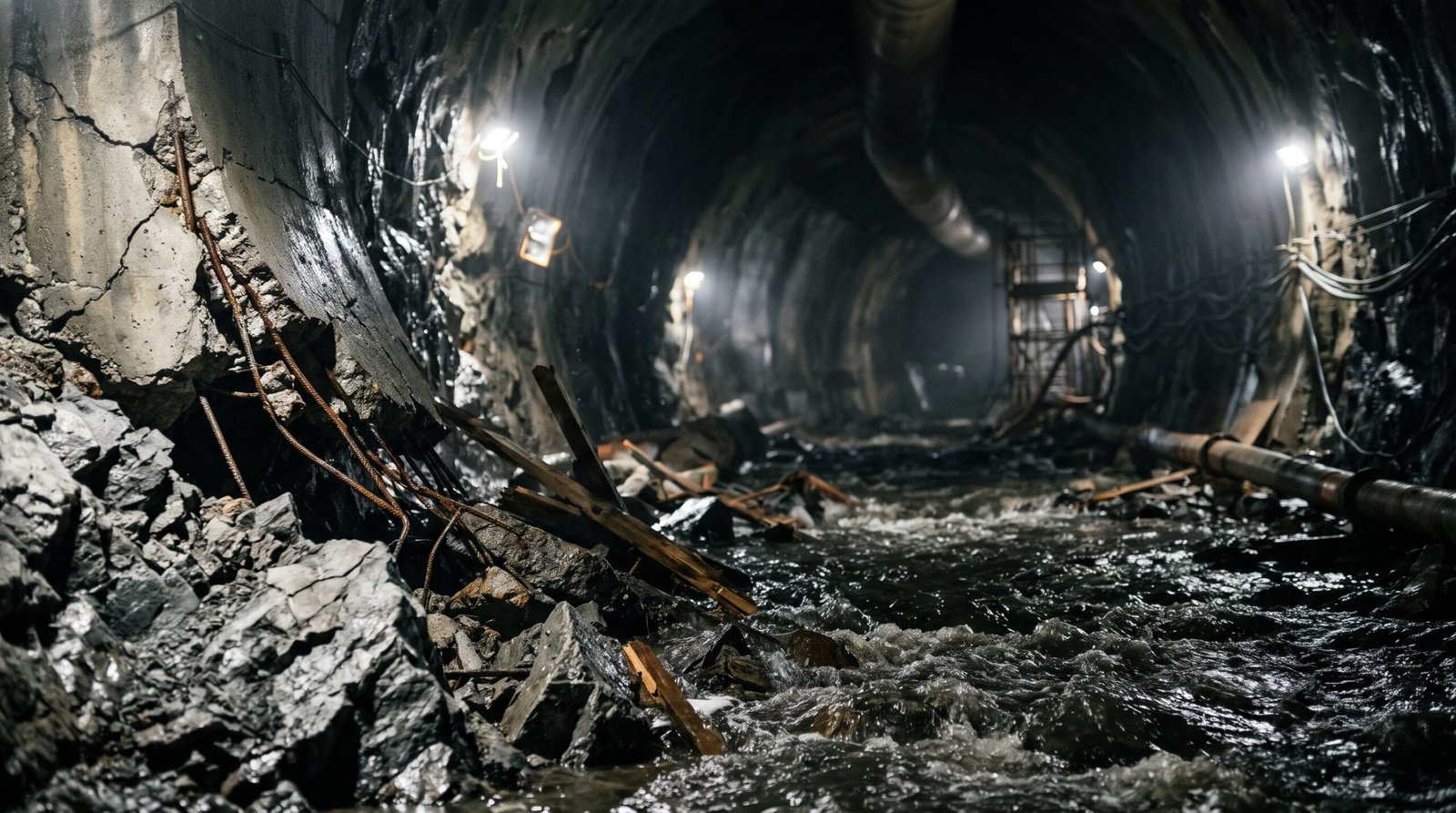
On 2 November 2026, the Ministry of Planning issued an office memorandum that should have made the nation weep. It authorises the 1,530-megawatt Tarbela 5th Extension Hydropower Project (T-5) at a staggering PKR 316.41 billion, of which PKR 180.70 billion is in precious foreign exchange. The original PC-I was approved at approximately PKR 82.36 billion. The cost has escalated by roughly 284 percent. Just seven days after that approval, on November 9, 2026, a weak section of rock collapsed during excavation work on the 2nd Bench Connecting Tunnel at T-5, allowing water from an intake pit to rush into the tunnel and the under-construction powerhouse area—a grim physical reminder of what happens when geotechnical rigor is sidelined.
Behind that cold arithmetic stand real lives: a mother in Swat who has waited decades for dependable electricity, and a factory owner in Faisalabad paying crippling tariffs for cheap electricity he can rely on. Every extra rupee in that PKR 234.05 billion surge comes directly from an overburdened taxpayer, or from a sovereign loan that the taxpayer’s children will be forced to repay.
The office memorandum itself confesses the institutional failure. It directs that the project be executed “in accordance with timelines” and that “no further cost escalation take place”—a bureaucratic admission that runaway escalation has already occurred on the Planning Commission’s watch. Worse still, it recommends a high-level committee to investigate “procedural lapses and delays” in the selection of consultants and the “enhancing scope of work due to change in design/variation orders.” In plain language, the very institution constitutionally charged with catching engineering and financial anomalies before approval is now asking, after the public treasury has been bled dry, how those failures happened.
The Planning Commission of Pakistan was never meant to be a passive post office stamping rubber-seal approvals on ministry files. Its core mandate in the development cycle is rigorous, uncompromising technical and financial scrutiny. In the water and power sector, that duty requires interrogating hydrology, rock mechanics, tunnelling methodologies, contract packaging, price-adjustment formulas, and consultant selection before the nation commits a single rupee. It demands asking uncomfortable questions when a supervision consultancy balloons, and possessing the technical depth to recognize when a contractor’s “variation order” is merely a design failure or commercial opportunism in disguise.
Consider the memorandum’s own numbers. Price adjustment alone runs to PKR 30.75 billion. Interest during construction (IDC) has swelled to PKR 45.52 billion. Duties and taxes add PKR 13.74 billion, while supervision consultancy stands at PKR 11.25 billion. These are not abstract accounting entries; each figure represents a specific engineering and contractual lever that a competent technical gatekeeper would have pulled years earlier, rather than lamenting after the concrete was poured and the rock gave way.
For decades, the engineering conscience of Pakistan’s development machinery was entrusted to seasoned practitioners—men and women who had stood inside diversion tunnels, argued with international contractors over rock classification, and carried personal accountability when concrete failed. Among the very finest of that vanishing breed was my dear friend and intellectual partner of twenty years, the late Lieutenant General Shahid Niaz (Retd), former Engineer-in-Chief of the Pakistan Army, who passed away on 7 November 2026.
For two decades, General Shahid and I shared one singular, consuming intellectual obsession: the Indus Waters Treaty and engineering innovation in hydropower. Just five days before his passing, on 2 November—the very day this disastrous Tarbela memorandum was signed—we held a long, detailed discussion on India’s 1,000 MW Pakal Dul Hydroelectric Project in Indian Illegally Occupied Jammu and Kashmir and the urgent strategic pathways for the reinstatement and protection of the Indus Waters Treaty. Even while battling severe pulmonary illness and relying on an oxygen cylinder to draw breath, his mind remained razor-sharp, his spirit unbroken, and his passion for Pakistan’s water security undimmed. He was among the rare elders who consistently encouraged my writing on the sanctity and integrity of the engineering profession.
General Shahid understood what a mega-project truly is: not a file circulated in Islamabad’s air-conditioned corridors, but a solemn promise made to the nation in steel, rock, and concrete. He lived by a simple, unyielding truth: engineering has no politics, only physics—and physics cannot be flattered. Colleagues respected him because he could read a structural drawing and a project balance sheet with equal fluency, and because he possessed the moral courage to say “no” without raising his voice. The nation owed him far more than it ever acknowledged.
His passing leaves an agonizing personal void, yet what hurts even deeper is knowing that the institutional habit of seeking people of his calibre has been deliberately abandoned by those currently steering the Planning Commission. May Allah grant General Shahid the highest place in Jannah.
Every government makes senior appointments, and every institution evolves. Yet when the oversight of Pakistan’s most complex, multi-billion-rupee hydraulic infrastructure—including Tarbela 5th Extension and the rehabilitation of the crippled 969 MW Neelum-Jhelum Hydropower Project—is handed to Dr. Awais-e-Siraj as Member (Implementation & Monitoring) at the Planning Commission, tragedy curdles into dark comedy.
Dr. Awais-e-Siraj is a medical doctor whose primary qualification for occupying the nation’s most critical infrastructure monitoring desk appears to be personal proximity and courtesy from the Minister for Planning. By appointing a medical practitioner without a day of hydraulic, structural, or energy-sector engineering experience to police projects worth hundreds of billions of rupees, the Minister for Planning has inflicted a grave disservice on Pakistan’s development governance.
One almost pictures the country’s premier infrastructure watchdogs approaching a fractured headrace tunnel or a PKR 64.57 billion turbine-generator package not with geotechnical stress models and finite-element analyses, but with a bedside manner and a stethoscope—pressing an ear gently against the concrete lining, asking the Tarbela spillway to take a deep breath and cough, or prescribing Panadol and bed rest to the shattered tailrace and turbines of Neelum-Jhelum.
Hospital administration and healthcare management are respectable professions, and running a clinic is demanding work. Nobody doubts that a medical administrator understands hospital staffing or clinical budgets. However, a hospital ward is not a high-pressure diversion tunnel. Procuring diagnostic equipment is not evaluating a multi-billion-rupee electromechanical turbine package, and credentialing physicians is not auditing the engineering basis for a geotechnical variation order. When we replace seasoned hydraulic engineers with medical generalists at the nation’s highest technical gatekeeping desk, we should not act surprised when mega-projects suffer financial cardiac arrest—and the taxpayer is left holding the bill.
The consultancy episode in the Tarbela 5th Extension demands immediate public scrutiny. According to accounts circulating across the engineering sector, an experienced international consultant was replaced by a local entity, after which supervision costs climbed sharply to PKR 11.25 billion. Whether that substitution was technically sound, and whether it saved or squandered billions, is precisely the sort of question a formidable Planning Commission should have resolved before signing off—not after. The memorandum’s own call for a probe into “procedural lapses and delays” in consultant selection confirms that the gatekeepers were asleep at the wheel.
Also Read: From Cement To Kia And GAC: Inside Yunus Brothers Group’s Multibillion-Rupee Business Empire
We do not need to reduce this crisis to a war of personalities; the remedy must be structural and immediate. Four concrete reforms are required to restore credibility to the Planning Commission:
First, require by statutory rule that the Members and Chiefs overseeing water, power, and infrastructure at the Planning Commission be practising or retired engineers with demonstrable dam, tunnelling, or power-system execution experience—restoring the institutional standard that once produced leaders like General Shahid Niaz.
Second, publish the complete technical appraisal notes and independent engineering reviews behind every revised PC-I exceeding PKR 10 billion, allowing Pakistan’s broader engineering community to scrutinize assumptions before public funds are committed.
Third, tie price-adjustment formulas and interest-during-construction projections to independent third-party engineering audits at the point of original approval, penalizing administrative delays that inflate IDC.
Fourth, ensure the proposed high-level committee on Tarbela 5th Extension is staffed by named, unimpeachable hydropower engineers—not generalist bureaucrats—with a strict 60-day deadline and a mandatory public report fixing responsibility for the 284 percent cost explosion and the November 9 tunnel collapse.
The people of Pakistan do not ask for miracles. They simply ask that when they are told a national hydropower project will cost PKR 82.36 billion, it does not quietly balloon into PKR 316.41 billion. They ask that the official guarding their hard-earned taxes knows what a penstock is, understands why a variation order matters, and possesses the backbone to stop bad engineering before concrete is poured.
Lieutenant General Shahid Niaz asked those exact questions throughout his distinguished life, and he asked them early, when honest engineering could still protect the public purse. That is the standard we have lost—and the standard we must urgently recover before the next office memorandum arrives with an even larger number, and fewer real engineers left to read it. Soon, I will release a detailed technical report on the tunnel incident at the Tarbela 5th Extension Hydropower Project.
Disclaimer: The views and opinions expressed in this article are solely those of the author(s) and do not necessarily reflect the editorial position, values or beliefs of The Scoop or its management.
The Scoop firmly believes in freedom of speech, intellectual diversity and the open exchange of ideas. As an independent media platform, we remain committed to providing space for differing perspectives, including those that may challenge or contradict our own views.
Publication does not constitute endorsement. Our commitment to freedom of expression and independent journalism extends beyond opinions with which we agree.