

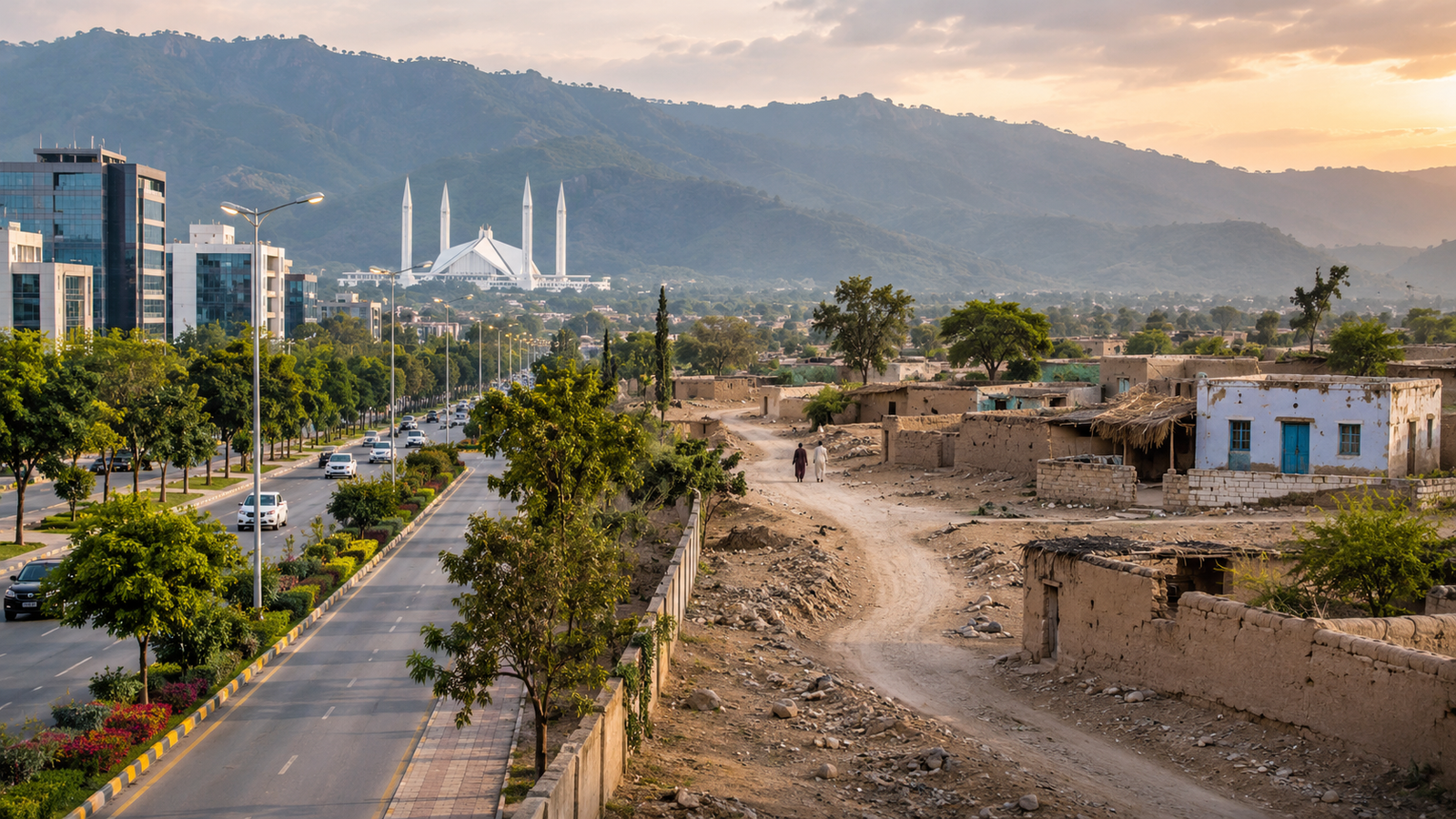
Pakistan’s development landscape reveals a significant geographical divide, with districts along the Islamabad-Lahore corridor recording some of the country’s highest welfare scores while large parts of Balochistan, interior Sindh and Khyber Pakhtunkhwa continue to lag behind.
An analysis of the 2023 “Population and Housing Census” shows that Islamabad leads with a welfare score of 819 out of 900, while Kohlu in Balochistan and Sujawal in Sindh share the lowest score of 269.
The difference of 550 points highlights the extent of regional inequality in access to basic services and household facilities across Pakistan.
The “Welfare Index” evaluates districts using nine indicators covering education, electricity, housing conditions, sanitation and other aspects of household well-being.
The geographical findings show a concentration of relatively high welfare scores across northern and central Punjab, particularly along the corridor connecting Islamabad and Rawalpindi with Jhelum, Gujrat, Gujranwala, Sialkot and Lahore.
However, the same analysis identifies substantially weaker outcomes in several districts of Balochistan, interior Sindh and the mountainous areas of Khyber Pakhtunkhwa.
Islamabad and Punjab Dominate Pakistan’s Welfare Rankings
Islamabad secured the highest national welfare score at 819 out of 900, followed closely by Karachi Central at 816 and Sialkot at 805.
Other leading districts include Karachi South with 796, Karachi Korangi with 790, Lahore with 787, Gujrat with 784, Gujranwala with 781, Rawalpindi with 780 and Karachi East with 778.
The findings demonstrate the strong performance of major urban centres and economically established districts in education, housing and access to essential infrastructure.
A geographical pattern is particularly visible across northern and central Punjab, where districts connected through the historic Grand Trunk Road network record relatively high welfare levels.
The corridor includes major cities such as Rawalpindi, Gujrat, Gujranwala and Lahore, alongside the industrial centre of Sialkot.
The concentration of high scores suggests an association between established urban development and access to household services, although the index does not independently determine the historical causes of these differences.
The findings also reveal a north-south divide within Punjab itself, with northern and central districts generally outperforming the national average while southern districts record comparatively weaker outcomes.
Balochistan and Interior Sindh Record Some of the Lowest Scores
While several districts in Punjab and Karachi perform strongly, the situation is considerably different in parts of Balochistan, Sindh and Khyber Pakhtunkhwa.
The lowest-ranking districts include Kohlu and Sujawal, both scoring 269, followed by Washuk and Dera Bugti at 288, Kolai Palas Kohistan at 292 and Kohistan Upper at 294.
Other districts near the bottom include Jhal Magsi at 309, Thatta at 313, Tharparkar at 315 and Badin at 321.
These districts fall substantially below the national welfare score of 610 out of 900.
“Islamabad’s index score is approximately 3.04 times that of Kohlu or Sujawal, illustrating the scale of the measured disparity.”
The differences are particularly pronounced when comparing Islamabad with the lowest-scoring districts.
Islamabad’s index score is approximately 3.04 times that of Kohlu or Sujawal, illustrating the scale of the measured disparity.
However, this ratio refers specifically to the composite index and does not mean residents of Islamabad are necessarily three times wealthier or enjoy three times the overall quality of life.
Weaknesses in education, electricity access, housing quality and sanitation contribute to the low scores recorded across several districts.
The findings indicate that geographical location remains strongly associated with the availability of essential household services and educational opportunities.
Education and Literacy Reveal Major Regional Gaps
Educational indicators account for three of the nine components used to calculate the “Welfare Index”, making schooling and literacy important determinants of district performance.
The index examines whether individuals have attended school, whether they are literate and whether children are enrolled in primary education.
According to the district-level findings, Islamabad scores 98 in literacy and 97 in school attendance, while Sialkot records scores of 90 in literacy and 99 in school attendance.
Gujrat also performs strongly, with a literacy score of 94 and a primary enrolment score of 93.
In contrast, several of Pakistan’s lowest-ranked districts face severe educational disadvantages.
Kolai Palas Kohistan records a literacy indicator score of just 1 out of 100, while its school attendance score stands at 4.
Similarly, Kohistan Upper scores 5 in both literacy and school attendance.
In Sindh, Sujawal records a literacy score of 16 and a school attendance score of 13, reflecting substantial gaps compared with the country’s highest-ranked districts.
These figures represent census-derived indicator scores rather than independent measurements of educational quality.
Nevertheless, they illustrate how access to schooling and basic educational attainment varies considerably between districts.
Electricity, Housing and Sanitation Widen the Development Gap
Beyond education, the “Welfare Index” highlights major disparities in access to household infrastructure.
The study assesses electricity connections, reliance on firewood for cooking, the condition of housing structures and the availability of toilet and kitchen facilities.
Islamabad performs strongly in several of these areas, recording an electricity access score of 92 and a cleaner cooking fuel indicator score of 88.
Karachi Central also performs particularly well in household infrastructure, achieving scores of 100 for housing quality, toilet facilities and kitchen facilities.
However, infrastructure conditions are substantially weaker in several lower-ranked districts.
In Kohlu, the electricity access indicator stands at 18, while the indicator measuring reduced reliance on firewood scores just 2.
The district also records a housing quality score of 4, with toilet and kitchen facilities each scoring 9.
Washuk records an electricity access score of 24, while Dera Bugti scores 31 on the same indicator.
In Sindh, Tharparkar’s cleaner cooking fuel indicator stands at 14, while its sanitation indicator scores 32.
These differences demonstrate how disadvantages in multiple household facilities can overlap within the same districts.
Where educational attainment is low and access to electricity, sanitation and durable housing is limited, districts tend to perform poorly across several components of the index rather than a single indicator.
How the Welfare Index Measures Development
The “Welfare Index” uses data from Pakistan’s 7th “Population and Housing Census”, conducted in 2023, combining nine indicators into a single composite measure.
Each indicator is measured on a scale of 0 to 100, producing a maximum possible district score of 900.
The indicators cover school attendance, literacy, primary school enrolment, functional ability, electricity access, reduced reliance on firewood, housing quality, toilet facilities and kitchen facilities.
Each component carries equal weight, meaning every indicator can contribute a maximum of 100 points to a district’s overall score.
The functional ability indicator uses census information concerning individuals without reported disabilities as a proxy for physical functioning. It should not be interpreted as a direct measure of healthcare quality or access to medical services.
The index therefore provides a multidimensional picture of household and population welfare rather than measuring income or economic output alone.
At the national level, the welfare score stands at 610 out of 900.
The analysis draws on census information covering approximately 241 million people and 38 million households, allowing comparisons between geographical areas using a common set of indicators.
However, because the index combines different dimensions into a single score, district rankings should be examined alongside their individual indicators.
Two districts may achieve similar overall scores while facing different challenges in education, energy access or housing conditions.
The index also does not directly measure employment, household income, nutrition, drinking water quality or the effectiveness of public healthcare services.
Regional Inequality Raises Questions About Development Priorities
The concentration of higher welfare scores around Islamabad, northern Punjab and Karachi highlights the geographical imbalance in Pakistan’s access to basic services.
Northern and central Punjab demonstrate relatively strong outcomes across several welfare indicators, while southern Punjab, Balochistan and parts of Khyber Pakhtunkhwa record weaker performance.
Difficult terrain, lower population density and historical differences in infrastructure investment are possible factors contributing to regional disparities.
However, the “Welfare Index” measures outcomes rather than establishing how much each factor contributes to the observed differences.
The findings nevertheless provide evidence for geographically targeted development planning.
For districts facing weak educational outcomes, improvements in schooling, enrolment and literacy would address several dimensions of the index.
In areas with low electricity and sanitation indicators, expanding reliable household infrastructure and essential facilities would address other recorded disadvantages.
Education, housing, sanitation and access to cleaner energy are particularly relevant areas for policy intervention in districts with consistently low welfare scores.
The scale of the differences also raises broader questions about how development resources are distributed between established urban centres and less-developed regions.
What the Welfare Index Means for Pakistan’s Future
Pakistan’s “Welfare Index” reveals that the country’s development challenges cannot be understood through national averages alone.
While the national score stands at 610 out of 900, individual district scores range from 819 in Islamabad to 269 in Kohlu and Sujawal.
The strongest outcomes are concentrated in Islamabad, several districts of northern and central Punjab, and parts of Karachi.
Meanwhile, many of the weakest outcomes are found in Balochistan, interior Sindh and mountainous areas of Khyber Pakhtunkhwa.
“The geographical differences show that improvements in education, housing and household infrastructure have not been distributed evenly across the country.”
The geographical differences show that improvements in education, housing and household infrastructure have not been distributed evenly across the country.
The analysis also demonstrates why district-level data matter for public policy. National figures can conceal substantial differences between communities, while more detailed indicators can help identify where specific services remain inadequate.
Although the “Welfare Index” is based on the 2023 census and cannot independently establish changes in living conditions since then, it provides a documented baseline for understanding Pakistan’s regional welfare disparities.
The findings reinforce the need to evaluate development not only through national economic performance but also through the availability of basic services across districts.
For policymakers, the challenge identified by the data is ensuring that improvements in education, electricity, housing and sanitation extend beyond the country’s established high-performing urban and industrial centres.