

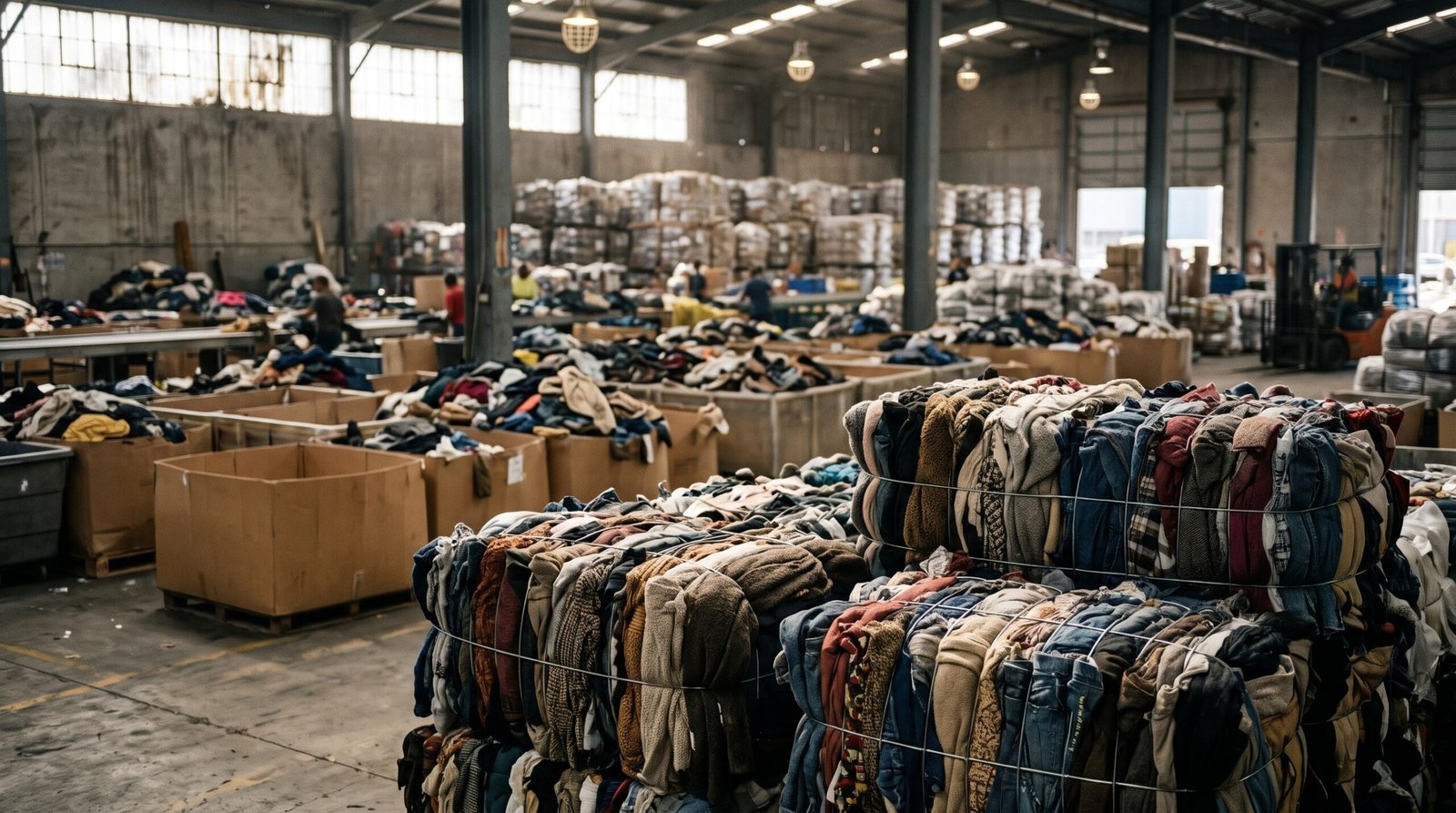
LAHORE/KARACHI: Pakistan’s second-hand economy has evolved into a substantial international trading business, connecting American clothing collection networks, European exporters, Karachi’s industrial sorting facilities, traditional landa bazaars and a new generation of digital retailers selling pre-owned international brands.
What was once widely perceived as a market serving primarily low-income households has developed into a layered commercial ecosystem encompassing imported clothing, footwear, handbags, accessories, household goods, vintage products and organised resale businesses.
Behind the crowded stalls selling winter jackets, branded jeans and imported sneakers lies an international supply chain involving shipping companies, customs agents, importers, grading factories, wholesalers, distributors and retailers.
The scale is striking.
Pakistan imported approximately $561.9 million worth of worn clothing and other worn articles during calendar year 2025, equivalent to roughly Rs157 billion at an illustrative exchange rate of Rs280 to the dollar, according to World Bank World Integrated Trade Solution (WITS) data based on international merchandise trade records.
The figure covers goods classified under Harmonised System code 6309. It does not represent the total value of Pakistan’s thrift economy, which also includes second-hand electronics, furniture, appliances, books, locally resold goods and other products recorded under different customs classifications.
Nevertheless, the import figure establishes that second-hand merchandise is no longer a marginal commercial activity.
Pakistan has also become an international sorting and redistribution centre for used textiles, with substantial volumes processed and exported to markets in Africa, Asia and beyond.
This raises a fundamental question: Who controls Pakistan’s second-hand trade, how much economic value does the country retain, and who ultimately benefits from the billions of rupees moving through its supply chains?
A Rs157 Billion Import Trade That Continues To Expand
Official trade statistics show that Pakistan’s imports of worn clothing and other worn articles have increased substantially over the past several years.
During FY2019–20, imports under HS 6309 stood at approximately $168 million. By FY2021–22, they had reached $432 million.
Imports subsequently amounted to $434 million in FY2023–24 before increasing to approximately $510 million in FY2024–25.
The FY2024–25 figure represented an increase of approximately 17.5 per cent over the preceding financial year.
In physical terms, reported imports reached approximately 1.137 million tonnes in FY2024–25, compared with about 990,266 tonnes in FY2023–24.
These quantities indicate the enormous logistical infrastructure required to move, store, sort and redistribute second-hand merchandise.
The financial-year data also show that the trade’s expansion is not simply a consequence of currency depreciation. Its reported dollar value and physical volumes have both increased.

The scale of imports becomes particularly significant when viewed against Pakistan’s broader economic circumstances, including pressure on household purchasing power, domestic manufacturing costs and consumer demand for affordable products.
However, the recorded import value should not be confused with domestic retail turnover. Goods may pass through multiple stages of wholesale distribution, sorting, processing and resale before reaching final consumers.
America Supplies Almost Half Of Pakistan’s Used-Articles Imports
An examination of international trade data reveals the importance of the United States in Pakistan’s second-hand supply chain.
In calendar year 2025, Pakistan imported approximately $279.1 million worth of worn clothing and other worn articles from the United States, accounting for almost half of its total imports under HS 6309.
China was the second-largest recorded supplier, contributing approximately $46 million, followed by Canada at $30.4 million, the United Kingdom at $23.5 million and South Korea at $22.4 million.
France, Australia, Germany, the United Arab Emirates and several other European and Asian countries also contributed to the trade.
The concentration of imports from developed economies reflects the international infrastructure surrounding second-hand merchandise collection and redistribution.
Used garments may pass through collection organisations, charities, commercial aggregators, sorting companies and exporters before reaching Pakistan.
However, the country recorded as the exporter is not necessarily the country where a particular garment was manufactured or originally purchased.
A jacket shipped from the United States, for example, could have been manufactured in Bangladesh, Vietnam, China or another textile-producing economy.
That distinction matters when examining the trade’s actual origins and commercial value.

Karachi’s Sorting Factories: The Industrial Side Of Landa
One of the least understood dimensions of Pakistan’s thrift economy is the industrial processing business operating behind the retail markets.
Karachi’s Export Processing Zone hosts businesses involved in importing, grading, sorting, processing and exporting second-hand textiles.
Among the identifiable operators is Resale International (Pvt) Ltd, which describes itself as a used-clothing grading and industrial wiping-rag manufacturing company.
According to its published corporate profile, the company operates two grading facilities covering more than 100,000 square feet and processes over 30 million pounds of clothing annually.
That represents approximately 13,600 metric tonnes of material a year, based on the company’s stated processing figure.
Resale International says its operations involve separating imported used goods into more than 250 categories, including clothing, footwear, toys, industrial wiping materials and vintage products.
These are company-reported operational figures rather than independently audited disclosures. They nevertheless illustrate the scale and sophistication that parts of Pakistan’s second-hand processing industry have achieved.
Another identifiable operator, Bushra International, operates in Karachi’s Export Processing Zone and markets graded second-hand clothing, used shoes, ladies’ handbags and school bags.
The company says it produces more than 200 grades of second-hand clothing and supplies merchandise in compressed bales of different sizes for commercial buyers.
These businesses demonstrate how second-hand goods are transformed from unsorted imported material into commercially classified products.
The sorting process can determine whether an item is suitable for premium resale, ordinary retail, lower-priced wholesale distribution, industrial reuse or eventual disposal.
The quality of that classification is central to the economics of the business.
A consignment containing relatively few premium items may produce very different returns from one with a higher proportion of desirable brands and reusable merchandise.
Consequently, the commercial value of an imported bale cannot be determined from its weight alone.
The Scoop’s review identifies Resale International and Bushra International as established participants in this segment. However, publicly available information does not establish their respective market shares or support a definitive ranking of Pakistan’s largest used-goods importers by revenue.
That ranking would require company-level customs values, import quantities and audited financial information.
Pakistan’s $282 Million Re-Export Business: Where The Used Clothes Go
Pakistan’s second-hand trade is not simply a story of foreign goods entering domestic markets.
It is also a substantial export business.
During FY2024–25, Pakistan exported approximately $282 million worth of worn clothing and other worn articles, equivalent to around Rs78.9 billion.

The principal export destinations were Kenya, Mozambique, Tanzania, Thailand and Chile.
Kenya alone purchased approximately $73 million worth of these goods, accounting for nearly 26 per cent of Pakistan’s exports in the category.
Mozambique accounted for $37.7 million, Tanzania $35 million, Thailand $25.5 million and Chile $12.3 million.
Together, these five destinations represented approximately 65 per cent of Pakistan’s recorded exports under HS 6309.
This trade reveals an important dimension of Pakistan’s commercial relationship with international second-hand markets.
Pakistan imports large quantities of mixed used merchandise, sorts it into different grades and exports selected products to markets where demand exists for particular categories.
The process creates commercial opportunities in logistics, warehousing, industrial processing, packaging and international distribution.
However, the available aggregate trade figures do not establish how much value Pakistan adds through these activities or how profitable the re-export business is.
The difference between $510 million in imports and $282 million in exports cannot be interpreted as the value of goods consumed domestically.
Imported merchandise may be re-exported in a subsequent year, remain in inventory, undergo processing, enter other product classifications or be discarded.
Establishing the industry’s actual domestic market size would require more detailed import, export, inventory and retail-sales information.
From Landa Bazaars To Premium Retail: The Changing Consumer Market
For decades, Pakistan’s second-hand clothing business has been associated with traditional landa bazaars, where imported garments and footwear are sold through informal retail networks.
These markets remain important sources of affordable winter clothing, jackets, sweaters, jeans, shoes and household textiles.
However, the commercial model is changing.
A growing segment of the industry is attempting to reposition second-hand products as desirable fashion merchandise rather than simply inexpensive substitutes for new goods.
International sportswear brands, designer jackets, vintage clothing and branded footwear can command considerable attention among consumers looking for products that would otherwise be difficult or expensive to purchase new.
Online retailers increasingly compete through product photography, brand identification, cleaning, condition grading, authenticity claims, customer service and delivery.
One identifiable participant is Khazanay, which says it began operating in 2015 and specialises in pre-loved footwear and original factory leftovers.
The company positions itself around branded products, affordability and sustainable consumption, illustrating how a business historically associated with informal markets can be transformed into a recognisable retail identity.
Other digital resale businesses, including Pakistan Thrifts and ReVogue, illustrate the emergence of online channels serving consumers interested in pre-owned products.
However, the publicly available information does not establish which companies lead the market by annual sales, revenue or profitability.
The distinction between traditional thrift sellers and organised retail businesses is significant.
A conventional landa retailer may sell merchandise from a physical stall with relatively limited overheads.
An organised online retailer may incur expenditure on photography, inventory management, digital advertising, payment processing, packaging, delivery, returns and customer support.
Premium pricing therefore does not necessarily translate into higher net profitability.
Nevertheless, the emergence of curated thrift retail demonstrates that the industry is competing not only on price but increasingly on convenience, trust, presentation and product selection.
The Business Of Sorting: Where The Money Is Made
The economics of the second-hand industry begin long before a garment reaches a consumer.
Imported merchandise may be purchased in mixed consignments, compressed bales or pre-sorted categories.
A commercial importer must account for procurement, freight, customs charges, port handling, inland transportation, storage, labour and financing costs.
Once merchandise reaches a grading facility, its commercial value depends on condition, brand, size, seasonal demand and the proportion of reusable products.
Higher-quality garments may be directed towards premium resale channels, while ordinary clothing may enter conventional wholesale markets.
Lower-quality textiles can be sold for industrial wiping materials or recycling, depending on their composition and condition.
The same imported consignment can therefore generate several revenue streams.
To illustrate the economics, consider a hypothetical consignment with a total landed and processing cost of Rs10 million.
If its graded products generate Rs13 million in sales, the business records a gross trading surplus of Rs3 million, equivalent to approximately 23 per cent of sales.
However, that surplus is not net profit. Administrative expenditure, financing charges, unsold stock, losses, taxes and other costs must still be deducted.
This example is illustrative rather than a claim about actual industry margins.
Without access to commercial invoices, audited accounts and inventory records, claims that Pakistan’s thrift businesses routinely earn exceptionally high profits would be speculative.
The industry’s apparent profitability must also be weighed against the risk of receiving poor-quality consignments, seasonal inventory losses and fluctuations in international freight costs.
The Domestic Manufacturing Conflict: A 30–40 Per Cent Market Share Claim
The expansion of imported second-hand footwear has generated serious concerns among Pakistan’s domestic manufacturers.
On March 5, 2026, representatives of the leather and footwear industry met Federal Minister for Commerce Jam Kamal Khan to discuss export opportunities, domestic manufacturing challenges and regulatory issues.
According to an official government statement, industry representatives estimated Pakistan’s annual footwear consumption at approximately 550 million pairs, against installed manufacturing capacity of nearly 700 million pairs.
They further claimed that imported used footwear accounts for approximately 30–40 per cent of domestic demand.
That estimate has not been independently substantiated by publicly available footwear-specific import and sales data.
The industry argued that second-hand branded shoes entering Pakistan at low declared values create unfair competition for local manufacturers.
Representatives proposed introducing a separate customs classification for used footwear, allowing regulators to monitor import volumes and valuations more accurately.
The Ministry of Commerce disclosed that the proposal had been placed on the agenda of the Tariff Policy Board for consideration.
The government’s March statement did not establish that a separate classification had subsequently been introduced.
The debate presents policymakers with a difficult choice.
Domestic manufacturers argue that cheap imported footwear undermines local production, employment and investment.
Consumers, however, benefit from access to lower-priced products, including international brands that may otherwise be beyond their purchasing power.
Restricting imports could protect some manufacturers while increasing costs for households already struggling with affordability.
Equally, allowing large quantities of imported footwear to enter without sufficiently transparent product-level statistics makes it difficult to evaluate the industry’s claims or design evidence-based policy.
The most immediate requirement is reliable data.
Without knowing how many pairs of used shoes enter Pakistan, their declared values, their actual selling prices and their share of domestic consumption, neither an import ban nor unrestricted expansion can be assessed properly.
Poverty, Purchasing Power And The Changing Meaning Of Thrift
The growth of Pakistan’s second-hand economy also raises broader questions about household purchasing power.
For lower-income families, used clothing and footwear can provide access to essential goods at prices significantly below those of new branded products.
For middle-income consumers, thrift shopping may offer an opportunity to purchase higher-quality international merchandise without paying full retail prices.
For younger consumers, vintage fashion, distinctive designs and sustainability considerations can provide additional motivations.
These groups do not necessarily shop for the same reasons.
A family buying affordable winter jackets is participating in the same broad resale economy as a consumer searching for a particular international sneaker model, but their purchasing decisions and spending power are very different.
A 2025 report on Pakistan’s second-hand clothing imports quoted Pakistan Second-Hand Clothing Merchants Association General Secretary Muhammad Usman Farooqui linking growing demand to financial pressures on households.
He also argued that taxes and duties on imported used clothing increased costs for consumers.
Those comments reflect the association’s position and should not be treated as independent proof that declining household income is the sole explanation for market growth.
The simultaneous expansion of low-cost landa retail and curated premium thrift businesses suggests that Pakistan’s resale market is serving several consumer segments.
That makes it difficult to characterise the entire industry either as a consequence of poverty or as a lifestyle trend.
It is increasingly both a necessity-driven market and a commercial opportunity.
Used Electronics, Furniture And Appliances: The Other Side Of The Resale Economy
Pakistan’s wider second-hand economy extends well beyond imported garments and footwear.
Used mobile phones, laptops, desktop computers, household appliances, office furniture, books, watches, handbags and other consumer goods circulate through specialised retail markets and online resale platforms.
These businesses operate under different commercial and regulatory conditions.
Used electronics, for example, may involve refurbishment, component replacement, repair warranties, battery-condition assessments and device-specific regulatory requirements.
Second-hand furniture may originate from domestic household sales, office liquidations, institutional auctions or imported consignments.
Pre-owned watches and handbags may involve authentication, condition assessment and specialist resale networks.
Locally resold goods can change ownership several times without generating a corresponding international import transaction.
Consequently, the Rs157 billion figure for imported worn articles cannot be used as a measure of the entire thrift economy.
A comprehensive valuation would require separate estimates for used apparel, footwear, electronics, furniture, appliances and other resale categories, while avoiding double-counting wholesale and retail transactions.
Pakistan does not yet have a publicly established, comprehensive annual valuation covering all these markets.
That statistical gap itself deserves attention.
Customs Valuation, Taxation And The Question Of Transparency
As the industry expands, the Federal Board of Revenue faces an increasingly important challenge: ensuring that second-hand imports are classified, valued and taxed correctly without imposing unnecessary costs on legitimate businesses or low-income consumers.
Used merchandise is inherently difficult to value because goods within the same shipment can vary considerably in quality, condition, age and commercial usefulness.
A consignment of worn clothing may contain items with very different resale values.
Similarly, branded footwear may range from heavily worn products to nearly unused shoes commanding substantial retail prices.
This creates potential valuation challenges for customs authorities.
Industry representatives have raised concerns about low declared values, particularly in the footwear segment.
However, concerns about valuation should not be confused with evidence that particular importers have engaged in under-invoicing or tax evasion.
Establishing wrongdoing would require shipment-level evidence, customs assessments, audit findings or enforcement records.
Taxation is another area requiring scrutiny.
Importers can face customs duties, regulatory duties, sales tax, advance income tax and other applicable charges, depending on the product classification, prevailing tariff and business status.
A 2025 industry account described multiple tax obligations affecting second-hand clothing traders and wholesalers.
Those reported rates should not be assumed to remain unchanged under the FY2026–27 tariff and tax framework without checking the applicable schedules and exemptions.
A transparent customs system should distinguish between legitimate low-value second-hand merchandise and higher-value goods that may warrant different treatment.
The objective should be accurate classification and fair taxation, rather than treating the entire second-hand industry as inherently suspicious.
The Environmental Question: Recycling Industry Or Imported Waste?
The thrift economy is frequently associated with sustainability because extending the useful life of clothing and footwear can reduce demand for newly manufactured products.
Reusing garments can help conserve resources already invested in manufacturing, transportation and distribution.
However, the environmental benefits depend on what happens to the imported merchandise.
Reusable clothing sold to consumers is different from damaged textiles that cannot be commercially recovered.
Large sorting operations may generate unusable material, creating costs associated with disposal or recycling.
Pakistan’s role as an international grading and re-export centre therefore raises important environmental questions.
How much imported material is successfully reused?
What proportion becomes industrial wiping material or recyclable feedstock?
How much ultimately enters domestic waste streams?
Are industrial facilities subject to appropriate environmental monitoring?
And who bears the cost of disposing of unsaleable imports?
Without reliable material-flow data, it would be premature to describe the entire sector as either an environmental success or an imported-waste problem.
The industry should be assessed on measurable outcomes, including recovery rates, disposal practices and compliance with environmental regulations.
The Real Winners: Importers, Grading Companies Or Retailers?
Pakistan’s second-hand economy contains several distinct business models, each capable of generating value at different stages.
International suppliers earn revenue by collecting, consolidating and selling merchandise.
Shipping and logistics companies earn fees transporting goods to Pakistan.
Importers arrange procurement, customs clearance and distribution.
Grading factories create value by separating mixed merchandise into commercially marketable categories.
Wholesalers distribute products across domestic and international markets.
Retailers earn revenue by selling individual products to consumers.
Digital businesses add another layer through branding, curation, product presentation and customer acquisition.
Yet the largest business by import volume is not necessarily the most profitable.
A high-volume importer may operate on narrow margins, while a smaller retailer specialising in desirable branded merchandise may achieve higher gross margins but incur substantial marketing and operating expenses.
Similarly, a grading factory’s commercial performance depends on recovery rates, productivity, inventory quality and export demand.
The identities of Pakistan’s highest-earning thrift entrepreneurs and companies remain difficult to establish from publicly available information.
Private businesses generally do not disclose detailed financial statements, while customs data do not automatically reveal domestic sales or profitability.
What can be established is that the industry has developed beyond informal street-level commerce into an international network of industrial processors, exporters and consumer-facing businesses.
What Pakistan Needs: A National Second-Hand Trade Framework
The growing scale of Pakistan’s used-goods trade presents an opportunity for policymakers to develop a more coherent framework for an industry that intersects with manufacturing, international commerce, consumer protection and environmental management.
The first priority should be improved statistical reporting.
Customs authorities should publish more detailed product-level data that distinguish used footwear, clothing categories and other merchandise wherever classification rules permit.
Second, policymakers should assess the impact of imported used goods on domestic manufacturers using independently verified consumption, production and pricing information.
Third, the government should examine whether existing tax structures appropriately distinguish essential low-cost second-hand goods from higher-value commercial merchandise.
Fourth, environmental authorities should evaluate how imported textiles are processed, recycled and disposed of.
Fifth, consumer-protection measures should address misleading authenticity claims, undisclosed defects and unclear return policies, particularly in premium online resale markets.
Finally, Pakistan should assess the economic potential of its grading and re-export industry, including employment, foreign-exchange earnings and opportunities for investment in textile recovery and recycling.
These measures would help transform a fragmented commercial sector into a better-understood component of the national economy.
A Billion-Rupee Industry That Pakistan Can No Longer Ignore
Pakistan’s thrift economy is no longer adequately described by the image of inexpensive clothes hanging in crowded winter markets.
It includes industrial grading facilities, international export relationships, specialist retailers, digital businesses and commercial supply chains stretching across continents.
The recorded $561.9 million in worn-articles imports during 2025 illustrates the scale of just one part of this wider economy.
The $282 million in exports during FY2024–25 demonstrates that Pakistan is also participating in the international redistribution of second-hand merchandise.
Yet important questions remain unanswered.
The country lacks a comprehensive public estimate of its total second-hand retail market.
The largest importers and retailers cannot be reliably ranked by revenue or profitability from the available data.
The share of imported used footwear in domestic consumption remains disputed.
The environmental consequences of processing enormous quantities of used textiles are insufficiently quantified.
And the financial relationship between imported second-hand goods and domestic manufacturing has yet to be comprehensively established.
For consumers, the thrift economy provides affordability, choice and access to products that might otherwise remain out of reach.
For entrepreneurs, it offers opportunities in imports, logistics, processing, retail and digital commerce.
For domestic manufacturers, it presents competitive pressures that cannot simply be dismissed.
For policymakers, it raises questions about trade classification, taxation, employment, industrial development and sustainability.
The central issue is no longer whether Pakistan’s thrift economy is significant. The trade figures establish that it is. The question is whether the government understands its full scale, who captures its economic value and how the industry should be regulated without undermining either consumers or legitimate businesses.
Pakistan has developed a substantial international second-hand trading industry. It now needs the transparency, reliable statistics and regulatory attention that such an industry deserves.