

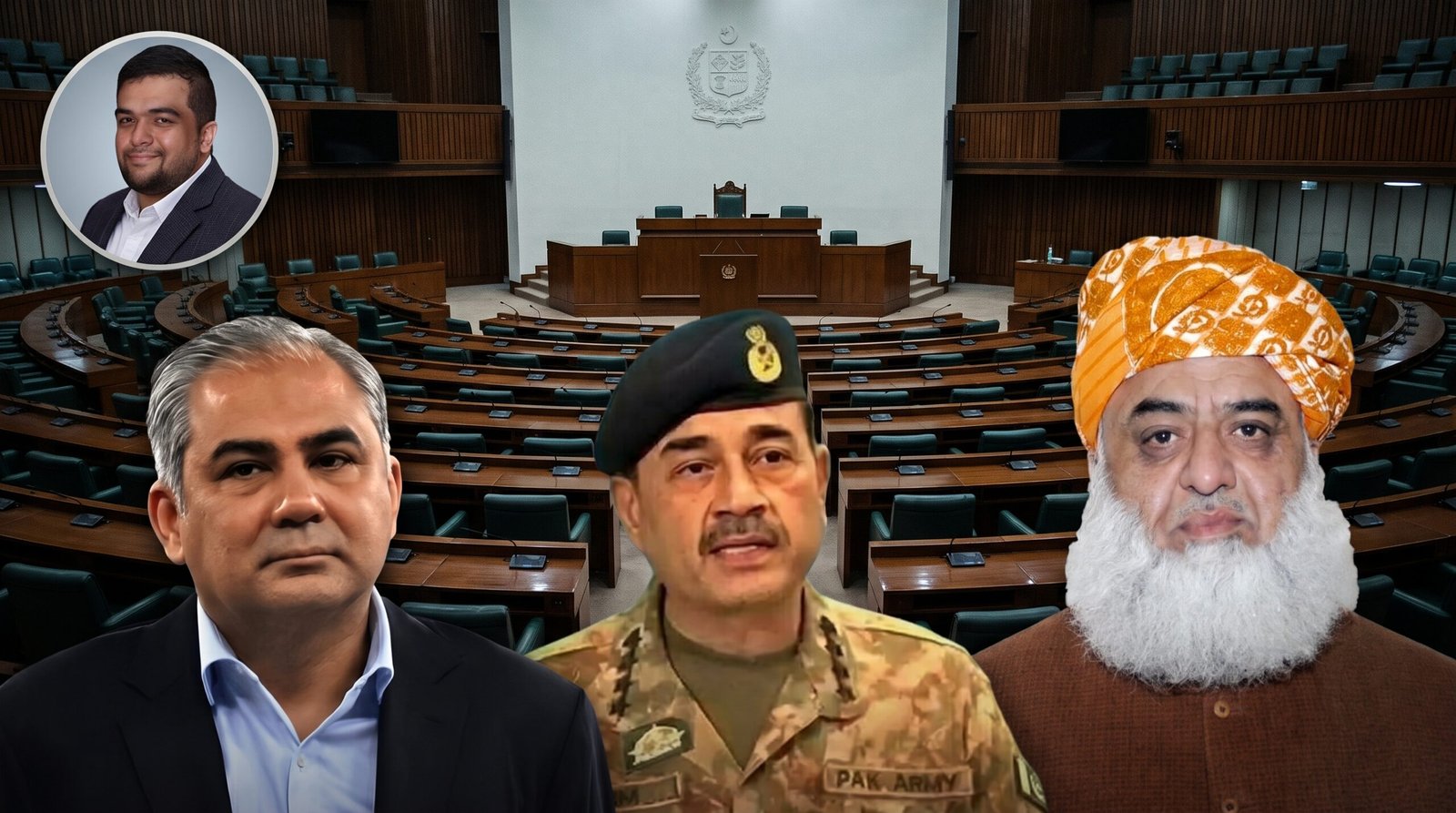
Pakistan’s political landscape has witnessed countless confrontations between politicians and powerful state institutions. Yet the latest exchange between Jamiat Ulema-e-Islam-Fazl (JUI-F) chief Maulana Fazlur Rehman and Interior Minister Mohsin Naqvi is particularly revealing, not simply because of the sharp language employed by both sides, but because it exposes a longstanding contradiction at the heart of Pakistani politics.
When does cooperation with the establishment become political wisdom, and when does the same relationship suddenly become an affront to democracy?
It is a question that Maulana Fazlur Rehman, one of Pakistan’s most experienced political negotiators and coalition builders, cannot reasonably avoid.
For decades, Fazlur Rehman has operated within Pakistan’s shifting political landscape, working with civilian governments, participating in parliamentary arrangements and dealing with the military establishment. His political longevity reflects considerable skill in negotiation and survival.
But political experience also invites scrutiny. A leader who has repeatedly operated within Pakistan’s power structures cannot convincingly present himself as entirely detached from those structures whenever political circumstances change.
The latest confrontation with Mohsin Naqvi brings that contradiction into sharp focus.
The Tehran Controversy: Diplomacy Or Political Point-Scoring?
The immediate dispute erupted after Fazlur Rehman questioned the presence of Interior Minister Mohsin Naqvi at discussions in Tehran, asking why Defence Minister Khawaja Asif was not participating in what the JUI-F leader apparently understood to be defence-related diplomacy.
His intervention carried an unmistakable political message: that important national security decisions were being handled through arrangements that appeared to bypass the conventional ministerial hierarchy.
Questions about ministerial responsibilities and the conduct of foreign policy are legitimate parliamentary concerns. However, legitimate scrutiny requires an accurate understanding of the assignment being questioned.
Naqvi subsequently explained in the Senate that his visit to Tehran had nothing to do with negotiating a defence agreement. According to the interior minister, Prime Minister Shehbaz Sharif had personally assigned him responsibilities connected with the regional crisis.
Khawaja Asif reinforced that explanation in the National Assembly, maintaining that the Tehran discussions were concerned with regional diplomacy rather than a new defence pact.
If these official explanations accurately describe the mission, the criticism of Naqvi’s presence loses much of its original force.
The important question should therefore be whether the diplomatic assignment served Pakistan’s national interests, not whether an opposition leader approves of the individual selected to carry it out.
Pakistan’s diplomatic engagement with Iran, the Gulf countries and other regional actors takes place against a highly sensitive security backdrop. Reducing such engagement to a contest over personalities risks obscuring the larger strategic picture.
Mohsin Naqvi’s Response: A Political Line Is Drawn
Naqvi’s response was unusually forceful.
Addressing the Senate on October 29, the interior minister said that he had previously held Fazlur Rehman in considerable personal regard, but that the JUI-F chief’s remarks concerning the state had fundamentally changed his opinion.
Naqvi accused the JUI-F leadership of treating the state favourably when enjoying political benefits and turning against it when excluded from positions of influence.
These are serious political accusations, not established findings of misconduct. Nevertheless, they raise a question worthy of examination: how consistently have Pakistan’s political parties defended institutional principles when their own access to power has changed?
The interior minister also alleged that JUI-F figures had previously supported imposing governor’s rule in Khyber Pakhtunkhwa before publicly opposing the measure.
That allegation requires documentary corroboration and a substantive response from the JUI-F leadership. If substantiated, it would expose a significant inconsistency in the party’s position.
But even without accepting every accusation exchanged in Parliament, the broader issue remains.
Political leaders should be judged by the consistency of their principles, not merely by the intensity of their speeches.
Fazlur Rehman’s Political History Cannot Be Ignored
Fazlur Rehman’s political career has spanned military-led and civilian administrations, coalition governments, opposition movements and major constitutional controversies.
He served as opposition leader during General Pervez Musharraf’s era and subsequently remained an influential participant in the country’s parliamentary and coalition politics.
He also served for years as chairman of the Parliamentary Committee on Kashmir, a position that placed him within an important institutional framework of the state.
These roles are legitimate parts of his political career. They do not, by themselves, establish wrongdoing or opportunism.
They do, however, make his current criticism of the political establishment open to a particularly demanding standard of scrutiny.
Khawaja Asif has already challenged Fazlur Rehman over his political record, questioning the achievements of his Kashmir Committee tenure and accusing him of benefiting from political arrangements he now criticises.
Those claims should be assessed against the parliamentary record rather than accepted simply because a minister has made them.
Nevertheless, the underlying question is unavoidable.
If cooperation with powerful institutions was politically acceptable in earlier circumstances, what principle now makes similar cooperation unacceptable?
A credible answer must distinguish between legitimate constitutional objections and the political disappointment of being outside a particular arrangement.
The Establishment Is Not A Convenient Political Scapegoat
Pakistan’s relationship between civilian politics and military institutions has always been complex.
The military’s constitutional responsibilities, particularly in national defence and security, must be respected. Equally, civilian supremacy under the Constitution, parliamentary oversight and lawful accountability remain essential features of the state.
These principles need not be mutually exclusive.
A mature political system should be capable of recognising the military’s contribution to national security while retaining the right to question policies, decisions and institutional conduct.
What deserves criticism is the selective application of those principles.
Political leaders cannot credibly praise institutional cooperation when it advances their own interests and condemn every comparable arrangement when it benefits their rivals.
Nor should criticism of the establishment automatically be described as hostility towards Pakistan. The state, the government and individual institutions are not interchangeable concepts.
This distinction is vital.
Respect for the state becomes more meaningful when it rests on constitutional conduct, consistency and accountability rather than political allegiance.
Field Marshal Asim Munir And Pakistan’s Regional Diplomacy
The Tehran controversy has also drawn attention to the regional diplomatic role of Field Marshal Syed Asim Munir.
According to the government’s account, Pakistan’s military leadership has participated in efforts to encourage dialogue and reduce regional tensions.
Khawaja Asif has argued that these engagements should be viewed in the context of Pakistan’s wider diplomatic responsibilities rather than as an attempt to negotiate a new defence agreement without the defence minister.
Pakistan has legitimate strategic interests in maintaining productive relations with Iran, Saudi Arabia and other regional partners, while seeking to prevent conflicts from destabilising its neighbourhood.
Diplomatic engagement that reduces regional tensions deserves consideration on its merits.
If Pakistan’s military and civilian leadership are working within their respective constitutional responsibilities to advance peace, that effort should not be dismissed simply because political opponents dislike the personalities involved.
At the same time, important diplomatic initiatives benefit from transparent explanations and institutional clarity. The government’s response to the Tehran controversy illustrates why providing that clarity matters.
Khyber Pakhtunkhwa: Political Rivalries Against A Security Backdrop
Another significant dimension of the confrontation concerns Khyber Pakhtunkhwa, where political instability and militant violence have created serious governance and security challenges.
Fazlur Rehman has criticised the government’s approach to governor’s rule and raised constitutional objections to the handling of the province’s political situation.
Those objections deserve examination because exceptional constitutional measures require rigorous justification.
However, opposition parties also carry responsibilities.
Political rivalry cannot become a substitute for a workable strategy to protect civilians, strengthen law enforcement, address militancy and restore public confidence.
Naqvi’s allegation that JUI-F representatives privately favoured governor’s rule while publicly condemning it adds another contentious dimension.
The JUI-F should be given an opportunity to respond directly to that specific charge, and the government should produce evidence if it wishes the allegation to carry weight beyond parliamentary rhetoric.
Pakistan’s security challenges are too serious to be reduced to a contest of accusations.
Religion, Political Influence And Accountability
Perhaps the most sensitive element of the exchange concerns Naqvi’s accusation that the JUI-F leadership has used religion for political and financial advantage.
Such an allegation cannot responsibly be treated as proven without evidence.
Religious political parties have a constitutional right to participate in elections, form alliances and advocate policies grounded in their ideological convictions.
That right, however, does not exempt them from ordinary standards of political accountability.
Religious authority should not become a shield against scrutiny of parliamentary performance, political alliances, governance decisions or access to public resources.
The same principle applies to secular parties, religious parties and politicians aligned with the government.
The real test is whether leaders are willing to defend their political conduct with facts rather than relying on moral authority, personal influence or institutional connections.
Why This Confrontation Matters Beyond Two Personalities
The dispute between Fazlur Rehman and Mohsin Naqvi is about more than the exchange of harsh words in Parliament.
It reflects a deeper struggle over political influence, access to power and the competing narratives surrounding Pakistan’s institutions.
Naqvi has chosen to confront allegations directly, defending his diplomatic assignment and challenging what he portrays as the JUI-F leadership’s political inconsistencies.
Fazlur Rehman, meanwhile, has sought to question the government’s constitutional and institutional conduct, particularly in relation to regional diplomacy and Khyber Pakhtunkhwa.
Both positions are open to scrutiny.
But Fazlur Rehman’s long political record places an additional burden on his argument. Experience confers authority only when accompanied by a willingness to account for one’s own decisions.
Political leaders cannot demand explanations from others while treating questions about their own alliances and institutional relationships as illegitimate.
Pakistan Needs Institutional Stability, Not Selective Outrage
Pakistan is confronting difficult economic, security and diplomatic challenges.
The country needs functioning institutions, credible parliamentary oversight, consistent constitutional principles and political leadership capable of distinguishing national priorities from partisan grievances.
Mohsin Naqvi’s defence of his participation in the Tehran discussions deserves to be judged against the actual mandate given to him by the prime minister and the diplomatic objectives pursued.
Fazlur Rehman’s criticism deserves to be judged against the same constitutional and political standards he has applied throughout his career.
Neither a government minister nor an opposition leader should enjoy immunity from scrutiny.
But there is a difference between holding institutions accountable and allowing political frustration to overwhelm a coherent position on the national interest.
Fazlur Rehman has every right to oppose the government, question ministers and challenge policies. What he cannot reasonably expect is that his own decades of political engagement with Pakistan’s power structures will remain beyond examination.
And that is where Mohsin Naqvi’s intervention has shifted the debate.
The interior minister has moved the argument away from his own presence in Tehran and towards a larger question about the consistency of Pakistan’s political leadership.
Whether every accusation he has made can be substantiated remains to be seen.
The demand for political consistency, however, is entirely justified.
Pakistan’s institutions should not become acceptable or unacceptable depending on who enjoys access to power. National interests require constitutional clarity, political responsibility and standards that remain the same whether a leader occupies the treasury benches or the opposition.
For Maulana Fazlur Rehman, that may be the most difficult question arising from this confrontation — and one that parliamentary rhetoric alone cannot answer.