

“If you give good people bad information, they make bad decisions”—Yuval Noah Harari, Big Think
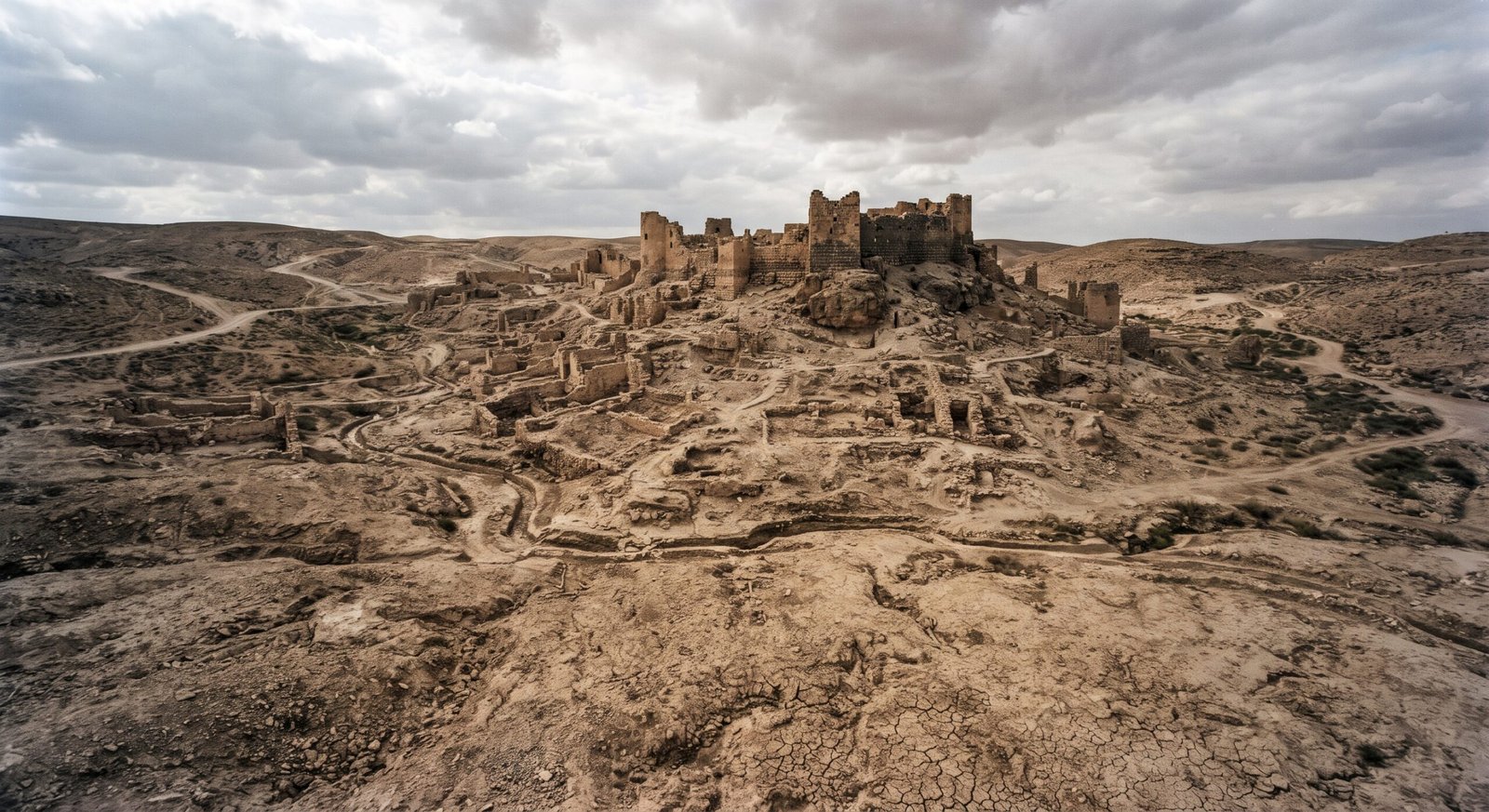
Civilisations build monuments to their permanence. History fills museums with their remains. Between these two facts lies a question that technological progress has never settled: why do societies capable of extraordinary achievement repeatedly fail to preserve the conditions of their own survival?
The answer requires more than an inventory of wars, droughts, epidemics and incompetent rulers. These identify dangers and sometimes decisive events. We must also explain why societies respond differently to comparable pressures, why warnings remain unanswered, and why arrangements that once produced prosperity can become obstacles to survival.
A secular investigation must begin with restraint. There is no scientifically established single cause of every civilisational collapse. Nor does history obey a timetable under which every society must rise, decay and disappear.
A more defensible proposition is that societies become vulnerable when mounting pressures encounter institutions unable—or unwilling—to recognise problems, distribute burdens and change course. This is a framework for investigation, not a universal law already proved.
Even “collapse” needs careful definition. The disappearance of a dynasty, fragmentation of an empire, abandonment of a city and destruction of a population are different events. A palace may fall while surrounding communities survive.
Political centralisation may disappear while farming, commerce and cultural life continue. Calling every such transformation the death of a civilisation can turn the misfortune of rulers into an inaccurate account of everyone else.
Research on Maya and Khmer societies illustrates this distinction. A comparative study published in PNAS describes varied responses to environmental pressures, including contrasts between vulnerable urban centres and more resilient dispersed agricultural settlements. The historical record contains adaptation alongside abandonment. We should therefore ask whose world collapsed, over what period, and what survived.
Harari’s observation directs attention to one crucial mechanism: the relationship between information and power. A society cannot correct a danger it cannot accurately describe. When officials gain promotion by reporting success, when researchers fear contradicting authority, and when journalism becomes an exercise in reassurance, errors can accumulate behind an appearance of stability.
However, misinformation alone cannot explain the problem. Decision-makers may possess accurate information and still resist action. A landowner can understand groundwater depletion while profiting from continued extraction. An administration can recognise deteriorating infrastructure while preferring projects that secure immediate political rewards. Knowledge does not automatically overcome an interest in postponement.
The deeper question is who benefits from the damaging arrangement, who bears its costs, and who has the authority to alter it. Consider the Indus civilisation. Research by Liviu Giosan and colleagues links weakening monsoon conditions and changing river environments with pressures on agriculture, settlement downsizing, crop diversification and movement towards wetter regions. This evidence does not justify attributing urban decline to the moral defects of an entire population. It reveals changing material conditions and attempts to adjust livelihoods to them.
The distinction matters. Environmental change can undermine an established settlement system without proving that its inhabitants were irrational or its institutions exceptionally corrupt. Some pressures exceed available technology and resources. A scientific account must leave room for physical constraints, uncertainty and misfortune.
Also Read: When Piety Serves Power
Nevertheless, environmental pressure interacts with political organisation. Research on Mayapan, a major Postclassic Maya capital, found a relationship between drought and civil conflict during the fifteenth century.
The authors argue that prolonged drought intensified factional tensions. They also document regional resilience after the capital’s collapse: political and economic organisation continued beyond the failed centre. Drought, conflict and institutional transformation belonged to the same history, but they were not interchangeable explanations.
These cases suggest why similar dangers can produce different outcomes. A harvest failure becomes more destructive when reserves are inadequate, access to food depends on concentrated power, and rival groups prevent coordinated relief. An external shock can expose weaknesses that prosperity previously concealed.
Inequality enters this analysis through concrete mechanisms. When affluent groups can purchase private alternatives to failing public services, they may experience deterioration much later than the majority. Their protection reduces the immediate pressure on them to repair common institutions. The people most exposed to danger may have the least influence over the response.
The HANDY model, developed by Safa Motesharrei, Jorge Rivas and Eugenia Kalnay, explores how resource depletion and unequal distribution can generate collapse within a simplified human–environment system. Its value lies in making possible mechanisms explicit. It is a thought experiment expressed mathematically, not proof that every civilisation followed the same trajectory or a reliable clock counting down to our own destruction. Why, then, does the pattern recur?
One plausible explanation is that the incentives producing vulnerability are repeatedly recreated. Concentrated benefits encourage powerful groups to defend existing arrangements. Dispersed costs make collective resistance difficult.
Political rewards arrive sooner than the benefits of maintaining soil, water, schools or public health. Success strengthens confidence in established methods, even when the conditions that made those methods successful are changing.
An institution can consequently become very effective at preserving its leadership while becoming less effective at performing its public purpose. Its procedures continue, its budgets expand, and its ceremonies remain impressive. What deteriorates is its capacity to learn from outcomes.
This proposition is testable only if we move beyond memorable examples. We would need to compare societies that experienced similar pressures but different outcomes, examine whether institutional weaknesses preceded breakdown, and identify cases that contradict the argument. Studying only fallen societies invites us to mistake features common to many societies for causes specific to failure.
For contemporary policy, the practical questions are more useful than predictions of doom. Can public bodies publish unwelcome findings? Can citizens challenge decisions without retaliation? Can governments change policy without treating correction as humiliation? Do resources reach exposed communities before temporary hardship becomes permanent damage?
Information must also connect to enforceable responsibility. Publishing an audit achieves little if its findings carry no consequence. Recording depleted aquifers does not restore them. Announcing a poverty strategy does not improve access to food. Effective institutions connect evidence with decisions, funding, implementation and independent assessment.
Resilience also requires room for local knowledge and collective action. Elinor Ostrom’s research challenged the assumption that shared resources necessarily end in ruin unless controlled exclusively through private ownership or central authority.
Communities can develop workable arrangements for governing common resources. The relevant lesson is to examine which rules work under particular conditions and give affected people a meaningful role in maintaining them.
For Pakistan, this approach would shift the discussion from declarations of national strength towards observable public capability: reliable water systems, credible statistics, accessible justice, functioning local institutions and protection against shocks. These are practical tests of whether collective resources sustain collective life.
The strongest general conclusion is conditional. Societies face greater danger when those controlling decisions can protect themselves from the costs of failure while obstructing correction. This mechanism cannot explain every historical collapse. It can explain why avoidable damage persists even where knowledge, wealth and administrative machinery exist.
Civilisations do not secure their future merely by remembering past greatness. They improve their chances by making error discoverable, power answerable and adaptation possible. The recurring historical warning is that a society can retain the instruments of command long after it has weakened the conditions of cooperation. Its survival may then depend on whether truth can still change a decision.