

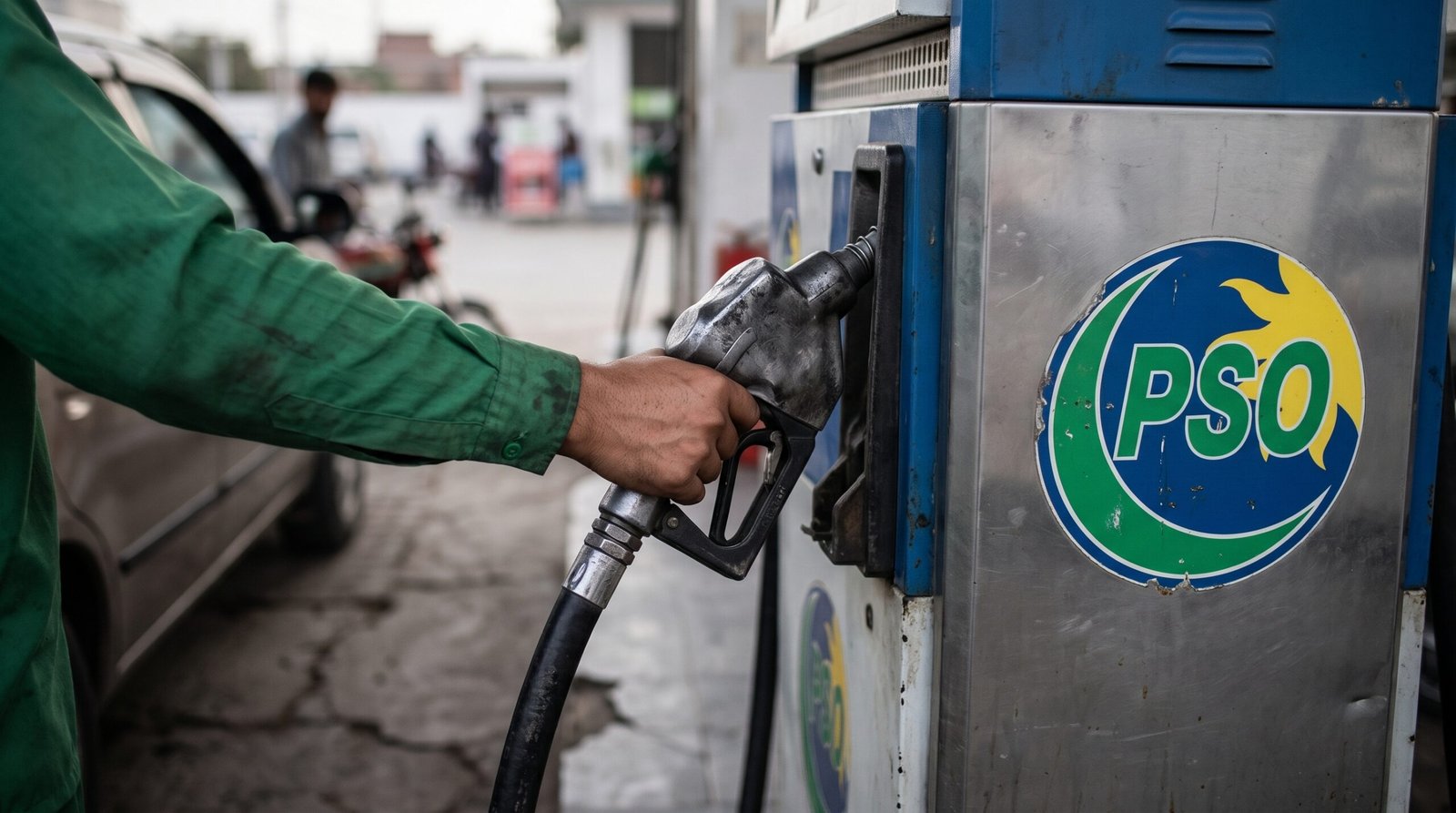
The federal government has informed the Senate that the lease and franchise agreements governing Pakistan State Oil’s (PSO) petrol pump network are confidential commercial arrangements, effectively limiting public access to the financial terms and conditions under which the state-owned oil marketing company operates retail outlets on privately owned land.
The disclosure emerged in a written response submitted by the Ministry for Energy (Petroleum Division) to Starred Senate Question No. 119, raised by Senator Haji Hidayatullah Khan, who sought comprehensive information regarding PSO petrol pumps operating in Rawalpindi, Islamabad and Khyber Pakhtunkhwa.
The parliamentary question sought the names, locations and other relevant particulars of petrol pumps operating on leased or franchised land, alongside the duration, terms and conditions of their respective agreements.
While the Petroleum Division submitted extensive station-wise records as Annexure-I, covering hundreds of retail outlets across the specified regions, it maintained that the underlying lease and franchise agreements were private contractual arrangements and could not be publicly disclosed.
The response raises broader questions about commercial confidentiality, parliamentary scrutiny and the transparency of arrangements involving a major state-controlled oil marketing enterprise.
Government Confirms Confidentiality Of Lease Agreements
Responding to the senator’s question, the Petroleum Division stated that the details of PSO’s existing retail outlets, including their names, locations and other relevant particulars, were attached as Annexure-I.
The ministry further confirmed that the information was publicly available on the OGRA website, where it is updated monthly.
However, the government adopted a different position regarding the contractual arrangements governing these outlets.
According to the written reply, the duration, terms and conditions of individual lease and franchise agreements constitute private contractual arrangements between PSO and the respective parties.
The ministry maintained that disclosure of such information is governed by confidentiality provisions contained in the agreements and applicable legal and regulatory requirements.
The response establishes a distinction between publicly available information identifying PSO’s retail network and commercially sensitive information concerning the contractual relationships behind individual outlets.
Hundreds Of Petrol Pumps Listed In Parliamentary Record
The annexure accompanying the government’s response provides an extensive station-wise record of PSO retail outlets operating across Islamabad Capital Territory, Khyber Pakhtunkhwa and Rawalpindi Division.
The supporting material spans 21 pages and contains multiple entries identifying retail outlets and their respective geographical locations.
The records are organised into regional sections, with the first major section covering Islamabad Capital Territory and Khyber Pakhtunkhwa, followed by a separate section for Rawalpindi Division.
The extensive listing demonstrates the geographical reach of PSO’s retail distribution network across the federal capital and northern Pakistan.
The annexure also reflects the administrative complexity of managing a large network of petrol stations operating across multiple districts, cities and commercial locations.
However, the station-wise information should not be confused with a disclosure of the financial arrangements governing individual sites.
The parliamentary response does not provide a consolidated public breakdown of the lease payments, franchise charges, revenue-sharing arrangements or contractual obligations associated with the outlets.
Consequently, the annexure establishes the presence and location of the retail network without revealing the full commercial structure supporting its operations.
Senate Question Sought Details Of Land Ownership And Contractual Arrangements
Senator Haji Hidayatullah Khan’s question specifically focused on PSO petrol pumps operating on leased or franchised land.
The distinction is important because petrol stations may operate under different commercial arrangements involving landowners, dealers, franchisees and oil marketing companies.
In some cases, an oil marketing company may have a direct lease arrangement for a retail site. In others, an independent dealer may operate a branded outlet under a commercial agreement with the company.
These arrangements can involve different responsibilities for investment, infrastructure, maintenance, operational management and commercial returns.
The senator’s request for the duration and terms of individual agreements was therefore relevant to understanding the nature of PSO’s contractual relationships across its retail network.
Such information could potentially establish whether individual locations are governed by short-term or long-term arrangements, whether agreements contain renewal provisions and how commercial obligations are distributed among the contracting parties.
However, the ministry’s response did not provide these particulars on a station-by-station basis.
Public-Sector Accountability Versus Commercial Confidentiality
The government’s response highlights a recurring issue in the governance of state-controlled commercial enterprises: the extent to which contractual confidentiality should limit disclosure of information sought through parliamentary oversight.
PSO operates in a competitive petroleum marketing environment, where retail site locations, commercial arrangements and dealership relationships can carry significant business value.
From a commercial perspective, disclosure of negotiated rental rates, franchise conditions or other commercially sensitive terms could potentially affect competitive relationships and future negotiations.
At the same time, PSO’s position as a state-controlled enterprise creates a legitimate public interest in understanding how its commercial network is managed and whether its contractual arrangements are consistent with sound governance and financial discipline.
These considerations are not necessarily mutually exclusive.
Commercial confidentiality may justify withholding specific sensitive provisions while still allowing regulators, auditors and authorised parliamentary bodies to examine contractual arrangements through appropriate procedures.
The ministry’s response does not establish that the agreements are improper or that PSO has violated any legal requirement.
Rather, it demonstrates that the information made publicly available in response to the parliamentary question does not extend to the underlying contractual terms.
What The Government’s Response Reveals — And What Remains Unanswered
The Petroleum Division’s submission establishes several important facts.
First, PSO maintains a substantial retail network across Islamabad, Khyber Pakhtunkhwa and Rawalpindi Division.
Second, station-level information concerning these outlets is maintained in records that the government says are publicly accessible through the Oil and Gas Regulatory Authority.
Third, the ministry acknowledges that individual lease and franchise agreements exist between PSO and the relevant contracting parties.
Fourth, the government considers the terms and conditions of those agreements subject to contractual confidentiality and applicable legal and regulatory requirements.
However, the response leaves several commercially significant questions unanswered in the publicly disclosed material.
It does not provide an aggregate assessment of the financial commitments associated with the specified lease arrangements.
Nor does it offer a consolidated classification distinguishing company-operated, dealer-operated, leased and franchised outlets within the listed network.
The response also does not establish how many of the relevant agreements are approaching expiry, how frequently contractual terms are reviewed or what mechanisms determine the commercial reasonableness of individual arrangements.
These omissions do not necessarily indicate a governance failure, but they limit the conclusions that can be drawn from the information placed before the Senate.
Why Lease Terms Matter In Petroleum Retailing
Land and location are among the most important commercial considerations in petroleum retail operations.
A petrol station’s business potential can depend heavily on traffic movement, surrounding population, accessibility, competing outlets and proximity to major roads or commercial centres.
Consequently, lease duration and renewal conditions can materially affect the long-term commercial viability of a retail site.
Long-term arrangements may provide greater operational stability and support investment in infrastructure, while shorter agreements may offer flexibility but create uncertainty over future operations.
Similarly, rental escalation clauses, maintenance obligations and provisions governing the termination or renewal of agreements can influence the financial exposure of the parties involved.
For a large oil marketing company, the management of these arrangements forms part of its wider commercial and operational strategy.
Understanding the contractual structure of a retail network is therefore relevant not only to property management but also to corporate governance, operational efficiency and long-term financial planning.
OGRA Records Provide Visibility Into Retail Network
The Petroleum Division’s reference to the Oil and Gas Regulatory Authority is significant because it identifies an official source through which retail outlet information can be accessed.
According to the ministry, the details of existing PSO retail outlets are available on OGRA’s website and updated monthly.
This indicates that the regulator maintains information relevant to the geographical distribution and identification of retail outlets.
However, the availability of station records does not necessarily mean that the regulator’s public database contains the underlying financial or contractual terms of each outlet.
The distinction matters because a list of authorised or existing petrol stations serves a different purpose from a detailed commercial disclosure.
The former assists in identifying the retail network, while the latter would provide insight into contractual obligations, financial commitments and commercial relationships.
The government’s reply makes clear that the two categories of information are treated differently.
Parliamentary Oversight Of State-Controlled Enterprises
The issue also has implications for parliamentary oversight of public-sector and state-controlled commercial entities.
Questions raised in the Senate provide lawmakers with an opportunity to seek information about government policies, public institutions and enterprises operating under federal oversight.
In this case, the senator sought information extending beyond the geographical distribution of petrol pumps to the contractual basis on which the outlets operate.
The government’s response supplied the station-wise listing but invoked confidentiality in relation to individual agreements.
The distinction illustrates the practical limits that can arise when parliamentary information requests involve commercially sensitive agreements.
A possible approach to reconciling these competing interests would be to provide aggregate commercial information or permit confidential examination of relevant contracts by authorised oversight institutions, subject to applicable law.
Such arrangements could preserve legitimate commercial confidentiality while strengthening institutional scrutiny.
Whether any further information will be sought through parliamentary procedures remains to be seen.
Implications For PSO And Pakistan’s Petroleum Sector
PSO occupies an important position in Pakistan’s petroleum supply and distribution system, and its retail network is a major component of its commercial operations.
The arrangements governing retail outlets are therefore relevant to the company’s broader financial and operational performance.
Efficient management of retail locations, dealership relationships and contractual obligations can influence business continuity, investment decisions and commercial competitiveness.
The Senate disclosure does not provide sufficient evidence to determine whether PSO’s existing lease and franchise arrangements are financially advantageous or disadvantageous.
Such an assessment would require detailed examination of individual contracts, relevant market conditions, site performance and the financial responsibilities of the parties involved.
Nevertheless, the parliamentary exchange highlights the importance of distinguishing between transparency regarding the existence of retail outlets and accountability for the commercial arrangements governing those outlets.
The Larger Question Of Transparency
The government’s response to Senate Question No. 119 ultimately presents a clear picture of what information is publicly accessible and where contractual confidentiality begins.
PSO’s extensive network of retail outlets across Islamabad, Khyber Pakhtunkhwa and Rawalpindi Division has been documented through official station-wise records.
However, the commercial terms under which individual outlets operate remain outside the scope of the public disclosure provided to the Senate.
For policymakers, regulators and parliamentary oversight bodies, the central question is how to ensure adequate scrutiny of state-controlled commercial enterprises without compromising legitimate business confidentiality.
The parliamentary record does not establish wrongdoing, financial irregularities or preferential treatment in the award or management of PSO retail arrangements.
It does, however, underline the need for effective oversight mechanisms capable of examining commercially sensitive agreements where necessary.
As Pakistan continues to confront challenges involving public-sector governance, corporate accountability and energy-sector efficiency, the management of commercial agreements within state-controlled enterprises remains an important area for institutional scrutiny.
The Senate response confirms that the locations of PSO’s retail outlets are publicly documented, but the financial and contractual arrangements behind individual sites remain protected by confidentiality provisions — leaving the broader question of how those agreements are scrutinised by public institutions open for further examination.