

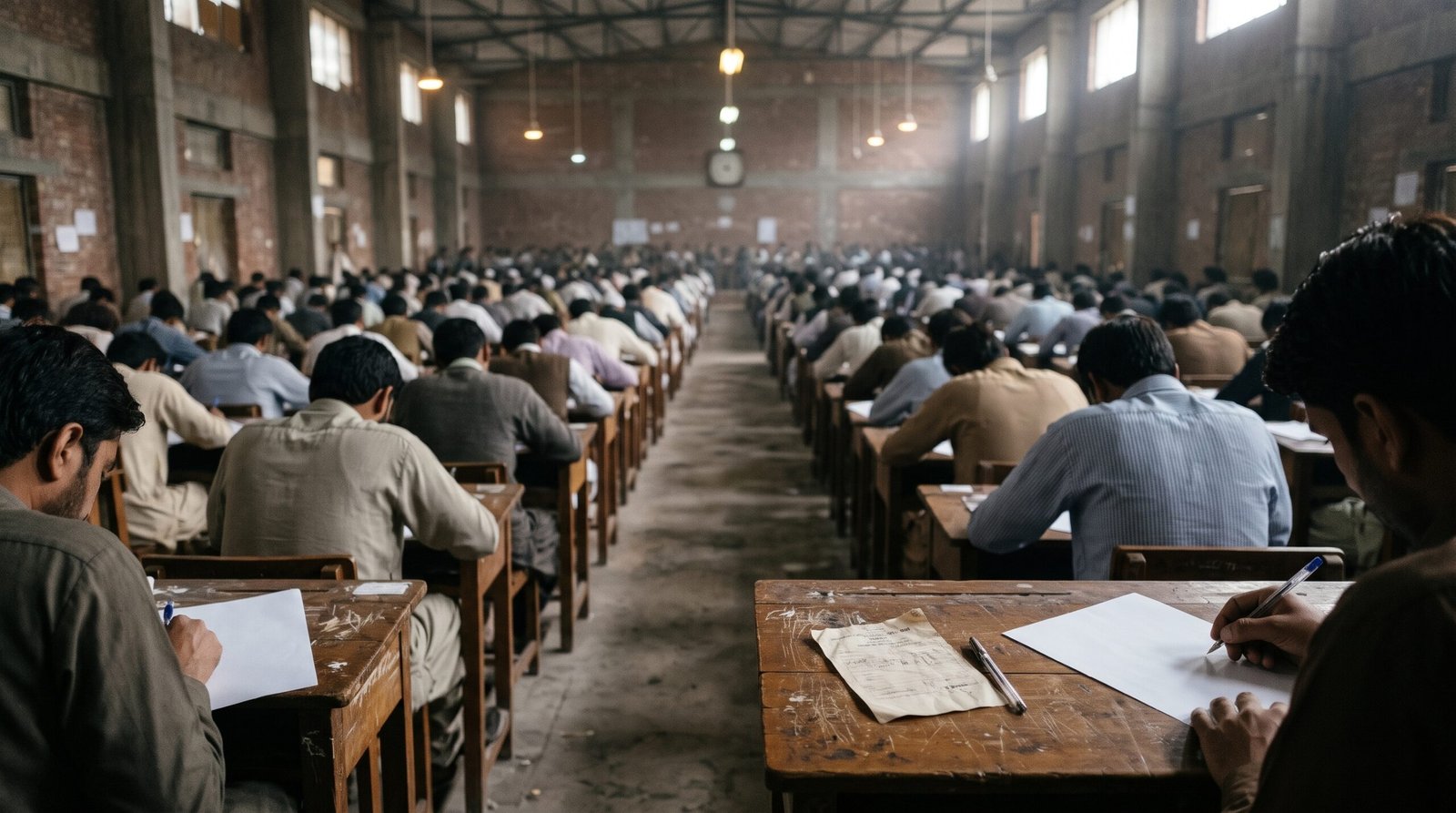
More than 57,000 applications were received for just 56 government positions advertised under two recruitment exercises associated with the Ministry of Law and Justice, according to official records submitted to the Senate in response to a question raised by Senator Dr Mohammad Humayun Mohmand.
The disclosures provide a detailed picture of the extraordinary competition for government employment in Pakistan, particularly for clerical, stenographic, administrative and technical positions.
The ministry’s written response to Starred Senate Question No. 113 includes vacancy announcements, city-wise application figures, candidates’ written examination results, shorthand and typing assessments, interview marks, selection committee compositions and the names of principal and alternate candidates.
The documents cover two separate recruitment exercises: 53 posts in newly established benches of the Appellate Tribunal Inland Revenue (ATIR) across Pakistan and three positions under a project aimed at strengthening the legal wings of the Ministry of Law and Justice and federal ministries and divisions.
Together, the two exercises attracted 57,470 applications, based on the application totals supplied in the ministry’s annexures.
38,426 Applications For 53 Tribunal Positions
According to the ministry’s response, 53 posts in BS-11 to BS-14 were advertised on March 18, 2025, for newly established benches of the Appellate Tribunal Inland Revenue.
The advertised positions included supervisors, stenotypists, upper division clerks (UDCs) and lower division clerks (LDCs).
The application figures reveal a particularly high level of interest in lower-grade administrative positions.
The ministry recorded 1,027 applications for supervisor positions (BS-14), 7,128 for stenotypists (BS-14), 16,238 for upper division clerks (BS-13) and 14,033 for lower division clerks (BS-11).
Upper division clerk positions attracted the highest number of applications, accounting for approximately 42 per cent of the total applicant pool.
Lower division clerk positions accounted for another 36.5 per cent, meaning that nearly four out of every five applications in this recruitment exercise were for UDC and LDC positions.
The figures underscore the considerable demand for clerical government employment, although the documents do not establish how many applicants were unemployed, already employed or applying for multiple positions.
Lahore Emerges As Major Recruitment Centre
The recruitment records also provide a city-wise breakdown of applications submitted through Islamabad, Lahore, Karachi, Peshawar and Quetta.
Lahore recorded particularly substantial participation in the clerical recruitment process, including 5,202 applications for upper division clerk positions and 4,211 for lower division clerk positions.
Karachi recorded 3,996 applications for UDC positions and 3,434 for LDC positions, while Peshawar accounted for 1,252 UDC applications and 1,025 LDC applications.
The figures indicate that competition for administrative government positions extended across multiple urban centres rather than being concentrated exclusively in Islamabad.
The ministry’s records, however, classify applications according to recruitment stations and test centres, which should not necessarily be interpreted as the applicants’ permanent residential locations.
Also Read: Gul Ahmed Textile Mills’ Quarterly Profit Surges 116% To Rs506 Million Despite 17% Decline In Sales
Another 19,044 Applications For Three Technical And Administrative Jobs
The second recruitment exercise, undertaken under the project titled “Strengthening and Capacity Enhancement of Legal Wings of Ministry of Law and Justice and Federal Ministries/Divisions”, attracted 19,044 applications for only three positions.
The vacancies comprised one technical assistant position (PPS-06), one assistant position (PPS-06) and one data entry operator position (PPS-05).
According to the ministry’s annexure, 3,251 applications were received for the technical assistant position, 8,476 for the assistant position and 7,317 for the data entry operator position.
The assistant position attracted the largest number of applications, with 8,476 candidates competing for a single vacancy.
Similarly, 7,317 applications were received for the data entry operator position, while 3,251 candidates applied for the technical assistant vacancy.
These figures translate into an average of 6,348 applications per advertised position across the three vacancies.
Islamabad Leads Applications For Legal Wings Project
The city-wise breakdown for the project revealed that Islamabad accounted for the largest number of applications, followed by Lahore and Karachi.
According to the ministry’s figures, Islamabad recorded 4,214 applications, Lahore 2,990, Karachi 2,285, Peshawar 953 and Quetta 433.
However, the ministry’s annexure contains a significant numerical discrepancy.
While the post-wise summary records 19,044 applications, the accompanying city-wise table totals only 10,875.
This leaves a difference of 8,169 applications between the two sets of figures.
The documents do not explain the discrepancy or establish whether the city-wise table represents only eligible applicants, a particular stage of screening or an incomplete breakdown.
Consequently, the overall figure of 57,470 applications across the two recruitment exercises should be treated as the sum of the ministry’s reported post-wise totals rather than an independently reconciled count of individual applicants.
Recruitment Records Reveal Written Tests And Interview Scores
One of the most significant aspects of the Senate disclosure is the publication of detailed recruitment assessments.
The annexures contain the names of shortlisted candidates, roll numbers, written examination scores, shorthand and typing results where applicable, interview marks, combined scores and recommendations.
For several positions, the assessment process assigned 70 per cent weightage to written examinations or technical assessments and 30 per cent to interviews.
The interview component was divided among the chairman and members of the departmental selection committee.
The records identify principal candidates recommended for selection and alternate candidates who could be considered subject to the applicable recruitment procedures.
For the technical assistant position under the legal wings project, Mir Zain Ali secured the highest listed aggregate of 81 marks.
For the assistant position, Abdul Fatir secured 79.20 marks, followed by Ms Rimsha Areej with 74.40 marks and Mohammad Ali Asif with 74.10 marks.
In the data entry operator assessment, Irfan Zahoor Qureshi secured 81.8 marks, while Muhammad Bilal secured 81.2 marks.
These results provide an insight into the assessment process, although the lists of merit positions and aggregate scores should not automatically be interpreted as proof that every listed candidate received an appointment.
Selection Committees Included Judicial Officers
The ministry also provided the composition of the departmental selection committees responsible for interviewing shortlisted candidates.
According to the documents, Departmental Selection Committee-II was chaired by Dr Zulfiqar Hussain Awan, Senior Joint Secretary (Administration/External).
Other members included judicial officers associated with special courts and district and sessions courts across Islamabad, Khyber Pakhtunkhwa, Punjab, Sindh and Balochistan.
The committee’s regional representation reflected the geographical spread of the advertised positions.
The disclosed membership included Abual Hasnat Muhammad Zulqarnain for the Islamabad Capital Territory, Rajab Ali for Khyber Pakhtunkhwa, Naveed Anjum Saleemi for Punjab, Rahmatullah Mooro for Sindh and Tariq Anwar Kasi for Balochistan.
Faisal Malik, Deputy Secretary (Administration/External), served as member and secretary.
The inclusion of judicial officers in the interview process is an important administrative detail because the recruitment concerned institutions operating within Pakistan’s legal and adjudicatory framework.
Nevertheless, the composition of a selection committee alone does not establish whether all recruitment procedures were followed correctly. Such an assessment would require examination of the applicable recruitment rules, eligibility criteria, evaluation records and final appointment orders.
Interviews Conducted Across Five Cities
The ministry’s records show that interviews for the tribunal-related positions were conducted during August 2025.
The interview schedule included Peshawar on August 16, Lahore on August 20, Karachi on August 22, Quetta on August 27 and Islamabad on August 31.
The interviews were conducted at judicial complexes, courts and tribunal premises in the respective cities.
For the three positions under the legal wings capacity enhancement project, the annexures record interviews at the International Mediation and Arbitration Centre, State Life Building, Islamabad, on July 3 and July 10, 2025.
A separate five-member committee was identified for this recruitment exercise, chaired by Project Director Nadeem Rasool.
The disclosed committee membership included Ehsan Ullah Khan, Muhammad Javed, Gulfam Hameed and Rauf Ahmed.
Women, Regional Quotas And Persons With Disabilities
The recruitment records also document positions and candidate assessments under various reserved categories, including women’s quotas, regional allocations and positions for persons with disabilities.
Separate merit lists were prepared for a number of positions across Punjab, Sindh, Khyber Pakhtunkhwa and Balochistan.
For example, the tribunal recruitment documents include stenotypist assessments under women’s quota arrangements, alongside general merit lists.
The records also include assessments for candidates applying under the quota for persons with disabilities.
In one stenotypist assessment, the selection committee recorded a discrepancy between a candidate’s national identity card and disability certificate.
In another case, the committee recommended consideration of a candidate for the stenotypist position despite a typing-speed shortfall, referring to the candidate’s disability-related circumstances.
These entries illustrate how recruitment committees dealt with individual eligibility and assessment issues.
However, the annexures do not provide sufficient information to determine whether every reserved vacancy was ultimately filled or whether the final appointments matched all applicable quota requirements.
What The Figures Reveal About Government Employment
The disclosed recruitment figures highlight the scale of competition for a limited number of government positions.
In the tribunal recruitment exercise alone, more than 38,000 applications were submitted for 53 advertised vacancies.
The additional 19,044 applications reported for three project positions demonstrate particularly intense demand for administrative and technical roles.
Such competition can reflect several overlapping factors, including perceptions of employment security, structured salary arrangements, career progression and the attractiveness of public-sector employment.
However, the figures should not be treated as a direct measurement of unemployment in Pakistan.
The ministry has not provided information establishing how many applicants were unemployed, how many were already working, how many submitted applications for multiple posts or how many ultimately appeared in the examinations.
Without those details, it is not possible to determine the number of unique jobseekers represented by the applications.
The figures nevertheless provide a substantial administrative indicator of demand for public-sector recruitment opportunities.
Questions Remain Over Final Appointments And Recruitment Outcomes
Although the ministry supplied extensive details of applications, shortlisted candidates, examinations, interview scores and selection committee membership, the material reviewed does not provide a consolidated final appointment status for all 56 advertised positions.
This distinction is important because recommendation by a selection committee is not necessarily equivalent to completion of the appointment process.
A comprehensive assessment of recruitment outcomes would require confirmation of the number of appointment letters issued, candidates who joined their positions, vacancies that remained unfilled and any subsequent changes to the merit lists.
The discrepancy between the post-wise and city-wise application totals for the legal wings project also warrants administrative clarification.
The records themselves do not establish recruitment irregularities or misconduct by any selection committee member or candidate.
Senate Scrutiny Brings Recruitment Data Into Public View
Senator Humayun Mohmand’s question sought details of the advertised positions, applications received, candidates interviewed, marks obtained and the composition of selection committees.
The ministry’s response has placed substantial recruitment information before Parliament, allowing scrutiny of how vacancies were advertised, candidates assessed and recommendations recorded.
The disclosures also highlight the importance of maintaining consistent and verifiable recruitment statistics, particularly where thousands of applicants compete for a handful of public-sector positions.
For policymakers, the figures raise a broader economic question: why do relatively small numbers of government vacancies attract such overwhelming interest, and what does this suggest about employment opportunities elsewhere in the economy?
For recruitment authorities, the immediate issue is ensuring that the process remains transparent, merit-based and properly documented from advertisement through final appointment.
The ministry’s 39-page response provides a detailed record of recruitment activity, but the ultimate assessment of its effectiveness will depend on the final hiring outcomes and the reconciliation of the figures supplied to the Senate.
For now, the most striking finding remains the scale of demand: 57,470 reported applications for 56 advertised positions, reflecting an average of more than 1,000 applications per vacancy across the two recruitment exercises.
That imbalance offers a revealing snapshot of the pressure surrounding government employment opportunities in Pakistan.