

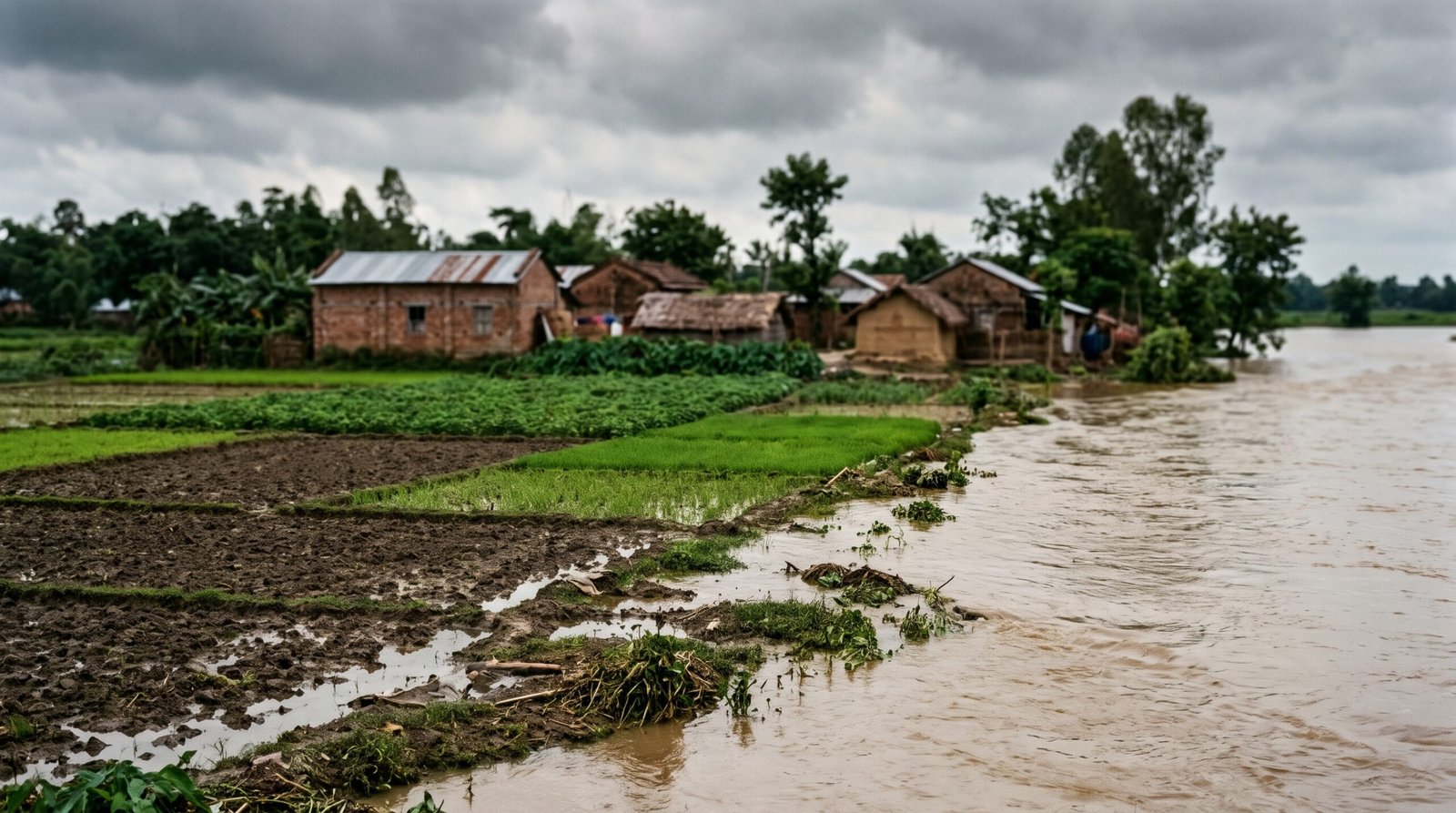
A falling water table may remain politically unimportant until a village well runs dry. A neglected drainage channel becomes an emergency when water enters homes. By then, the damage is described as a sudden disaster, although part of the vulnerability may have developed over many years.
Nature does not issue moral verdicts. Rainfall, river flows, heat and soil conditions respond to physical processes. Their consequences for human life depend partly on where people live, how they obtain their livelihoods, and what protection they can command. A scientific account must examine both the hazard and the society it encounters.
The previous part considered how wealth can accumulate while households and public institutions become less secure. Environmental pressures extend that argument. Income can rise while groundwater is depleted or productive land deteriorates. If these losses remain outside the calculations guiding decisions, apparent prosperity can conceal a shrinking capacity to sustain it.
Also Read: Rule 9 Of Seventh Schedule To ITO 2001 Cannot Become A Licence To Tax What FBR Wants
We should nevertheless resist a convenient explanation in which every abandoned city proves that its inhabitants mismanaged nature. Environmental changes have sometimes exceeded the knowledge, technology or resources available to communities. Survival cannot always be secured through better leadership. Historical analysis must distinguish avoidable vulnerability from constraints people could not reasonably overcome.
The Indus civilisation illustrates the need for this care. Climate research has identified changes in monsoon conditions associated with its urban decline. Association, however, does not establish a single sequence operating uniformly across a vast region. Different settlements depended on different combinations of rainfall, rivers, crops and exchange.1 Archaeobotanical research by Cameron Petrie and Jennifer Bates documents considerable diversity in Indus agricultural practices, including the cultivation of winter and summer crops. Their work describes farmers adapting production to different environments before, during and after the period of the great cities. The people involved were active managers of uncertainty.2
This changes the question we should ask. Instead of imagining a population passively awaiting catastrophe, we must investigate which adaptations worked, for whom, and for how long. A shift towards smaller settlements may represent the loss of an urban order while also enabling households to continue living under altered conditions.
Adaptation also has limits. Changing crops requires suitable soil, water, seed, labour and knowledge. Moving requires somewhere to go. Communities can adjust to one disturbance and still become vulnerable when another follows before reserves have recovered. Recognising resilience should not become an excuse to demand endless endurance from people with few resources.
Angkor offers a different example. Its extensive water-management network supported a large urban complex, but that achievement also created dependencies. A modelling study published in Science Advances in 2018 examined how extreme flows could produce erosion and sedimentation within the network, redistributing water and causing damage to spread through connected infrastructure. The system’s scale did not make it immune to disruption.3
The lesson is not that large infrastructure is inherently mistaken. Interconnection can improve reliability and distribute resources efficiently. But it can also transmit failure. A system designed around familiar conditions may perform poorly when the range of conditions changes, especially where older components remain essential to its operation.
Even at Angkor, the explanation remains contested and incomplete. A separate study published in PNAS in 2019 found evidence of gradual decline rather than a single catastrophic fifteenth-century collapse. It raised the possibility that changing political priorities and the departure of urban elites contributed to inadequate maintenance. Infrastructure failure may therefore have been partly a consequence of institutional withdrawal, as well as a source of further decline.4
This is precisely why environmental history must remain political without becoming simplistic. Drought, flooding, maintenance, trade and administrative decisions can interact. Identifying one visible breakdown does not tell us which process began first or which intervention might have changed the outcome.
For present-day societies, the most useful question is whether essential systems can continue functioning under stress. Can a failed supply route be replaced? Can drainage accommodate exceptional rainfall? Can hospitals operate during power interruptions? Can households obtain clean water when ordinary provision is disrupted?
Spare capacity may appear wasteful in normal times. Alternative routes, reserve stocks and maintenance budgets are easy targets when immediate savings dominate decisions. Their value becomes apparent during disruption, when a system operating without margins has little room to absorb error.
Pakistan’s 2022 floods demonstrate the scale of loss when an extreme hazard reaches exposed communities. The joint Post-Disaster Needs Assessment, led by the government with international partners, estimated physical damage exceeding US$14.9 billion and economic losses of about US$15.2 billion. Housing, agriculture and livestock, and transport and communications were among the most severely affected sectors. These figures measure devastation; they do not establish that Pakistan underwent civilisational collapse.5
Their relevance is the interaction of losses. A household may lose shelter, stored grain, livestock and access to work together. A damaged road can obstruct treatment and prevent produce reaching markets. Disease and interrupted schooling can prolong deprivation after floodwaters recede. Recovery therefore requires more than replacing individual structures.
Responsibility must also be allocated fairly. International climate pressures cannot be reduced to failures of domestic administration. Equally, the global character of the problem does not remove domestic responsibility for land-use decisions, drainage, warnings and accessible relief. Both levels require action; neither provides an excuse for neglect at the other.
A practical response begins with information people can use. Water availability, groundwater trends, flood exposure and infrastructure condition should be measured and disclosed. Warnings must reach communities in time and in forms that make action possible. Advising evacuation without transport, shelter or protection for essential assets leaves a large part of the problem unanswered.
Also Read: Why Civilisations Collapse—II
Agricultural adaptation must account for livelihoods. A recommendation to change crops is incomplete unless farmers can obtain suitable inputs, advice and buyers. Restrictions on resource use are more likely to work when those affected participate in the rules and can sustain themselves while adjusting. Otherwise, policy transfers the cost of protection to people already struggling to survive.
Urban policy requires similar honesty. Expanding settlement without dependable drainage, water and maintenance creates liabilities that are absent from the advertised price of development. Public authorities should assess those costs before approving construction, including how risks are transferred to neighbouring or downstream communities.
No intervention guarantees safety. Engineering can reduce exposure while creating new dependencies. Conservation can succeed locally while damage shifts elsewhere. Policies require monitoring and revision, with outcomes examined beyond the project’s immediate boundary.
The recurring historical danger is the persistence of arrangements after the conditions supporting them have changed. A successful crop, settlement pattern or water network can become vulnerable. Whether society notices and responds depends on who receives the warnings, who controls resources and who is expected to bear the adjustment.
We cannot prevent every drought or flood. We can reduce the number of people forced to face them without reserves, public protection or a meaningful voice in decisions. That is where environmental resilience becomes a question of governance—and where the next article must examine whose interests the law protects.
Endnotes
- The Indian monsoon variability and civilization changes in the Indian subcontinent (2017).
- C. A. Petrie and J. Bates. “Multi-cropping”, Intercropping and Adaptation to Variable Environments in Indus South Asia. Journal of World Prehistory 30, 81–130 (2017).
- The demise of Angkor: Systemic vulnerability of urban infrastructure to climatic variations. Science Advances (2018).
- Geoarchaeological evidence from Angkor, Cambodia, reveals a gradual decline rather than a catastrophic 15th-century collapse. PNAS 116, 4871–4876 (2019).
- World Bank. Pakistan: Flood Damages and Economic Losses Over USD 30 billion and Reconstruction Needs Over USD 16 billion—New Assessment (28 October 2022).
[To be continued]