

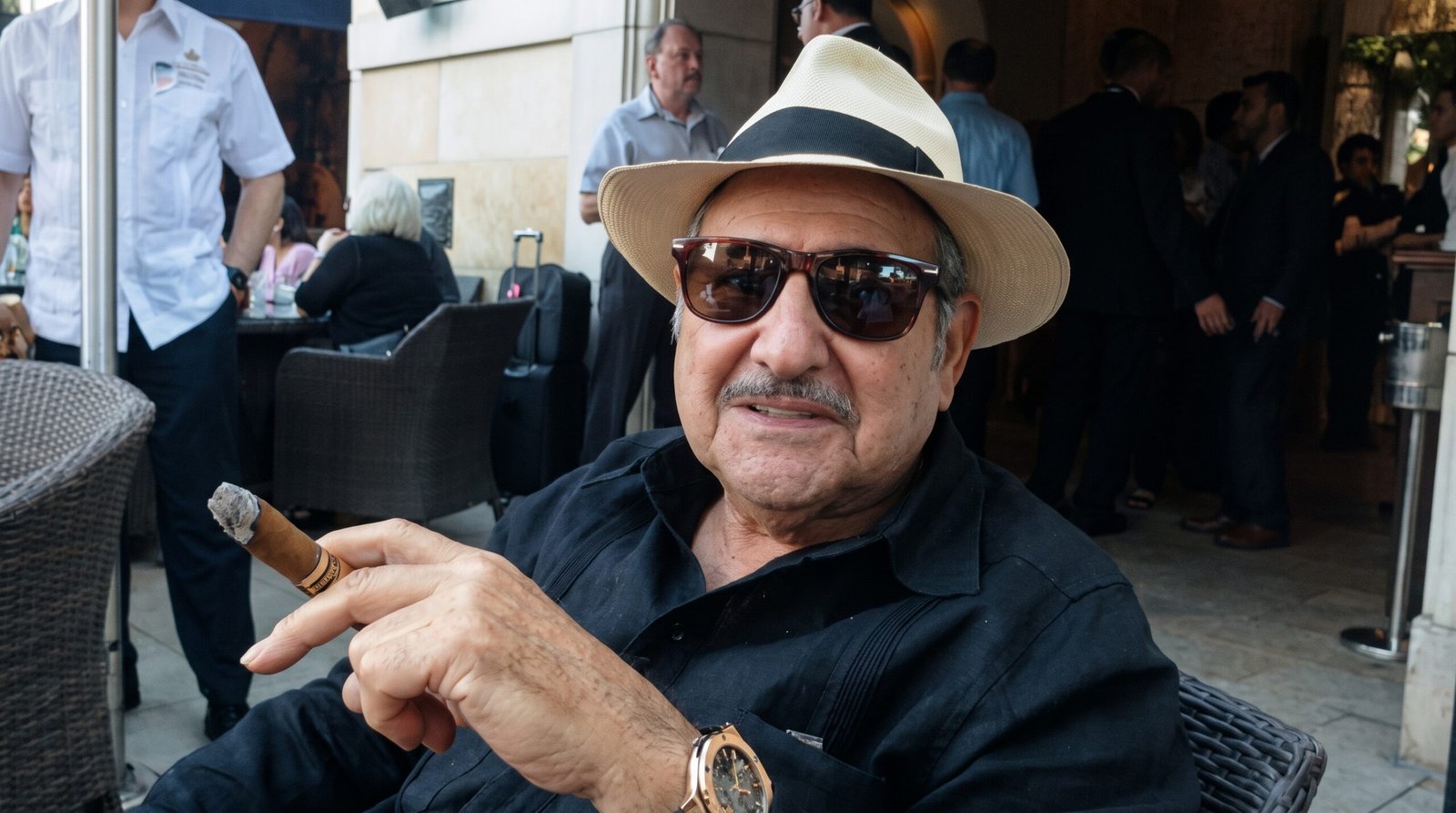
In the world of premium cigars, few family businesses possess a history as remarkable as that of Arturo Fuente. From its Cuban origins to its establishment in Florida and subsequent expansion into the Dominican Republic, the company’s journey has been shaped by devastating fires, financial hardship, migration, agricultural experimentation and generational ambition.
Yet behind its internationally recognised OpusX collection lies a fascinating numerical mystery: the recurring appearance of the number 13.
The subject has returned to the spotlight with the release of a short documentary-style video by Holt’s Cigar Company, titled The Hidden Meaning of 13 | Storytime with Carlito Fuente, featuring Carlos “Carlito” Fuente Jr., the third-generation cigar manufacturer.
The film’s subject revisits a deeply personal chapter of the Fuente family’s history, one that Carlito has discussed publicly for more than a decade.
In February 2012, speaking to Cigar Aficionado, Carlito explained the origins of the family’s fascination with the number.
“It’s my father’s number,” he said.
What appears to outsiders as an unusual numerical coincidence is, for the Fuente family, an expression of identity.
A Number Written Into the Family’s History
The connection between Arturo Fuente and the number 13 is not confined to a single cigar or anniversary collection.
Carlos Fuente Sr. was born on 13th Street. The company’s American headquarters in Tampa was located at 1310 North 22nd Street.
The company’s founder, Arturo Fuente, passed away at the age of 85. Adding the two digits, eight and five, produces 13.
The wrapper tobacco used for the original ForbiddenX 13 collection was cultivated on a 13-acre plot of land, while the cigars themselves were presented in boxes containing exactly 13 pieces.
Reflecting on these connections, Carlito told Cigar Aficionado:
“It’s symbolic to everything for my family.”
These coincidences gradually became part of the family’s commercial identity, appearing in product names, packaging, decorative symbols and commemorative collections.
From Cuba to an International Cigar Dynasty
Arturo Fuente was born on 18 November 1887 in Güines, Cuba.
In 1912, at the age of 24, he established A. Fuente & Company in West Tampa, Florida, bringing the traditions of Cuban cigar craftsmanship to the United States.
The business grew rapidly, but disaster struck in 1924 when a fire destroyed its original factory.
The setback interrupted commercial production for more than two decades. Arturo subsequently rebuilt the business on a modest scale, preserving the family’s knowledge and traditions.
In 1957, Carlos Fuente Sr. took ownership of the company, beginning a new chapter in its development.
The following decades brought further challenges, including the disruption of Cuban tobacco supplies, unsuccessful manufacturing ventures and fires that destroyed facilities in Central America.
In 1980, Carlos Fuente Sr. and his son Carlito established operations in the Dominican Republic, a decision that would transform the company’s fortunes.
The family’s experiences provide an important historical context for understanding its unusual relationship with a number so frequently associated with misfortune.
The Hidden Meaning of Flor Fina 8-5-8
One of the earliest numerical tributes to the Fuente family patriarch is the Arturo Fuente Flor Fina 8-5-8.
Arturo Fuente died on 11 February 1973 at the age of 85.
In 1975, the family introduced the Flor Fina 8-5-8 in his memory, preserving a connection to the founder through its numerical designation.
His age would subsequently acquire additional significance:
8 + 5 = 13
Long before ForbiddenX 13 became part of the company’s portfolio, the Fuente family was already using numbers to commemorate its history.
ForbiddenX 13: A Century of History in Six Cigars
As the company approached its centenary in 2012, the Fuente family introduced the Fuente Fuente OpusX ForbiddenX 13 collection.
Rather than relying exclusively on conventional anniversary branding, the company used six editions to represent significant moments in its history.
Nacimiento 1912 — The Birth
The name commemorates the establishment of the family enterprise in Florida in 1912.
God’s Whisper 1924 — Faith Amid Destruction
This edition remembers the fire that destroyed Arturo Fuente’s original factory, forcing the family to confront financial hardship and an uncertain future.
Heart of the Bull 1957 — The Second Generation
The name marks the transfer of ownership to Carlos Fuente Sr. The bull represents his astrological sign, Taurus.
Destiny 1980 — The Dominican Chapter
This edition commemorates the family’s relocation of manufacturing operations to the Dominican Republic, a pivotal moment in its international expansion.
Torch Bearer 2012 — A Century of Heritage
Created to commemorate the company’s hundredth anniversary, the edition symbolises the transmission of knowledge and responsibility between generations.
Keeper of the Flame 2013 — The Future
The final edition looks beyond the company’s first century, acknowledging the responsibility of future generations to preserve its heritage.
Presented in boxes of 13, the collection effectively translated a century of corporate history into a series of commemorative objects.
The Mystery of the 13 Acres
Another dimension of the story lies at Château de la Fuente, the family’s tobacco-growing estate in the Dominican Republic.
During the late 1980s and early 1990s, Carlito challenged the prevailing belief that the Dominican Republic could not consistently produce the high-quality wrapper tobacco required for an internationally competitive premium cigar made entirely from Dominican leaves.
The agricultural experiment became known as Project X.
Its eventual success led to the introduction of Fuente Fuente OpusX in 1995, marking an important development in the Dominican cigar industry.
According to Carlito’s 2012 interview, the wrapper leaves for ForbiddenX 13 were grown on a particular 13-acre plot of land.
The company has also described a proprietary ageing process involving specially designated barrels and a restricted area of its factory.
The precise blending and ageing techniques remain commercially confidential, contributing to the mythology surrounding the ForbiddenX name.
The Mysterious Clock and the Number 13
Perhaps one of the most intriguing visual elements associated with Arturo Fuente is the recurring clock motif incorporating the number 13.
Far from being merely decorative, the clock reflects the family’s philosophy of patience and its reluctance to accelerate production at the expense of established processes.
In an explanation of the Don Carlos packaging, Liana Fuente, Carlito’s daughter, identified the clock as a reference to the company’s longstanding motto:
“We will never press the hands of time.”
The number 13 within the design pays tribute to the family’s association with the number.
The clock therefore brings together two central elements of the Fuente identity: time and family heritage.
It also provides a more credible explanation of the imagery than the supernatural theories sometimes associated with the number.
The Emotional Bond Between Father and Son
Understanding the number 13 requires understanding Carlito’s relationship with his father.
Carlos Fuente Sr., who passed away in 2016, played a defining role in shaping his son’s approach to both business and family.
In remarks reproduced by Holt’s in a November 2025 profile, Carlito acknowledged the continuing influence of his father:
“Every day I ask myself what my father would say if he was still alive.”
The number 13 can consequently be understood not merely as a recurring marketing device but as a continuing tribute to the man whose influence remains central to Carlito’s personal and professional identity.
For a family business spanning multiple generations, such symbols can become a means of preserving memories long after the individuals associated with them have passed away.
Rare Pink: When 13 Became a Symbol of Remembrance
The significance of 13 acquired another emotional dimension in 2020 with the introduction of Arturo Fuente’s Rare Pink collection.
The project was inspired by Liana Fuente’s commitment to breast cancer research after losing both her grandmother and aunt to the disease.
The company pledged a contribution of $13 per box towards breast cancer research during the collection’s introduction.
The amount carried personal significance.
Liana was born on the sixth day of the month, while her grandmother was born on the seventh.
6 + 7 = 13
What began as a family symbol was now being incorporated into a charitable initiative connected with personal loss and remembrance.
The Impossible 13
The number surfaced again in June 2022 during La Gran Fumada, an event celebrating the 26th anniversary of the Arturo Fuente Cigar Club in Santo Domingo.
Participants received a numbered collection of 13 previously non-commercial cigars drawn from Carlito’s personal reserves.
The collection became known as the Impossible 13.
Even the anniversary carried an interesting numerical coincidence: 26 represents twice the number 13.
Whether deliberate or coincidental, the recurring pattern reinforced the number’s association with the family’s history and public identity.
El Trece Magistral 13: The Symbolism Continues
At the 2025 Premium Cigar Association Trade Show, Arturo Fuente showcased another edition bearing the number: Fuente Fuente OpusX ForbiddenX El Trece Magistral 13.
Its appearance, more than a decade after the original ForbiddenX 13 collection, demonstrated the enduring nature of the symbolism.
The number was no longer simply an anniversary reference. It had become an established part of the company’s historical narrative.
The Psychology Behind the Number 13
Across Western societies, the number 13 has historically been associated with superstition.
Some buildings omit the 13th floor, certain hotels avoid assigning the number to rooms, and Friday the 13th remains a widely recognised cultural symbol of misfortune.
The fear of the number even has a scientific term: triskaidekaphobia.
However, numerical symbolism differs considerably between cultures and individuals.
For the Fuente family, 13 has acquired positive associations through personal experiences, family milestones and deliberate commemorations.
Psychologically, people often attach meaning to recurring patterns, particularly when those patterns are connected to emotionally significant experiences.
The Fuente family has transformed such associations into a narrative that connects several generations.
There is no credible evidence that the number’s use by Arturo Fuente is connected to occult practices, secret societies or supernatural phenomena.
Its documented origins are substantially more personal.
The Business of Heritage and Storytelling
From a commercial perspective, Arturo Fuente’s relationship with the number 13 also illustrates the importance of storytelling in the development of family-owned brands.
The company has created a recognisable identity through historical references, numerical symbolism, limited production, family narratives and distinctive packaging.
The emotional significance of these elements helps differentiate its products in a competitive international market.
The story also demonstrates how personal memories can be converted into commercial intellectual and cultural assets, while preserving a connection between the business and its founders.
That commercial mythology, however, should remain distinct from the established health risks associated with tobacco consumption.
The Real Secret of 13
Perhaps the greatest mystery surrounding Arturo Fuente is not the frequency with which the number 13 appears throughout its history.
It is how a family that repeatedly experienced events most people would regard as extraordinary misfortune chose to embrace a number traditionally associated with bad luck.
A factory destroyed by fire. A business rebuilt from modest beginnings. Manufacturing ventures lost. A family forced to start again in unfamiliar territory. A father whose influence continues long after his death.
These experiences are the foundations of the Fuente narrative.
The recent Holt’s video brings renewed attention to a story that ultimately extends beyond cigars.
It is about the human tendency to attach meaning to memories, to transform adversity into identity and to preserve the influence of those who came before us.
For the rest of the world, 13 may simply be an unlucky number.
For the Fuente family, it carries more than a century of history.
For Carlito Fuente, it is also a number that keeps the memory of his father alive.