

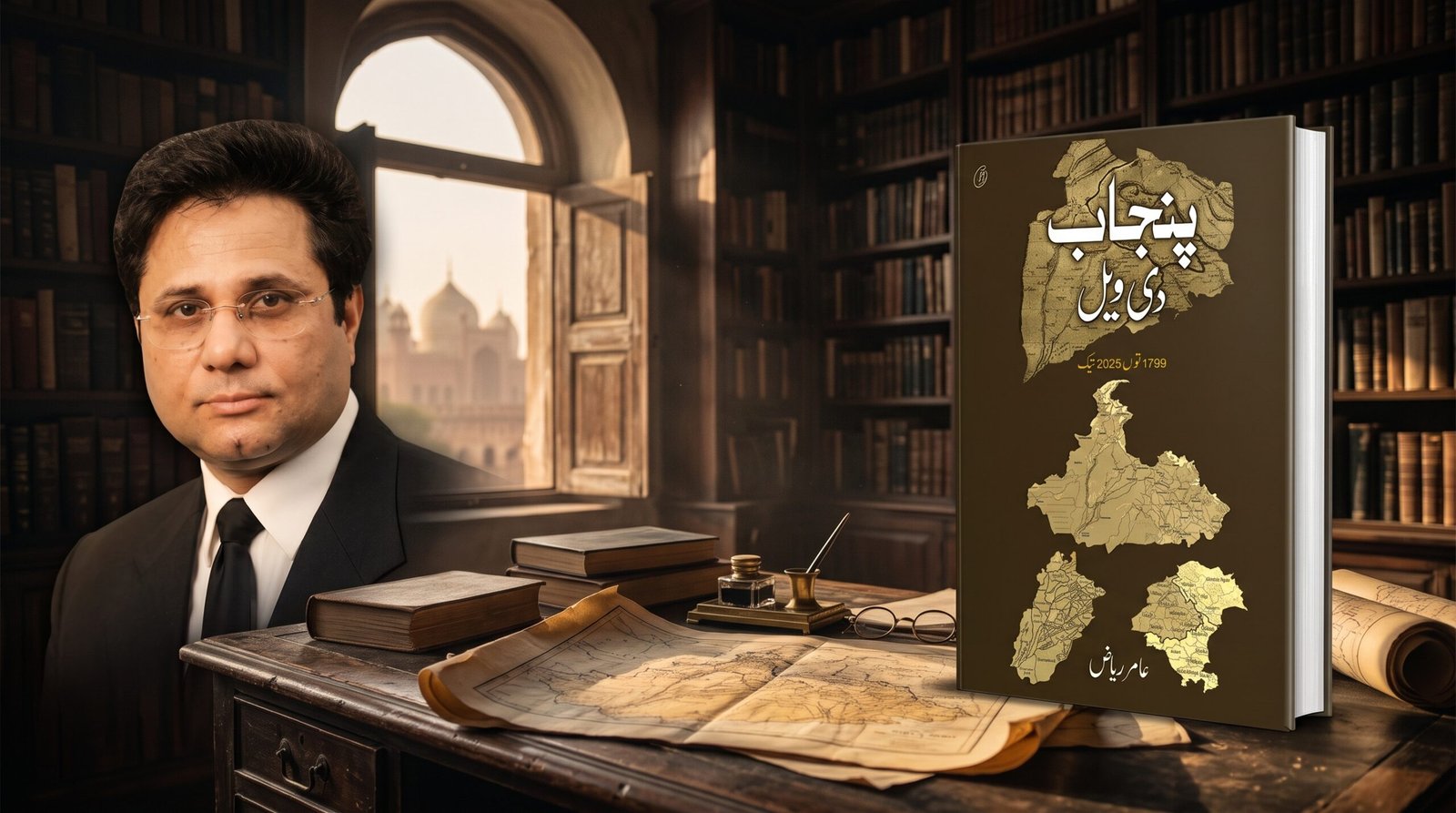
Aamir Riaz’s Punjab di Vel (1799–2025) is not a conventional history book. It is an argument—sometimes a passionate one—about how Punjab’s present was forged by decisions, classifications, and silences that began long before 1947. At over 500 pages, with extensive appendices and Chicago-style citations, it presents itself as a work of rigorous scholarship. And in many ways, it is. However, a close reading, placed alongside older scholarship such as ethnographer Yury Gankovsky’s The Peoples of Pakistan: An Ethnic History, reveals both the book’s genuine contributions and its unresolved tensions.
Aamir Riaz’s is an ambitious, long-durée historical work that attempts to reverse-engineer Punjab’s present predicaments from the perspective of the present. Its core strength lies in breaking away from the “Sikh state versus British relief” colonial narrative framework, restoring the pluralistic political reality of the Lahore Darbar, and deeply dissecting how British colonial linguistic classification policies (binding language to religion) created lasting fissures.
However, the book also has notable weaknesses: the excessively long time span (over two hundred years compressed into 524 pages) inevitably leads to uneven treatment; its use of folk oral tradition (such as the dhola about the death of Ahmad Khan Kharal) lacks sufficient source criticism; and the core argument of “anti-nationalism” coexists in tension with the emotional structure of “recovering the fragmented”.
To dispel the long-standing Western and Pakistani nationalist narratives’ misunderstandings about “Punjabis have no language loyalty” and “Punjabi is merely a dialect”, Gankovsky’s The Peoples of Pakistan: An Ethnic History provides crucial complementary material.
Gankovsky approaches from an ethnic history perspective, proving that Punjabi, as the carrier of a stable ethnic community’s language, has a continuity far beyond the colonial administrative divisions, and that its decline in modern Pakistan is entirely a product of political power, not ethnic deficiency.
I. Punjab di Vel’s Breakthroughs and Its Internal Tensions
The book’s most compelling section is its deconstruction of the Lahore Darbar. Aamir Riaz repeatedly emphasizes that Ranjit Singh’s regime was not a “Sikh government” but a pluralistic political entity. Muslims, Hindus, Sikhs, and Europeans held important positions within it, with 15 administrative departments operating according to modern principles.
This directly challenges a dual distortion: on one hand, colonial historians’ simplification of Punjab’s political complexity; on the other hand, later communal narratives’ retroactive projection of 19th-century Punjab through the lens of religious identity.
The book’s second major contribution is its anatomy of British language policy. Aamir argues that the British deliberately bound language and script to religious identity—Devanagari/Hindi to Hindus, Gurmukhi/Punjabi to Sikhs, Shahmukhi/Urdu to Muslims—thereby creating a lasting “clever educational game”.
This insight is profound: it reveals that the root cause of Punjabi’s marginalization in Pakistan and India’s Hindi-Urdu divide lies not in the language’s own “inadequacy” but in the fact that it was stripped of its political legitimacy by colonial governance techniques.
However, the book’s weaknesses are equally evident. First, insufficient critical treatment of oral sources. When dealing with contested events such as the death of Ahmad Khan Kharal, Aamir cites a dhola (folk ballad) that names a Sikh as the shooter, but does not sufficiently question when this ballad was collected, by whom it was transcribed, and whether it has been colored by later communal sentiments.
Oral tradition can preserve the wounds that official archives deliberately conceal, but it can also absorb fears and hatreds from later eras. A work claiming to “correct historical narratives” should itself be more rigorous in its treatment of all sources.
Second, there is an imbalance in chapter allocation. Commentators have noted that discussions of the book almost entirely revolve around the first chapter on Ranjit Singh, with subsequent chapters on colonial rule, language politics, and partition receiving far less attention. This may reflect readers’ cognitive inertia, but it also suggests that the book itself may not be as persuasive in its handling of the 20th century as it is with the 19th.
II. Gankovsky’s Contribution: Placing Punjabi Back into the Continuity of Ethnic History
The core value of Gankovsky’s The Peoples of Pakistan: An Ethnic History (originally published in Russian in 1964, with an English translation by People’s Publishing House in Lahore in 1971), its can be outlined as follows: it was a Soviet scholar’s systematic study of Pakistan’s ethnic composition from a Marxist historical materialism perspective, and it was published in Lahore. This fact itself carries weight—a work from Moscow interpreted Pakistan’s ethnic structure for Pakistani readers, and its methodology had a profound impact on South Asian ethnic history research.
Gankovsky’s argument can directly address two common misconceptions about Punjabis: Misconception One: “Punjabis lack language loyalty; they readily abandon Punjabi for Urdu and English”. Gankovsky’s ethnic history framework demonstrates that the formation of an ethnic community (narodnost/nation) has its own logic, not entirely determined by the language policies of a short-term state.
Punjabi, as the language of a vast agricultural and commercial population in the multiple rivers’ region, possesses a continuity of centuries-long oral and literary tradition (from Baba Farid to Waris Shah). British colonial policy and Pakistan’s post-independence Urdu-first policy did compress the public space for Punjabi, but this is precisely evidence of political suppression, not evidence of “Punjabis” natural indifference to their mother tongue”.
Aamir Riaz’s book repeatedly asks: why do we continue to reproduce colonial classifications? Gankovsky’s answer would be: because the material foundations of ethnic communities have been obscured by state violence and administrative convenience, but language itself remains latent beneath the surface. Misconception Two: “Punjabi is merely a dialect, not a language”.
Gankovsky’s work places Punjabi within the broader context of Pakistan’s ethnic history, demonstrating that the historical depth and speaker population of Punjabi as an independent language far exceed modern administrative boundaries.
Its internal dialect divisions (Majhi, Multani, Pothohari, etc.) are themselves markers of a mature language, not evidence of fragmentation. Aamir Riaz’s book criticizes the colonial “divide and classify” policy, and Gankovsky’s research provides the pre-colonial baseline: before the British arrived, Punjabis did not need the permission of a “standard language” to speak their mother tongue.
III. Comprehensive Assessment
The value of Punjab di Vel lies in its questions: it forces readers to confront those narratives that seem self-evident—why is Lahore described as “Sikh rule”? Why is 1849 described as “liberation”? Why is Punjabi’s marginalization treated as natural?
These questions themselves constitute intellectual labour. However, the book’s answers are not always equally solid. Its handling of the 19th century (especially the Ranjit Singh period) is far more convincing than its handling of the 20th century; its use of colonial archives and administrative documents is more reliable than its use of folk oral sources.
Gankovsky’s The Peoples of Pakistan provides an essential complement from another direction. It reminds us that before any “narrative” exists, there are “people”—Punjabis as an ethnic community with a long history, whose language, folkways, and economic life have their own trajectories. Aamir Riaz demonstrates how colonial and post-colonial power attempted to cut off this trajectory; Gankovsky demonstrates that this trajectory existed long before power intervened. Read together, the two books accomplish one thing: they return to Punjabis the dignity of their own history, rather than allowing them to be defined by the categories of rulers. This is the most fundamental significance of dispelling misunderstandings.
IV. The Strength: Unsettling the Colonial Frame
Riaz’s most valuable intervention is his refusal to accept the standard periodization of Punjab’s history. The Lahore Darbar of Ranjit Singh, he argues, was not a “Sikh state” in any simple sense. It was a plural political order in which Muslims, Hindus, Sikhs, and Europeans held administrative and military positions. To describe it through a single religious label is to retroactively impose later communal categories onto a more complex reality.
This argument matters because it challenges two powerful narratives at once. Colonial historians often portrayed British annexation as a civilizing relief. Later nationalist accounts, both Indian and Pakistani, frequently reproduced the same religious boundaries the British had codified.
Riaz shows that the British did not merely govern Punjab; they reorganized its social world by binding language to religion—Gurmukhi to Sikhs, Shahmukhi to Muslims, Devanagari to Hindus. This “educational game,” as he calls it, had consequences that outlasted the empire.
Also Read: Rule 9 Of Seventh Schedule To ITO 2001 Cannot Become A Licence To Tax What FBR Wants
V. The Weakness: Uneven Evidence, Uneven Chapters
Yet the book is not equally persuasive throughout. Its treatment of the 19th century is far more grounded than its handling of the 20th. Commentators have noted that discussions of the book tend to cluster around the first chapter on Ranjit Singh, while later chapters on colonial policy and partition receive less attention. This may reflect readers’ habits, but it also suggests that the later sections are less tightly argued.
More seriously, Riaz’s use of oral sources is sometimes insufficiently critical. When discussing the death of Ahmad Khan Kharal, for example, he cites a folk ballad (dhola) that names a Sikh as the shooter. Oral tradition can preserve what official archives suppress. But it can also absorb the fears and hatreds of later generations. A book that claims to correct distorted narratives must apply the same scrutiny to all its sources—including the ones it finds sympathetic.
VI. Gankovsky’s Corrective: Language as Ethnic Continuity
This is where Yury Gankovsky’s The Peoples of Pakistan: An Ethnic History becomes useful. Gankovsky, a Soviet scholar writing in the 1960s, approached Pakistan’s ethnic composition through a historical-materialist lens. His work insists that ethnic communities have long continuities that cannot be erased by administrative decisions.
Two common misconceptions about Punjabis collapse under this framework. The first is that Punjabis lack language loyalty, that they readily abandon Punjabi for Urdu or English. Gankovsky’s analysis shows that Punjabi, as the language of a vast agricultural and commercial population, has centuries of literary and oral tradition. Its marginalization in modern Pakistan is a product of state policy, not ethnic deficiency. The second misconception is that Punjabi is merely a dialect. Its internal diversity—Majhi, Multani, Pothohari—is a sign of maturity, not fragmentation.
Read together, Riaz and Gankovsky accomplish something important. Riaz shows how colonial and post-colonial power tried to cut Punjabis off from their own history. Gankovsky shows that this history existed long before power intervened. The first book asks the right questions; the second provides part of the answer.
Conclusion: A Book Worth Arguing With
Punjab di Vel is not a flawless book. Its scope is too broad for its length, its later chapters are uneven, and its treatment of oral evidence needs more rigor. But it is a book worth arguing with. It forces readers to confront narratives that have become comfortable—about Sikh rule, about British relief, about Punjabi indifference to their own language. And in doing so, it restores a measure of dignity to a history too often told by others.
Endnotes
- Aamir Riaz’s Punjab di Vel and the Lahore Darbar
The characterization of the Lahore Darbar as a pluralistic political order rather than a “Sikh state” is drawn from Aamir Riaz’s central argument as summarized in reviews of the book. The Friday Times review notes that Ranjit Singh’s administration included Muslims, Hindus, Sikhs, and Europeans in significant positions, and that reducing it to “Sikh rule” distorts its historical reality.
The review also discusses Riaz’s method of “reverse engineering” Punjab’s present from its past. A report on the book’s Lahore launch in Dawn similarly records the author’s insistence that the Darbar operated with 15 departments on modern principles, and that figures from diverse backgrounds served within it.
- The British “Educational Game” and Language Policy
Riaz’s analysis of British language policy—specifically the deliberate association of scripts with religious identities (Gurmukhi with Sikhs, Shahmukhi with Muslims, Devanagari with Hindus)—is detailed in a Minute Mirror essay on the language question in the book. The author explains how the British abolished Persian as the administrative language, promoted English as the language of “civilization,” and assigned local languages religious identities, a framework that post-colonial states have failed to dismantle.
- The Ahmad Khan Kharal Ballad and the Problem of Oral Sources
The discussion of the dhola naming a Sikh shooter in Kharal’s death, and the need for source criticism of oral tradition, draws on a three-part Minute Mirror series on poetry and resistance. The third installment specifically addresses the competing accounts: the colonial record states Kharal was killed in an engagement, while local literary remembrance (via Shafqat Tanvir Mirza and A.D. Ejaz) names Gulab Rai Bedi as the shooter. The essay argues that oral memory can absorb later communal divisions and must be treated as historical—vulnerable to later politics—rather than simply authentic. The second installment provides the context of the dhola as a living form of memory.
- Uneven Chapter Attention and the Ranjit Singh Focus
The observation that discussions of Punjab di Vel cluster around the first chapter on Ranjit Singh, while later chapters receive less attention, is made explicitly in the Minute Mirror essay on language. The author notes: “It is strange that discussions of Aamir Riaz’s book tend to focus on its first chapter, which deals with Ranjit Singh, while the rest of the book receives far less attention than it deserves”.
- Yury Gankovsky, The Peoples of Pakistan: An Ethnic History
The book was published in English translation by Igor Gavrilov (Moscow: Nauka Publishing House, 1971) and later issued in Lahore by Peoples Publishing House. A 2017 edition was published by Peace Publications in Lahore. The Krea University library record confirms the Lahore edition’s 245-page length.
- The Tension Between “Anti-Nationalism” and “Recovery”
Riaz’s stated position that he is “not a nationalist” and that he advocates understanding people’s history through trade research is recorded in the Dawn report on the book launch. The tension between this stance and the book’s emotional structure of recovering a fractured past is an analytical observation from reading the reviews, particularly The Friday Times’s discussion of the book’s engagement with loss and memory.