

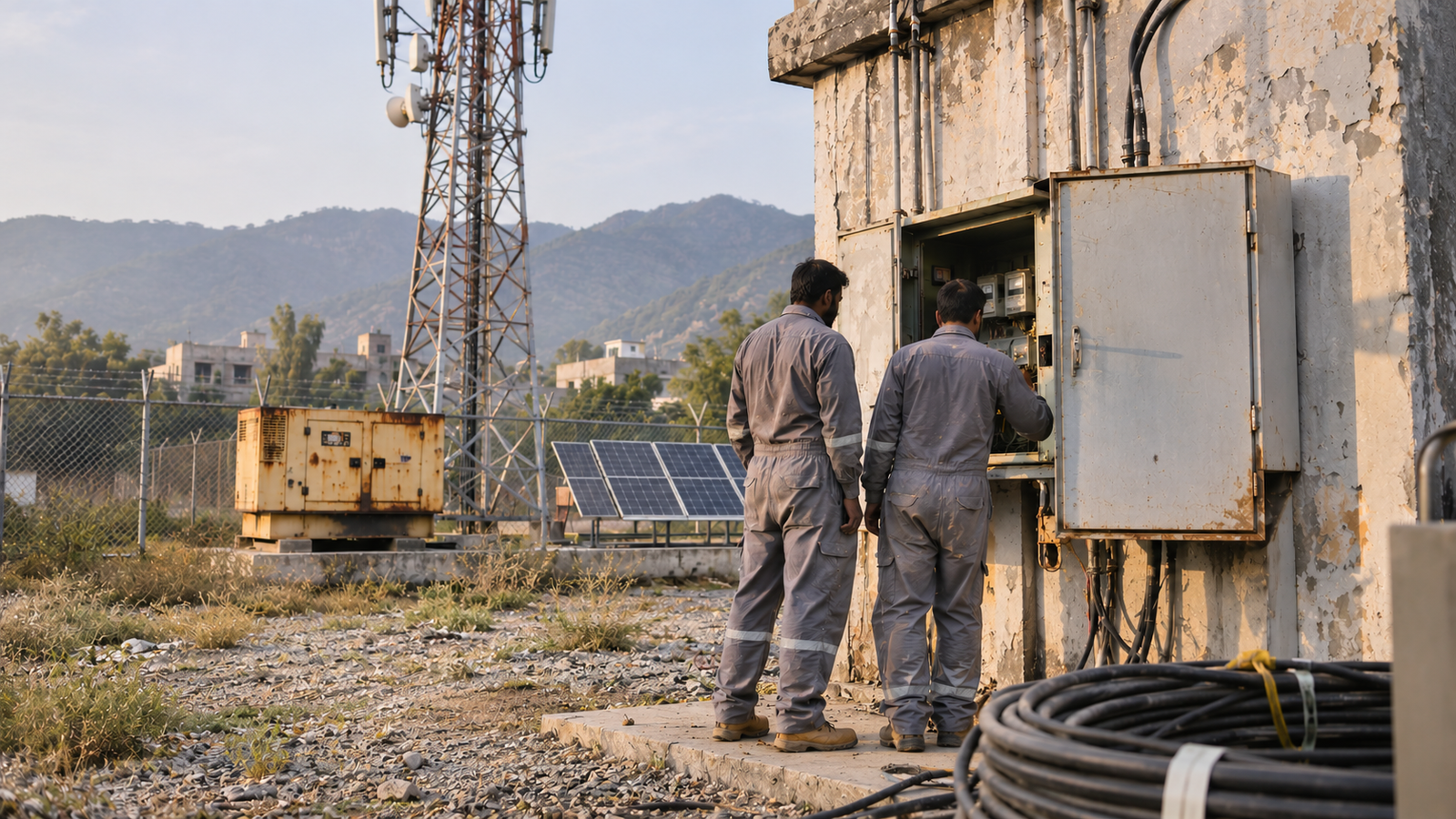
Pakistan’s $2 billion multi-year capital investment in 5G deployment, fiber-optic expansion, and Tier-III artificial intelligence-ready data centers faces severe financial strain unless the federal government grants telecom infrastructure industrial electricity tariffs, the chief executives of the country’s largest operators have warned Prime Minister Shehbaz Sharif.
The joint appeal—submitted by the Chief Executives of Jazz World, CMPak (Zong), PTML (Ufone and Telenor), and Pakistan Telecommunication Company Limited (PTCL)—seeks formal prime ministerial directives to replace commercial power rates on licensed telecom sites with lower industrial tariffs. Operators contend that commercial electricity pricing has become financially untenable as next-generation 5G networks and data centers drive a sharp structural increase in site-level power consumption.
According to industry figures presented to the federal government, commercial electricity tariffs levied on telecom infrastructure have climbed by approximately 197% since 2018. Over the same period, fuel expenditures required to power telecom sites have surged by roughly 300%, compressing operating margins across the sector.
“The industry has committed $2 billion over the next three years to roll out 5G and expand fiber networks, and is also investing in Tier-III data centers.”
Simultaneously, sector revenues have eroded. Operators reported that average revenue per user (ARPU) has declined by approximately 22% since 2018, while an additional 5% withholding tax continues to compound the sector’s fiscal burden. With Pakistan’s nationwide 5G rollout already projected to require another two years, telecom executives warned that rising 5G data traffic will accelerate electricity demand and further widen the cost gap between commercial and industrial tariff slabs.
To resolve the impasse, the operators requested a binding policy directive extending existing industrial power rates to licensed telecom facilities—or, alternatively, establishing a dedicated “Digital/Telecom Infrastructure” consumer category billed at industrial rates—with power distribution companies (DISCOs) instructed to enforce the transition within a fixed timeline.
Also Read: Crescent Star Insurance Insider Offloads 442,800 Shares On PSX Ready Market At PKR 6.40
To address regulatory concerns regarding potential tariff abuse, the operators proposed strictly ring-fencing the concession. Under the proposal, industrial rates would apply exclusively to Pakistan Telecommunication Authority (PTA)-certified towers, base transceiver station (BTS) sites, switching centers, exchanges, data centers, fiber-to-the-home (FTTH) nodes, and network operations centers. Corporate offices, customer service centers, franchises, and retail outlets would remain excluded under commercial billing. In exchange, the companies committed to reinvesting the resulting energy savings directly into 5G expansion, rural connectivity, and fiber deployment.
“They claim lower tariffs would cut the growth of off-grid solar use from 15% to 5–7% and lift their grid electricity use by 15–20%, covering any revenue loss for DISCOs within two to three years.”
Beyond telecom balance sheets, the operators framed the tariff revision as a revenue-stabilizing measure for Pakistan’s cash-strapped power utilities. Escalating commercial rates have accelerated the sector’s migration toward off-grid solar installations for towers and data centers, eroding base-load demand for the national grid. Reclassifying telecom sites under industrial tariffs would curb off-grid solar adoption and restore grid consumption, allowing DISCOs to offset initial tariff reductions within two to three years.
The telecom executives also cited established statutory and regulatory precedents. They noted that federal frameworks—including the Mobile Cellular Policy 2004 and the Finance Act 2021—have formally recognized telecommunications as an industry, and pointed to the National Electric Power Regulatory Authority’s (NEPRA) 2018 decision to extend industrial electricity tariffs to dairy and poultry farms.
The proposal is currently under review by a joint task force comprising the Ministry of Information Technology and Telecommunication, the Power Division, NEPRA, the PTA, telecom operators, and DISCOs. Formed under the policy directive governing the 5G spectrum auction, the task force convened its inaugural session on August 4 to evaluate an industrial power tariff framework. Prime Minister Shehbaz Sharif has since instructed the body to finalize its recommendations.