


ISLAMABAD/KARACHI, November 16, 2026: Pakistan’s agricultural import regulatory system is facing serious questions following the emergence of an inspection document recording live insect pests aboard a Canadian canola shipment and separate allegations that recommendations approved by the Federal Minister for National Food Security and Research were subsequently altered in the handling of groundnut imports from Afghanistan.
Information reviewed by The Scoop, including official Port Qasim Authority shipping records, a photographed Department of Plant Protection (DPP) inspection report and accounts provided by agricultural industry sources, raises concerns about transparency, phytosanitary compliance and the implementation of import regulations.
The two cases concern different commodities and different regulatory decisions. No evidence presently establishes that they are part of a coordinated arrangement or that the same individuals authorised both transactions.
Nevertheless, they raise a common question: Are Pakistan’s agricultural import controls being implemented in accordance with the country’s plant-quarantine laws, and can the responsible officials produce the records supporting their decisions?
In the Canadian canola case, official port records establish that approximately 36,365 metric tonnes of oilseeds were discharged from MV Sea Unity at Port Qasim by November 15, 2026.
A separate inspection sheet supplied to The Scoop, dated November 11, records live insect pests during examination of the vessel’s cargo.
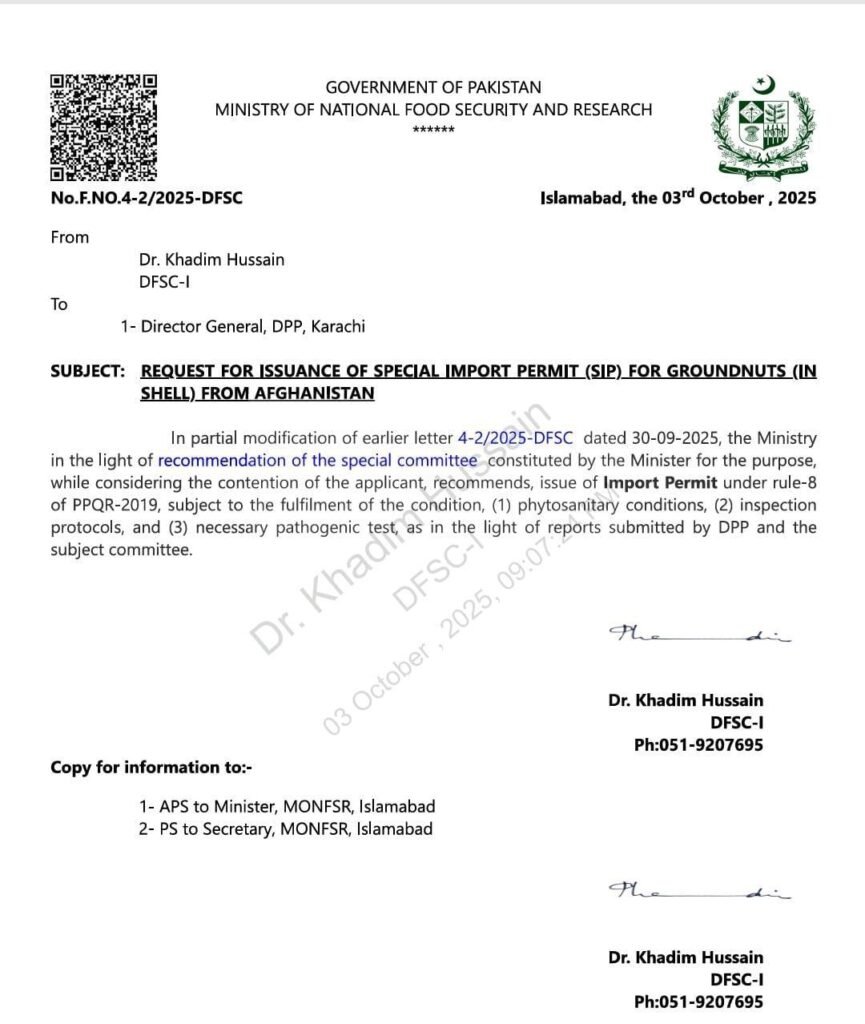
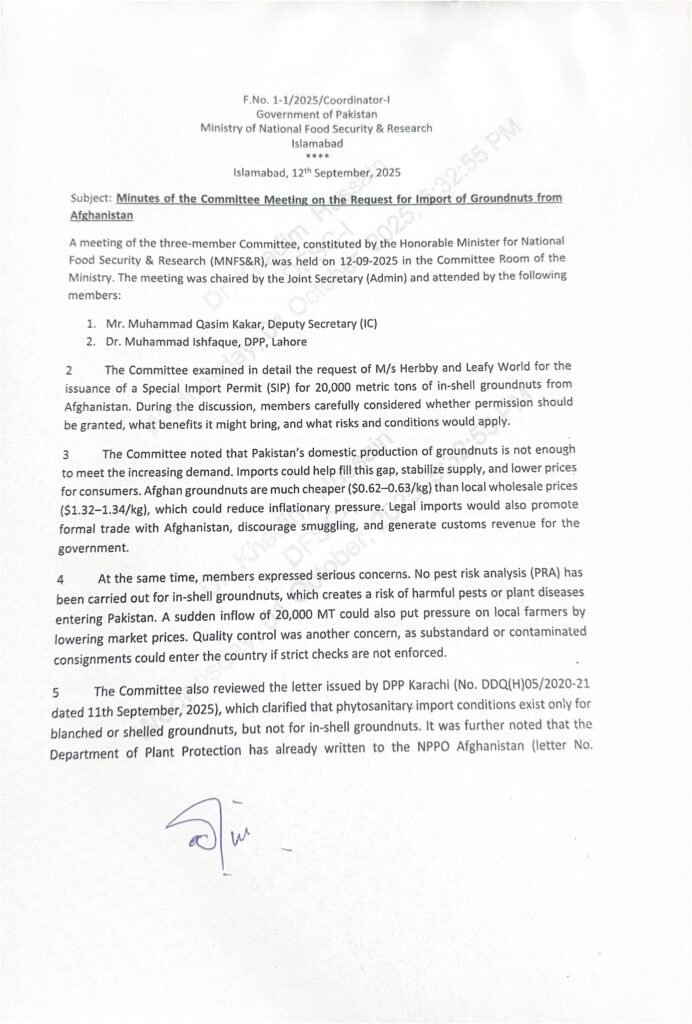
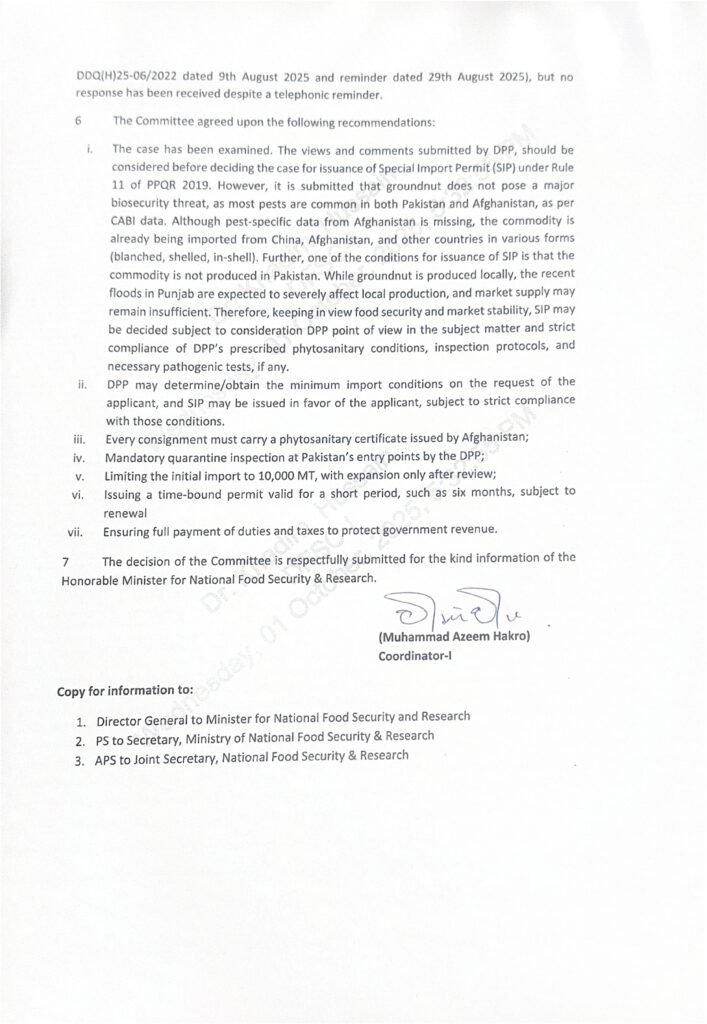
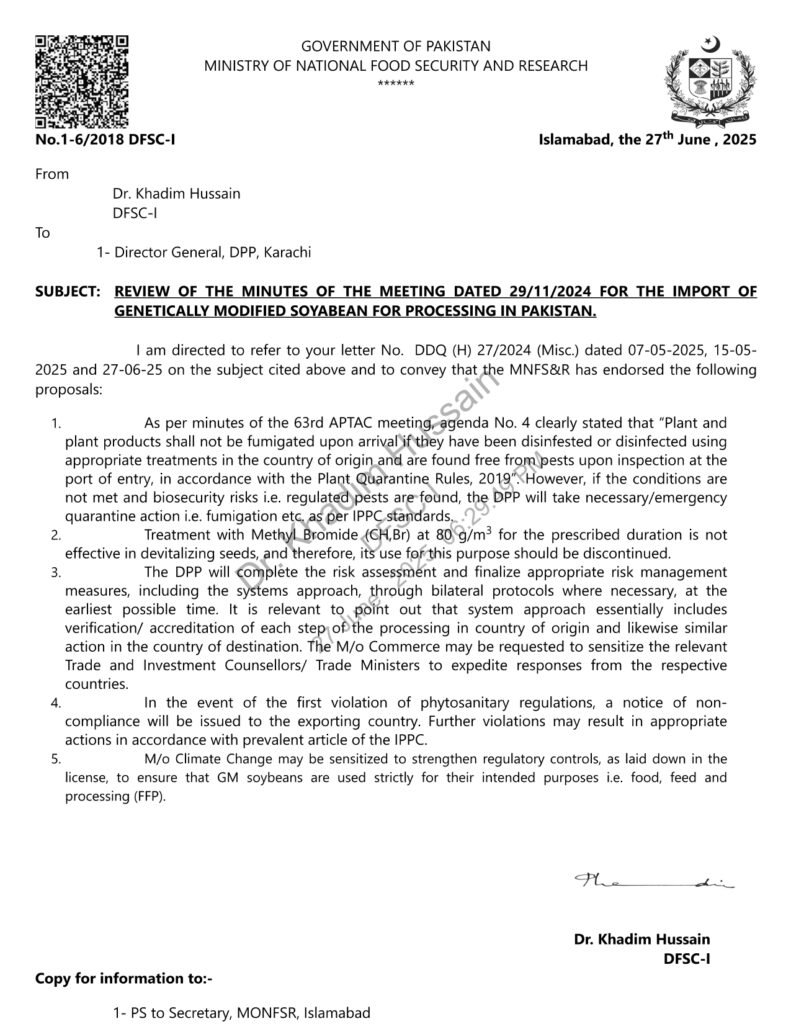
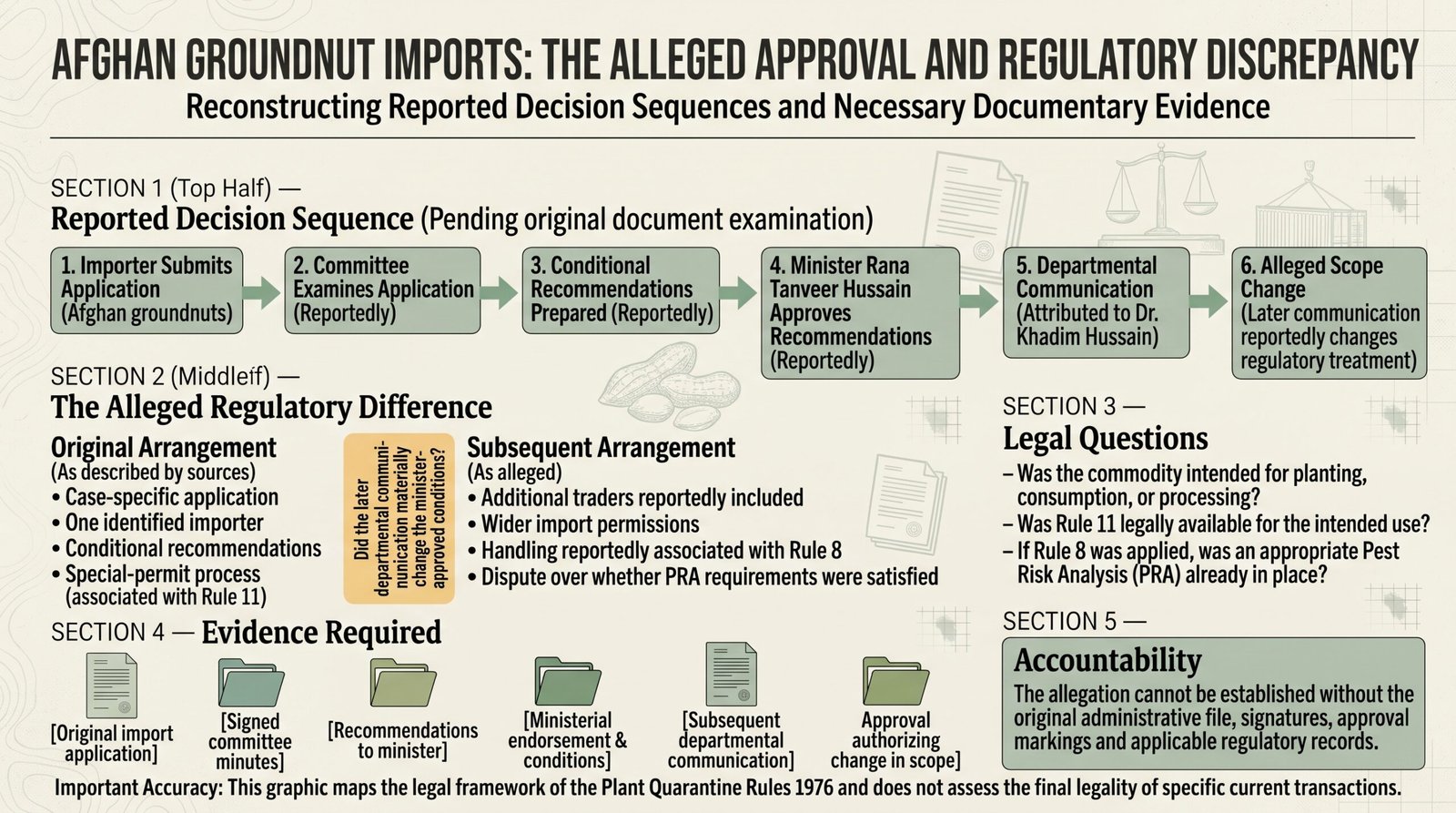
In the Afghan groundnut case, sources allege that a committee’s conditional recommendations, subsequently approved by Federal Minister Rana Tanveer Hussain, were materially changed in a later departmental communication attributed to Dr Khadim Hussain.
The sources maintain that the original arrangement concerned a specific importer under a special-permit process associated with Rule 11 of the Pakistan Plant Quarantine Rules, 2019, whereas the subsequent handling allegedly extended import permissions to additional traders under Rule 8 without an adequate Pest Risk Analysis.
The Scoop has independently verified the vessel’s shipping chronology and the relevant provisions of the quarantine rules. However, the photographed canola inspection sheet has not been authenticated by DPP, and the original groundnut committee minutes and subsequent approval documents have not yet been independently examined in full.
The allegations concerning individual officials therefore remain subject to verification.
Canadian Canola Shipment: What the Official Records Establish
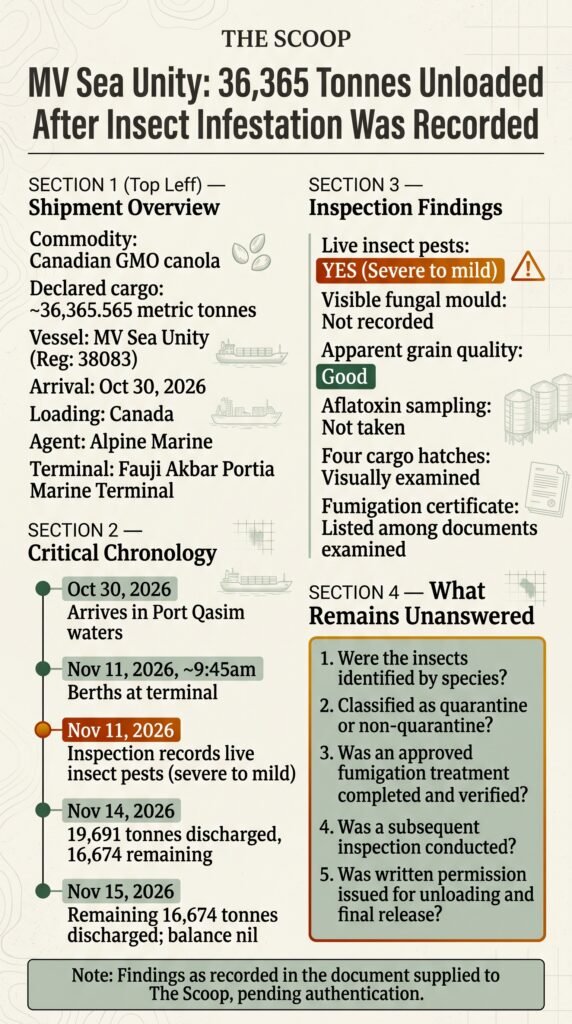
The first controversy concerns MV Sea Unity, which arrived in Port Qasim waters on October 30, 2026, carrying Canadian canola seed.
Port Qasim Authority’s November 9 shipping statement identifies the vessel under registration number 38083, lists Canada as the loading country and records Alpine Marine as the shipping agent.
The vessel berthed at Fauji Akbar Portia Marine Terminal on November 11 at approximately 9:45am.
According to an inspection document shared with The Scoop, a visual examination was conducted later that day under the heading of the Government of Pakistan’s Department of Plant Protection.
The document identifies the cargo as GMO canola originating from Canada and records a quantity of approximately 36,365.565 metric tonnes.
Its most significant observation concerns insect infestation.
Against the inspection field asking whether live insect pests or signs of infestation were present, the response is marked “Yes”, with a handwritten description indicating infestation ranging from severe to mild.
The same sheet records no visible fungal mould, describes the apparent grain quality as good and indicates that aflatoxin samples were not taken as part of the recorded examination.
Also Read: Signed Sugar Deal Puts Government Under Scrutiny As PSMA Demands 2.7 Million Tonnes In Exports
These findings create an important distinction.
The presence of live insects is a phytosanitary concern requiring an appropriate regulatory assessment. It does not, on its own, prove that the insects were quarantine pests, that the commodity was unsafe for human consumption or that the shipment was illegally cleared.
However, the official decision taken after the inspection becomes central to assessing whether the applicable safeguards were followed.
All 36,365 Tonnes Subsequently Unloaded
The shipping records establish the subsequent movement of the cargo.
Port Qasim Authority’s statement issued at 8am on November 14 showed that MV Sea Unity had discharged 19,691 metric tonnes of canola, with 16,674 tonnes remaining aboard.
The following day’s statement, dated November 15, recorded the unloading of the remaining 16,674 tonnes.
The balance was shown as nil.
This means the vessel’s complete declared cargo of approximately 36,365 tonnes had been physically discharged by the morning of November 15.
The same shipping report scheduled MV Sea Unity to sail from the terminal later that day.
The chronology is significant because the unloading occurred after the date of the inspection document recording live insect pests.
The question is what happened between the initial inspection and the commencement of unloading.
Was the cargo treated through an approved fumigation process?
Were the insects identified and classified?
Did the authorities conduct a subsequent inspection?
Was written permission issued allowing the bulk cargo to be discharged?
And did the consignment receive final plant protection and customs clearance before any onward movement to domestic processing facilities?
The shipping records do not answer these questions.
They record physical cargo handling, not the phytosanitary status of the consignment or its final customs release.
What the DPP Inspection Document Does — and Does Not — Prove
The inspection document contains several additional entries that require explanation.
It refers to four cargo hatches being visually examined.
It also contains a handwritten fumigation dosage entry and lists a fumigation certificate among the documents examined.
However, the materials available to The Scoop do not include the full fumigation certificate, the chemical used, treatment conditions, exposure duration or any subsequent verification report.
The form does not contain an identifiable pest species or laboratory findings confirming whether a regulated quarantine organism was present.
The absence of aflatoxin sampling on this particular sheet also does not prove that the complete shipment was never tested for food-safety contaminants. Such examinations may be conducted separately under other applicable procedures.
Agricultural sources have questioned the adequacy of the inspection and the completeness of its supporting documentation.
One source also identified an official named Khalid as the inspector associated with the report.
However, the photographed document’s inspector-identification field is blank, and the signature is insufficiently clear to independently establish its author.
The Scoop therefore cannot attribute the report conclusively to Khalid without confirmation from DPP.
The document’s authenticity, the official inspection findings and the subsequent decisions remain matters for verification.
Did the Department Follow Rule 45?
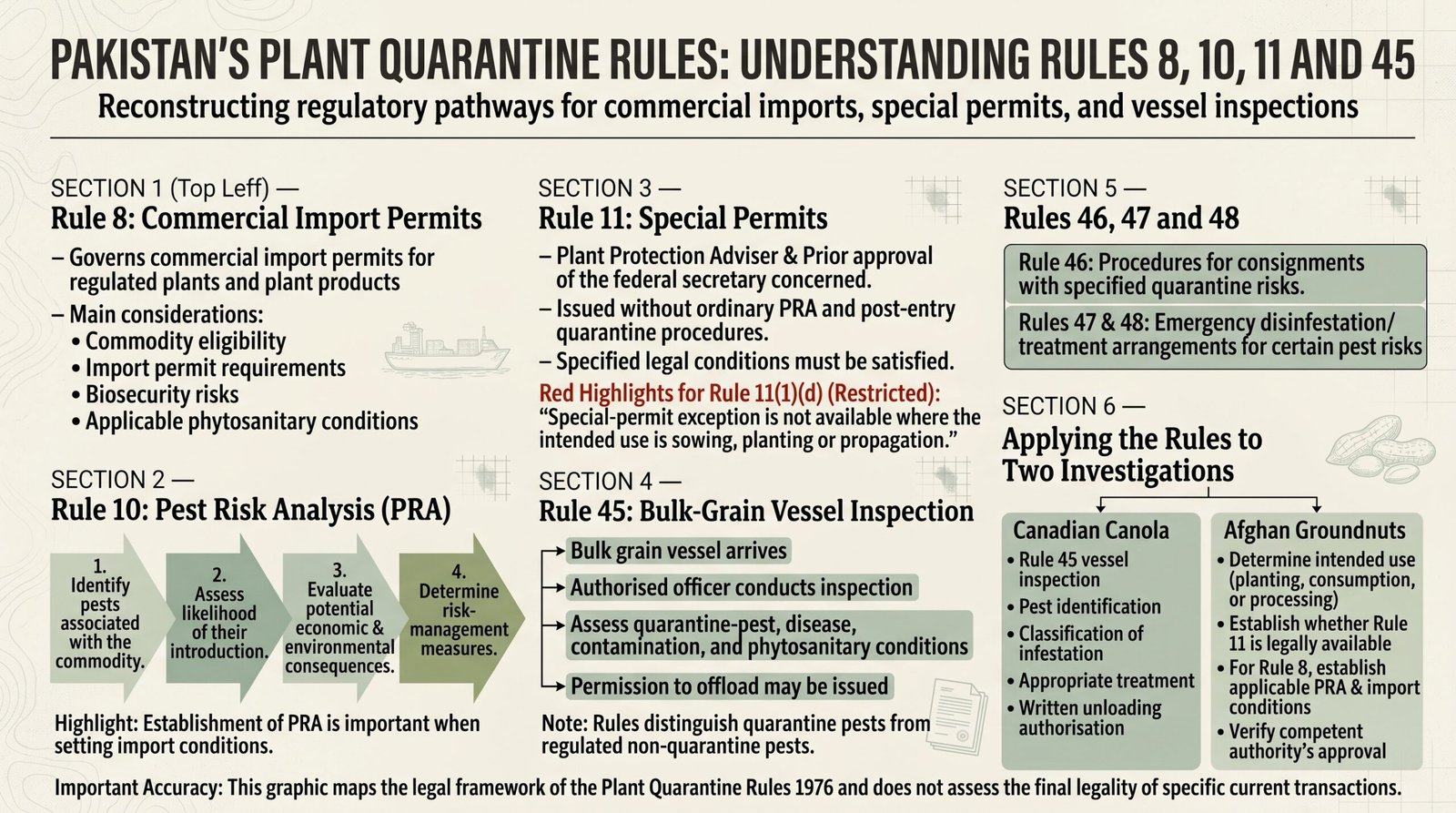
Pakistan’s Plant Quarantine Rules, 2019, provide a specific framework for examining bulk grain shipments.
Rule 45 requires authorised officers to inspect vessels carrying bulk grain on board and allows permission to offload where the relevant quarantine-pest, disease, contamination and phytosanitary conditions have been satisfied.
The rules distinguish between quarantine pests and regulated non-quarantine pests.
That distinction determines which regulatory action is appropriate.
Rule 46 addresses consignments affected by specified quarantine risks and provides for refusal of entry and other prescribed actions where its conditions are met.
Rules 47 and 48 address emergency disinfestation and treatment of certain pest risks through approved arrangements.
Consequently, the detection of an insect does not necessarily require the automatic rejection of an entire shipment.
The relevant questions are whether the pest was identified, whether it was subject to quarantine controls, whether appropriate treatment was undertaken and whether a competent officer approved the cargo’s subsequent handling.
If the live insects recorded on November 11 were determined to be manageable non-quarantine pests, DPP should be able to produce the scientific assessment and any treatment or reinspection records supporting its decision.
If they were identified as quarantine pests, the department would have to explain how it complied with the more restrictive requirements of the rules.
In either case, the decision should be traceable through the official file.
GMO Canola: Approval Does Not Eliminate Quarantine Obligations
The controversy has emerged shortly after Pakistan and Canada established a new framework for genetically modified canola trade.
On July 20, 2026, Deputy Prime Minister Ishaq Dar and Canadian Foreign Minister Anita Anand signed a protocol covering phytosanitary requirements for genetically modified canola intended for food, feed and processing.
The agreement was designed to facilitate predictable trade under defined plant-health conditions.
Separately, Pakistan’s National Biosafety Committee approved 43 genetically modified canola events at its October 22, 2025 meeting, with the Pakistan Environmental Protection Agency subsequently publishing the relevant notification in July 2026.
These developments support lawful imports of appropriately authorised GM canola.
They do not remove the need for consignment-specific compliance with applicable biosafety and plant-quarantine requirements.
Whether the Sea Unity shipment contained approved GM events, whether its importer held the necessary permits and whether the relevant phytosanitary conditions were met require confirmation from the competent authorities.
It is equally important not to confuse genetic modification with insect infestation.
Many commercial GM canola varieties have been developed for herbicide tolerance rather than comprehensive resistance to insect pests.
Therefore, the presence of insects does not itself demonstrate any defect in GM technology.
The regulatory question concerns the inspection, treatment and release of the imported consignment.
Who Imported the Canadian Cargo?
Industry sources have also raised questions about the commercial recipients of MV Sea Unity’s shipment.
The Scoop has been provided with names of several edible-oil and oilseed-processing businesses as possible participants in the consignment’s supply chain.
However, publicly available shipping statements do not identify the actual importers, consignees or final recipients.
The Scoop has not obtained the shipment’s complete Import General Manifest, bills of lading, customs Goods Declarations or terminal dispatch records.
Without these documents, it would be inappropriate to identify any company as a confirmed recipient of the vessel’s cargo.
Port Qasim Authority’s records identify Alpine Marine as the shipping agent. This does not establish that the company owned, imported or purchased the agricultural commodity.
The records held by the shipping agent, customs authorities and terminal operator could establish the commercial ownership, consignee-wise quantities and subsequent movement of the shipment.
Such information would be important for determining whether the cargo remained under regulatory control after discharge or was subsequently released to processing facilities.
No evidence presently available to The Scoop establishes wrongdoing by any particular edible-oil company in connection with the consignment.
Afghan Groundnut Imports: A Second Controversy
The questions surrounding the Canadian canola shipment are accompanied by a separate dispute concerning the Department of Plant Protection’s handling of groundnut imports from Afghanistan.
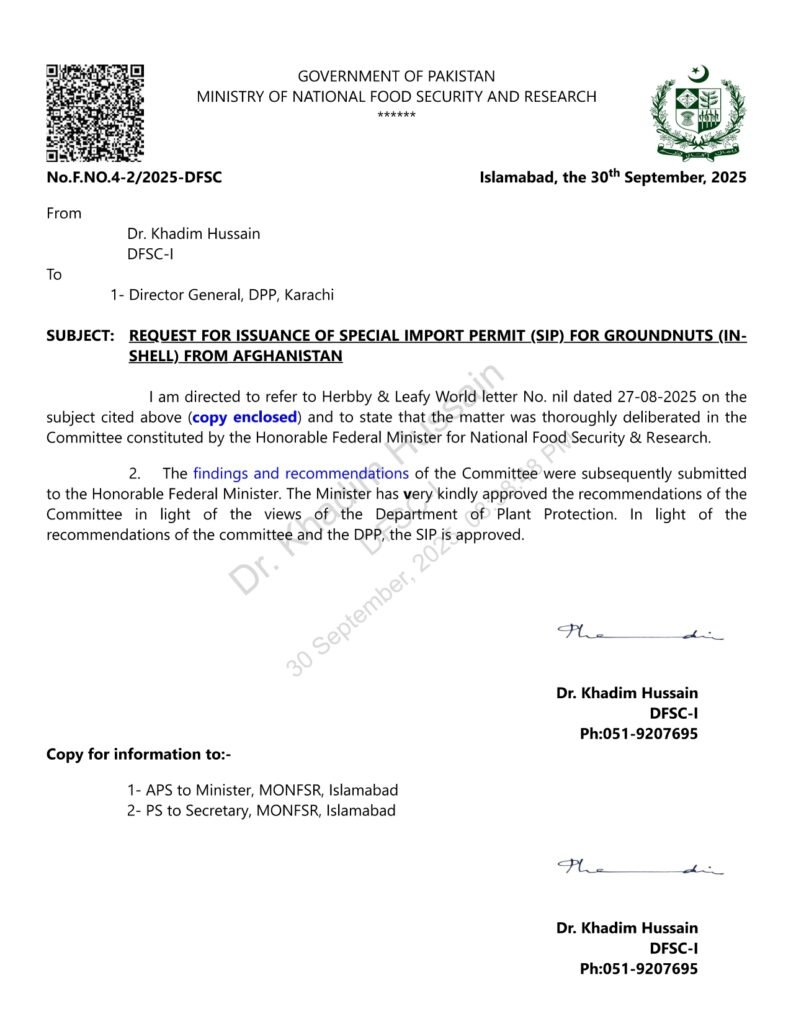
Agricultural industry sources speaking to The Scoop allege that recommendations approved by Federal Minister Rana Tanveer Hussain were subsequently altered through a departmental communication attributed to Dr Khadim Hussain.
According to the sources, the matter initially concerned an application involving a specific importer.
A committee reportedly examined the case and prepared conditional recommendations for approval.
The sources maintain that the recommendations were presented to the minister, who approved them.
However, they allege that the subsequent implementation departed from those conditions and resulted in wider permissions for additional importers.
The alleged alteration principally concerns the regulatory mechanism applied to the imports.
Sources claim that the original recommendations contemplated a case-specific approval associated with Rule 11, requiring the competent authority’s authorisation.
They further allege that a later communication treated the matter as an ordinary import-permit case under Rule 8 without demonstrating that the relevant Pest Risk Analysis requirements had been satisfied.
The Scoop has received a description of four documents said to support this sequence, but has not independently examined their complete original text, signatures, dates and approval markings.
It therefore remains unverified whether the subsequent communication materially contradicted the ministerial decision, reflected an additional lawful approval or implemented a different interpretation of the applicable rules.
Nevertheless, the reported discrepancy raises substantial questions about the handling of the import application.
Did Dr Khadim Hussain Change the Minister’s Approved Recommendations?
The principal allegation concerns the scope and authority of the decision reportedly communicated after ministerial approval.
Sources contend that the original recommendation was specific to one applicant and that the subsequent arrangement made similar permissions available more widely.
If the minister-approved decision contained binding restrictions, the relevant file should establish whether those restrictions were retained, amended or superseded through a competent authority.
If the later communication changed the scope of the approved decision, the ministry should identify who authorised that change.
Importantly, a department’s decision to process applications from additional eligible importers is not necessarily unlawful.
The question is whether the additional applications were processed independently under the appropriate regulations or whether the original limited approval was treated as authority for wider permissions without satisfying the necessary conditions.
Dr Khadim Hussain’s precise role also requires clarification.
The Scoop has not independently established whether he drafted, signed, approved or merely communicated the reported change.
His responsibilities and the statutory authority applicable at the time must be determined from the original departmental record.
The allegations do not, at this stage, establish misconduct or deliberate wrongdoing by Dr Khadim Hussain.
However, the difference described by the sources is sufficiently material to justify examination of the original committee minutes, ministerial endorsement, file notings and subsequent import permissions.
Rules 8, 10 and 11: The Legal Question at the Heart of the Dispute
The legal framework makes the intended use of the Afghan groundnuts especially important.
Rule 8 of the Pakistan Plant Quarantine Rules, 2019, governs commercial import permits for regulated plants and plant products.
It requires the authorised officer to be satisfied that the commodity is eligible for importation and that associated biosecurity risks can be effectively mitigated.
Rule 10 establishes the broader Pest Risk Analysis requirement for commercial imports.
The assessment considers pests associated with a commodity, their potential introduction, economic and environmental consequences and appropriate risk-management measures.
Rule 11 provides a special-permit mechanism under which the Plant Protection Adviser, with prior approval from the federal secretary concerned, may issue certain permits without completing the ordinary PRA and post-entry quarantine procedures, provided the specified conditions are satisfied.
However, Rule 11 contains an especially important restriction.
Under Rule 11(1)(d), the special-permit exception is not available where the intended use of the commodity is sowing, planting or propagation.
This creates two separate questions for the Afghan groundnut case.
First, if the imports were intended as seed for cultivation, could the original proposed Rule 11 procedure lawfully have applied at all?
Second, if the matter was subsequently processed under Rule 8, had an appropriate PRA already established the import conditions, or was another lawful regulatory pathway available?
Merely moving an application from Rule 11 to Rule 8 does not, by itself, prove an irregularity.
Indeed, where planting material is involved, the ordinary permit framework may be more appropriate than the special-permit exemption.
But the change would still require a proper legal basis and compliance with the applicable import and risk-assessment conditions.
Why Groundnut Seed Cannot Be Treated Like Ordinary Food Imports
The classification of the Afghan commodity is crucial.
Pakistan’s Import Policy Order identifies groundnut seed under tariff code 1202.3000.
The listed conditions include a valid DPP import permit, a phytosanitary certificate from the relevant exporting-country authority and a plant protection release order.
Where the seed is intended for sowing, additional requirements concerning variety enlistment, sampling and quality conformity may apply through the federal seed-regulatory authorities.
Groundnuts intended for consumption or processing may be subject to different requirements.
Consequently, the original import applications and permits must establish whether the commodity was intended for agricultural cultivation, food consumption or industrial processing.
The distinction cannot be determined solely from the everyday use of the word “seed”.
For viable planting material, phytosanitary safeguards are especially significant because imported seeds may be introduced directly into agricultural fields.
Insects, pathogens and other regulated organisms associated with planting material can potentially affect domestic crops if appropriate safeguards are not applied.
This does not establish that Afghan groundnuts are unsafe or that their importation is inherently inappropriate.
It reinforces the importance of applying the correct rules to the correct commodity.
Was a Pest Risk Analysis Available for Afghan Groundnuts?
Sources have alleged that the subsequent import permissions were granted without the necessary PRA.
The Scoop has not independently established whether a commodity- and origin-specific risk assessment existed at the relevant time.
This question can only be resolved by examining DPP’s risk-assessment records, approved import conditions and the permits issued to the importers.
It is possible for an existing, valid risk assessment to support subsequent consignments of the same commodity from the same country under established conditions.
That would be materially different from issuing permits where no applicable assessment or authorised alternative procedure existed.
The Department of Plant Protection should therefore disclose whether a PRA covering groundnuts from Afghanistan was completed, when it was approved, and whether it covered planting material or only commodities intended for consumption.
If a valid assessment existed, the department should explain how it supported the challenged approvals.
If no such assessment existed, it should identify the regulatory provision or authorised procedure relied upon.
The question is not merely whether a document carried the heading of Rule 8 or Rule 11.
It is whether the requirements governing the actual transaction were fulfilled.
Two Cases, One Regulatory Institution
Although the Canadian canola and Afghan groundnut matters concern different circumstances, both place the Department of Plant Protection’s implementation of agricultural import controls under examination.
In one case, the concern arises from an inspection observation followed by the discharge of a substantial imported oilseed consignment.
In the other, it arises from an alleged discrepancy between an approval reportedly endorsed by the federal minister and the subsequent departmental handling of import permits.
Both involve processes through which regulated agricultural commodities may enter Pakistan.
Both require technical decisions that must be supported by relevant scientific or regulatory evidence.
And both raise questions about whether those decisions can be reconstructed through reliable official records.
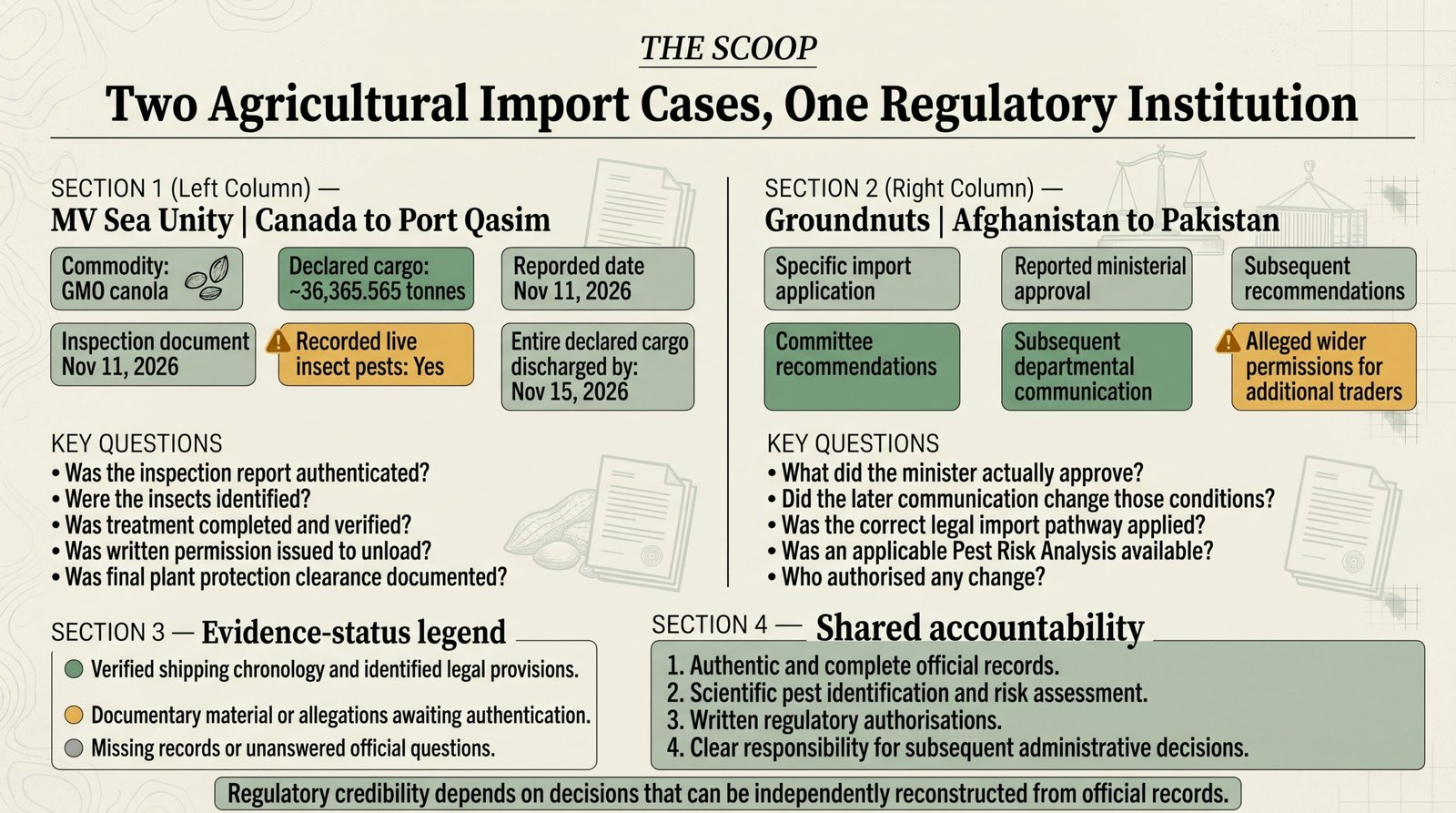
Agricultural sources have argued that Pakistan’s plant-quarantine system requires greater transparency in inspection, testing and import-permit decisions.
They have also called for greater accountability where technical recommendations or approved conditions are subsequently modified.
Such concerns merit examination, but the existence of two disputes does not establish a wider pattern of corruption or deliberate abuse of authority.
That conclusion would require additional documentary and investigative evidence.
Also Read: Tap The Untapped For 20% Tax-To-GDP
The Ministry’s Responsibility
The Ministry of National Food Security and Research, headed by Federal Minister Rana Tanveer Hussain, has a central role in ensuring that import regulations are implemented consistently and that decisions involving agricultural biosecurity are properly documented.
The federal secretary and DPP authorities also exercise powers assigned under the applicable legal framework.
In the groundnut matter, the ministry should establish exactly which recommendations the minister approved and whether any subsequent change received the necessary authorisation.
In the canola matter, the department should establish whether the recorded infestation was appropriately assessed, whether required treatment occurred and on what basis permission to unload was issued.
These questions should be addressed through original records rather than competing assertions.
An independent technical review could help determine whether the department followed the required procedures and whether any regulatory deficiencies require correction.
The Documents That Could Establish the Truth
For the Canadian canola shipment, the key records include:
- The authenticated November 11 inspection report, complete with the inspector’s identity and accompanying observations.
- Any pest identification, sampling, laboratory or reinspection reports.
- The fumigation certificate and supporting treatment records.
- The written authority permitting unloading.
- The DPP plant protection release order and relevant Pak-EPA GMO permits.
- Customs declarations, bills of lading and consignee-wise cargo-dispatch records.
For the Afghan groundnut approvals, the essential records include:
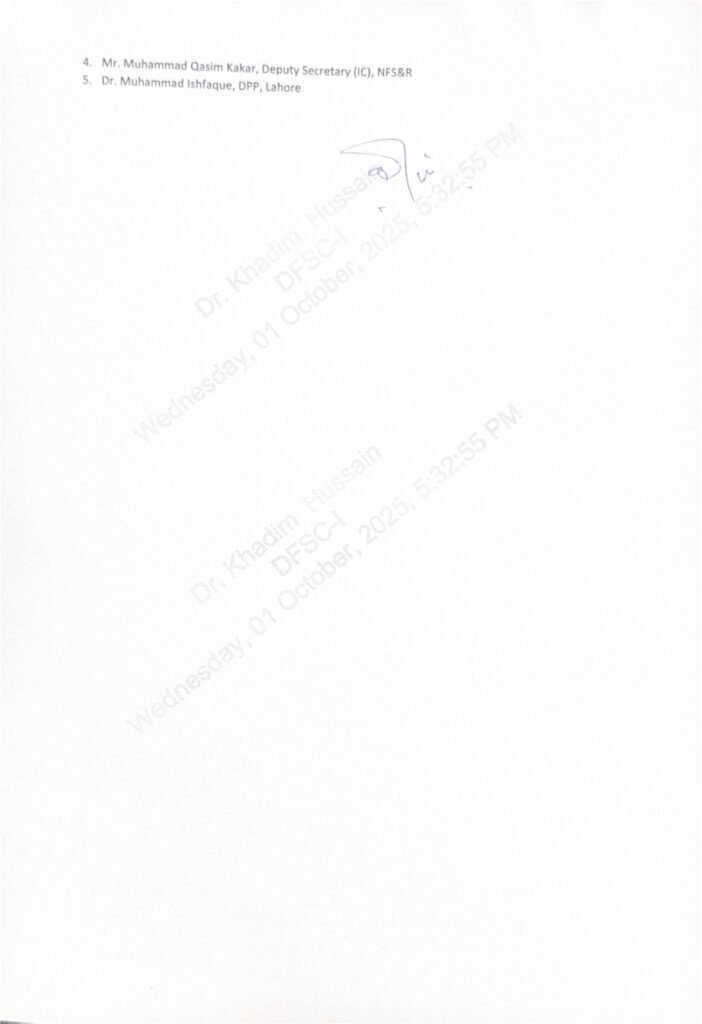
- The original import application and the committee’s signed minutes.
- The recommendations placed before the federal minister.
- The minister’s recorded approval and any conditions attached to it.
- The subsequent communication attributed to Dr Khadim Hussain.
- Any approval or direction authorising changes to the original decision.
- The applicable Pest Risk Analysis or approved alternative regulatory basis.
- Import permits issued to the original applicant and any additional importers.
These documents would establish whether the concerns reflect failures in regulatory compliance, lawful decisions requiring clearer explanation, or allegations unsupported by the complete administrative record.
Right of Reply and Accountability
The allegations surrounding the Afghan groundnut approvals require a response from Dr Khadim Hussain and the relevant officials of the Ministry of National Food Security and Research.
The Canadian canola findings similarly require clarification from DPP, the responsible inspection authorities and the relevant importers or their authorised representatives.
As of the preparation of this report, The Scoop had not obtained the full official clearance file for MV Sea Unity or a substantive official response addressing the reported alteration of the groundnut recommendations.
No conclusion of wrongdoing has been reached against Dr Khadim Hussain, the inspector associated with the canola report, the shipping agent or any importer.
The public interest lies in establishing the documented sequence of decisions and whether the relevant legal requirements were observed.
Pakistan Cannot Afford Unaccountable Agricultural Import Decisions
Pakistan depends on international agricultural trade to sustain important parts of its food and industrial supply chains.
Oilseed imports support domestic edible-oil production, while legitimate seed and agricultural commodity imports can contribute to productivity, competition and market stability.
Unnecessary import restrictions can impose costs on businesses and consumers.
But regulatory facilitation must operate alongside effective phytosanitary controls.
A credible plant-quarantine system should make legitimate imports predictable while ensuring that identified biological risks are assessed, documented and managed.
The Canadian canola controversy requires an explanation of how a vessel whose inspection sheet recorded live insects was subsequently permitted to discharge its entire cargo.
The Afghan groundnut controversy requires clarification of whether minister-approved recommendations were changed, whether such changes were authorised and whether the required risk-assessment safeguards were applied.
The evidence presently available does not establish that either transaction was unlawful.
It does establish a compelling need for the relevant files to be examined and the decisions explained.
The central question now confronting Pakistan’s agricultural authorities is straightforward: can the Department of Plant Protection demonstrate, through its own records, that the decisions taken in both cases complied with the law?
For an institution entrusted with protecting the country’s crops, food supplies and agricultural biosecurity, that is not merely an administrative question.
It is a test of regulatory credibility and public accountability.