

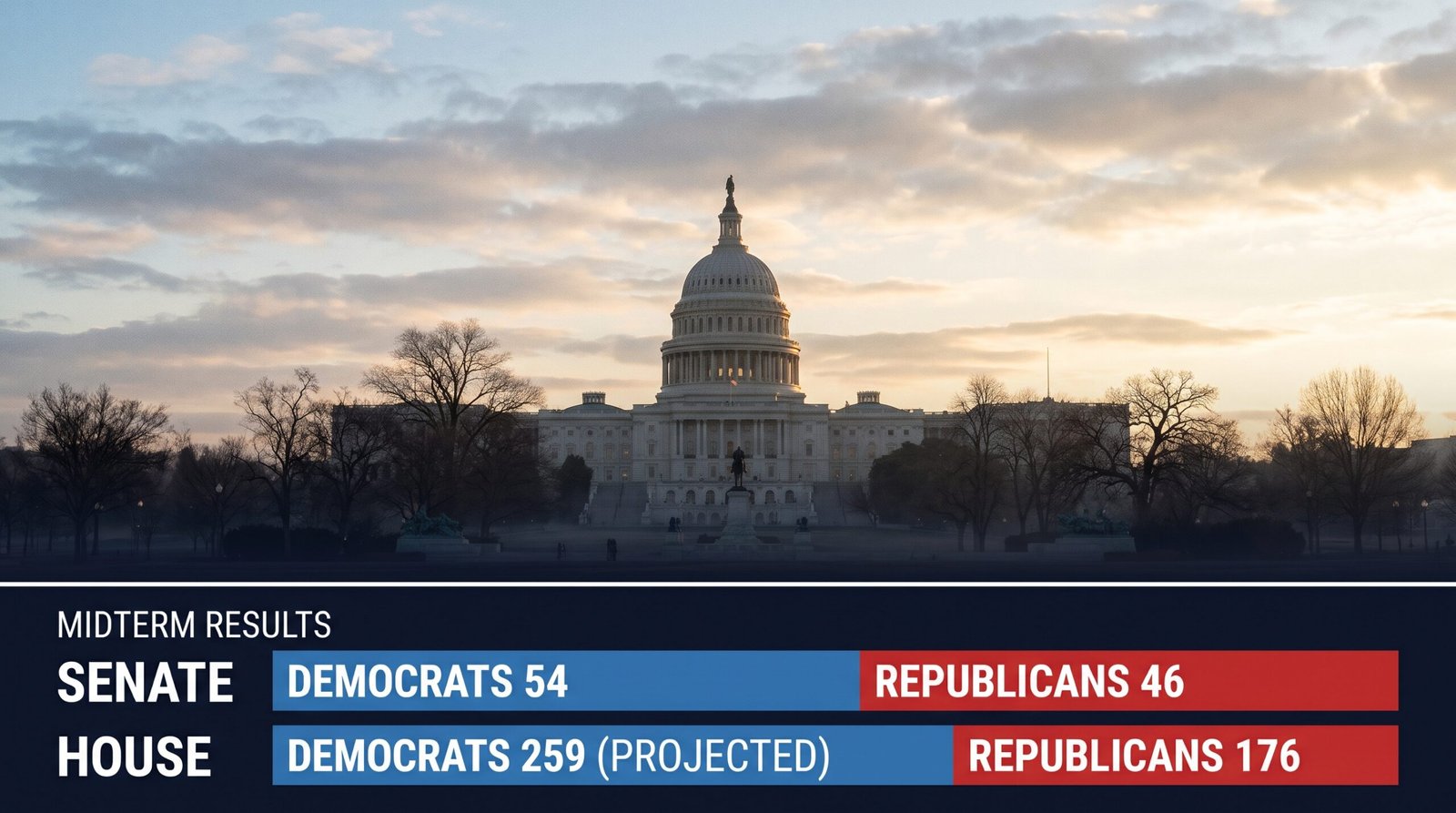
The Democratic Party has officially seized control of both the United States House of Representatives and the US Senate following Tuesday’s midterm elections, delivering a sweeping rebuke of the Republican legislative majority. The decisive victories across multiple battleground states ensure that the Democratic leadership will now dictate the American legislative agenda, congressional oversight, and fiscal appropriations for the remainder of the presidential term.
In the upper chamber, Democrats commanded the map by flipping seven Senate seats across conservative and battleground territories. Prior to the midterms, the Republican Party held a 53-47 majority.
The shift was equally dramatic in the House of Representatives. Democrats secured the lower chamber with decisive victories in heavily contested districts across North Carolina, Pennsylvania, Texas, Michigan, New York, Ohio, Kentucky, and Colorado. Early estimates project the Democratic majority could reach up to 259 seats, completely erasing the 218-seat operational baseline previously held by the GOP.
“The decisive wins came as President Trump’s approval rating hit 38%, historically low for a president in the midterms, in an election where 89% of voters said cost of living was a major or crucial factor in their votes.”
The electoral sweep represents a total rejection of recent Republican governance. Despite aggressive redistricting efforts by Republican legislatures in key states like Texas and Florida aimed at securing a structural advantage, the geographic redrawing failed to stave off heavy incumbent losses.
Market analysts point to severe domestic economic pressures as the primary catalyst for the legislative overhaul. Exit polling data revealed that an overwhelming 89% of the American electorate identified the rising cost of living as a critical driver behind their voting decisions.