


A divided September 2026 ruling over section 4C and default surcharge forces a larger question: can the State charge a taxpayer for delays governed by the courts while the legality of a tax was being decided?
At the end of a long constitutional battle, a company pays the tax a superior court says it owes. The revenue authorities then send another bill: a charge for not having paid earlier, while the courts were hearing the challenge and regulating recovery. To the tax collector, this is compensation for money received late. To the taxpayer, it looks like a price imposed for having sought constitutional protection. Which account is consistent with law?
That question came into sharp focus on 17 September 2026, when a three-member Alternative Dispute Resolution Committee (ADRC), constituted under section 134A of the Income Tax Ordinance, 2001, decided the applications of Pakistan State Oil Company Limited (PSO) concerning default surcharge on super tax under section 4C for tax years 2022, 2023 and 2024. Its nine-page majority decision and four-page dissent are revealing, not because they settle the national argument over super tax, but because they illuminate the distance between collecting revenue and administering justice.
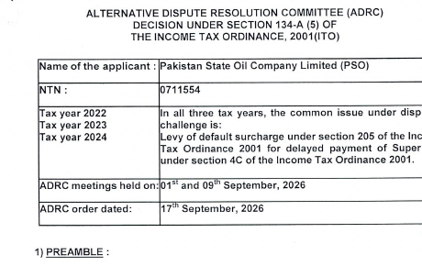
Pakistan State Oil ADRC decision of 17 September 2026
Three years, different judicial histories
PSO is a state-owned enterprise in the petroleum sector. The committee recorded that the company paid super tax for tax year 2022 on 28 February 2023 and 29 January 2026; for 2023 on 28 March 2024 and 29 January 2026; and for 2024 on 31 December 2024 and 29 January 2026. These dates matter. A surcharge case cannot be decided simply by comparing one return date with one final payment: the intervening orders and the taxpayer’s conduct must be reconstructed year by year.
For 2022, PSO had approached the Sindh High Court at Karachi, which issued interim protection on 16 December 2022 subject to security. On 22 December 2022, the court decided the connected Shell Pakistan litigation, holding that section 4C applied only from tax year 2023, while suspending its judgment for sixty days. When the matter reached the Supreme Court, PSO was directed to pay at the four-per-cent rate, which it did on 28 February 2023. This chronology explains why the majority did not treat the entire interval as judicially protected.
For 2023, the litigation travelled through the Islamabad High Court. Following its decisions in Fauji Fertilizer and Pakistan Oilfields, PSO paid an amount on 28 March 2024. For 2024, it paid on 31 December 2024 in line with the governing Islamabad High Court rulings. The Federal Constitutional Court (FCC) subsequently overturned the relevant high-court outcomes and upheld the levy on 27 January 2026. PSO discharged the recorded balances two days later. In April 2026 the department imposed default surcharge for each year; those orders brought the parties to the ADRC.
Also Read: Bookme Targets 100 Million Users, Eyes 50% Of Transaction Value From International Markets
A majority that refused both absolutes
The committee’s majority, led by retired Justice Nadeem Akhtar with advocate Abid H. Shaban, accepted a narrow but important proposition. Section 4C creates a tax liability from the prescribed statutory date.
Section 205, however, is engaged only where a legally recognisable failure to pay exists. When operative court orders regulate the timing, extent or security for payment, a taxpayer who complies with those directions cannot simultaneously be said to default for the same protected period.
The result was expressly qualified. For tax year 2022, the majority permitted surcharge only from 31 December 2022 to 28 February 2023; for 2023, only from 31 December 2023 to 28 March 2024; for 2024, none.
A court case is not a blanket tax holiday. Nor did the majority accept that every surcharge needs proof of malicious intention, or that a separate statutory assessment of surcharge is necessarily unlawful. It considered the particular orders, their operation and the dates of compliance. That precision is the most useful part of the ruling.
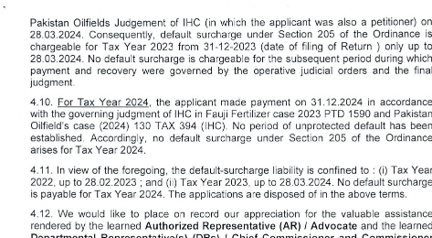
The majority’s operative relief by tax year and signatures (ADRC decision, p. 9).
The majority relied centrally on Masood Textile Mills Ltd v Commissioner of Income Tax, 2003 PTD 2653, affirmed as KLR 2003 SC 223: subsequent reversal of a court’s relief cannot retrospectively convert obedience to an operative order into default. It distinguished China Power Hub Generation Company (2024 PTD 1218), a withholding-agent dispute under section 161, and RCD Ball Bearing Ltd (PLD 1991 SC 308), arising in the social-security context. This is not general immunity from section 205. It is an insistence that the legal effect of a judicial order cannot be erased by the revenue ledger.
The dissent: a serious contention and a troubling leap
Faheem Mohammad, the Inland Revenue member, signed a dissent. He agreed with the basic treatment of the 2022 period but rejected relief for 2023 and 2024. His central allegation was that PSO, although assessed in Karachi and having litigated before the Sindh High Court for 2022, chose the Islamabad High Court for subsequent years to obtain relief without the security obligations imposed in Sindh. He described this as “forum shopping” and invoked Sandalbar Enterprises (PLD 1997 SC 334), Taufiq Asif (PLD 2024 SC 610) and the Islamabad High Court’s 2026 Meezan Bank ruling on territorial jurisdiction.
Territorial jurisdiction is no technical ornament. Courts must examine whether the impugned assessment or recovery action has a sufficient nexus with the forum chosen. A party cannot acquire jurisdiction by convenience, and a dissenting member is entitled to raise this concern. The State also has a legitimate interest in preventing tactical litigation designed only to postpone payment.
The problem is the next step. The dissent treated alleged forum shopping as a reason to deny section 205 protection flowing from orders that were in fact made and operated at the relevant time. The majority did not purport to validate the Islamabad High Court’s jurisdiction. It asked a different question: could an ADRC, deciding a surcharge dispute, simply disregard operative orders that had not been set aside during the payment period?
Accusing a litigant of deliberately exploiting jurisdiction cannot, by itself, substitute for a competent court’s determination of the legal effect of its own orders. Neither should a broad moral diagnosis of corporate conduct replace a precise calculation of days of default.
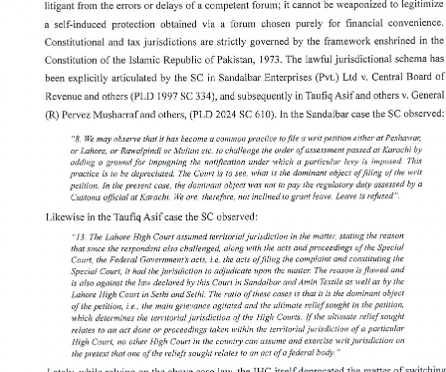 An extract of the dissent discussing territorial jurisdiction and alleged forum shopping (dissent, p. 12).
The dissent went still further, portraying repeated constitutional litigation as a threat to national revenue and the public. The policy concern deserves discussion. It is less convincing when it risks conflating use of the courts with abuse of the courts. A state-owned company remains entitled, and indeed obliged, to pursue arguable questions of law responsibly; government ownership does not make constitutional remedies an act of disloyalty.
What does “fails to pay” actually mean?
Section 205(1) imposes default surcharge on a person who “fails to pay” specified amounts by the due date. The current official consolidation of the Ordinance provides a formula linked to twelve per cent or Karachi Interbank Offered Rate plus three percentage points a year, whichever is higher; the rate applicable to any historic period must be ascertained under the law then in force. The words “shall be liable” are powerful, but they do not answer the preliminary question whether a payment obligation was lawfully suspended, replaced or regulated by judicial direction.
A distinction is necessary between requiring deliberate evasion in every section 205 case—which the PSO majority expressly declined to do—and recognising that a binding court order can eliminate an attributable statutory failure for a defined period.
The first proposition would rewrite a compensatory provision as if it were always a criminal penalty. The second gives effect to the hierarchy of legal authority. A computation cannot begin with “days unpaid” without asking “days legally in default”.
The contrasting arguments also invoke sections 4C(3) and (4), 120 and 137: whether a self-assessed amount was due on the original return date, whether later determination gives a fresh period for payment, and whether separate surcharge proceedings can follow an assessment of principal tax.
Those issues cannot be resolved by slogan. The stronger common ground is narrower: even if the substantive liability arose earlier, enforcement and the allegation of default remained subject to the court orders in force at each point.
The courts were already asking the question
This debate did not begin with PSO. In When Courts Suspend Recovery, Can FBR Still Levy “Default Surcharge”?, published on 23 May 2026, this writer analysed the Lahore High Court’s order in Honda Atlas Cars (Pakistan) Ltd v Federation (W.P. No. 24928 of 2026, 30 April 2026). The court required a reasoned departmental examination of the judicial protections and compliance record before recovery; it did not announce that every taxpayer who files a constitutional petition is exempt from surcharge.
The Appellate Tribunal Inland Revenue’s subsequent decision in The Attock Oil Company Ltd v Commissioner Inland Revenue, ITA No. 773/IB/2026, 6 July 2026, developed the point in greater detail. The tribunal distinguished the date on which super tax might accrue from whether an enforceable default existed while payment was controlled by the Islamabad High Court and Supreme Court. It set aside the surcharge challenged there. These are different decisions in different procedural settings, but they converge on one legal necessity: examine the actual judicial regime, not merely the department’s preferred original due date.
The taxpayer must equally demonstrate compliance, including security, instalments and prompt discharge when protection expires. Courts cannot be turned into an interest-free credit facility. A lawful stay is protection for a bona fide dispute, not a licence to ignore the conditions attached to it.
Read More: Unity Foods: Eight Years Of Red Flags, Billions At Stake — Who Failed Pakistan’s Investors?
Constitutional validation is not fiscal absolution
The background question remains section 4C itself. The FCC’s January 2026 ruling, followed by the detailed decision discussed in Super Tax Detailed Judgment: Constitution’s Breaking Point, upheld sections 4B and 4C. Tax administrators are entitled to act on that authoritative judicial outcome. The present dispute is not an invitation to pretend the judgment never occurred. It is an invitation to distinguish what the judgment settled from what it did not.
In When Income Is Taxed Twice and Super Tax, Senate Bypass, and the FCC’s Constitutional Misreading, this writer challenged the idea that every amount Parliament calls income tax must fall unquestionably within Federal Legislative List (part I) Entry 47.
Section 4C constructs a base from taxable income, certain receipts and imputed or schedule-based income; the result can bear heavily on enterprises already exposed to corporate or minimum tax, disallowed losses and cash-flow constraints.
Entry 52, dealing with a tax on production capacity “in lieu of” specified taxes, offers no permission to treat substitution as accumulation. The Court took a different view of section 4C’s separate charge. That disagreement is now part of the documented constitutional debate, not a claim that no judgment exists.
Another objection concerns legislative procedure. In our earlier examination of the Money Bill route, the exclusion of the Senate from effective deliberation and the implications for fiscal federalism were analysed against Articles 73, 160 and 162 of the Constitution.
The FCC accepted the Finance Act route. The consequences for predictable investment and the integrity of legislative scrutiny nevertheless merit open policy discussion. A formally valid tax can still be economically damaging, poorly designed and administered in ways that offend legal fairness.
The debate over super tax, minimum tax and refunds adds a further distortion: a business can face a fresh charge while substantial credits or refunds remain contested. The answer cannot be another arbitrary power to recover first and inquire later. It requires a coherent tax base, orderly adjustment of legitimate credits and transparent accounting for the State’s own obligations.
A state-owned enterprise and a different ADR system
PSO’s corporate status adds an institutional paradox: public bodies litigate against each other, hire professionals, generate repeated notices and then seek negotiated resolution, with all costs ultimately borne, directly or indirectly, by the public.
The 2026 form of section 134A specifically requires an aggrieved state-owned enterprise to enter the ADR process; its rules also distinguish enterprises wholly owned by the Federal Government from other enterprises for particular consequences of a decision. PSO’s exact ownership and the legal consequences in its case must be evaluated under that text, not assumed from the label “state-owned”.
Two safeguards are particularly important. First, the law expressly says that an ADRC decision shall not be cited or treated as a precedent in another case or for another tax year. This PSO order cannot replace a binding court judgment.
Second, the legislative arrangements for decisions, withdrawal of litigation, and their binding effect require attention to the specific status of the enterprise and proceedings. The public significance of the majority and dissent lies in their reasoning and the questions they expose, not in any general precedential authority of the committee.
If Parliament wants ADR to reduce fiscal friction, it should publish anonymised aggregate outcomes, timelines, the amount of principal tax and surcharge resolved, and the reasons disputes repeatedly reach this stage. Secrecy preserves neither taxpayer confidence nor the exchequer. Transparency, within legitimate privacy limits, could show whether mediation is correcting administrative errors or merely disposing of avoidable disputes.
Stop taxing litigation; start designing certainty
A defensible reform starts with an administrative instruction that every section 205 show-cause notice concerning section 4C contain a year-by-year chronology: statutory due date; original demand; each interim and final judicial order; its conditions; dates and amounts of payment; periods of actual enforceable default; and the law and rate applicable to each day.
The taxpayer should be heard before assessment, and the final speaking order should answer each material submission. Courts should insist on compliance with their security conditions; revenue officers should be equally bound by their suspension of recovery.
Parliament should then clarify in section 205 that where an operative order of a competent court governs the timing or manner of payment, no surcharge accrues for a period of actual compliance, without extending this protection to deliberate breaches or periods outside the order. Such wording would not defeat revenue collection. It would remove the temptation to charge for time during which the legal obligation was judicially reconfigured.
Finally, the super-tax base itself needs reconsideration. A low-rate, broad, predictable income tax, with genuine refunds and fewer overlapping regimes, would reduce the need for recurring extraordinary levies. Our wider case for structural tax reform is that the State should finance public goods without destroying the capacity to invest, employ and produce. Squeezing another levy from the same reported profits, then demanding surcharge for the years spent testing its legality, is not a model of fiscal responsibility.
One practical test of institutional sincerity is whether government will examine the cost of these disputes to itself. Lawyers’ bills, official time, blocked operating funds, multiple judicial proceedings and uncertainty in corporate accounts are real economic costs, whether or not every item appears under the heading of tax expenditure.
Public enterprises are meant to deliver services efficiently, not to function as arenas for protracted litigation between agencies of the same State. Annual disclosure of total contested principal, surcharge, court compliance, legal expenditure and ADR settlements would give Parliament a clearer picture of this hidden cost. Preventing a contestable demand is usually cheaper than defending it for years.
The PSO decision leaves a modest but vital principle intact. The State may defend a tax before the highest court, win, and collect it. What it cannot do without examining the intervening law is convert compliance with a judge’s order into the taxpayer’s default. A tax administration worthy of public trust must know the difference between money owed and disobedience proved.
Sources and linked reading
- Primary document: ADRC, Pakistan State Oil Company Limited, order dated 17 September 2026 (nine-page majority plus four-page dissent); copy supplied to author.
- Official statutory text: Income Tax Ordinance, 2001, amended through 30 June 2026; sections 4C, 134A, 137 and 205.
- Dr Ikramul Haq, “When Income Is Taxed Twice: Constitutional Limits and the Super Tax Debate,” The Friday Times, 7 February 2026.
- Dr Ikramul Haq, “Super Tax, Senate Bypass, and the FCC’s Constitutional Misreading,” The Friday Times, 31 January 2026.
- Dr Ikramul Haq, “Super Tax Detailed Judgment: Constitution’s Breaking Point,” The Friday Times, 2 May 2026.
- Dr Ikramul Haq, “FCC’s super tax detailed judgement: When ‘additional duty’ becomes unconstitutional extraction?”, Minute Mirror, 29 April 2026.
- Dr Ikramul Haq, “When Courts Suspend Recovery, Can FBR Still Levy ‘Default Surcharge’?”, The Friday Times, 23 May 2026.
- Appellate Tribunal Inland Revenue, The Attock Oil Company Limited v CIR, ITA No 773/IB/2026, decision of 6 July 2026; judgment text.
- Dr Ikramul Haq, “Super Tax, Minimum Tax & Refunds,” Minute Mirror, 11 April 2026.
- Dr Ikramul Haq, “Pakistan’s Tax Problem Is Structural, Not Just High Rates,” The Friday Times, 25 April 2026.
- Dawn, “Super tax provisions not violative of fundamental rights, FCC holds,” 29 January 2026.
Legal note: The ADRC decision has case-specific force and the operative 2026 section 134A bars its use as a precedent in a different case or tax year. Interpretation and assessment of historic surcharge rates should be verified against the law applicable in each period.