

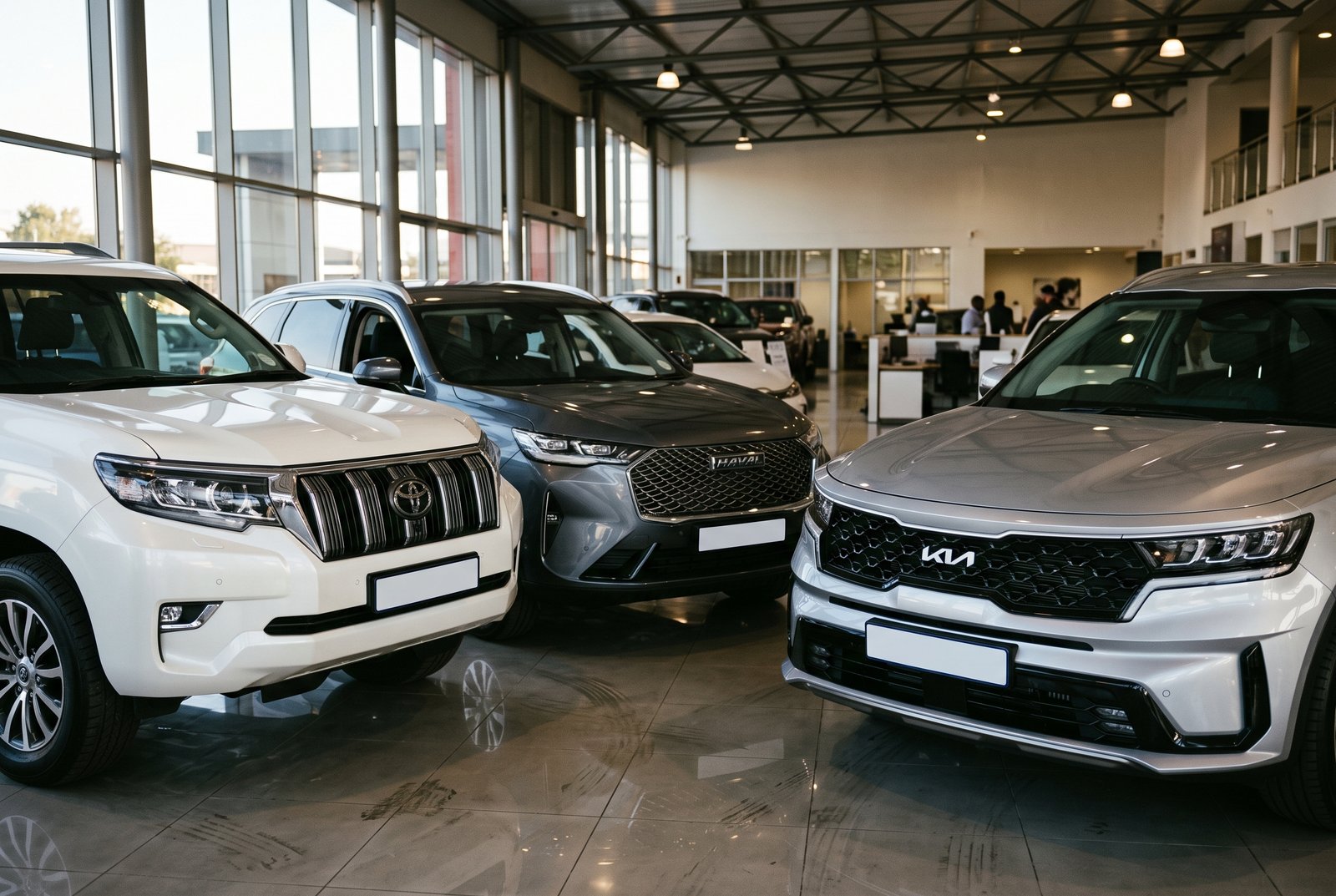
Pakistan’s automotive industry is witnessing a significant transformation as Chinese manufacturers challenge the longstanding dominance of Japanese brands and intensify competition with South Korean automakers.
The battle is particularly visible in the Rs 7 million–15 million sport utility vehicle (SUV) and crossover segment, where Haval, Toyota, Hyundai, Kia, Changan, MG and other manufacturers are competing for an increasingly demanding customer base.
For decades, Japanese manufacturers enjoyed a formidable advantage through reliability, resale value, extensive dealership networks and established customer loyalty. Korean brands subsequently challenged that dominance by introducing contemporary designs, greater comfort and modern features.
Now Chinese manufacturers are attempting to rewrite the rules.
With hybrid powertrains, advanced driver-assistance systems, powerful engines and increasingly sophisticated interiors, Chinese vehicles are challenging traditional perceptions of automotive quality and value.
But the central question remains: are Chinese manufacturers genuinely taking over Pakistan’s SUV market, or are Japanese and Korean brands preparing for a longer competitive battle?
Haval’s Rise: The Chinese Brand Challenging Established Manufacturers
Among Chinese automotive brands operating in Pakistan, Haval has emerged as one of the most prominent challengers.
Locally assembled by Sazgar Engineering Works, the Haval H6 and Jolion have established a visible presence in Pakistan’s SUV and crossover segment.
The Haval H6 HEV, combining a turbocharged petrol engine with an electric motor, has attracted buyers seeking strong performance, hybrid fuel efficiency and modern technology.
Sazgar’s financial performance reflects the commercial significance of its automotive operations.
For FY2026, the company reported net revenue of approximately Rs 192 billion, compared with Rs 109 billion in the preceding financial year, representing growth of roughly 76%.
Its reported earnings per share increased from Rs 270.26 to Rs 390.51.
According to an October 2026 management briefing, Sazgar’s production facility had capacity for approximately 100 vehicles daily, with expansion plans intended to increase capacity to 180 vehicles.
The company also reported 32 operational 3S dealerships, with plans to add another five.
These developments suggest that Haval’s expansion is not merely a short-term marketing success but part of a broader investment in production, distribution and after-sales infrastructure.
However, the sustainability of this growth will depend on long-term reliability, spare-parts availability, warranty support and customer satisfaction.
Also Read: Tesla Unveils Thruster-Equipped Roadster, Targets 2028 Production
What Do the Sales Figures Actually Reveal?
Pakistan’s automotive sales statistics provide important insights into the competitive landscape, although they do not offer a complete picture of the SUV market.
According to figures reported for September 2026 by the Pakistan Automotive Manufacturers Association (PAMA), Sazgar recorded 2,474 sales in its combined Haval and Tank category.
Indus Motor Company reported 4,142 overall vehicle sales during the same month.
Toyota’s combined Corolla, Yaris and Corolla Cross category accounted for 3,563 units, while the Fortuner and IMV category recorded 579 units.
Hyundai reported 51 Tucson sales and 12 Santa Fe sales.
These numbers highlight the scale of Sazgar’s emergence as an automotive manufacturer.
However, comparing the figures directly would be misleading because the reporting categories combine different vehicle types.
Toyota’s Corolla Cross is grouped with sedans, while its Fortuner figures are combined with IMV vehicles. Sazgar’s reported volumes also cover multiple nameplates.
Furthermore, manufacturers including Kia and Changan are not comprehensively represented in PAMA’s published model-level data.
Consequently, publicly available figures do not establish a definitive national SUV market-share ranking.
A meaningful comparison requires individual model sales, consistent reporting periods and data from all major manufacturers.
Toyota’s Counterattack: Can Reliability Defeat Technology?
Toyota remains one of Pakistan’s most established automotive brands, benefiting from decades of local manufacturing, an extensive dealership network and strong customer familiarity.
However, the arrival of technologically advanced Chinese SUVs has created a challenge for traditional Japanese manufacturers.
Indus Motor Company’s FY2026 annual report disclosed total vehicle sales of 45,035 units, compared with 33,757 units in FY2025, reflecting growth of approximately 33%.
The company has also highlighted its investment of around $100 million in the locally assembled Corolla Cross Hybrid programme.
The Corolla Cross Hybrid represents Toyota’s effort to compete in an increasingly electrified market while maintaining its traditional emphasis on reliability and fuel efficiency.
Unlike some Chinese competitors, Toyota has generally focused on established engineering, practical ownership considerations and long-term brand confidence rather than competing solely on equipment levels.
Indus Motor Company Chief Executive Ali Asghar Jamali has publicly discussed the challenges facing Pakistan’s automotive industry and the growing competition from Chinese manufacturers.
Toyota’s position remains supported by its established after-sales network and familiarity among Pakistani buyers.
Nevertheless, the company faces an increasingly difficult question: will younger consumers continue paying a premium for established reliability when competing manufacturers offer more technology, stronger performance and additional features at comparable prices?
The answer could determine how effectively Japanese manufacturers defend their position over the next decade.
Korean Manufacturers Face Pressure From Both Sides
South Korean manufacturers occupy an important position in Pakistan’s automotive market.
Hyundai and Kia helped popularise modern crossovers among Pakistani consumers, particularly through the Tucson and Sportage.
These vehicles offered alternatives to conventional sedans, combining elevated driving positions, contemporary styling and family-oriented practicality.
However, Chinese competition has intensified considerably.
Hyundai has responded through newer-generation vehicles, including the Tucson Hybrid, while Kia has introduced the Sportage L and expanded its portfolio of electrified vehicles.
Hyundai Nishat Motor announced in July 2025 that it had assembled 50,000 vehicles locally.
Speaking at the milestone ceremony, Hyundai Nishat Motor Chief Executive Yamada Masaki said:
“Fifty thousand units assembled locally is not just a number; it’s proof of Pakistan’s growing capabilities in the global mobility landscape.”
The statement underlined Hyundai’s emphasis on local manufacturing and long-term participation in Pakistan’s automotive industry.
Yet the challenge for Korean manufacturers is becoming more complex.
They must compete with Japanese brands on reliability and resale confidence while simultaneously challenging Chinese manufacturers on technology, equipment and pricing.
For consumers, this competition is creating more choices. For manufacturers, it is placing increasing pressure on product development, localisation and pricing strategies.
Lucky Motor’s CEO Sees Opportunity in the Energy Transition
Lucky Motor Corporation, which assembles Kia vehicles in Pakistan, is pursuing a strategy that extends beyond conventional petrol-powered SUVs.
The company has expanded its involvement in electric mobility through Kia products and its partnership with Chinese manufacturer GAC.
Lucky Motor Corporation Chief Executive Muhammad Faisal has described Pakistan’s changing energy environment as an opportunity for the automotive industry.
“Every crisis has an opportunity,” Faisal said, highlighting how rising fuel costs are accelerating consumer interest in new-energy vehicles.
He has also emphasised the importance of rooftop solar installations, which could make electric vehicles increasingly attractive to Pakistani households capable of generating their own electricity.
Lucky Motor has outlined plans to begin local assembly of GAC electric vehicles as early as December 2026, subject to the company’s implementation schedule.
The development illustrates a significant transformation in Pakistan’s automotive industry, where established manufacturers are increasingly collaborating with Chinese companies to introduce new technologies and expand their product portfolios.
This also means that the competitive landscape can no longer be described simply as Chinese versus Japanese versus Korean manufacturers.
Automotive companies are increasingly entering cross-border partnerships, creating overlapping industrial and commercial interests.
Price Comparison: What Can Pakistani Buyers Get for Rs 7 Million–15 Million?
The SUV market has become particularly competitive because manufacturers are targeting overlapping price categories.
Approximate prices and market positioning for selected models are outlined below. These are indicative ranges rather than independently confirmed October 2026 dealer quotations.
| Model | Indicative Price Range |
| Haval H6 HEV | Rs 11.5m–11.8m |
| Toyota Corolla Cross Hybrid | Rs 9.3m–9.7m |
| Hyundai Tucson Hybrid | Rs 12.2m–13.3m |
| Kia Sportage L Hybrid | Around Rs 12m–13.3m |
| Changan Oshan X7 | Around Rs 8m–9.5m |
| MG HS | Around Rs 8m–10m |
Prices vary by variant, tax treatment and manufacturer revisions. Buyers should obtain current written quotations before making purchasing decisions.
The comparison illustrates how Chinese manufacturers have positioned their products against established Japanese and Korean competitors.
However, purchase price alone does not determine value.
Registration costs, fuel economy, maintenance, insurance, spare-parts availability and depreciation can substantially affect the total cost of ownership.
Is China Winning the Technology War?
One of the strongest arguments in favour of Chinese SUVs is their emphasis on technology.
Manufacturers have increasingly introduced hybrid powertrains, large digital displays, panoramic sunroofs, advanced driver-assistance systems and connected-vehicle features.
The Haval H6 HEV, for example, offers approximately 240 horsepower and 530 Nm of combined torque, according to published specifications.
Such figures make it competitive against several established rivals.
The Changan Oshan X7 has also attracted attention through its combination of turbocharged performance, cabin space and equipment.
Meanwhile, newer Chinese manufacturers are attempting to differentiate themselves through electrification and more advanced vehicle platforms.
However, technology must be evaluated carefully.
A larger infotainment display does not necessarily indicate better software reliability.
Similarly, additional electronic features can increase repair complexity and maintenance costs once vehicles move beyond their warranty periods.
Independent safety testing, long-term reliability studies and transparent ownership-cost comparisons remain essential.
The real test for Chinese manufacturers will be whether their technological advantages remain compelling after several years of Pakistani road conditions, extreme summer temperatures and heavy urban traffic.
Hybrid SUVs Could Change the Economics of Ownership
Pakistan’s dependence on imported petroleum makes fuel efficiency an increasingly important consideration.
Hybrid vehicles offer an advantage in congested urban conditions because electric assistance can reduce petrol consumption, particularly during stop-and-go driving.
Consider a hypothetical motorist covering 20,000 kilometres annually.
A conventional petrol SUV averaging 10 kilometres per litre would consume approximately 2,000 litres annually.
A hybrid SUV averaging 17 kilometres per litre would consume approximately 1,176 litres.
The difference would be approximately 824 litres.
At an illustrative petrol price of Rs 280 per litre, the annual fuel saving would approach Rs 231,000.
These are illustrative assumptions, not verified road-test results for particular vehicles.
Actual savings depend on driving conditions, vehicle specifications, fuel prices and individual driving habits.
Nevertheless, the calculation demonstrates why hybrid technology is becoming increasingly relevant to Pakistani motorists.
Over five years, fuel savings could become substantial, although they must be weighed against the initial purchase-price premium and potential maintenance costs.
Resale Value: Japan’s Strongest Defence
Despite growing competition, Japanese manufacturers continue to enjoy an important advantage in Pakistan’s used-car market.
Toyota’s reputation for reliability, established parts availability and widespread familiarity among independent mechanics has historically supported demand for its vehicles.
Chinese manufacturers, by comparison, are still establishing long-term ownership records for several newer models.
While some Chinese SUVs have developed active resale markets, asking prices alone cannot establish whether their depreciation is lower or higher than that of Japanese or Korean competitors.
A proper resale comparison would require actual transaction prices, vehicle age, mileage, condition and original purchase costs.
Without this information, claims that Chinese SUVs have overtaken Japanese brands in resale performance would be premature.
For many Pakistani buyers, particularly those who replace their vehicles every three to five years, resale value remains almost as important as the original purchase price.
This creates a challenge for Chinese manufacturers seeking to convert initial sales growth into long-term customer loyalty.
Localisation: The Battle Beyond Showrooms
Pakistan’s automotive industry is also facing a larger structural question: how much value is being created domestically?
Local assembly can support employment, investment and supplier development, but it does not automatically indicate high levels of local content.
Manufacturers differ significantly in their use of imported components, local suppliers and domestically manufactured parts.
Japanese manufacturers benefit from decades of local vendor development.
Chinese manufacturers are expanding assembly operations and production capacity, while Korean assemblers are pursuing their own localisation strategies.
The long-term economic contribution of each manufacturer should therefore be measured not only through vehicle sales but also through local parts procurement, employment, exports, technology transfer and investment in Pakistan’s industrial base.
A company selling more vehicles is not necessarily generating a proportionately greater contribution to domestic manufacturing.
Transparent localisation data would help establish which manufacturers are making the strongest long-term contribution to Pakistan’s economy.
Who Is Actually Winning Pakistan’s SUV Market?
The answer depends on how success is measured.
In terms of recent growth and visibility within the locally assembled SUV segment, Haval has emerged as one of the strongest challengers.
Sazgar’s financial performance, reported sales and capacity expansion demonstrate that Chinese-backed SUV manufacturing has become a significant commercial force.
Toyota, meanwhile, continues to benefit from its established manufacturing operations, brand recognition, dealership network and customer confidence.
Hyundai and Kia remain important competitors, particularly in the premium crossover category, although incomplete public reporting makes their precise SUV market shares difficult to establish.
Changan, MG and newer Chinese entrants could intensify competition further as product ranges expand and additional technologies enter the market.
But a definitive claim that Chinese manufacturers have captured the largest share of Pakistan’s entire SUV market would require more comprehensive model-level sales data than is currently available in public industry reporting.
The Scoop Analysis: A Structural Shift, Not Yet a Complete Takeover
Pakistan’s automotive industry is experiencing a structural change.
Chinese manufacturers have demonstrated that they can compete with established Japanese and Korean brands on technology, performance, equipment and, in some cases, price.
Their growing presence has also encouraged greater competition in hybrid and electric powertrains.
However, Japanese manufacturers retain important advantages in customer confidence, established ownership infrastructure and brand familiarity.
Korean manufacturers, meanwhile, are attempting to defend their positions through updated products, hybrid technology and broader electrification strategies.
The next phase of competition will be determined by factors that extend beyond showroom appeal.
Manufacturers will need to demonstrate consistent product reliability, affordable maintenance, responsive after-sales support and competitive resale performance.
They will also face increasing pressure to localise production, manage currency-related costs and introduce vehicles suited to Pakistan’s economic conditions.
For consumers, the intensifying competition is potentially beneficial because it encourages innovation and provides greater choice.
For manufacturers, the challenge is more demanding.
A successful launch may attract attention, but sustained customer satisfaction determines whether a brand becomes a permanent part of the market.
China’s automotive manufacturers have undoubtedly disrupted Pakistan’s SUV industry.
Whether they can permanently displace the advantages accumulated by Japanese and Korean manufacturers remains to be seen.
For now, the evidence points towards a more competitive market in which Chinese brands are gaining influence, Japanese manufacturers remain resilient and Korean companies are being forced to innovate.
The ultimate winner may not be a particular country or manufacturer, but Pakistani consumers — provided greater competition translates into better vehicles, stronger after-sales service and more affordable ownership.