

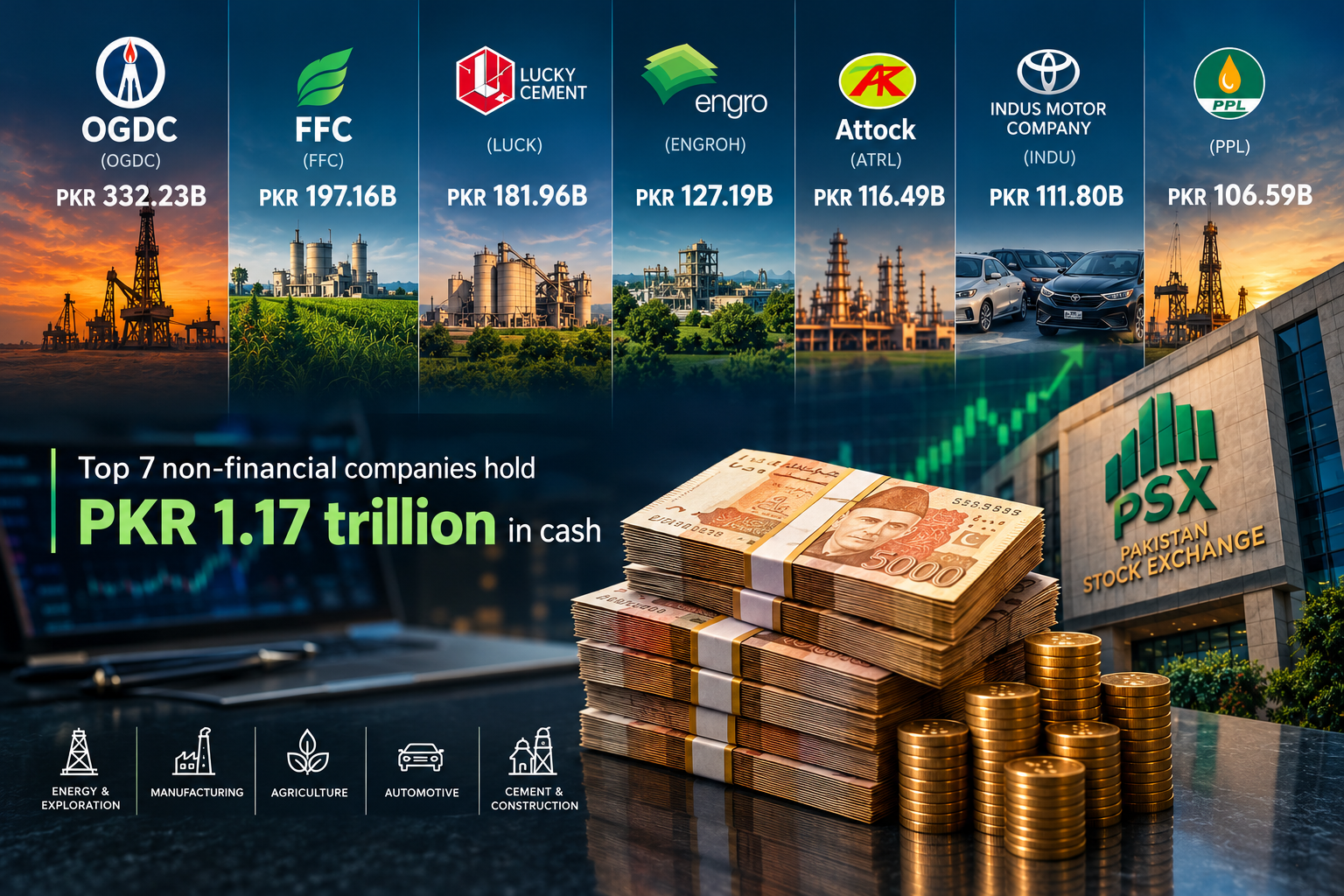
The top seven non-financial companies listed on the Pakistan Stock Exchange (PSX) are currently sitting on a combined reported cash pile of PKR 1.17 trillion. The staggering liquidity concentration underscores the financial muscle of Pakistan’s leading energy, manufacturing, and agricultural conglomerates, while also reflecting broader macroeconomic trends that have incentivised cash accumulation over aggressive capital expenditure.
The Cash Kings of the PSX
According to recent corporate financial disclosures visualised in market data, the state-owned exploration giant Oil & Gas Development Company (OGDC) holds the undisputed top position. The company reported a massive PKR 332.23 billion in cash on hand.
Following OGDC, the fertilizer and cement sectors dominate the upper tiers of corporate liquidity:
-
Fauji Fertilizer Company (FFC): PKR 197.16 billion
-
Lucky Cement (LUCK): PKR 181.96 billion
-
Engro Holdings (ENGROH): PKR 127.19 billion
The remainder of the top seven represents a cross-section of the refinery, automotive, and exploration sectors:
-
Attock Refinery (ATRL): PKR 116.49 billion
-
Indus Motor Company (INDU): PKR 111.80 billion
-
Pakistan Petroleum Limited (PPL): PKR 106.59 billion
Sectoral Dominance and Economic Realities
The heavy concentration of cash within the energy and exploration sector—with OGDC, PPL, and Attock Refinery collectively accounting for over Rs 555 billion—highlights the unique dynamics of Pakistan’s energy chain. For E&P companies, large cash reserves are often intertwined with the country’s persistent circular debt crisis, where funds are either held against receivables or accumulated pending major dividend payouts and future exploration investments.
The presence of Indus Motor Company (INDU) on the list with Rs 111.80 billion is particularly notable. Despite recent demand contractions and production hurdles in the domestic automotive sector, major auto assemblers traditionally maintain substantial cash reserves generated through advance customer bookings and retained earnings, which yield significant interest income.
Similarly, diversified conglomerates like Engro Holdings and cash-rich manufacturers like Lucky Cement and Fauji Fertilizer showcase the profitability of entrenched market leaders in the agricultural and construction sectors.
Investment Versus Interest Income
From a macroeconomic perspective, the accumulation of Rs 1.17 trillion by just seven non-financial entities reflects a defensive corporate strategy. In a high-inflation, high-interest-rate environment, companies are frequently rewarded more for parking cash in high-yielding government securities and bank deposits than for pursuing new capital-intensive industrial projects.
While this liquidity provides these blue-chip companies with robust balance sheets and the capacity for high dividend payouts to shareholders, it also raises critical questions about the pace of private-sector industrial expansion, domestic reinvestment, and job creation in the broader economy.