

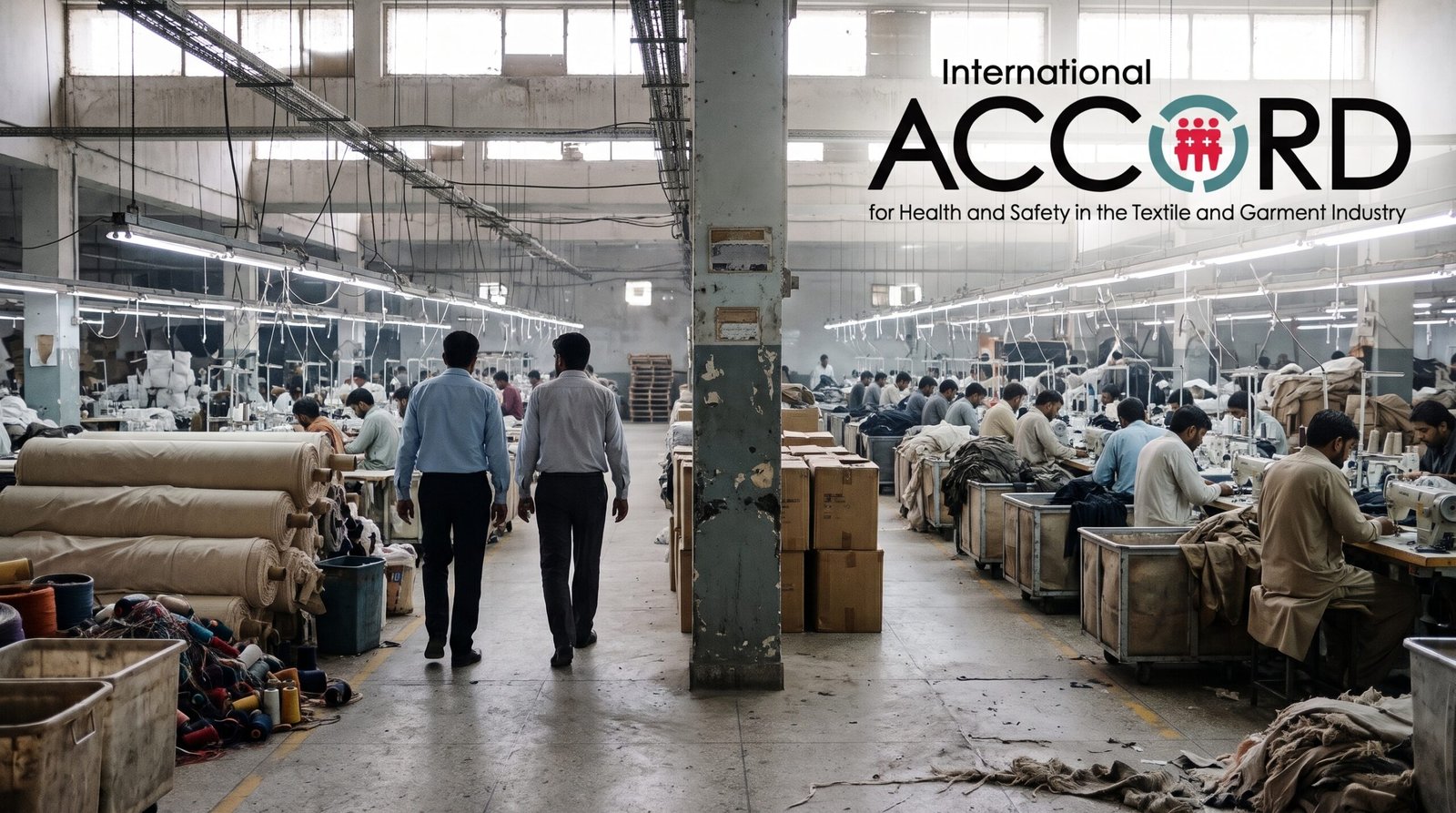
LAHORE: Pakistan’s textile industry is one of the country’s most valuable economic assets, earning billions of dollars in foreign exchange, employing millions of workers and sustaining an extensive industrial ecosystem. Yet a foreign-governed private compliance arrangement is increasingly exercising influence over this critical sector, raising an uncomfortable question: who ultimately controls Pakistan’s factories?
Is it the Pakistani state, which provides the legal and regulatory framework? Is it the industrialists who invest billions in manufacturing facilities and employ thousands of workers? Or is it an internationally governed arrangement whose decisions can influence whether Pakistani exporters retain their relationships with global buyers?
These questions have acquired renewed significance as concerns intensify within the textile industry over the activities of the International Accord and its Pakistani subsidiary, Health and Safety Accord (Private) Limited.
The organisation was established to improve workplace safety, particularly fire, structural, electrical and boiler safety. Its origins lie in the tragic collapse of Rana Plaza in Bangladesh in 2013, which exposed serious failures in industrial safety.
No responsible manufacturer, regulator or policymaker should oppose genuine efforts to prevent industrial tragedies.
But the controversy now confronting Pakistan is no longer simply about making factories safer.
It concerns the expanding interpretation of occupational health and safety, the involvement of international organisations in domestic industrial relations, the growing use of worker complaints mechanisms, overlapping inspections and the possibility of commercial penalties imposed through international buyers.
Most importantly, it concerns the accountability of an international compliance programme whose decisions can have far-reaching consequences for Pakistan’s industrial economy.
When a private international arrangement can influence factory operations, worker-management relationships, remediation expenditure and access to foreign buyers, Pakistan has every right to ask who authorised that influence, who supervises it and where its limits lie.
Accord’s Own Documents Raise Questions About Expanding Its Mandate
Perhaps the most significant development emerges from the International Accord’s own Steering Committee records.
Minutes of meetings held on September 11–12, 2025, record that the expansion of the Pakistan Accord complaints mechanism beyond occupational health and safety was to be discussed during negotiations for the renewed agreement.
This is important.
Concerns about mandate expansion are not limited to complaints from industrialists. The possibility of extending the complaints mechanism beyond occupational safety was itself placed on the international organisation’s discussion agenda.
The renewed Pakistan Accord, effective January 1, 2026, contains provisions for inspections, safety training, worker participation and an independent complaints mechanism.
Article 22 specifically establishes a mechanism through which workers can raise health and safety concerns.
Crucially, it also provides that complaints falling outside Accord’s scope are to be forwarded to signatory brands, while complainants are advised of other available mechanisms.
This distinction raises a central question.
If the agreement recognises that certain employment matters fall outside Accord’s jurisdiction, why was the expansion of its complaints mechanism beyond occupational health and safety being considered?
Was any such expansion formally approved?
If so, who approved it, under what authority and following what consultation with Pakistan’s government, industry and labour institutions?
What are the precise limits of the current complaints mechanism?
And who decides whether a dispute involving wages, maternity benefits, overtime, social security or other employment matters falls within occupational safety or general labour regulation?
A private arrangement cannot be permitted to interpret its jurisdiction so broadly that the distinction between workplace safety and industrial regulation effectively disappears.
Ministry of Commerce Raised Concerns Over Investigations Beyond Safety
The controversy takes on greater significance because the concerns are not confined to factory owners.
Correspondence dated July 14, 2025, cited in material examined by The Scoop records the National Compliance Centre, operating under the Ministry of Commerce, raising concerns with the Country Director of Pakistan Accord following a complaint from the Pakistan Hosiery Manufacturers and Exporters Association.
The correspondence concerned an unannounced factory visit and an investigation into matters described as falling outside the organisation’s agreed health and safety mandate.
The NCC identified fire, building, electrical and boiler safety as the core areas of Accord’s technical inspection responsibilities.
It also drew attention to workplace harassment matters falling outside the relevant occupational safety jurisdiction, indicating that such issues belonged within established company procedures, statutory grievance mechanisms and competent Pakistani authorities.
Significantly, the correspondence recommended that Accord engage the relevant industry association before surprise visits and route future communications through the association.
These are consequential concerns.
They suggest that disagreements over Accord’s operational boundaries had reached the country’s national compliance administration.
If Pakistan’s own compliance authorities have questioned the boundaries of Accord’s investigations, why has there not been a transparent public clarification of the organisation’s powers and limitations?
What response did Accord provide to the Ministry?
Were the concerns addressed?
Were inspection and complaint-handling procedures modified?
And what mechanisms exist to prevent similar disputes?
Industry associations cannot be given a veto over genuine safety inspections. However, questions of jurisdiction, coordination and procedural fairness cannot simply be brushed aside.
An international organisation operating within Pakistan must be accountable to a clearly defined legal and institutional framework.
From Fire and Building Safety to Wages, Maternity Benefits and Social Security?
Another critical concern relates to the expanding range of complaints being considered through Accord’s procedures.
A November 2026 document titled Pakistan Accord Complaints Mechanism: OSH Definition & Examples identifies matters including overtime, maternity-related payments, medical expenses, social security registration, production targets, childcare, employment grievances and workplace harassment.
Certain employment conditions undoubtedly have occupational safety implications.
Excessive working hours may create serious health risks. Workplace violence and harassment can affect physical and psychological safety. Dangerous production conditions may require immediate intervention.
But the existence of such connections does not mean every workplace dispute automatically falls under an international safety programme.
The distinction between occupational safety and general labour administration is central to the controversy.
Can an organisation established to oversee workplace safety investigate payroll records, maternity payments, employment benefits and social security compliance under an unrestricted interpretation of occupational health?
At what point does a safety inspection become an employment investigation?
Who determines whether a particular demand for documents is relevant to the original complaint?
Can factories challenge requests for commercially sensitive or personal employment information?
And does a factory’s refusal to cooperate with an investigation it believes to be outside Accord’s jurisdiction expose it to commercial escalation involving international buyers?
These questions go directly to the limits of Accord’s authority.
Pakistan already has labour departments, statutory bodies, employment laws and grievance mechanisms.
The establishment of an additional international complaints process must not create overlapping jurisdictions without clearly defined responsibilities.
Factory Records, Surprise Investigations and Pressure Through Foreign Buyers
Industry representatives describe increasingly demanding inspections and investigations involving matters beyond conventional structural and fire-safety assessments.
According to accounts shared with The Scoop, some investigations have involved requests for personnel files, overtime registers, medical information, social security documentation and other employment records.
Such documents may be relevant in particular occupational safety investigations, but the necessity and proportionality of each request must be established.
Manufacturers also describe concerns over unannounced visits and the possible escalation of disputes to international buyers.
The issue is not whether genuine safety violations should be reported to purchasing brands.
They should.
The issue is whether the same commercial enforcement mechanism can be invoked when manufacturers dispute the jurisdiction, procedure or factual basis of an investigation.
What happens when a Pakistani factory disagrees with Accord’s interpretation of its mandate?
Can the organisation escalate the matter to an international customer before the dispute is independently resolved?
What opportunity does the manufacturer have to present its position?
Who adjudicates a disagreement between Accord’s inspectors and a factory’s technical or legal representatives?
And who is accountable if an improper or disproportionate escalation contributes to lost orders or production disruption?
These questions demand answers because international buyer relationships are central to the survival of export-oriented factories.
A compliance dispute should not become an instrument of commercial pressure without an effective and impartial review mechanism.
The Power to Influence International Orders
The renewed Pakistan Accord agreement makes the commercial consequences particularly clear.
Article 24 requires signatory companies to ensure that their Pakistani suppliers participate in Accord inspections, remediation, health and safety activities and training.
Where a supplier fails to comply, the agreement provides for a formal notice and warning process that can ultimately result in termination of the commercial relationship under the agreed escalation protocol.
This is substantial commercial leverage.
Although Accord itself is not a Pakistani regulator empowered to cancel factory licences, its arrangements with international buyers create an enforcement mechanism with potentially serious economic consequences.
A manufacturer may comply with Pakistani company law, taxation requirements, industrial regulations and existing buyer standards, yet a dispute under an additional compliance arrangement can still threaten valuable international business.
That power must be examined carefully.
Who has the final say when an Accord compliance requirement is contested by a Pakistani exporter?
Can a private international safety mechanism effectively influence a factory’s commercial future without a corresponding right to independent review?
Are manufacturers guaranteed an impartial hearing before a disputed issue results in serious buyer-level consequences?
Does the programme provide effective safeguards against errors, inconsistent inspections or disproportionate demands?
And what recourse is available when a supplier believes a decision has caused unjustified commercial damage?
International buyers have a legitimate interest in ensuring safe supply chains.
But legitimate commercial expectations must not become a substitute for transparent governance and due process.
Pakistani Exporters Already Face a Heavy Compliance Burden
Pakistan’s textile industry is not operating in a compliance vacuum.
Exporters are already required to satisfy domestic labour legislation, environmental requirements, international standards, buyer-specific compliance policies and third-party certification procedures.
One major integrated textile exporter, according to an industry account shared with The Scoop, has undergone as many as 20 compliance and buyer audits in a single month.
Such exercises require substantial involvement from human resources departments, technical teams, factory managers, general managers and sometimes chief operating officers.
Each additional inspection consumes management time and creates administrative costs.
For manufacturers struggling with energy tariffs, taxation, financing pressures and intense regional competition, these costs cannot be dismissed as insignificant.
Safety inspections can deliver benefits that routine buyer audits may miss. The objective should therefore be to coordinate credible inspections and eliminate unnecessary duplication, rather than weaken safety enforcement.
But this raises further questions.
Why are inspection and documentation requirements not being better coordinated?
Can international buyers develop a consolidated safety compliance framework that reduces unnecessary repetition?
Are compliance costs proportionate to the risks being assessed?
And are international brands providing adequate financial support for the remediation measures they require?
Article 25 of the renewed agreement obliges signatory brands to negotiate commercial terms that make necessary safety remediation financially feasible.
The practical operation of this obligation deserves scrutiny.
If international brands demand expensive upgrades, how much of the financial burden are they actually sharing with Pakistani manufacturers?
The answer matters particularly for smaller exporters operating under increasingly difficult economic conditions.
Accord’s Direct Access to Workers Raises Questions About Accountability
Another sensitive aspect of the Accord’s operations concerns its growing engagement with factory workers.
A recently distributed Urdu-language booklet encourages workers to participate in workplace safety committees, report concerns and use direct telephone and email channels for complaints, including confidential submissions.
The existence of confidential complaints channels is not objectionable. Workers need reliable methods to report unsafe conditions without fear of retaliation.
Accord itself has published information on its awareness programmes and the distribution of worker booklets.
However, industry representatives have also raised concerns about outside organisations approaching workers at factory gates and encouraging engagement with complaints mechanisms.
These accounts have intensified questions over who is authorised to conduct such outreach, how participating organisations are supervised and how information obtained from workers is used.
Pakistan’s industrial workforce includes economically vulnerable people who may have limited access to independent legal advice.
This makes safeguards for informed participation, confidentiality and freedom from intimidation essential.
Who monitors organisations operating alongside Accord?
What authority do external trainers and representatives possess?
Are they permitted to collect employment information unrelated to occupational safety?
What arrangements govern the confidentiality and security of workers’ personal data?
And how does Accord prevent its complaints mechanism from being used to pursue disputes outside its agreed responsibilities?
The renewed agreement expressly provides for trade-union participation in safety training and covers freedom of association in relation to workplace safety committees.
These are recognised elements of its programme.
The issue is therefore not the mere participation of trade unions.
It is whether every activity remains within the agreed framework, respects Pakistani law and is subject to transparent oversight.
Worker protection must not become a justification for undefined authority over factory management and industrial relations.
Also Read: Punjab Government Hikes Wheat Release Price By 18.42% And Raises Retail Flour Rate Nearly 16%
Foreign Ownership and International Governance
The corporate structure of Accord’s operations in Pakistan adds another layer to the controversy.
Health and Safety Accord (Private) Limited was incorporated in September 2023.
Its original incorporation records, cited in documents supplied to The Scoop, identify the Netherlands-registered International Accord B.V. as holding approximately 99.9967 per cent of its shareholding.
The programme is funded through international brand signatories, while its overarching governance is exercised through the International Accord framework.
Foreign ownership and international funding do not automatically constitute wrongdoing.
Pakistan welcomes foreign investment, international partnerships and technical expertise.
But the nature of the Accord’s influence makes the question of accountability particularly important.
Under Articles 2 and 3 of the renewed agreement, the International Accord Steering Committee oversees signatory obligations and retains overall programme management until a national governance body is established.
Article 4 expressly envisages such a body, incorporating Pakistani industry, brands, trade unions and other agreed stakeholders.
Article 5 further requires the governance framework to be implemented consistently with Pakistani law.
If even the Accord’s own agreement recognises the need for national governance, why has meaningful domestic oversight not yet been fully institutionalised?
What authority will Pakistani industrial representatives exercise within the proposed national structure?
Will they have an effective role in reviewing inspection policies, complaints procedures and remediation requirements?
Who will supervise the conduct of international and locally engaged personnel?
And will manufacturers have access to an independent forum for challenging disputed compliance decisions?
The issue is not the nationality of the shareholders.
It is whether a foreign-governed arrangement with significant influence over Pakistan’s export supply chains is subject to adequate domestic institutional checks.
Bangladesh’s Experience: A Lesson Pakistan Cannot Ignore
Pakistan is not the first textile-exporting country to confront disputes over international factory-safety governance.
In Bangladesh, legal challenges and prolonged negotiations eventually resulted in a transition away from the original Accord office’s operational arrangements.
In June 2020, the Bangladesh Accord’s operational responsibilities were transferred to the locally established RMG Sustainability Council.
The RSC was designed to preserve workplace safety standards while involving domestic manufacturers, international brands and trade unions in a locally anchored governance structure.
The transition followed a complex legal and institutional process.
It did not eliminate the importance of international safety standards or end buyer participation.
Instead, it demonstrated that international worker-safety commitments can be implemented through a governance framework rooted more firmly in the country where factories operate.
The implications for Pakistan are substantial.
If Bangladesh could develop a national structure involving international buyers and labour representatives, why should Pakistan not pursue an equivalent institutional arrangement?
Why should the country’s industrial sector remain dependent on an externally managed governance mechanism when the Accord itself has committed to developing a national body?
And what lessons can be learned from Bangladesh about balancing worker protection, international buyer confidence and domestic regulatory authority?
Pakistan should examine this precedent seriously rather than allow institutional uncertainty to continue.
Why Pakistan, But Not India?
Another important question concerns the geographical reach of the International Accord.
Its established country programmes are in Pakistan and Bangladesh.
However, Steering Committee minutes from September 2025 document feasibility studies and discussions concerning expansion into India, Cambodia and Morocco.
Those discussions ultimately identified Cambodia as the preferred next country for further engagement, while India remained under consideration.
This raises an important issue of consistency.
India has a significantly larger textile and garment manufacturing sector, including extensive formal and informal production.
Yet it does not currently operate an Accord country programme comparable to Pakistan’s.
An industry representative involved in the discussions told The Scoop that a senior board member of a major international buyer had indicated India had not permitted Accord to establish such a programme.
That account warrants an explanation from the organisations and authorities involved.
Nevertheless, India’s absence from the country programme cannot, by itself, establish that its government prohibited Accord’s operations.
The wider question remains.
Why are certain major textile-producing countries operating under the Accord while others are not?
Are international buyers applying consistent safety expectations across competing sourcing destinations?
What commercial and regulatory considerations determine the selection of countries for Accord programmes?
And how are manufacturers in different countries protected against unequal compliance burdens?
For Pakistan, these are economic questions as much as regulatory ones.
Its textile exporters compete directly with manufacturers in India, Bangladesh, Vietnam and other international sourcing destinations.
Any additional compliance requirements should be transparent, proportionate and implemented in a manner that does not unnecessarily undermine Pakistan’s competitiveness.
Pakistan Already Has Institutions Responsible for Compliance
The wider controversy becomes more significant when viewed against Pakistan’s own institutional development.
The Ministry of Commerce’s National Compliance Centre is intended to strengthen national capacity to meet international labour, environmental and sustainability requirements.
The government has also initiated work on a National Occupational Safety and Health policy framework.
These initiatives reflect a recognition that Pakistan needs stronger domestic regulatory institutions and more coordinated compliance oversight.
The absence of effective coordination between national authorities and international programmes creates the risk of overlapping responsibilities, inconsistent procedures and uncertainty for manufacturers.
Pakistan should therefore consider whether a comprehensive national compliance framework could provide oversight of public and private inspection bodies operating in the industrial sector.
Such a framework could define registration requirements, technical qualifications, inspection protocols, complaint-handling procedures, appeals mechanisms and accountability standards.
It could also provide an institutional platform for engagement with international brands and worker representatives.
This approach would not require Pakistan to reject international safety expertise.
It would require international programmes to operate within a coherent national framework.
International cooperation should strengthen Pakistani institutions, not leave them sidelined in decisions affecting the country’s industrial economy.
The Questions Accord Must Answer
The International Accord and its Pakistani management must address several fundamental issues.
First, what is the precise legal and operational limit of its mandate in Pakistan?
Second, what authority allows its representatives to examine employment records, wage-related disputes, social security documentation and other matters that may fall within the responsibilities of Pakistani labour authorities?
Third, how many complaints have been classified as outside its agreed occupational health and safety remit, and how many have been referred to international buyers under Article 22?
Fourth, what safeguards prevent disputed complaints from escalating into commercial pressure on factories?
Fifth, what independent appeal or review mechanism exists for manufacturers challenging inspection findings and remediation requirements?
Sixth, how are participating trade unions, outside organisations, trainers and complaints personnel supervised?
Seventh, how are international brands sharing the cost of mandated safety improvements?
Eighth, what progress has been achieved towards establishing the national governance structure expressly envisaged in the renewed agreement?
Ninth, how does Accord coordinate its work with the Ministry of Commerce, provincial labour authorities and Pakistan’s national compliance institutions?
And finally, who is accountable if an investigation or compliance decision exceeds the organisation’s agreed authority and causes serious commercial consequences?
These questions deserve clear, documented and publicly accessible answers.
Pakistan Must Not Surrender Its Regulatory Authority
Pakistan’s textile industry is fighting to remain competitive in an increasingly difficult international environment.
High energy costs, expensive financing, weak industrial investment and intense regional competition are already affecting the sector.
The country cannot afford additional uncertainty arising from overlapping inspections, ambiguous compliance mandates or inadequately defined institutional responsibilities.
At the same time, Pakistan cannot afford another industrial safety tragedy.
The protection of workers must remain a fundamental obligation of factory owners, government regulators and international buyers.
But effective worker protection requires credible institutions, fair procedures and enforceable accountability.
It should not depend on an arrangement whose relationship with the country’s regulatory framework remains insufficiently defined.
International buyers are entitled to demand safety standards.
Trade unions are entitled to protect workers’ lawful rights.
Independent inspectors are entitled to identify genuine hazards.
But none of these legitimate responsibilities should be interpreted as unlimited authority over Pakistan’s industrial affairs.
The growing influence of the Accord raises a question that extends well beyond one organisation.
Can Pakistan develop its own effective institutions to regulate industrial compliance while maintaining international credibility?
Or will decisions affecting its manufacturers, export relationships and industrial operations increasingly be shaped by privately governed international arrangements without sufficiently developed domestic oversight?
Pakistan should welcome global expertise, investment and cooperation.
It should also insist on institutional transparency, respect for national law and meaningful participation by its own regulators, manufacturers and workers.
The debate must not be reduced to a false choice between protecting workers and protecting industry.
Both objectives are essential.
A safe factory must also be economically sustainable. A credible compliance programme must also be accountable. And international standards must coexist with legitimate national regulatory authority.
The fundamental question facing Pakistan is no longer simply who inspects its factories.
It is who governs them, who determines the limits of that authority, and who protects Pakistan’s industrial interests when international compliance demands collide with domestic institutions.
Until these questions are answered, concerns about the International Accord’s expanding influence will remain a serious issue for Pakistan’s textile industry, its economic competitiveness and its industrial sovereignty.