
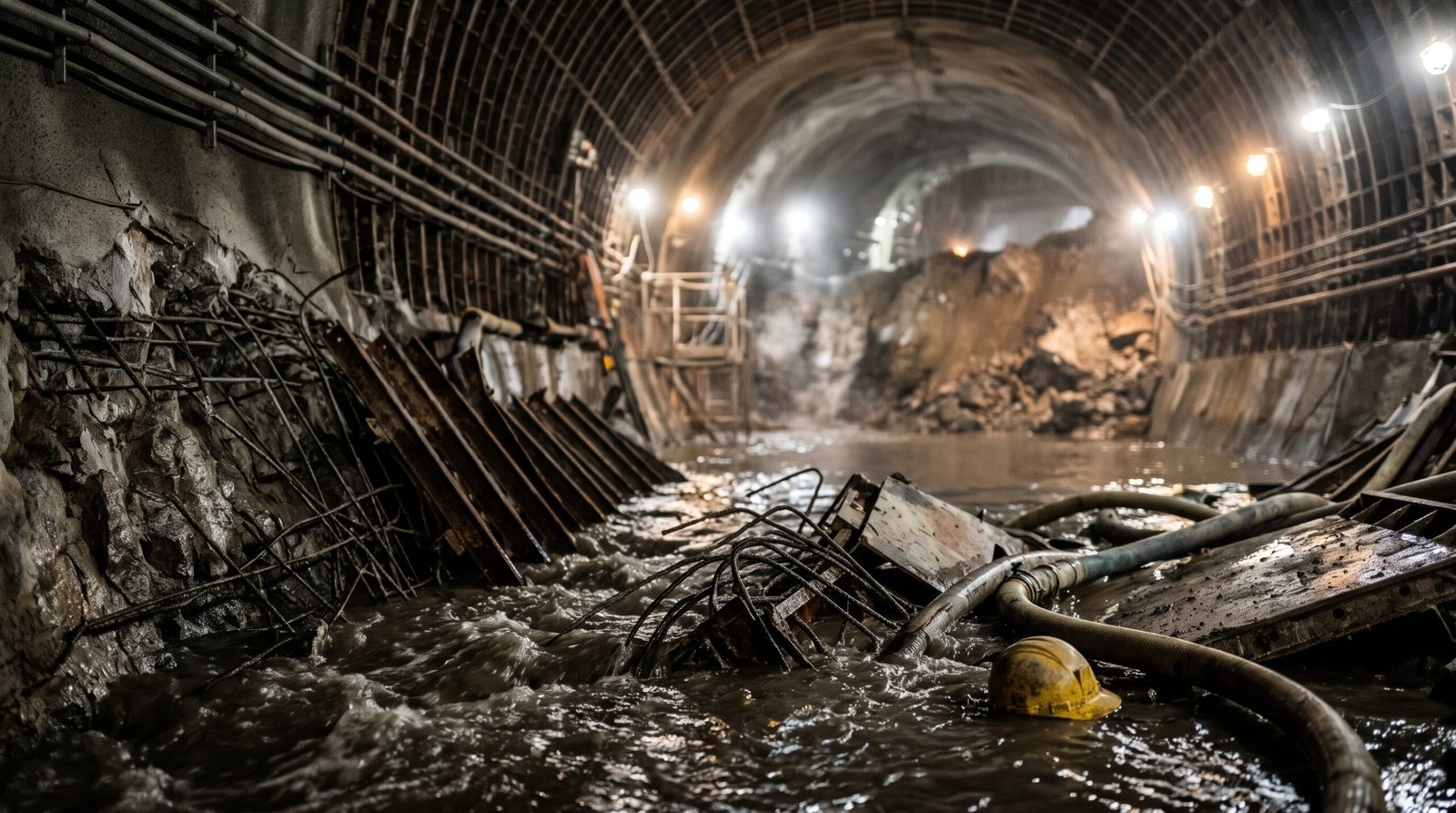
Pakistan’s elite answers to no one, and the engineering profession has paid for it. A profession that once built Tarbela and Mangla now watches its own regulator sit in the dock of a conflict of interest and says nothing. A tunnel flooded on 9 November 2026. Workers ran for their lives, and one was swept away and rescued. The cofferdam had already failed in August 2025. A project priced at Rs82.36 billion now costs Rs316.41 billion, and no one has been held to account. The Pakistan Engineering Council (PEC), the body meant to guard the honour of the profession, is led by a man the Auditor-General has recorded as co-owner of the supervising consultant, MM Pakistan. Our own country’s ethics code stands over this wreckage like an epitaph for a profession that no longer enforces it.
I write this for historians and for the engineers who work in hydropower, who will understand better than anyone what has been lost. Let me be exact about what is known and what is my judgement. No court, tribunal or inquiry has found MM Pakistan or Mott MacDonald negligent. The cause of the 9 November incident is undetermined: WAPDA says weak rock collapsed, while the Haripur district says a protective bund was breached. What I offer is an argument from the record, and it is mine.
A three-member inquiry found that a flood did not cause the August 2025 collapse of the downstream cofferdam. The contractor proposed replacing the approved roller-compacted design with a rock-filled structure that the contract did not allow. The consultant accepted it conditionally. WAPDA approved it late. Three parties touched the decision, and each is part of the story. The consequences are on the public ledger. Cost rose by 284 per cent. Completion slid from January 2021 to June 2028. Expected annual energy has fallen to about 1.347 billion units, against 1,810 GWh originally, a loss of roughly a quarter. The World Bank loan closes on 30 September 2027, nine months before the revised completion date. In a country that spends its summers in load-shedding and its winters in debt, these are not abstractions.
Responsibility here is shared. The contractor originated the unapproved change, and WAPDA authorised it. I do not deny either. But in a mega-project there is one party whose job is to be the independent check on temporary works, and that is the supervising consultant. Its duty was to say no. The contractor’s proposal reached WAPDA’s desk because the check that should have stopped it did not hold.
It is often said that the Engineer under the FIDIC conditions is only a supervisor. The contract says otherwise. The Employer, often through the consultant, supplies the design, and the Engineer issues supplementary drawings and instructions, clarifies ambiguities and reviews the Contractor’s temporary works. The Engineer instructs or approves every variation and must weigh its cost and time impact (Clause 13), measures and values the work executed (Clause 12), certifies each payment and deducts for defective work or unapproved extras (Clause 14), and judges the Contractor’s claims for money and time impartially (Clause 20). On quality, the Engineer may inspect at all times, reject defective materials and workmanship and order them redone at the Contractor’s cost (Clause 7), suspend the works when safety or quality is compromised (Clause 8), and withhold the Taking-Over and Performance Certificates (Clauses 10 and 11). A rock-filled cofferdam the contract did not allow was exactly the kind of change that had to pass through this gate. That is why I place the heaviest professional responsibility on the Engineer. The Contractor who proposed the change and WAPDA which approved it remain answerable for their own acts. The actual agreement, with its liability cap and notice clauses, must still be obtained.
The Auditor-General has recorded concerns on the Rs3,269.7 million direct award to MM Pakistan, the lowering of the key-expert criteria, and the conflict of interest of the PEC Chairman as co-owner. These are audit observations, not findings of causation. Yet WAPDA’s own Project Director told the CDWP meeting of 21 May 2026 that the previous consultant failed to provide a qualified Project Manager, made key appointments without client consent, placed unqualified staff in leadership roles, and withdrew its staff on 17 May 2024 without the 30 days’ notice the contract required. WAPDA is preparing claims against MML-UK and considering international arbitration. Those are the statements of an interested party, and the consultant is not recorded as having answered them. But when the employer itself is drafting claims against the consultant while the same consultant’s local partner supplied over 80 per cent of site supervision staff, one expects the profession’s regulator to ask questions. It has asked none.
The Chairman of the PEC is also a co-owner of MM Pakistan, the consultant on this project of national importance. That single fact explains the silence. The PEC Ethics Policy 2025 is plain. Engineers must act with integrity and honesty. All engineers and firms must be accountable for their actions, decisions and their impact on society, the environment and stakeholders. They must maintain competence through continuous learning and perform their duties diligently. They must act impartially and avoid conflicts of interest, whatever their personal preferences or affiliations. By virtue of his post, the Chairman holds the very power that enforces these rules, and he is bound by them like every other engineer. Yet the way the PEC has been run shows that he treats himself as exempt. He stands like an absolute monarch, inviolable and beyond the reach of any court, answerable to no one. No statute grants the Chairman such immunity, and I do not claim that one exists. I describe the effect: a regulator cannot investigate itself, and a Chairman cannot be judge in his own firm’s case. Whatever his intentions, every body that might ask the question either answers to him or depends on him. That is what “untouchable” means. It does not require a conspiracy, only a system in which no door leads to an investigator who is free to open it. When a site engineer errs, the profession’s machinery moves swiftly. When the supervising firm of a Rs316 billion project errs, the machinery is silent, because the machinery is owned by the same circle.
Silence has a price beyond money. Hydropower engineers learn from failure. The Hoover Dam builders left a record of unstable rock, cofferdam overtopping, cavitation and dust that still instructs us. If Tarbela 5 is allowed to dissolve into unpublished reports and sealed minutes, the next generation inherits the loss without the lesson. The July 2025 inquiry report, the Ministry of Water Resources inquiry report and the Departmental Accounts Committee minutes on the replacement consultancy must be published. The consultant’s written conditional acceptance of the cofferdam change must be produced. The 9 November incident needs an independent root-cause review that names the firm that was supervising that day. And a notice of claim should be issued before any time bar runs.
Historians will one day ask who knew, and who said so. The honest answer will have to include those of us who watched and wrote nothing. This OPED is my small refusal to join that silence.
Disclaimer: The views and opinions expressed in this article are solely those of the author(s) and do not necessarily reflect the editorial position, values or beliefs of The Scoop or its management.
The Scoop firmly believes in freedom of speech, intellectual diversity and the open exchange of ideas. As an independent media platform, we remain committed to providing space for differing perspectives, including those that may challenge or contradict our own views.
Publication does not constitute endorsement. Our commitment to freedom of expression and independent journalism extends beyond opinions with which we agree.