

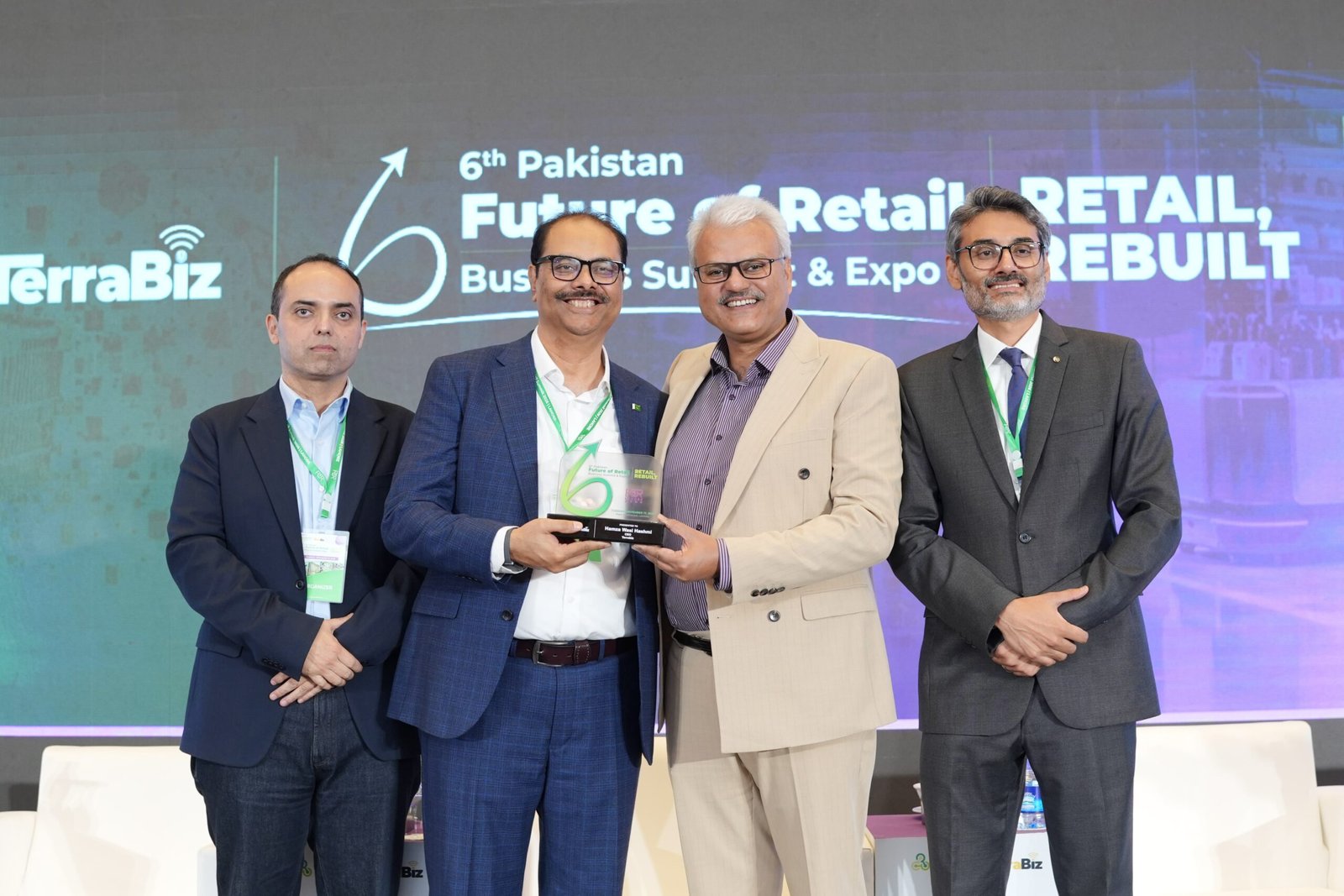
LAHORE, November 17, 2026: As Pakistan’s retail industry navigates rising consumer prices, rapidly expanding digital payments and changing shopping habits, TerraBiz Founder and Chief Executive Officer Hamza Wasi Hashmi has delivered a message to the country’s leading retailers: competitive pricing alone cannot guarantee customer loyalty.
Addressing the opening session of the 6th Pakistan Future of Retail Business Summit & Expo 2026 at the Pearl-Continental Hotel in Lahore on Tuesday, Hashmi placed consumer trust, customer experience and collaboration at the centre of the industry’s future.
The summit, themed Retail, Rebuilt, was jointly organised by TerraBiz and the Chainstore Association of Pakistan (CAP), bringing together retail executives, manufacturers, technology companies, financial institutions, policymakers and business leaders.
The Scoop participated as the event’s Official Media Partner.
Beyond Discounts: Why Customer Experience Matters More Than Ever
Departing from conventional discussions about retail expansion, taxation and technology, Hashmi approached the challenges confronting the industry from the perspective of an ordinary Pakistani consumer.
“I am an organiser, but I am also a shopper, a husband and a father,” he told delegates.
“Like the families in our team, my family feels rising prices too. We make choices about what to buy, where to eat, and which purchases can wait.”
His remarks reflected an important reality for Pakistan’s retail businesses: consumers are increasingly selective about discretionary spending, while expectations surrounding service, product quality and convenience remain significant.
According to the Pakistan Bureau of Statistics, consumer price inflation stood at 9.6 per cent year-on-year in October 2026, compared with 10.3 per cent in September.
Although the annual inflation rate moderated, prices continued to rise, sustaining pressure on household budgets.
For retailers, this creates a difficult balancing act. Businesses must remain price-competitive while maintaining service standards, operational efficiency and profitability.
However, Hashmi suggested that retailers risk overlooking one of the most important determinants of repeat business.
“When a store handles an exchange kindly, or gives a refund without making us fight for it, our trust grows. I may forget the discount. I remember how I was treated,” he said.
The observation highlighted a fundamental challenge for organised retail: attracting customers through promotional campaigns is one thing, but retaining them through consistent service is another.
For Pakistani brands seeking sustainable growth, transparent return policies, responsive customer support and reliable after-sales services are increasingly important elements of long-term competitiveness.
E-Commerce Growth Brings New Responsibilities
Hashmi also drew attention to the growing complexity of online shopping, particularly when customers encounter problems with deliveries, product quality or returns.
“When an online order goes wrong, the conversation certainly continues at home! Was it the seller, the delivery, or the returns policy? To the customer, it is one experience—and one promise,” he remarked.
His observations were particularly relevant as Pakistan’s digital payment infrastructure continues to expand.
According to the State Bank of Pakistan’s Annual Payment Systems Review for FY2025-26, formal banking channels processed approximately 14.3 billion retail payment transactions worth Rs673 trillion during the financial year.
Of these, approximately 13.2 billion transactions were conducted through digital channels, representing 92 per cent of the total transaction volume recorded through formal banking channels.
The figures demonstrate the rapid expansion of digital financial activity, although they should not be interpreted as indicating that 92 per cent of retail shopping itself takes place digitally.
The growing availability of online payments, mobile banking, digital wallets and electronic transaction systems is creating new opportunities for retailers.
However, the expansion also increases expectations concerning payment security, delivery reliability, refund processing and customer communication.
For consumers, the distinctions between retailers, payment providers, logistics companies and online marketplaces often disappear when a transaction fails.
A delayed refund, incorrect delivery or unresolved complaint can damage confidence in an entire brand, irrespective of which service provider was responsible.
Hashmi’s remarks therefore pointed towards an increasingly important requirement: retail businesses must manage the complete customer journey rather than treating individual transactions as isolated commercial activities.
Manufacturing and Retail: A Partnership Pakistan Cannot Afford to Ignore
Another important element of Hashmi’s address was the growing relationship between Pakistan’s textile manufacturers and organised retail businesses.
He particularly welcomed the establishment of the All Pakistan Textile Mills Association’s Fiber to Fashion Pavilion at the summit.
“The APTMA Fiber to Fashion Pavilion is a particularly welcome step,” Hashmi said, highlighting the role of Asad Shafi across APTMA and CAP in bringing manufacturers and retail brands closer together.
He expressed hope that relationships established during the event would develop into lasting commercial partnerships.
The initiative comes amid efforts by APTMA and CAP to strengthen domestic manufacturing-to-retail linkages, reduce dependence on imported merchandise and help Pakistani fashion brands access international markets.
In October 2026, the two associations initiated a manufacturing-retail collaboration aimed at connecting established textile producers directly with domestic fashion brands.
The initiative sought to address challenges involving product development, quality, technology, pricing and supply reliability.
For Pakistan’s economy, closer coordination between manufacturers and retailers could potentially unlock opportunities extending beyond domestic sales.
These include greater local value addition, improved product development, more efficient supply chains and the international expansion of Pakistani brands.
However, achieving these objectives will require sustained commercial engagement, investment and competitiveness rather than relying solely on networking events.
Retail Innovation Expo: Turning Ideas Into Business Opportunities
Hashmi urged delegates to actively engage with exhibitors participating in the Retail Innovation Expo, describing the exhibition as an opportunity for businesses to identify practical solutions.
“Meet the exhibitors, ask questions and explore what their solutions could do for your business,” he said.
The exhibition brought together businesses operating across retail technology, digital payments, e-commerce, logistics, supply chains and related services.
The summit’s wider agenda covered several challenges facing the retail ecosystem, including consumer protection, regulatory issues, technological adoption, retail infrastructure and manufacturing collaboration.
Such discussions are increasingly relevant as businesses seek to improve inventory management, delivery performance, customer engagement and operating efficiency.
For smaller retailers in particular, access to affordable technology and efficient financial services could determine their ability to compete with larger organised retail networks.
Six Editions, Two Cities and a Growing Retail Platform
Reflecting on the conference’s development, Hashmi noted that the Future of Retail initiative had reached its sixth edition, with three events previously held in Karachi and three in Lahore.
“When TerraBiz and the Chainstore Association of Pakistan created this platform together, the idea was simple: bring the people shaping retail into one room, and give them a reason to keep talking and working together,” he explained.
He said one of the most encouraging aspects of the summit was the participation of longstanding supporters alongside new delegates.
Hashmi acknowledged the contributions of CAP leadership, industry representatives and partners who had supported the initiative.
He also welcomed participants travelling from Karachi, Islamabad, other Pakistani cities and overseas.
Among the dignitaries acknowledged during his opening remarks were Rana Ihsaan Afzal Khan, Coordinator to the Prime Minister on Commerce, and guests of honour Khurram Schehzad and Sardar Yasir Ilyas Khan.
The conference also featured the CAP Impact Awards, designed to recognise contributions across retail destinations, logistics and e-commerce.
These segments reflect the widening definition of retail in Pakistan, where traditional stores, shopping centres, online marketplaces, delivery networks and payment platforms increasingly form an interconnected commercial ecosystem.
The Real Test Begins After the Conference
While the event brought industry leaders together to discuss investment, innovation and sectoral development, Hashmi’s remarks suggested that the industry’s future must ultimately be measured by improvements experienced by consumers.
Retailers face a range of difficult questions.
Can Pakistani brands improve service quality without substantially increasing their costs? Can manufacturers and retailers collaborate to deliver internationally competitive products? Can digital commerce providers make refunds and deliveries more reliable? And can the industry translate technological innovation into better customer experiences?
These questions remain especially important in a market where affordability, trust and convenience increasingly influence purchasing decisions.
For Pakistan’s retail industry, the challenge is no longer simply about establishing more stores or attracting customers through discounts.
It is about building businesses capable of consistently delivering on their promises.
Hashmi concluded his address by expressing the hope that every participant would leave the conference with a practical outcome.
“My hope is that everyone leaves with one useful idea, one valuable connection, and one thing they will do differently.”
That message effectively captured the summit’s broader ambition: moving beyond industry discussion towards cooperation and measurable improvements in the way Pakistan shops.