
LAHORE, November 17, 2026: Pakistan’s retail industry could be approaching a significant transformation in consumer spending patterns as global technology company Yango accelerates its entry into instalment-based shopping, with early results suggesting that customers using its Pay Later service are spending substantially more than conventional shoppers.
Presenting its strategy at the 6th Pakistan Future of Retail Business Summit & Expo 2026, held in Lahore under the theme Retail Rebuilt, Yango Fintech revealed that more than 200 retail stores were in the pipeline to adopt its payment solution, with capacity for at least another 50 store launches in Punjab and Sindh before the end of 2026.
The Scoop was the Official Media Partner of the conference.
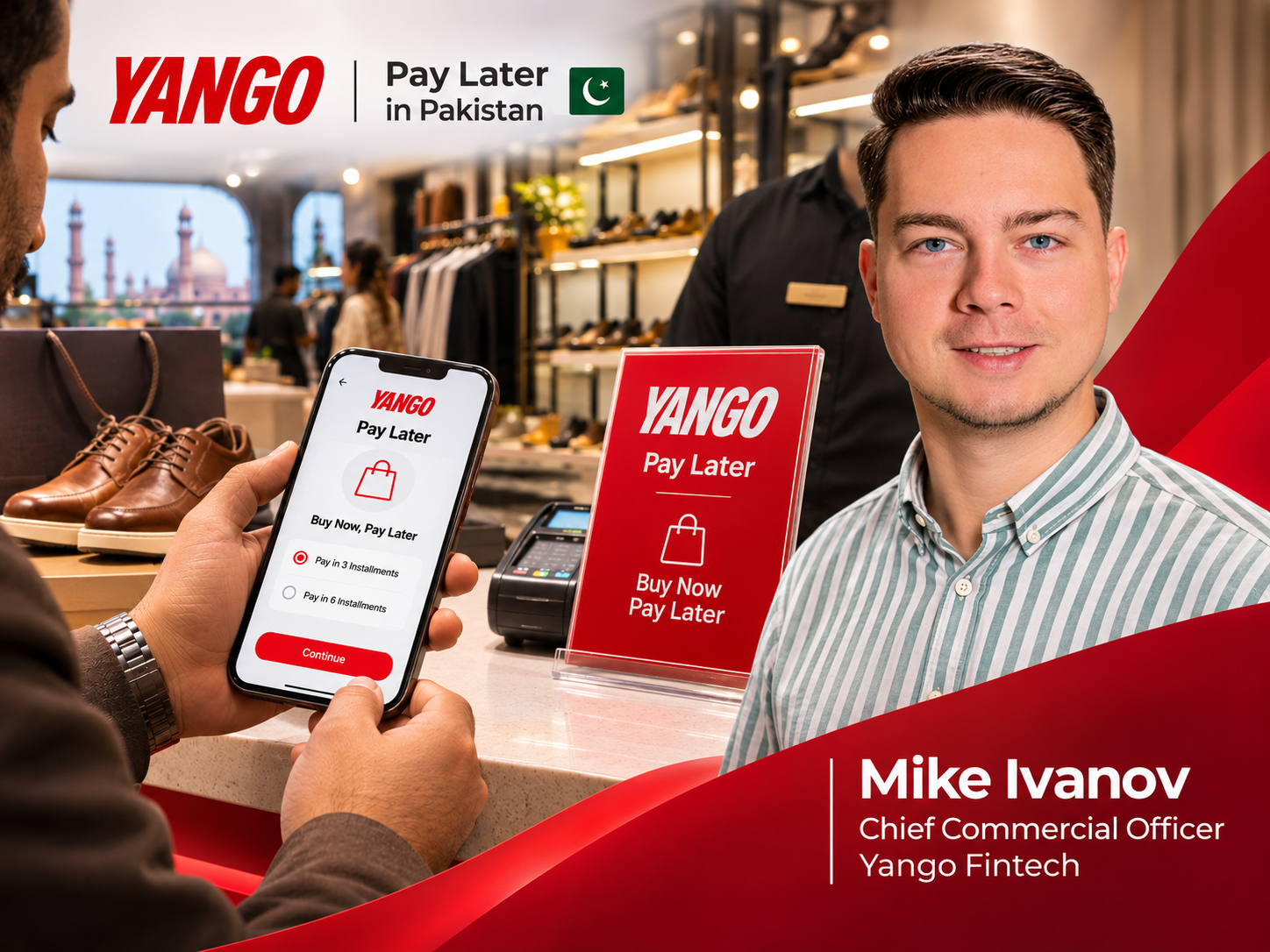
The presentation, titled Connected Retail — How Pay Later Is Changing the Purchase Decision, was delivered by Mike Ivanov, Chief Commercial Officer of Yango Fintech, alongside Muhammad Faisal Mahmood, Head of Retail at Urban Sole.
It offered an unusually detailed glimpse into the commercial impact of Buy Now, Pay Later (BNPL) services in Pakistan, including figures showing purchases worth up to five times those of conventional transactions at participating retailers.
Yango reported an 86 per cent approval rate for its Pay Later product, a 27 per cent increase in average transaction values and an 11.5 per cent incremental business uplift for a retailer operating both physical and online stores after three months.
These figures, presented by the company, suggest that instalment-based shopping could become an increasingly important tool for Pakistan’s retailers, particularly as inflation, limited disposable income and low credit-card penetration continue to influence purchasing decisions.
However, the figures remain company-reported performance indicators, and the presentation did not provide sufficient information about sample sizes, transaction volumes or calculation methodologies to independently verify the claimed improvements.
Pakistan’s $82 Billion Retail Opportunity
One of the presentation’s central arguments was that Pakistan’s retail market remains overwhelmingly dependent on physical shopping despite the expanding digital economy.
According to estimates presented by Yango, annual spending on retail goods in Pakistan stands at approximately $82 billion, of which nearly $77 billion, or 94 per cent, takes place through physical stores.
Online retail spending, by comparison, accounts for approximately $5 billion, representing only 6 per cent of the estimated market.
The $82 billion figure was presented as a company estimate rather than an officially verified measure of Pakistan’s retail economy.
Nevertheless, the underlying argument is significant: the future of digital commerce in Pakistan may depend less on replacing traditional shops and more on connecting physical retail with digital discovery, payments and consumer financing.
Independent research broadly supports the scale of the opportunity. Payments and Commerce Market Intelligence (PCMI) estimated Pakistan’s retail e-commerce market at $5.4 billion in 2024, within a wider e-commerce market worth $7.7 billion.
Yango’s presentation maintained that cash on delivery still accounted for more than 90 per cent of online orders. PCMI’s separate 2024 research estimated cash-on-delivery payments at 75 per cent of e-commerce transaction volume, indicating that the precise share depends on the period and methodology.
These figures highlight why companies offering alternative payment arrangements see considerable room for expansion.
Rather than forcing customers to choose between online and offline shopping, Yango is attempting to connect both channels through a single instalment-based purchasing system.
From Ride-Hailing to Retail Financing
Yango entered Pakistan in 2023 through ride-hailing and subsequently expanded its local ecosystem through delivery, cargo, advertising and business services.
Its Pay Later service, introduced in September 2026, marked the company’s formal entry into Pakistan’s fintech market.
The product initially operated through selected online merchants, allowing consumers to divide eligible purchases into equal payments made every two weeks.
The company subsequently expanded the concept to include payments at physical stores, placing instalment financing directly at the retail counter.
At the Lahore conference, Yango outlined three interconnected channels through which customers can access the service.
The first is Online Pay Later, which enables customers to select instalment payments during checkout on participating merchant websites.
The second is App Shop Pay Later, which connects products from participating merchants with customers browsing the Yango application.
The third is Offline Pay Later, allowing customers to purchase products through instalments at physical retail outlets.
This integrated approach is designed to bridge the distance between a customer’s initial discovery of a product and the eventual purchase.
A customer may discover shoes, clothing or cosmetics through the Yango app before visiting a participating shop to complete the transaction.
Conversely, a customer already standing inside a retail outlet may decide to make a larger purchase after being offered the option to spread payments over time.
The company describes the system as Sharia-compliant and says its offline offering enables instalment purchases without a mark-up.
At its September launch, Yango stated that the product’s structure and operating principles had been reviewed by Dr Muhammad Imran Ashraf Usmani of Usmani & Co. Shariah Advisors.
Also Read: The Invisible Ledger: What Power Costs The Farmer
Yango Claims Access to Five Million Shoppers
A major selling point for participating retailers is Yango’s existing customer network.
The presentation reported that the Yango application has more than five million monthly active users, creating a potential audience for merchants whose products are integrated into its shopping platform.
The company also reported approximately 1.42 million average weekly viewers for its shopping experience.
According to the presentation, Pay Later transactions represented 46 per cent of sales compared with 54 per cent for cash-on-delivery transactions within the sales mix being reported.
The figures were not accompanied by a detailed breakdown of the measurement period or the participating merchant base.
Yango’s strategy extends beyond payment processing.
Retailers can place their products in the application’s shopping environment and potentially reach consumers through in-app promotional formats, product feeds and targeted visibility.
This effectively combines elements of a digital marketplace, an advertising platform and a consumer financing service.
For conventional retailers, the attraction is straightforward: access to additional potential customers without abandoning their existing stores.
For Yango, the opportunity is to convert an established audience for mobility and other digital services into an audience for retail purchases.
Urban Sole: Instalment Shoppers Spend Up to Three Times More
Among the strongest evidence presented for the model’s commercial potential was the experience of Pakistani footwear retailer Urban Sole.
According to performance figures shared at the conference, Urban Sole’s Pay Later transactions produced average purchase values between 1.9 and three times higher than regular retail purchases.
The company also reported approximately 145 Pay Later sales per store per month.
Importantly, the presentation disclosed that this monthly figure was an approximation derived from two weeks of performance, meaning it should not be interpreted as a fully observed monthly sales total.
More than half of Urban Sole’s Pay Later sales exceeded Rs10,000, while over 90 per cent of customers using the product reportedly made their initial instalment payment at the store counter.
For retailers, the results suggest that the availability of instalments may alter not merely how customers pay, but how much they are willing to purchase.
Muhammad Faisal Mahmood, Head of Retail at Urban Sole, directly linked this shift to changing customer behaviour.
“Pay Later has changed how our customers decide on a purchase: they learn about our offers online in Yango and come to the store planning to spend more with Pay Later,” Mahmood said in the presentation.
His observation points towards a broader change in Pakistan’s retail landscape.
Traditionally, a customer visiting a footwear outlet might decide what to purchase based on the cash or available balance immediately at their disposal.
Under an instalment model, the same customer may evaluate the purchase based on the size and timing of individual payments.
That can increase purchasing flexibility, but it also raises important questions about affordability and the risk of encouraging consumers to take on commitments beyond their means.
Makeupcity Reports Nearly Fivefold Purchase Values
The second major case study involved beauty and cosmetics retailer Makeupcity.
Its reported results were even more striking.
According to the presentation, the average transaction value of purchases made through Pay Later was 3.7 to five times that of conventional purchases.
Makeupcity also reported a 9 per cent contribution from additional Pay Later retail sales per month.
The company disclosed that the presence of Yango’s in-store ambassadors had helped generate an 80 per cent increase in Pay Later sales, while the approval rate for customers applying to use the facility reached 92 per cent.
Khalid Khan, Head of Retail at Makeupcity, acknowledged that the retailer initially did not expect its customer base to respond so strongly to instalment-based purchases.
“At first we did not expect our customer segment to avail installment purchase,” Khan said in the presentation.
He added that the company now believed Pay Later purchases appealed both to existing customer segments and to new shoppers introduced through Yango.
The Makeupcity experience is particularly relevant because beauty and cosmetics products are not traditionally associated with high-value consumer financing in the same way as household appliances, electronics or automobiles.
If consumers increasingly adopt instalment plans for relatively routine retail purchases, BNPL providers could expand into a much wider range of consumer categories.
However, the presentation did not disclose the underlying average purchase amounts, the complete observation period or the number of transactions supporting Makeupcity’s reported increases.
Consequently, the results cannot yet establish whether the higher spending patterns will remain consistent as the service expands.
A New Model for Retail Growth
Yango’s broader presentation suggested that the advantages of instalment financing extend beyond the two participating retailers.
Its aggregated performance indicators included an 86 per cent approval rate and a 27 per cent increase in average purchase values for Pay Later transactions compared with regular retail and cash-on-delivery orders.
The company also claimed an average 11.5 per cent incremental business uplift after three months for a brand combining physical and online retail.
Another notable feature is its effort to make the product accessible beyond conventional credit-card users.
According to Yango, customers can use cash, debit cards and digital wallets to make their first instalment payment.
This matters in Pakistan, where access to credit cards is limited compared with the wider population using bank accounts, mobile wallets and other payment services.
Yango also reported that more than half of instalments were paid off within seven days, although the presentation did not clarify whether the figure referred to individual instalments or the full repayment of outstanding purchases.
The company said it was developing its own decision-making models and could accommodate both existing Yango users and customers who had not previously used its services.
The model therefore represents more than a new checkout option. It could become an alternative channel through which retailers assess demand, reach customers and influence purchasing behaviour.
Digital Payments Are Expanding Rapidly
Yango’s expansion comes amid broader changes in Pakistan’s payment infrastructure.
According to the State Bank of Pakistan’s Annual Report on Payment Systems for FY2025-26, transactions conducted through formal banking channels reached 14.3 billion, with a total value of approximately Rs673 trillion.
Digital channels accounted for 13.2 billion of those transactions, representing 92 per cent of the volume processed through formal banking channels.
The figure marked a substantial increase from the 88 per cent digital share recorded in FY2024-25.
The central bank also reported that point-of-sale infrastructure had expanded to 337,791 terminals across 295,367 merchant locations.
However, these statistics cover payments conducted through the formal financial system and should not be confused with the digital share of all purchases made across Pakistan’s retail economy.
Cash transactions taking place outside the banking system are not fully captured in those figures.
Nevertheless, the growth of digital financial infrastructure creates favourable conditions for retail platforms seeking to combine conventional shopping with electronic payment and financing arrangements.
Regulatory Questions and Consumer Protection
The increasing popularity of BNPL products also presents important challenges for regulators, retailers and financial service providers.
Unlike conventional cash transactions, instalment-based purchases involve commitments that may extend beyond the date of sale.
This raises questions about credit assessment, repayment obligations, customer data protection, dispute resolution and the consequences of missed payments.
In November 2025, the Securities and Exchange Commission of Pakistan introduced amendments to its non-banking finance company regulations that expressly addressed BNPL arrangements.
The regulator also strengthened requirements aimed at improving the transparency of borrowing terms and financial obligations.
Competition in the sector has intensified.
In April 2026, the SECP announced that it had granted a BNPL business licence to KOKO TECH Pakistan (Private) Limited, a company ultimately owned by Alibaba.com Holdings.
Yango’s presentation did not identify the precise regulated entity or contractual arrangement supporting its financing operations, nor did it provide detailed information about underwriting, overdue payments, customer defaults or merchant charges.
These omissions do not establish any regulatory deficiency, but they represent important areas for further disclosure as instalment-based shopping becomes more widespread.
Similarly, the company’s reported increases in sales and average purchase values must ultimately be measured against repayment performance, merchant costs and customer affordability.
A sustainable BNPL market will require growth in retail activity without encouraging excessive consumer indebtedness.
More Than 200 Stores Preparing to Join
Yango’s ambitions extend beyond its existing retail partnerships.
The company disclosed that more than 200 stores were already in line to go live with its Pay Later solution.
It also indicated that more than 50 additional store launch opportunities remained available for 2026, particularly in Punjab and Sindh.
The presentation displayed a portfolio of participating retail brands covering fashion, footwear, cosmetics, lifestyle and home products.
These included Urban Sole, Makeupcity, Sana Safinaz, EGO, Habitt, Bagallery, Allure Beauty, Rollover, Alkaram and others.
The inclusion of established retail businesses is important because their physical store networks could help normalise instalment financing among customers who might otherwise be reluctant to use financial technology products exclusively online.
Yango’s earlier expansion strategy also included a target of partnering with more than 100 online retailers by the end of 2026.
The online merchant target and the 200-plus physical stores awaiting activation represent different measures of the company’s intended reach and should not be treated as interchangeable.
Its presentation also emphasised a phased regional approach, with store ambassadors deployed to assist customers and monitor performance at individual retail locations.
Such arrangements could play a particularly important role in a market where consumer understanding of instalment financing remains uneven.
Is Pakistan Entering a New Era of Consumer Spending?
The larger significance of Yango’s presentation lies in the relationship between technology, consumer financing and purchasing behaviour.
Pakistan’s retailers have traditionally competed through product quality, brand recognition, store locations, pricing and promotional discounts.
Alternative financing could introduce another increasingly influential factor: the ability to make a purchase affordable through smaller scheduled payments.
The reported experiences of Urban Sole and Makeupcity suggest that the availability of instalments can affect customers’ decisions before they reach the checkout counter.
For brands, the potential benefits include higher transaction values, improved conversion rates, access to new customers and stronger integration between online marketing and physical sales.
For consumers, the attraction is greater payment flexibility, especially when purchasing higher-value products.
But higher spending does not automatically represent greater financial wellbeing.
The long-term effectiveness of the model will depend on transparent pricing, appropriate credit assessment, manageable repayments and whether the additional sales generate sustainable profits for retailers.
It will also depend on whether Yango’s early performance figures can be replicated across a larger network of merchants and over longer reporting periods.
The shift towards connected retail is already evident in Pakistan’s payment infrastructure, expanding e-commerce ecosystem and growing use of mobile applications.
What remains uncertain is how quickly instalment-based shopping will develop from a relatively specialised offering into a mainstream retail payment method.
Yango’s presentation at Future of Retail 2026 suggests that the company intends to be a major participant in that transition.
For Pakistan’s retail industry, the question is no longer simply whether customers prefer shopping online or in physical stores. Increasingly, the question is how access to flexible payment options will influence what they purchase, how much they spend and which retailers ultimately capture that spending.