

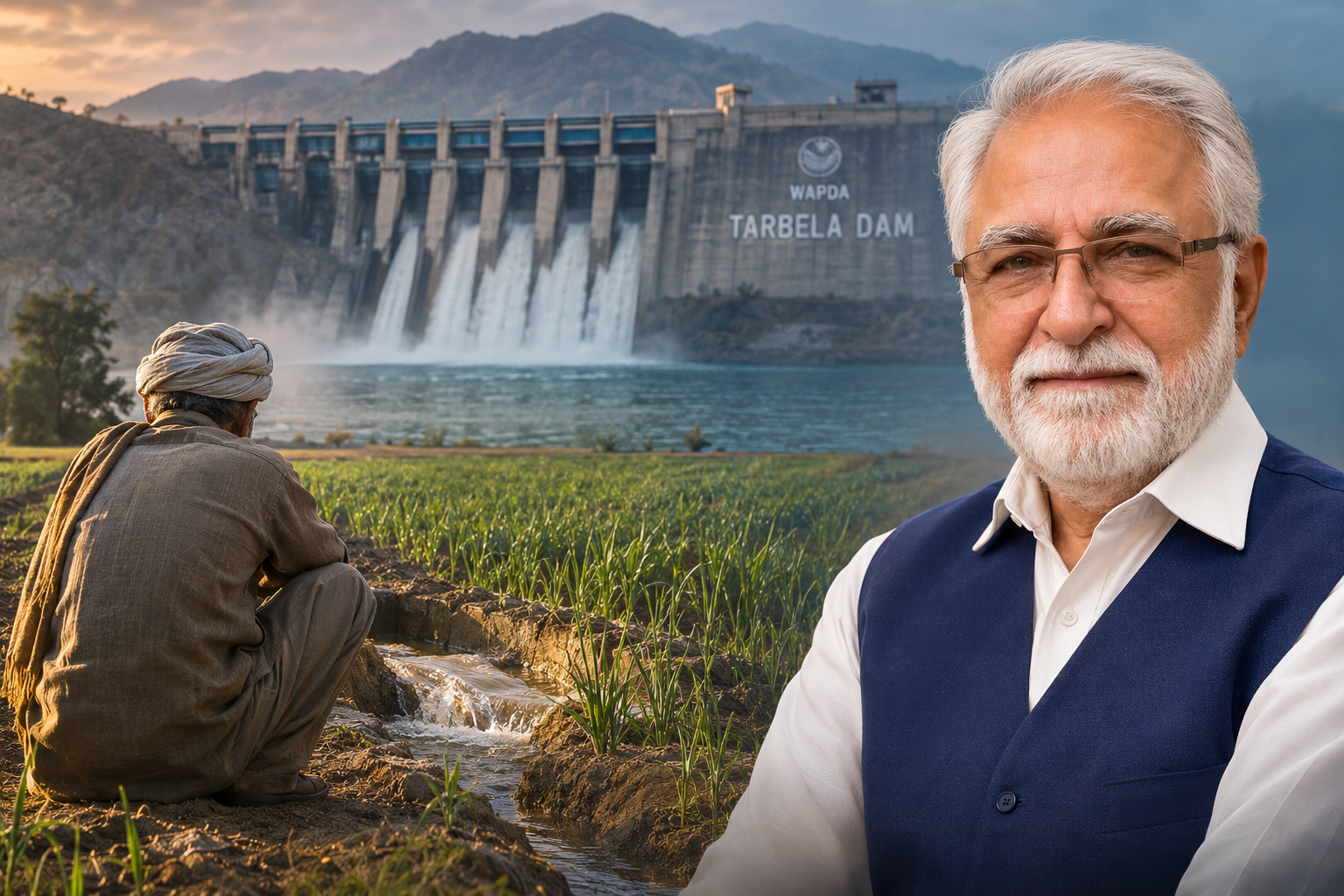
On the Rohri Canal, off Sukkur Barrage, a farmer does not follow the engineering news from Tarbela. He watches his water. His outlet serves a hundred and twenty acres; his turn comes once a week, if it comes. He is sowing wheat against a closing window, and what happens at a construction site far upstream will help decide what he harvests in April.
On November 9, water broke into the construction works of Tarbela’s Fifth Extension Hydropower Project for the second time in fifteen months. WAPDA blamed collapsing weak rock. The investigation will establish what failed underground. It will not ask what failed above it: a project so far behind schedule that its construction site dictates how the country’s largest reservoir operates.
Provincial indents that day stood at 55,000 cusecs. The next day Tarbela’s mean release was 118,400, and on November 11 releases remained at 77,600 against an indent of 45,000. In two days the reservoir fell six and a half feet, and the system spent roughly 190,000 acre-feet above what the provinces had asked for. Emergency measures may have been necessary; nor was the surge simply wasted: Chashma’s storage rose by 209,000 acre-feet between November 10 and 12. But downstream gain is not April water. None of it can be called back to Tarbela, the reservoir that could have held it for April, when wheat fills its grain. In a year when a 22 per cent shortage has already been announced, Tarbela’s storage was spent on a construction schedule.
It was the latest turn of a pattern. June 2023: releases ran below provincial indents. March 2024: WAPDA asked that Tarbela be held at 1,420 feet so Tunnel 3’s trash racks could be replaced; Sindh answered that it needed maximum releases, not storage. Two months later the opposite: a capped reservoir forced releases above indent while the early Kharif opened under a 30 per cent shortage estimate. June 2025: the Indus ran almost a third above its ten-year average, yet a demand for 195,000 cusecs was met with 150,000, the low-level outlet untested, out of service since 2022. Too little when the crop asks, too much when it does not. When the powerhouse and the crop compete, the reservoir is scheduled for the powerhouse.
This is not an engineering accident. It is a reversal of priorities.
Tarbela was built first to serve irrigation; the 1960 Treaty works replaced the river water Pakistan surrendered, electricity the companion. Paragraph 14(c) of the 1991 Water Apportionment Accord settled the priority: “The existing reservoirs would be operated with priority for the irrigation uses of the Provinces.” The clause is the governing principle, and it cannot stop at the water’s edge: the works that deliver irrigation must be planned around the crop, not the crop around the works. Tarbela is not a power station with a reservoir attached; its live storage has shrunk from 9.68 million acre-feet to 5.58 as sediment advances. Punjab draws on Mangla as well; Sindh’s canals have no second reservoir behind them. When Tarbela is run for a construction schedule, it is Sindh’s wheat that stands most exposed.
The appraisal understood the obligation. WAPDA’s 2016 assessment assumed Tunnel 5 would close for 20 months, affecting one high-flow season; ECNEC approved on condition that IRSA certify irrigation would not suffer. The closure approved in 2022 ran 33 months. When it expired in June 2025 the works were unfinished; IRSA refused extensions, fearing irreparable damage to irrigation. The works continue.
Also Read: State Bank Of Pakistan Forecasts GDP Growth Up To 4.5% For Fiscal Year 2027
The record since tells one story in three seasons. In October 2025, WAPDA asked IRSA to draw down 2.8 million acre-feet, almost half of what Tarbela had left, within a month for the tunnel works. IRSA unanimously refused. In April, Sindh’s irrigation minister protested in writing that the tunnel projects had capped Tarbela’s outflows at 150,000 cusecs at peak sowing. That same month IRSA accepted what it could not refuse: Tarbela held low through the filling season. By July the provinces asked for 170,000 cusecs and got 152,400; Sindh went short by 22,000, Punjab by 22,500, and IRSA spent half a million acre-feet of Mangla’s storage in the very weeks Mangla was meant to be filling. Somewhere below Sukkur, a farmer’s turn did not come.
The costs that make headlines carry invoices. The approved cost of the Fifth Extension has climbed from Rs82.36 billion in December 2016 to Rs316.4 billion this August; an inquiry into last year’s cofferdam collapse held WAPDA, the contractor and the consultant collectively responsible. Contractors claim, consultants bill, lenders book the interest; every rupee will be examined and paid. This column is about the costs that appear on no bill.
Ask that farmer what unreliable water costs. When his turn fails, he pumps groundwater if it is sweet, buys from a neighbour, or waits and risks the crop. In much of Sindh the water below is saline; waiting is the only option. A smaller crop means less to repay the arhti and less for next season’s seed. Tubewell-only irrigation has risen from 18 per cent of the country’s watered land in 2010 to 31 per cent in 2024. Farmers with capital buy their way out of the public system’s failures; smallholders, tenants and farmers at the tails of canals cannot. Public unreliability becomes a private production expense. He does not want charity. He wants his water, on time.
The loss does not stop at the farm gate. Wheat supplies close to two fifths of the country’s calories. The federation’s target for this Rabi is 33 million tonnes; the latest harvest of 29.61 million tonnes ran 2.2 million below the 2023-24 record. The government has approved importing up to a million tonnes; the USDA’s Foreign Agricultural Service warns one and a half million may be needed. In 2023-24, itself a record-harvest year, the country spent $1.032 billion importing 3.6 million tonnes of wheat. That bill had many causes; it measures scale, not blame. Every tonne a farmer cannot grow for want of timely water becomes a tonne the state buys abroad with borrowed dollars.
Punjab’s advisory prices every day’s delay past November 20 at 15 to 20 kilograms per acre. A missed irrigation at crown-root initiation cannot be repaid later. Each week of delay pushes the crop into April’s heat, which Pakistani research prices at 4 to 6 per cent of yield per degree Celsius. This Rabi’s shortage is natural hydrology, not any construction site. A system this tight has no slack: unreliable delivery converts shortage into lost yield. Water that arrives after the window does not compensate the crop. It merely arrives.
The World Bank’s June assessment shows what does get counted: extra interest on the Fifth Extension’s loans priced to the dollar, $63.5 million foreseen at appraisal, $179 million now. On its own numbers the Bank may be right to finish the project. But its analysis prices electricity and financing. It does not price the farmer. The question has never been asked.
It should be asked, and it can be answered. The daily records exist: releases, indents, storage, Mangla’s compensating operations. Analysts can reconstruct how the system would have run without the restrictions, crediting water usefully delivered downstream, charging nothing to natural scarcity, counting refused drawdowns as no loss. Two changes would enforce that thirty-five-year-old promise. When a project’s cost is revised upward, ECNEC should be told what the delay did to the water, not just the budget. And the certification demanded once before reservoir works begin, that irrigation will not suffer, should be demanded every year until they end.
If you live in a city, none of this reaches you. When the Fifth Extension is inaugurated, television will show the plaque, the speech, the megawatts. It will not show the acre left unsown, the farmer who borrowed to pump and still harvested less, or the flour dearer in your kitchen. Urban Pakistan has been taught to look at a reservoir and see electricity. It has never been asked to see the wheat that feeds it.
The Fifth Extension will be completed, and Pakistan needs its megawatts. Turbines do not consume the water that spins them; electricity was always meant to be the byproduct of water stored for crops. Contractors will submit final claims, consultants will be paid, and the accounts will be reconciled. The farmer who bought water, sowed late, borrowed more to run his tubewell or harvested less will submit no bill. His losses will scatter across rural Pakistan until they reappear in the one account the country cannot ignore: the import bill for the wheat we did not grow.
Who calculates what the farmer pays when electricity projects come first and irrigation must wait? The 1991 Water Accord placed irrigation first. Our infrastructure decisions must begin to reflect that priority.