
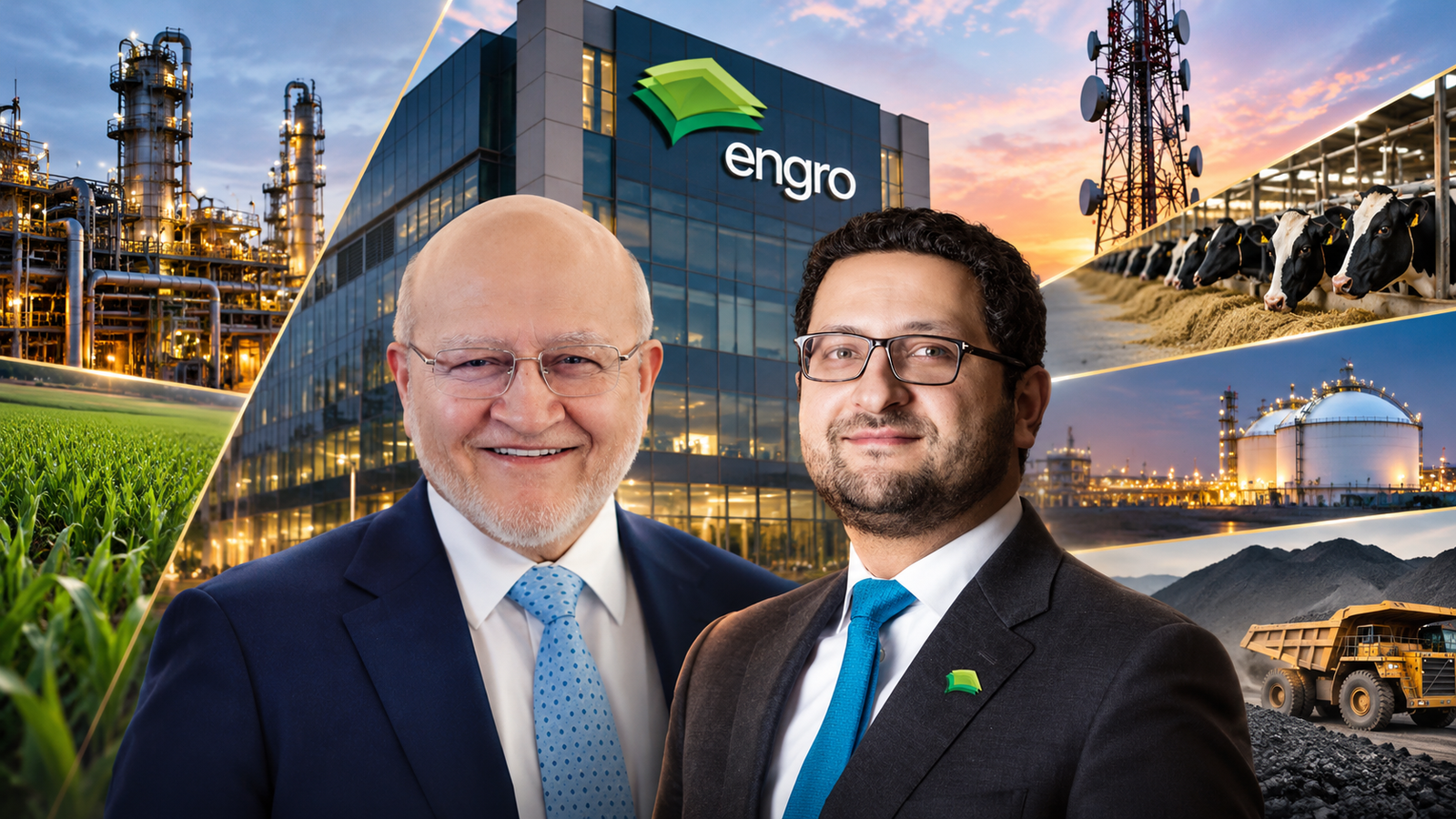
LAHORE, November 15, 2026: Few Pakistani business families have built an economic footprint as extensive, diversified and strategically important as the Dawoods.
From agricultural fertilisers used by millions of farmers to the mobile towers connecting Pakistan’s cities and villages, the businesses associated with the Dawood family and Engro Holdings occupy significant positions in the country’s industrial and economic infrastructure.
The empire stretches across fertilisers, petrochemicals, food and dairy, power generation, coal mining, liquefied natural gas, chemical storage, telecommunications infrastructure, commodity trading and international investments.
At the centre of this vast enterprise stands Engro Holdings Limited, formerly Dawood Hercules Corporation Limited, chaired by Hussain Dawood and led by Chief Executive Officer Abdul Samad Dawood.
According to the group’s financial disclosures for the nine months ended September 30, 2026, Engro Holdings reported consolidated assets of approximately Rs1.113 trillion, liabilities of Rs782.3 billion and total equity of Rs330.4 billion.
Its consolidated revenue from continuing operations reached Rs426.4 billion during the first nine months of 2026.
These figures establish Engro as one of Pakistan’s major corporate enterprises. They do not, however, represent the personal wealth of the Dawood family. Engro Holdings is publicly listed, and substantial economic interests in its operating businesses belong to institutional investors, minority shareholders and joint-venture partners.
The more compelling story is how an enterprise whose family roots date back more than a century evolved into a modern investment-led conglomerate.
From Bombay to Pakistan: The Beginning of the Dawood Fortune
The Dawood business story began in 1920, when Ahmed Dawood, born in Bantva in 1905, started his own business in Bombay, then part of British India.
His early commercial activity centred on cotton yarn trading, a business that demanded an understanding of commodities, suppliers, credit and changing market conditions.
Following the partition of British India in 1947, Ahmed Dawood migrated to Pakistan and began rebuilding and expanding his commercial interests.
The Dawood Group was established in Pakistan in 1948, followed by investments in cotton mills, textiles, jute, shipping, insurance and other industries.
Over subsequent decades, businesses associated with the family included Dawood Cotton Mills, Burewala Textile Mills, Dawood Jute Mills, Dawood Shipping Company, Central Insurance Company and Lawrencepur Woolen and Textile Mills.
The family subsequently moved into large-scale industrial manufacturing, including fertilisers.
One of its most consequential investments came through Dawood Hercules Chemicals, established in 1968 as a venture involving the Dawood Group and the American company Hercules Chemicals.
The fertiliser business helped establish the family’s position in industrial Pakistan.
Over time, however, the family’s business interests would undergo repeated transformations as Pakistan’s political, regulatory and economic environment changed.
The Dawood enterprise was no longer simply a collection of manufacturing companies. It was becoming an investment group capable of entering, expanding, restructuring and exiting different industries.
Engro’s Origins: An American Fertiliser Business Becomes a Pakistani Corporate Giant
An important distinction in the Dawood–Engro story is that Engro was not originally established by the Dawood family.
Its roots lie in the American multinational Esso.
In 1965, Esso Pakistan Fertilizer Company Limited was incorporated to manufacture and market fertilisers in Pakistan.
Its urea plant began operations in 1968, laying the foundation for a business that would eventually become one of Pakistan’s most recognisable industrial companies.
The company later operated under the Exxon name.
A defining turning point arrived in 1991, when Exxon decided to divest its fertiliser interests. The Pakistani business underwent an employee-led buyout and emerged as Engro Chemical Pakistan Limited.
The transaction became an important chapter in Pakistan’s corporate history because it transferred a major multinational operation into Pakistani management.
The Dawood Hercules Group became a significant Engro shareholder in 2000, eventually bringing the Engro enterprise into the family’s broader investment sphere.
Under Hussain Dawood’s leadership from 2002 onwards, Engro progressively expanded beyond its traditional fertiliser business.
The company entered and developed investments in petrochemicals, energy, dairy, port infrastructure and telecommunications.
In 2010, the fertiliser operations were separated into Engro Fertilizers Limited, while Engro Corporation became the diversified parent company.
This restructuring helped establish the architecture for a conglomerate that could manage distinct operating businesses under one investment strategy.
Hussain Dawood: The Architect of Modern Engro
Hussain Dawood has been one of the most influential figures in Pakistan’s corporate sector over the past two decades.
A graduate in metallurgy from the University of Sheffield, with an MBA from Northwestern University’s Kellogg School of Management, he has overseen a period of major expansion in Engro’s business portfolio.
His approach has emphasised long-term investments, professional management, international partnerships and the development of large operating businesses.
Rather than concentrating exclusively on traditional family-owned manufacturing, Engro developed a structure combining corporate subsidiaries, listed companies, international joint ventures and strategic investments.
Under his stewardship, the group expanded into sectors closely connected with Pakistan’s industrial development.
These include agricultural productivity, energy availability, industrial raw materials, food processing and digital infrastructure.
The significance of this strategy lies not merely in diversification, but in identifying industries with substantial and recurring national demand.
Fertilisers remain essential for agriculture.
LNG terminals are critical for imported gas supplies.
Telecommunications towers are necessary for mobile connectivity.
Power generation remains central to industrial and household electricity demand.
By participating in these sectors, Engro developed commercial exposure to some of Pakistan’s most important economic activities.
Yet investing in essential industries also creates exposure to government policies, administered prices, taxation, regulation and the financial health of the wider economy.
Abdul Samad Dawood: The Next Generation Takes Charge
While Hussain Dawood remains chairman, much of Engro’s investment and restructuring strategy is associated with the group’s chief executive, Abdul Samad Dawood.
With more than two decades of experience in investment management, corporate governance, mergers and acquisitions, Abdul Samad has been involved in several major transactions.
His professional record includes involvement in the acquisition of The Hub Power Company interests, the divestment of the former Dawood Hercules fertiliser business to Fatima Fertilizer, and Engro’s dairy partnership with Royal FrieslandCampina.
More recently, he has been associated with the group’s major telecommunications infrastructure expansion and corporate restructuring.
In May 2026, Engro Holdings confirmed the reappointment of Hussain Dawood as chairman and Abdul Samad Dawood as CEO.
Sabrina Dawood also serves on Engro Holdings’ board.
The leadership structure reflects a combination of family stewardship and professional corporate management, with independent directors participating in oversight.
The next generation’s challenge is different from that faced by earlier Dawood leadership.
Rather than simply expanding into more sectors, it must decide where capital can generate the strongest long-term returns while managing the financial obligations and risks associated with major acquisitions.
Also Read: FBR Reform: Rearranging Offices, Avoiding The Hard questions
Engro Fertilizers: The Agricultural Foundation of the Empire
Fertilisers remain among Engro’s most important businesses.
Engro Corporation holds approximately 56.2% of Engro Fertilizers Limited, a listed company with extensive operations in urea production, marketing and agricultural services.
The business manufactures and supplies products essential to Pakistan’s agricultural economy.
Its production capabilities, distribution network and established brands have made it a significant participant in the domestic fertiliser market.
For the first nine months of 2026, Engro Fertilizers generated revenue of approximately Rs150 billion, compared with Rs135 billion during the corresponding period of 2025.
Its reported profitability increased to approximately Rs16 billion from Rs14 billion.
However, urea sales volumes declined from approximately 1.28 million tonnes to 1.248 million tonnes.
The divergence between improving profitability and lower sales volumes demonstrates an important feature of Pakistan’s fertiliser industry.
Financial performance is influenced not only by agricultural demand but also by product pricing, gas costs, inventories and government policy.
Engro’s own disclosures attributed the improvement partly to higher urea margins following changes in discounts and selling prices, alongside an accounting remeasurement gain relating to Sindh Infrastructure Development Cess.
The longer-term challenge is maintaining commercial profitability while ensuring fertilisers remain accessible to farmers facing rising production costs.
Pakistan’s agricultural productivity, food inflation and rural incomes are closely connected to the price and availability of agricultural inputs.
For Engro, the sector offers enduring demand but also substantial economic and political sensitivity.
Telecommunications: The Rs-Billion Bet on Pakistan’s Digital Infrastructure
One of Engro’s most significant recent transformations has been its expansion into telecommunications infrastructure.
Through Engro Connect and its operating businesses, Engro Enfrashare and Deodar, the group has become Pakistan’s largest independent telecommunications tower platform.
The defining transaction came in June 2025, when Engro completed its partnership with Jazz and acquired control of the Deodar tower infrastructure portfolio.
The transaction, valued at approximately $562.7 million, added more than 10,500 tower sites to Engro’s existing infrastructure business.
By September 2026, Engro’s connectivity portfolio had reached 15,418 tower sites.
The business generated approximately Rs62 billion in revenue during the first nine months of 2026, compared with Rs31 billion during the previous corresponding period.
Profitability, excluding specified prior-year one-off effects, increased to approximately Rs5.8 billion from Rs2.3 billion.
An important qualification is that the 2026 results include Deodar’s operations for the entire nine-month reporting period, whereas the comparable 2025 period included only four months.
Consequently, the growth cannot be attributed entirely to organic expansion.
The commercial logic behind the tower business is comparatively straightforward.
Telecommunications operators require towers to provide network coverage but do not necessarily need to own those towers themselves.
Independent tower companies can lease infrastructure to multiple operators, potentially improving utilisation and reducing duplication.
Engro’s opportunity lies in adding tenants to existing sites, improving operating efficiency and supporting future digital connectivity requirements.
However, the business also carries substantial capital and financing requirements.
Its performance depends on tenancy growth, operator consolidation, financing costs and the ability to maintain infrastructure efficiently.
The company’s November 2026 briefing indicated a tenancy ratio above 1.35, leaving scope for additional infrastructure sharing.
If Engro successfully increases tower utilisation without proportionately increasing capital expenditure, telecommunications could become an increasingly important contributor to its earnings.
Engro Energy: Coal, Power Generation and the Thar Investment
Energy represents another major pillar of the group.
Through Engro Energy Limited and its associated businesses, Engro participates in electricity generation and coal mining.
Its portfolio includes Engro Powergen Qadirpur, Engro Powergen Thar and an investment in Sindh Engro Coal Mining Company.
The Thar projects represent substantial investments in indigenous energy resources.
Engro Powergen Thar operates within the coal-based electricity generation ecosystem, while Sindh Engro Coal Mining Company is associated with the extraction and supply of lignite coal.
The investments were developed against the backdrop of Pakistan’s dependence on imported fuels and recurring difficulties in securing affordable energy supplies.
In the first nine months of 2026, Engro Energy reported approximately Rs94 billion in revenue, compared with Rs92 billion in the previous corresponding period.
Profitability, on the company’s adjusted comparison, increased to approximately Rs24.6 billion from Rs21.6 billion.
Electricity dispatch rose to 3,607 gigawatt-hours from 3,359 gigawatt-hours.
The group also reduced its stake in the listed Engro Powergen Qadirpur Limited in February 2026.
Engro Energy sold approximately 18.53% of the company’s shares for around Rs1.5 billion, retaining an ownership interest of approximately 50.36% and continuing management control.
The decision illustrated the group’s willingness to monetise a portion of an established investment without necessarily surrendering control.
Nevertheless, Engro’s energy portfolio operates in one of Pakistan’s most difficult economic environments.
The electricity sector faces circular debt, payment pressures, questions surrounding generation costs and increasing scrutiny of power purchase agreements.
Coal investments also face environmental and climate-related challenges.
The expansion of domestic coal generation may support fuel diversification and reduce some import exposure, but it raises questions about emissions, water use, environmental management and the long-term transition towards cleaner energy.
For Engro, future energy-sector investment decisions will require balancing financial returns, national energy requirements and increasingly demanding environmental expectations.
Engro’s LNG and Chemical Terminals: Strategic Infrastructure at Port Qasim
Engro’s infrastructure interests extend beyond electricity generation.
Through its partnerships in LNG and chemical terminals, the group operates assets that support Pakistan’s energy imports and industrial supply chains.
Engro Elengy Terminal, developed at Port Qasim, was Pakistan’s first LNG import and regasification terminal.
The terminal began operations in 2015 and is operated through a structure in which Engro holds approximately 56% and Royal Vopak holds the remaining 44% of Elengy Terminal Pakistan Limited.
Its facilities allow imported liquefied natural gas to be converted back into gaseous form and supplied to Pakistan’s gas transmission system.
Engro also maintains a 50% interest in Engro Vopak Terminal Limited, a joint venture with Royal Vopak of the Netherlands.
This business handles and stores bulk liquid chemicals, LPG and other industrial products.
The terminal operations are strategically significant because imported fuels and chemicals are essential inputs for electricity production, manufacturing and other sectors.
However, the businesses are not immune to volatility.
During the first nine months of 2026, Engro’s terminal businesses reported combined revenue of approximately Rs11 billion, compared with Rs14.6 billion a year earlier.
Profitability declined to around Rs1.6 billion from Rs2.3 billion.
The group attributed weaker results to reduced LNG imports and lower terminal throughput amid geopolitical disruptions.
This demonstrates that even strategically important infrastructure businesses can experience earnings pressure when cargo volumes and international supply conditions deteriorate.
Dairy: The Partnership That Put Engro Into Pakistani Households
Another important element of Engro’s transformation was its entry into consumer food products.
Through Engro Foods, the group developed brands that became familiar to millions of Pakistani consumers.
Its dairy business subsequently entered into a partnership with Royal FrieslandCampina, the Dutch multinational dairy cooperative.
FrieslandCampina became the majority shareholder in the business, which operates as FrieslandCampina Engro Pakistan Limited.
The current ownership structure gives Royal FrieslandCampina a 51% controlling interest, while Engro Corporation holds approximately 39.93%.
The company markets products including Olper’s and other dairy offerings.
Its presence in packaged dairy products connects Engro’s investment portfolio with household consumption patterns and Pakistan’s wider food economy.
According to Engro’s latest corporate briefing, FrieslandCampina Engro Pakistan generated approximately Rs88 billion in revenue during the first nine months of 2026, compared with Rs80 billion in the corresponding period of 2025.
Profitability increased to approximately Rs6.5 billion from Rs2.1 billion.
The improvement was supported by product mix, operating efficiencies and performance in value-added dairy products.
Nevertheless, the sector continues to confront inflation, consumer purchasing-power constraints, taxation and the challenge of improving Pakistan’s formal dairy supply chain.
The FrieslandCampina partnership highlights a distinctive feature of Engro’s strategy: retaining a significant economic interest in a company while allowing an international partner to hold operational control.
Petrochemicals: Why Engro Is Preparing to Exit a Major Business
Perhaps the clearest indication of the group’s evolving investment strategy is its proposed exit from Engro Polymer & Chemicals Limited.
The business has been part of Engro’s industrial portfolio since 1997.
It produces polyvinyl chloride, caustic soda and related chemicals that are used by several downstream industries.
For years, Engro Polymer represented an important component of the group’s industrial diversification.
However, in September 2026, Engro Corporation announced an agreement to sell its entire 56.19% shareholding in Engro Polymer & Chemicals for approximately Rs19.7 billion.
The purchaser was then known as Lotte Chemical Pakistan Limited, subsequently renamed Noventra Limited in October 2026.
The transaction values the shares being transferred at approximately Rs38.60 each.
The Competition Commission of Pakistan approved the proposed acquisition on October 20, 2026.
However, competition clearance alone does not establish that the transaction has closed. The latest financial statements reviewed for this profile continued to describe completion as subject to the outstanding contractual and regulatory requirements.
The proposed sale represents a substantial portfolio decision.
During the first nine months of 2026, Engro’s polymers business generated approximately Rs65 billion in revenue and returned to a modest profit of around Rs300 million, compared with a loss of approximately Rs3.5 billion in the corresponding period of 2025.
Despite the improvement, the group’s decision to sell suggests that management sees opportunities to redeploy capital away from a business exposed to industrial cycles, feedstock prices and international competition.
If completed, the transaction would reduce Engro’s direct exposure to the petrochemicals sector.
It would also reinforce the group’s transition towards businesses where management believes capital can earn more attractive long-term returns.
International Trading and Overseas Investments
Engro’s corporate footprint is not limited to Pakistan.
Through entities including Engro Eximp FZE and Engrotech Ventures FZCO, the group has established an international commercial presence.
Its overseas activities include commodity trading and related investment operations.
During the first nine months of 2026, Engro Eximp FZE reported revenue of approximately $548 million, including $264 million classified as captive revenue.
Profitability reached approximately $5.1 million, while trading volumes increased to around 668,000 tonnes.
The international operations provide Engro with access to suppliers, markets and commercial opportunities outside Pakistan.
Such exposure also carries risks associated with foreign exchange, commodity prices, logistics, geopolitical instability and counterparty performance.
The Great Corporate Restructuring: Engro Holdings and Dawood Lawrencepur
The most important structural transformation of recent years took effect on January 1, 2025.
Under a court-sanctioned Scheme of Arrangement, Dawood Hercules Corporation was reorganised and renamed Engro Holdings Limited.
Engro Corporation became a wholly owned subsidiary of the new holding company.
Meanwhile, the former Dawood Hercules investments outside Engro were separated into DH Partners Limited.
The restructuring was intended to simplify the holding structure and give management greater flexibility in capital allocation.
It also affected the rights and economic interests of shareholders, since Engro Corporation’s former minority investors became shareholders in Engro Holdings through the arrangement.
Another significant reorganisation followed in 2026.
DH Partners Limited and Cyan Limited were amalgamated into Dawood Lawrencepur Limited under a separate scheme, with an effective date of January 1, 2026.
Dawood Lawrencepur remains a distinct listed investment platform associated with the wider Dawood business network.
Its businesses and investments include renewable energy activities such as Tenaga Generasi and other investments.
This distinction matters because the Dawood family’s broader corporate interests are not identical to the assets consolidated within Engro Holdings.
The widely circulated figure of 23 material Engro entities relates to Engro Holdings’ corporate structure, not to every company historically connected with the Dawood family.
Similarly, Dawood Lawrencepur should not be presented as a wholly owned subsidiary of Engro Holdings.
The two companies have a disclosed associated-company relationship, including cross-shareholding and common directors.
The Financial Picture: A Trillion-Rupee Balance Sheet With Major Obligations
Engro’s scale becomes particularly evident in its September 2026 financial results.
The group reported:
- Total consolidated assets:113 trillion
- Total liabilities:3 billion
- Total equity:4 billion
- Nine-month revenue from continuing operations:4 billion
- Consolidated profit after tax:4 billion
- Profit attributable to owners of Engro Holdings:1 billion
- Earnings per share:33
The figures require careful interpretation.
Consolidated revenue increased from approximately Rs370.7 billion during the first nine months of 2025 to Rs426.4 billion in the corresponding period of 2026.
However, reported consolidated profit declined from approximately Rs83 billion to Rs48.4 billion.
That reduction must be considered alongside significant exceptional accounting gains in the previous year.
On a comparison excluding specified one-off effects, Engro’s corporate briefing showed consolidated profit increasing from approximately Rs38.2 billion to Rs48.4 billion and profit attributable to owners rising from approximately Rs21.4 billion to Rs29.1 billion.
In other words, the statutory comparison presents a different picture from the adjusted earnings comparison.
Both are important.
The group also reported total liabilities of Rs782.3 billion against total equity of Rs330.4 billion.
These liabilities encompass multiple categories of financial and operating obligations and should not be mistaken for interest-bearing borrowing alone.
Nevertheless, the increase in liabilities, which management partly attributed to additional borrowings across its fertiliser, corporate and connectivity businesses, demonstrates the financing demands of its investment strategy.
The acquisition and operation of telecommunications infrastructure, investment in large industrial assets and the continuing development of energy businesses all require substantial capital.
Engro’s future performance will therefore depend not only on increasing operating earnings but also on controlling financing costs, maintaining cash flow and improving returns on invested capital.
A Strategy Built on Acquisitions, Partnerships and Exits
A recurring feature of the Dawood–Engro story is the willingness to enter and leave major industries.
The group has participated in acquisitions, business combinations, international partnerships, demergers and divestments.
Several transactions illustrate this approach.
The acquisition and subsequent investment cycle involving The Hub Power Company demonstrated the group’s interest in energy assets.
The sale of the former Dawood Hercules fertiliser operations to Fatima Fertilizer showed that established businesses were not necessarily permanent holdings.
The FrieslandCampina transaction brought an international majority partner into a successful domestic consumer business.
The acquisition of Deodar transformed Engro’s telecommunications infrastructure footprint.
The planned divestment of Engro Polymer would represent another major exit.
Together, these decisions suggest a corporate philosophy in which ownership is not necessarily an end in itself.
Instead, management seeks to allocate capital across industries depending on perceived opportunities, operating performance, market conditions and potential returns.
This strategy offers flexibility but requires considerable discipline.
Every acquisition brings integration risk. Every divestment creates questions about timing and valuation. And every restructuring must protect minority shareholders while delivering the commercial benefits promised by management.
Philanthropy, Education and Institutional Development
The Dawood family’s influence extends into philanthropy, education and institutional development.
The Dawood Foundation has supported educational and community initiatives over several decades.
Among its prominent projects is the TDF MagnifiScience Centre in Karachi, an interactive science museum intended to promote scientific learning and public engagement.
Hussain Dawood has also been associated with the Karachi School for Business and Leadership, which focuses on management education and leadership development.
Engro Foundation undertakes social development initiatives connected with education, livelihoods, healthcare and communities around the group’s operations.
These efforts form part of the family’s wider institutional presence.
However, philanthropic contributions should be assessed separately from the commercial performance, regulatory obligations and environmental responsibilities of the group’s businesses.
Large corporate enterprises have responsibilities extending beyond charitable activity, particularly when their operations involve industrial emissions, natural resources and essential public infrastructure.
The Risks Facing Pakistan’s Corporate Powerhouse
Engro’s diversification provides exposure to several industries, but it does not eliminate the risks arising from Pakistan’s economic environment.
Fertiliser manufacturing remains sensitive to gas availability, pricing policy and agricultural demand.
Energy companies face payment risks, regulatory decisions and the financial position of the electricity sector.
Coal investments face increasing environmental scrutiny.
LNG terminals depend on international cargo flows and Pakistan’s gas demand.
Dairy companies must navigate consumer affordability and taxation.
Telecommunications infrastructure depends on operator demand, financing conditions and efficient asset utilisation.
Commodity trading remains exposed to international price movements and disruptions in logistics.
The Engro Polymer transaction also highlights the difficulty of maintaining attractive returns in industries exposed to international competition and industrial cost pressures.
At the group level, increasing financial obligations and the need to deploy substantial amounts of capital require consistent oversight.
The central challenge is whether the earnings generated by Engro’s operating businesses can support expansion, financing costs and shareholder returns through Pakistan’s recurring economic cycles.
The Next Chapter: What Will Engro Become?
The Dawood family’s business story has already passed through several distinct phases.
Ahmed Dawood established the foundations through trading and industrial entrepreneurship.
The subsequent generations built and consolidated interests across manufacturing and investment businesses.
Hussain Dawood helped transform Engro into a diversified enterprise with extensive participation in Pakistan’s essential industries.
Abdul Samad Dawood now leads a company increasingly focused on major transactions, strategic investments and capital allocation.
The question facing the group is whether its next chapter will be defined by ownership of traditional industrial assets or by the management of a portfolio of infrastructure and operating businesses.
The rapid expansion into telecommunications towers suggests a growing interest in assets that can generate recurring infrastructure revenues.
The continuing significance of energy and fertilisers demonstrates that established industries remain central to the business.
Meanwhile, the proposed exit from petrochemicals shows a willingness to reconsider long-standing investments.
Future acquisitions, investment discipline, debt management and governance standards will determine whether this approach creates sustainable value.
The Dawood Legacy: Industrial Power and an Unfinished Transformation
More than a century after Ahmed Dawood began trading cotton yarn in Bombay, the family associated with his name remains an important force in Pakistan’s corporate landscape.
The journey from a small trading business to a diversified enterprise with more than Rs1.1 trillion in consolidated assets is an extraordinary example of commercial evolution.
Yet Engro is not simply a family fortune or a collection of privately owned companies.
It is a complex, publicly accountable corporate structure involving shareholders, professional managers, lenders, partners and thousands of employees.
Its companies influence agricultural production, industrial manufacturing, energy security, food consumption and telecommunications connectivity.
That reach gives Engro substantial economic relevance, but it also subjects the group to greater expectations concerning transparency, environmental responsibility, governance and financial discipline.
The Dawood family’s most significant achievement may not be the number of businesses it has accumulated.
It may be its ability to repeatedly transform those businesses as Pakistan’s economy evolves.
Whether the next generation can maintain that record while controlling financial risk will determine the future of one of the country’s most prominent corporate enterprises.
For Engro, the challenge is no longer simply to build a bigger empire. It is to demonstrate that an empire of this size can continue to create lasting value for its shareholders, employees and the wider Pakistani economy.
Also Read: Nvidia Crisis Triggers Intense Scrutiny Of US Export Control Agency Over China Chip Curbs