

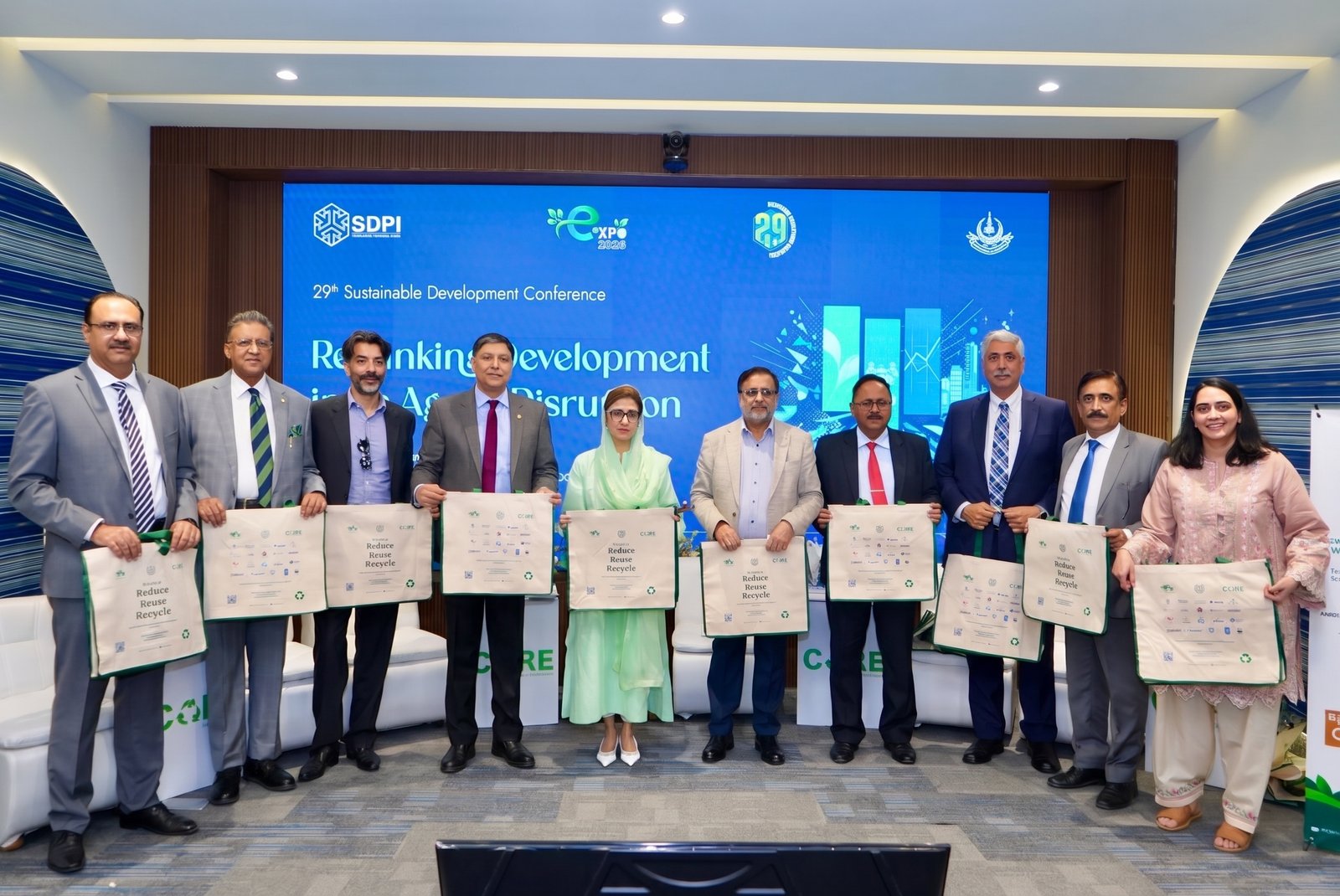
ISLAMABAD: As Pakistan grapples with mounting municipal solid waste and a fragmented regulatory landscape, the Collect & Recycle (CoRe) Alliance has issued an urgent call for the implementation of a harmonized, phased, and inclusive Extended Producer Responsibility (EPR) framework. The push aims to completely overhaul the nation’s waste management and recycling systems, shifting the economic model from linear consumption to a sustainable circular economy.
The comprehensive policy recommendations were debated during a dedicated session titled “From Policy to Practice: Strengthening Extended Producer Responsibility (EPR) for Better Systems in Pakistan”. The session took place on November 5, 2026, anchoring the 29th Sustainable Development Conference organized by the Sustainable Development Policy Institute (SDPI) in collaboration with the CoRe Alliance at the Allama Iqbal Open University (AIOU) in Islamabad.
The high-level dialogue brought together a cross-section of government representatives, industry stakeholders, and environmental experts to bridge the gap between ambitious climate policy and on-the-ground operational realities.
The Policy Push: A Harmonized National Framework A central theme of the session was the necessity of a nationwide approach to EPR, a policy mechanism that holds producers accountable for the entire lifecycle of their products, including post-consumer disposal.
During the proceedings, Namwar Yusuf Rahman, Project Manager at the CoRe Alliance, presented a detailed summary of the Alliance’s comprehensive White Paper. Originally submitted to the Federal Minister for Climate Change and Environmental Coordination in May 2026, the White Paper outlines key recommendations for a harmonized regulatory approach. Rahman explained that while regulatory consistency is vital at the federal level, the framework must remain flexible enough to accommodate specific provincial and local waste management realities across Pakistan’s diverse municipalities.
Amir Mohyuddin, Additional Secretary of the Ministry of Climate Change and Environmental Coordination (MoCC&EC), echoed this sentiment. Addressing the delegates, he stated, “A harmonized and phased approach, supported by clear responsibilities and coordinated stakeholder efforts, is essential to strengthening better systems in Pakistan”.
Economic Levers: Green Financing And Tax Incentives Transitioning to a circular economy requires massive capital deployment, a challenge that dominated the panel discussions. Sheikh Waqar Ahmad, CEO of the CoRe Alliance, argued that drafted policies must be paired with aggressive economic incentives to mobilize private capital.
“Building a circular economy requires both enabling policy frameworks and practical action,” Ahmad noted. “We need to emphasize on greater industry participation, tax incentives and easier access to financing to attract private investment in recycling infrastructure”.
The expert panel—which included Zainab Naeem (Research Fellow, SDPI) and Zia Hyder (CEO, SPEL Group and Board Director, CoRe Alliance)—further explored these mechanisms. Discussions covered the establishment of industry-led Producer Responsibility Organizations (PROs) operating under strict regulatory oversight, the introduction of phased recycling targets, shared value-chain responsibilities, and the deployment of digital traceability systems to monitor waste flows.
Crucially, the panel highlighted the need for the formal integration of informal waste workers—the vast network of scavengers and scrap dealers who currently form the backbone of Pakistan’s undocumented recycling sector.
Operational Realities: The Importance Of Source Segregation While financing and policy form the foundation, operational logistics remain the biggest hurdle to commercial recycling viability. Babar Aziz Bhatti, CEO of Green Earth Recycling and Chairperson of the CoRe Alliance EPR Committee, shed light on the physical realities of the recycling sector.
Bhatti emphasized the recycling industry’s substantial capacity to process significant volumes of material but issued a stark warning regarding input quality. He highlighted that “proper waste segregation is essential to reducing processing costs and improving the quality of recycled products,” pointing out that mixed, contaminated waste dramatically reduces the commercial value of recyclable plastics and packaging.
Practical Action: Enforcing The Single-Use Plastics Ban Moving beyond theoretical policy, the CoRe Alliance matched its advocacy with tangible community action. To actively support the enforcement of the Single-Use Plastics (Prohibition) Regulations, 2023, within the Islamabad Capital Territory (ICT), the Alliance formally handed over 5,000 co-branded reusable tote bags to the Pakistan Environmental Protection Agency (Pak-EPA).
A formal handover ceremony was conducted a day prior at the Pak-EPA office in Islamabad in the presence of Dr. Mohsina Zubair and Dr. Zaigham Abbas, Directors (Lab/NEQS) at Pak-EPA. The initiative is designed to promote sustainable alternatives to local consumers and drastically reduce reliance on single-use plastics in the federal capital.
Delivering the opening remarks at the SDPI session, Dr. Shezra Mansab Ali Khan Kharal, Minister of State for Climate Change and Environmental Coordination, praised the dual approach. “Pakistan’s transition towards a circular economy requires collective action and strong collaboration between government and industry,” Dr. Kharal stated. “Effective EPR implementation can strengthen waste management and recycling systems, promote responsible resource management and help establish better systems in Pakistan”.