

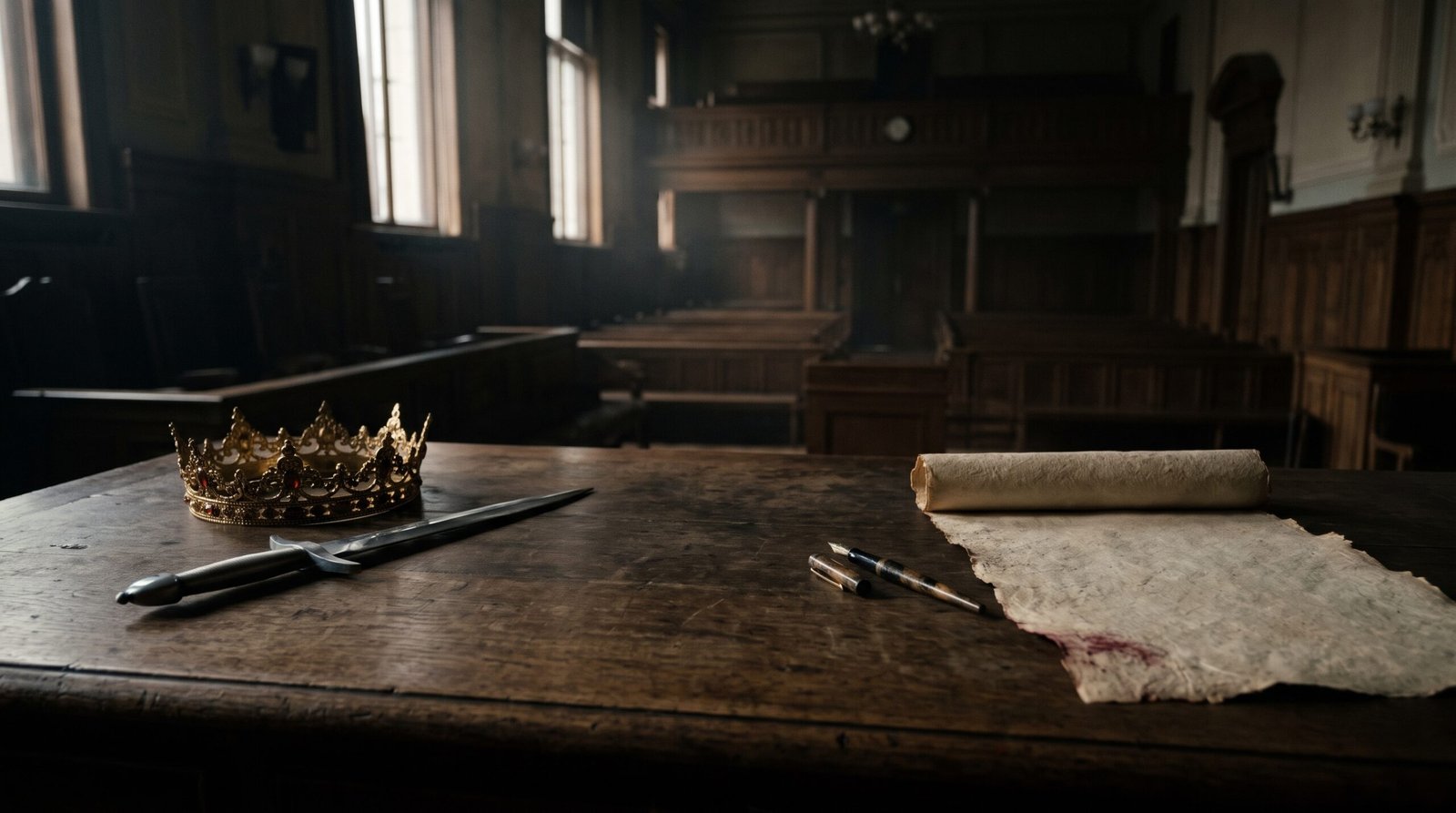
Iftikhar Arif’s “Khoon Baha” is a poem about the impossibility of justice when the machinery of the state itself stands accused. The “horsemen” are dead. The heirs demand blood money— the traditional compensation owed to the families of the slain but the killers are not private men; they are the throne, the dagger, the crown, the army.
The judges who should complete the obligations of justice sit beneath the shadow of the same power they are meant to supervise. And the “saints”—the moral guardians—watch but do not intervene. The poem ends not with resolution but with paralysis: the people demand that the story be written, yet the poet sits “ashamed before the pen,” unable to record a justice that never arrived.
This is not ancient history. It is the daily ledger of the many modern states, even today when a quarter of twenty-first century has already lapsed. The poem was written decades ago, yet it reads like a verdict that has never been served.
In the poem, the heirs demand blood money from the killers; the judges are supposed to complete the obligations; the saints are supposed to supervise the judges. But in the court of time, on one side stands the throne, on the other the dagger; on one side a jeweled crown, on the other an army. The tribes cry out “Long live the crown and throne,” and the poet ends “ashamed before the pen,” not knowing what to write.
The poem stings today because what it describes is not the tyranny of some distant era, but the universal architecture of contemporary state repression. In Pakistan, in Egypt, in Iran, in Myanmar, the same script repeats: the horsemen fall, the heirs demand an accounting, the judges sit in the shadow of the throne, the saints look away. The blood money is never paid. The ledger is never settled.
The Throne, the Dagger, the Crown
Arif’s poem is precise about the architecture of injustice. There is the throne (political power), the dagger (the security apparatus), the crown (wealth and privilege), and the army (organized force). Against these stand the people — with only “helplessness” on one side and “destiny” on the other. The judges are meant to complete the obligations, but their supervision is assigned to “saints” who do not act. The result: a system in which the killers never pay, the heirs never receive, and the poet is left “ashamed before the pen.” This pattern repeats across the world.
Egypt: The Square and the Cell
In Egypt, the “horsemen” of the 2011 revolution—the young activists who filled Tahrir Square demanding bread, freedom, and social justice—were slaughtered and imprisoned by the very state they sought to reform. The Rabaa massacre of 2013 left hundreds dead, and the subsequent years brought tens of thousands of political prisoners, many held without trial under draconian protest laws.
The heirs—families of the killed and forcibly disappeared — still demand blood money. The judges are supervised not by saints but by the military. In Egypt, as in Arif’s poem, the state has made the demand for justice itself, a crime.
Iran: Woman, Life, Freedom
In Iran, the “horsemen” include Mahsa Amini, killed in morality police custody for an improperly worn headscarf, and the hundreds of protesters shot dead in the ensuing “Woman, Life, Freedom” uprising. The state’s response was not blood money but more blood—mass arrests, executions of protesters, and a brutal crackdown on dissent.
Blood Money (Khoon Baha)—Iftikhar Arif
|
apne shahsavāroñ ko qatl karne vāloñ se ḳhūñ-bahā talab karnā vārisoñ pe vājib thā qātiloñ pe vājib thā ḳhūñ-bahā adā karnā vājibāt kī takmīl munsifoñ pe vājib thī munsifoñ kī nigrānī qudsiyoñ pe vājib thī vaqt kī adālat meñ ek samt masnad thī ek samt ḳhanjar thā tāj-e-zar-nigār ik samt ek samt lashkar thā ik taraf muqaddar thā tā.ife pukār uTThe tāj-o-taḳht zindābād sāz-o-raḳht zindābād sāz-o-raḳht zindābād
ḳhalq ham se kahtī hai saarā mājrā likkheñ kis ne kis tarah paayā apnā ḳhūñ-bahā likkheñ chashm-e-nam se sharminda ham qalam se sharminda sochte haiñ kyā likkheñ
|
اپنے شہسواروں کو قتل کرنے والوں سے خوں بہا طلب کرنا وارثوں پہ واجب تھا قاتلوں پہ واجب تھا خوں بہا ادا کرنا واجبات کی تکمیل منصفوں پہ واجب تھی منصفوں کی نگرانی قدسیوں پہ واجب تھی وقت کی عدالت میں ایک سمت مسند تھی ایک سمت خنجر تھا تاج زرنگار اک سمت ایک سمت لشکر تھا اک طرف مقدر تھا طائفے پکار اٹھے تاج و تخت زندہ باد ساز و رخت زندہ باد ساز و رخت زندہ باد خلق ہم سے کہتی ہے سارا ماجرا لکھیں کس نے کس طرح پایا اپنا خوں بہا لکھیں چشم نم سے شرمندہ ہم قلم سے شرمندہ سوچتے ہیں کیا لکھیں |
To demand blood money from those who killed our horsemen — that was the duty of the heirs, and the duty of the killers was to pay the blood price. Completing all obligations was the duty of the judges — (and overseeing the judges was the duty of the saints). In the court of time, on one side stood the throne, on another side, the dagger, a jeweled crown on one side, on another side, an army. On one side was helplessness, on another side, destiny. The tribes cried out: “Long live the crown and throne!” “Long live pomp and possessions!”
|
The heirs—mothers holding photographs of their dead children—are themselves arrested when they speak. The throne and the dagger march together, and the judges complete the obligations of the state, not of justice.
Belarus: The Dictator’s Ledger
In Belarus, after the fraudulent 2020 election, protesters demanding a free vote were met with mass arrests, torture, and killings. The “heirs”—the families of those killed and the thousands imprisoned — still wait for blood money. The judges are instruments of the regime. The saints —the international community—issue statements, impose sanctions, and then move on. The pen, as Arif says, stands ashamed.
Myanmar: The Generals’ Blood Debt
In Myanmar, the military junta that seized power in 2021 has killed thousands of protesters and civilians, burning villages and displacing millions. The heirs—the families of the dead— demand accountability. The courts are the junta’s courts. The saints of the international community have done little beyond rhetoric. The army and the crown stand together; the people stand with helplessness and destiny.
The Common Architecture of Repression
What connects Balochistan to Cairo, Tehran to Minsk, Yangon to Quetta? It is the structure Arif describes: a state that treats demands for rights as existential threats, that deploys the dagger against the horsemen, that wraps the judges in the cloak of the throne, and that asks the people to celebrate the very power that kills them. The state’s “blood money” is never paid; the heirs are told to wait; the pen is censored; and the people are told to sing praises of the crown.
The modern state has perfected the art of making justice impossible without making it illegal. Enforced disappearance is a way to kill without a body; administrative detention is a way to imprison without a trial; sedition laws are a way to silence without a corpse. The blood money is never paid because the killing is never acknowledged. The horsemen simply vanish.
What the Pen Must Do
Arif’s poem ends in paralysis—”we sit and wonder: what shall we write?”— but the paralysis is itself an indictment. The poet is ashamed because he cannot write the justice that did not happen. Yet the poem exists. It is written. It bears witness to the fact that the killers never paid, that the judges failed, that the saints looked away.
The lesson for our time is that the pen must write even when the story is unbearable. We must record the names of the disappeared whether abroad or within. We must write the numbers of those killed in Rabaa. We must document the executions in Iran, the torture in Belarus, the massacres in Myanmar. We must record the architecture of impunity — the laws, the courts, the security apparatus, the international silence — that makes the blood price impossible to collect.
The people in Arif’s poem say: “Write down the whole story. Who received, and how, their own blood money— write it all.” The answer is: no one received it. The killers never paid. The judges completed the obligations of power, not justice. The saints did not supervise. And the throne, the dagger, the crown, and the army stood together against the people. That is the story. The pen must tell it
And in telling it, the pen becomes something the dagger cannot kill: memory. The horsemen are dead, but they are not forgotten. The heirs still demand. The poem still speaks. And somewhere, in the court of time, the ledger is being written — not by the judges who serve the throne, but by those who refuse to let the blood be washed away by silence.
The blood money is still owed. The debt is still due. And the pen, ashamed as it is, must write it down.