


LAHORE/MULTAN: Pakistan’s cotton research establishment is facing a deepening institutional crisis after a series of official documents obtained by The Scoop revealed extensive damage to experimental cotton crops, longstanding deficiencies in pest management, deteriorating research infrastructure, disputes over employee salaries and pensions, and serious allegations concerning the appointment and financial decisions of Pakistan Central Cotton Committee (PCCC) Chief Executive Officer Dr Khadim Hussain.
The documents, including internal research reports, government notifications, minutes of the PCCC’s 92nd meeting, financial statements, a formal complaint addressed to the federal government and a Lahore High Court order, raise questions about the management of an institution entrusted with strengthening Pakistan’s cotton sector.
At the centre of the investigation is the reported devastation of approximately 43 acres of experimental and breeding cotton crops at the Central Cotton Research Institute (CCRI), Multan, during the 2026 growing season.
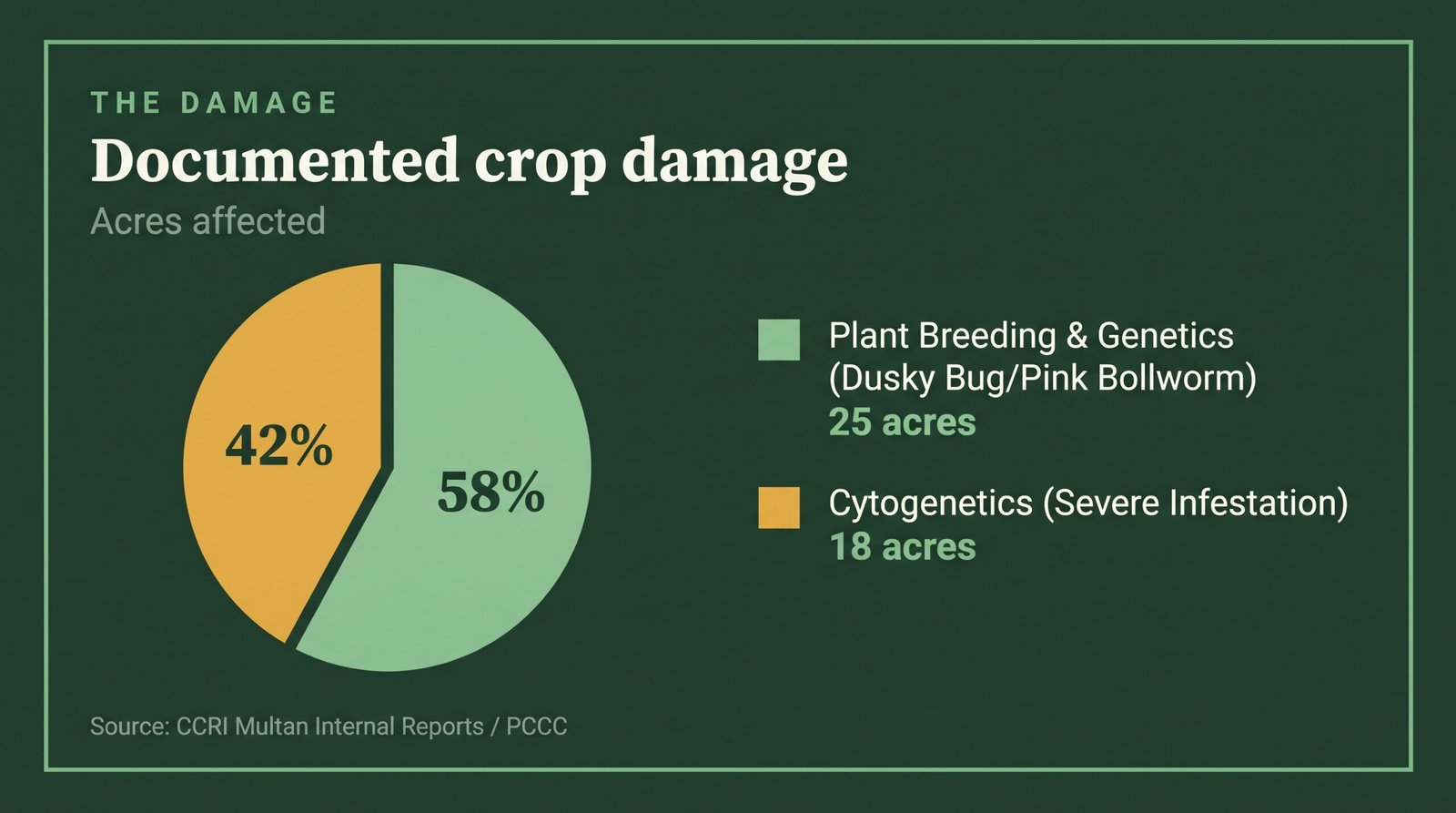
The figure is derived from two departmental reports identifying approximately 18 acres of affected cytogenetics crops and 25 acres of affected plant-breeding fields. Independent confirmation is still required to establish that the reported areas do not overlap.
The records indicate that experimental crops suffered severe attacks by pink bollworm and dusky cotton bugs, spraying was scheduled after fields had become heavily infested, pest-monitoring equipment was not maintained at prescribed intervals and valuable seed material suffered extensive damage.
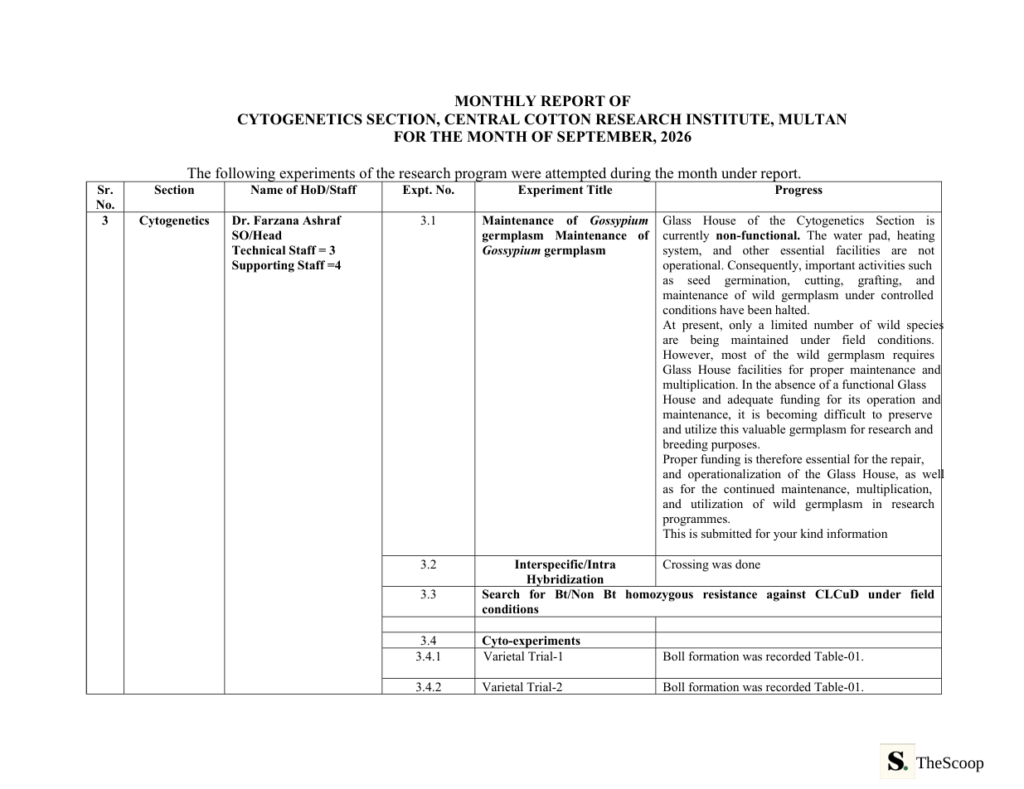
More significantly, the Cytogenetics Section’s September 2026 report describes poor entomological measurements persisting over several years without significant improvement in protecting crops or maintaining seed quality.
The documents also reveal that essential research facilities, including a glasshouse used for preserving valuable cotton germplasm, were not functioning.
Meanwhile, separate financial records show a substantial increase in reported cotton cess collections, while a formal complaint dated August 13, 2026, alleges irregularities involving PCCC’s leadership arrangements, pension-related transactions and administrative decisions.
The complaint, submitted by former PCCC administrative officer Muhammad Yousaf to Federal Minister for National Food Security and Research Rana Tanveer Hussain, specifically challenges Dr Khadim Hussain’s authority and conduct.
These allegations have not been established by a judicial or independent investigative finding in the material reviewed.
Nevertheless, when examined alongside the institution’s own research reports, board minutes, accounting statements and court records, they raise substantial questions requiring an explanation from PCCC management and the federal ministry.
43 Acres Of Research Crops Reportedly Devastated
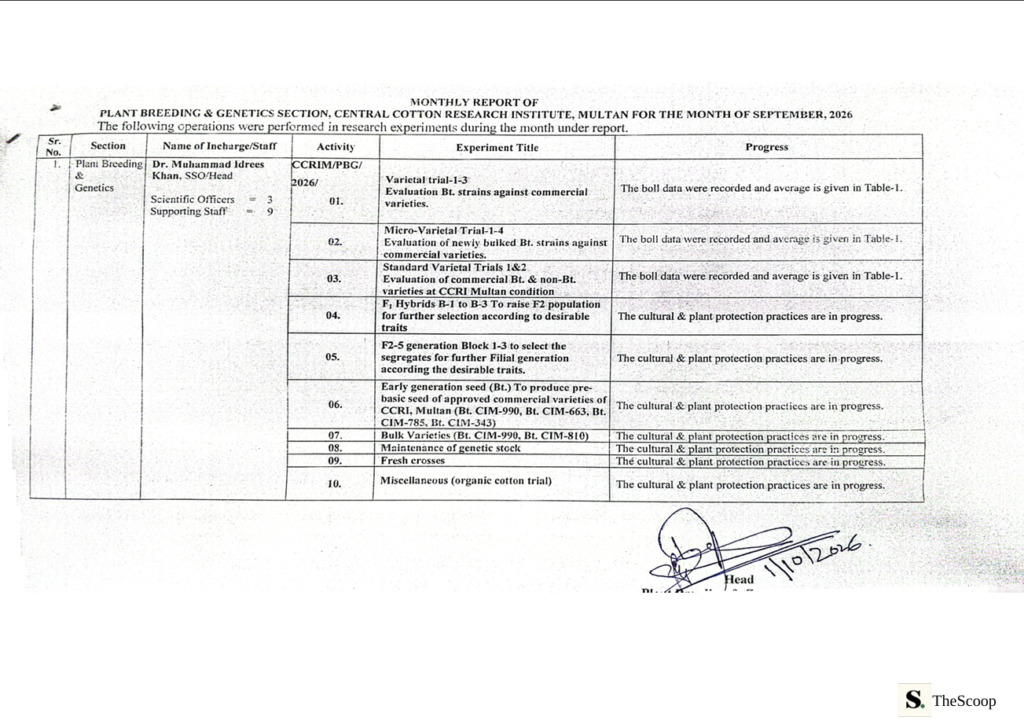
The September 2026 monthly reports of CCRI Multan’s Cytogenetics Section and Plant Breeding and Genetics Section document extensive damage to experimental cotton crops.
The Cytogenetics Section recorded approximately 18 acres of severely affected crops, while the Plant Breeding and Genetics Section identified approximately 25 acres damaged by dusky cotton bugs and pink bollworm infestations.
Together, the reports point to approximately 43 acres of affected experimental fields, subject to confirmation that the areas are separate.
These fields were not ordinary commercial plantations.
They formed part of scientific programmes involving varietal evaluation, breeding-line development, seed multiplication and the preservation of genetic material relevant to Pakistan’s cotton industry.
The consequences of damage to experimental crops can extend beyond the immediate agricultural season.
Cotton breeding programmes depend on maintaining viable seed material, evaluating successive generations and preserving promising genetic lines for further research.
Where experimental seed is damaged or loses germination potential, researchers may have to repeat trials or replace breeding material.
The reports warn of risks to seed quality and future germination, although they do not establish the quantity of genetic material permanently lost.
The economic and scientific consequences remain unquantified.
Both research sections recommended assessment of the damage, but no completed independent loss assessment has been provided among the documents reviewed by The Scoop.
Years Of Poor Pest Management: A Warning From Within The Institute
One of the most consequential findings appears in the Cytogenetics Section’s September 2026 report.
The document records that poor entomological measurements had persisted over several years without significant improvement in crop protection or seed quality.
This observation suggests that the difficulties documented during the 2026 season may not have been isolated.
Instead, the report points towards recurring deficiencies that warrant examination across multiple research seasons.
The document does not identify the precise years involved or establish which officials were responsible during each period.
However, it raises questions about whether earlier warnings and technical recommendations were acted upon.
Were recurring pest-management problems reported to PCCC headquarters?
Were corrective measures recommended?
Were those measures implemented?
Did shortages of funding, equipment, pesticides or technical personnel contribute to the continuing difficulties?
And were research managers required to explain why improvements had not been achieved?
These questions become particularly significant because an agricultural research institution is expected to maintain systematic records of pest populations, crop-protection interventions and the effectiveness of its research operations.
The findings warrant examination of earlier annual reports, departmental correspondence, field registers and financial allocations.
Responsibility for failures predating Dr Khadim Hussain’s tenure cannot be assigned to him without establishing his role during those periods.
However, the current leadership should explain what action was taken after the longstanding problems were identified.
Spraying Scheduled After Fields Were Heavily Infested
The internal reports also raise concerns about the timing of crop-protection measures.
According to the Cytogenetics Section, spraying was scheduled after experimental crops had already become heavily infested.
The Plant Breeding and Genetics Section recorded similar circumstances.
The reports further indicate that monitoring traps installed to assess whitefly and pink bollworm activity were not maintained according to prescribed procedures.
Trap capsules were reportedly not replaced at required intervals, while gum applications were not repeated as necessary.
Such shortcomings can undermine the reliability of pest-monitoring arrangements and complicate decisions about appropriate interventions.
Although insect infestations can occur even where preventive measures are followed, the institute’s own observations warrant investigation into whether timely action could have reduced the damage.
The available documents do not establish who authorised the spraying schedule or whether funding, procurement or operational constraints contributed to delays.
Those questions should be answered through field records, purchase requests, spraying registers and correspondence between researchers and management.
Experimental Seed Quality Compromised
The Cytogenetics Section report records serious damage to individual experimental fields.
In one field containing the Cyto-535 variety, approximately 50 per cent of the seed was reported damaged by dusky cotton bugs, while much of the remaining seed was affected by pink bollworm.
Other fields recorded poor seed vigour, low germination and severe insect damage.
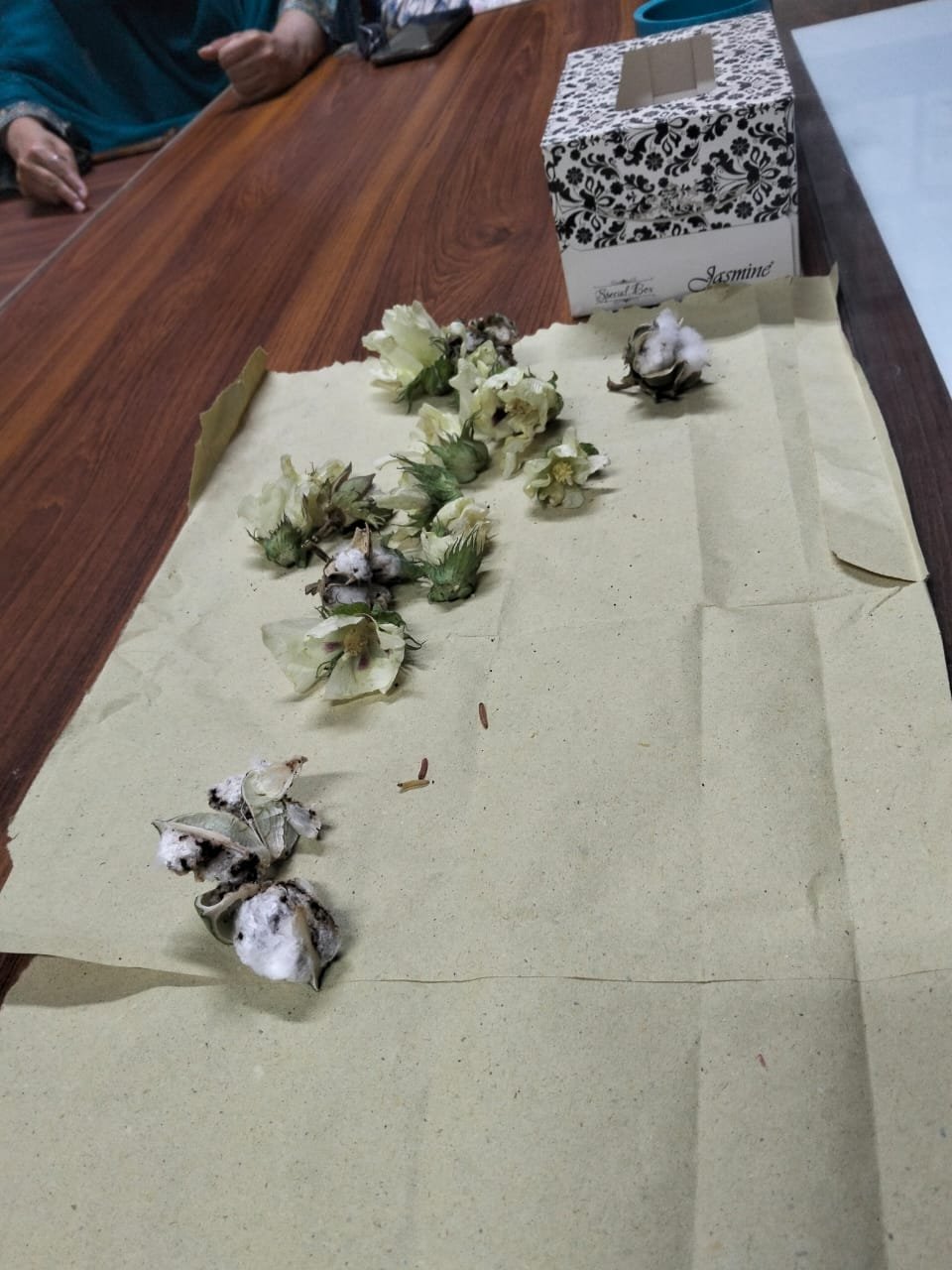
The report also describes significant jassid infestation and crop stunting in a field containing Cyto-547.
Researchers warned that the condition of the seed could adversely affect germination during the following season.
These observations raise concerns about the continuity of breeding programmes.
Experimental seed is not simply an agricultural commodity. It can represent years of scientific evaluation, selection and multiplication.
However, the records do not establish that all affected genetic material was permanently lost.
An independent scientific assessment is needed to determine the extent of recoverable seed, the quantity requiring replacement and any disruption to future trials.
Research Glasshouse Non-Functional
The problems extended beyond pest infestations.
The Cytogenetics Section’s September 2026 report recorded that its research glasshouse was non-functional.
According to the document, the water-pad system, heating arrangements and other essential facilities were not operational.
As a result, research activities involving seed germination, cutting, grafting and the maintenance of wild cotton germplasm under controlled conditions had been halted.
The report warned that only limited wild cotton material could be maintained under field conditions, while much of the germplasm required suitable glasshouse facilities.
Researchers called for funding to repair and restore the facility.
This raises questions about the institution’s maintenance arrangements and research priorities.
How long had the glasshouse remained non-functional?
Were repair estimates submitted?
Was funding requested from PCCC headquarters?
Were those requests approved or rejected?
And what alternative arrangements were made to protect valuable genetic resources?
The answers are particularly important because wild cotton germplasm can provide genetic material for research into improved varieties, pest resistance and environmental adaptation.
The documents establish that the facility was reported non-functional in September 2026. They do not establish the full duration of the problem or the reasons repairs had not been completed.
September 16 Warning Reached Senior Management
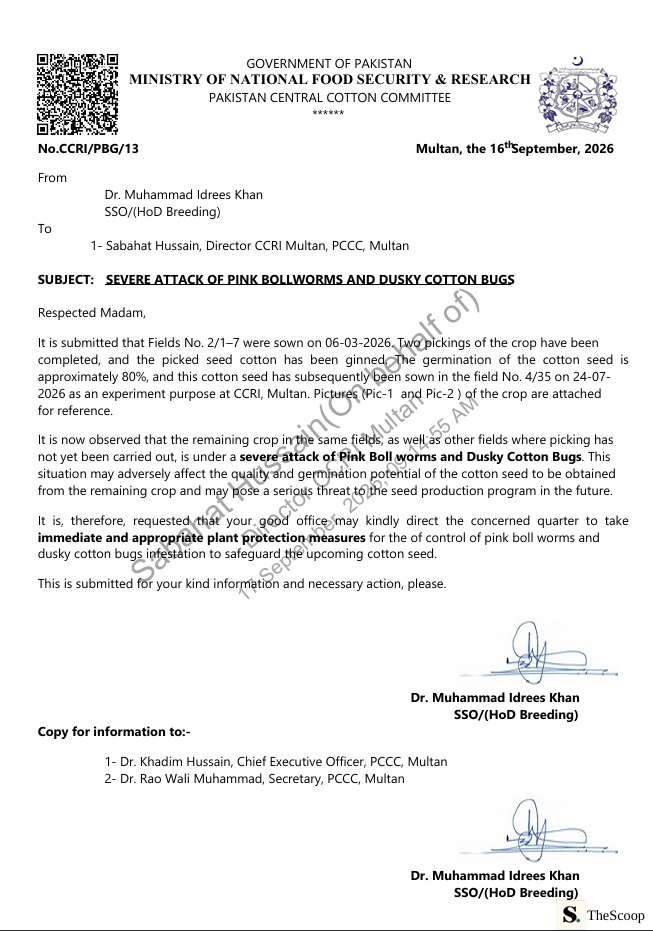
An official communication dated September 16, 2026, establishes that concerns about severe infestations were formally escalated.
The letter, issued by Dr Muhammad Idrees Khan, SSO and Head of Breeding, was addressed to Sabahat Hussain, Director CCRI Multan.
It warned that experimental fields were experiencing severe attacks by pink bollworms and dusky cotton bugs.
The communication stated that earlier cotton pickings had been completed and seed had been ginned, while the remaining crop was facing serious infestation.
It warned that the situation could affect seed quality and germination potential, threatening future seed production.
The letter requested immediate and appropriate plant-protection measures.
Copies were marked to Dr Khadim Hussain, Chief Executive Officer PCCC, and Dr Rao Wali Muhammad, Secretary PCCC.
The correspondence establishes that the warning was formally copied to the chief executive’s office.
It does not independently prove that Dr Hussain personally read the letter or ignored its recommendations.
Nevertheless, it provides an important basis for examining the institution’s response.
Was an emergency inspection ordered?
Were additional pest-control resources released?
Did management seek an assessment of the damage?
Were corrective instructions issued?
And was any official held responsible for deficiencies established through an inquiry?
No subsequent response or completed investigation has been provided among the records reviewed.
Board Minutes Reveal Temporary CEO Arrangement
The investigation also raises questions about PCCC’s leadership arrangements.
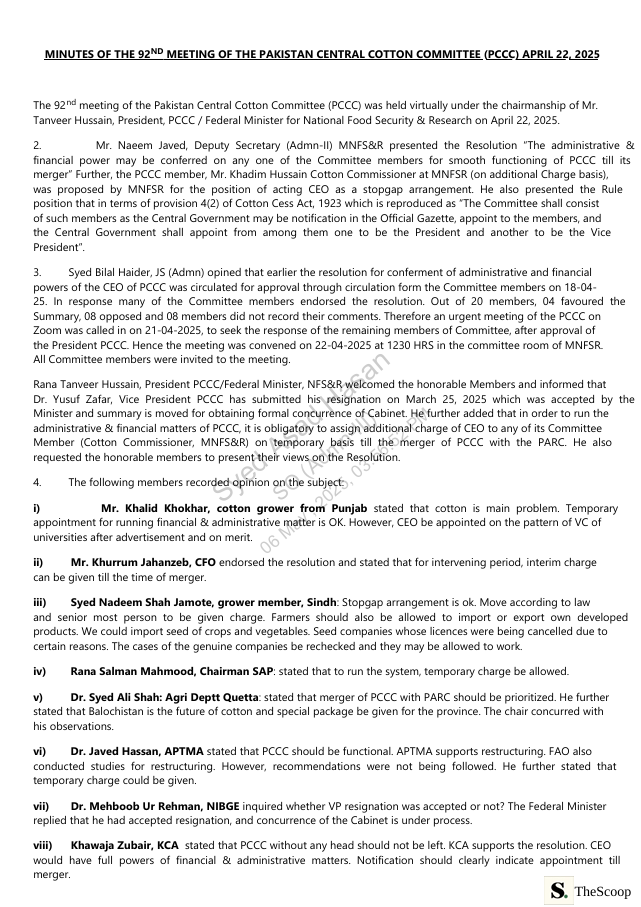
Minutes of the committee’s 92nd meeting, held virtually on April 22, 2025, under the chairmanship of Federal Minister Rana Tanveer Hussain, record discussions concerning the assignment of additional administrative and financial powers to the Cotton Commissioner.
The proposal was linked to the planned merger of PCCC with the Pakistan Agricultural Research Council (PARC).
According to the minutes, the minister described the arrangement as temporary and assured members that a permanent appointment would be made through advertisement and on merit, with the permission of the competent authority.
The temporary arrangement was discussed as lasting until the merger or May 31, 2025.
The resolution received support from 11 of the 13 available members.
However, the minutes also record concerns.
Iqbal Khar, a grower representative from Khyber Pakhtunkhwa, questioned the clarity of the appointment process and requested a physical meeting.
Abdul Hameed, representing growers from Balochistan, urged the ministry to prioritise the merger rather than the allocation of administrative charge.
Dr Javed Hassan, representing the All Pakistan Textile Mills Association, observed that restructuring studies, including work by the Food and Agriculture Organization, had already been conducted but their recommendations were not being followed.
These observations show that PCCC’s leadership structure and institutional restructuring were already subjects of debate.
Government Notification Names Dr Khadim Hussain
An official notification dated April 29, 2025, reproduced in the complaint dossier, identifies Dr Khadim Hussain as Cotton Commissioner and records his appointment as a member of PCCC’s Board of Governors under a stopgap arrangement.
The notification is significant because it provides a documentary connection between Dr Hussain and the institutional arrangements discussed at the April 22 meeting.
However, the board membership notification is not, by itself, proof of a regular or acting CEO appointment.
The complaint alleges that Dr Hussain subsequently exercised chief executive powers without the required authority or beyond the intended temporary arrangement.
That allegation requires examination of his appointment notification, the legal provisions governing the post, any extension orders and subsequent decisions of the competent authority.
The central question is whether Dr Hussain’s exercise of CEO powers was supported by valid authorisation throughout the relevant period.
PCCC and the Ministry of National Food Security and Research should make the appointment and extension records available.
Former PCCC Officer Challenges CEO’s Appointment And Conduct
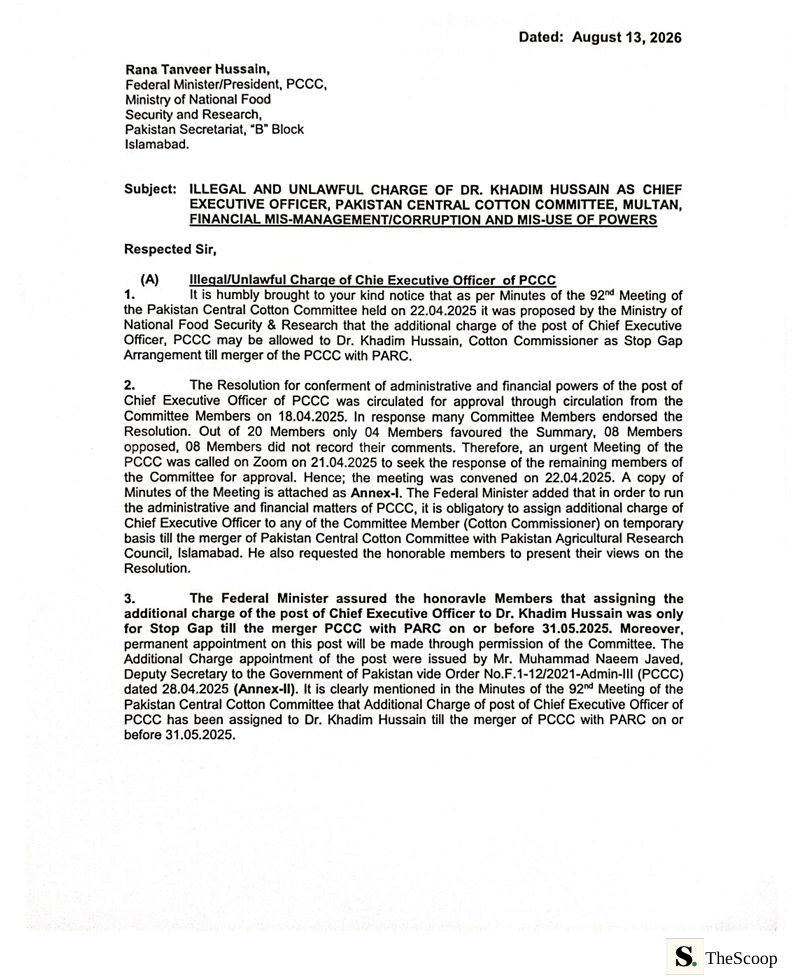
A formal complaint dated August 13, 2026, addressed to Federal Minister Rana Tanveer Hussain by Muhammad Yousaf, a former PCCC administrative officer, raises a series of allegations against Dr Khadim Hussain.
The complaint is titled around alleged illegal charge, financial mismanagement, corruption and misuse of powers.
It challenges the basis of Dr Hussain’s appointment, questions financial transactions and seeks administrative and disciplinary action.
The complainant alleges that Dr Hussain was not properly authorised to continue exercising the powers of chief executive and that his decisions should be examined.
He also raises concerns about the institution’s merger arrangements, pension payments and employee-related decisions.
These are allegations made by a named complainant.
The complaint does not constitute an official finding that Dr Hussain committed corruption, unlawfully occupied office or misused public funds.
Its significance lies in the specific allegations and supporting annexures, which provide material for further verification.
An independent investigation would need to examine the original financial records, relevant service rules, appointment orders and responses of the officials concerned.
Cotton Cess Collections Rise Sharply
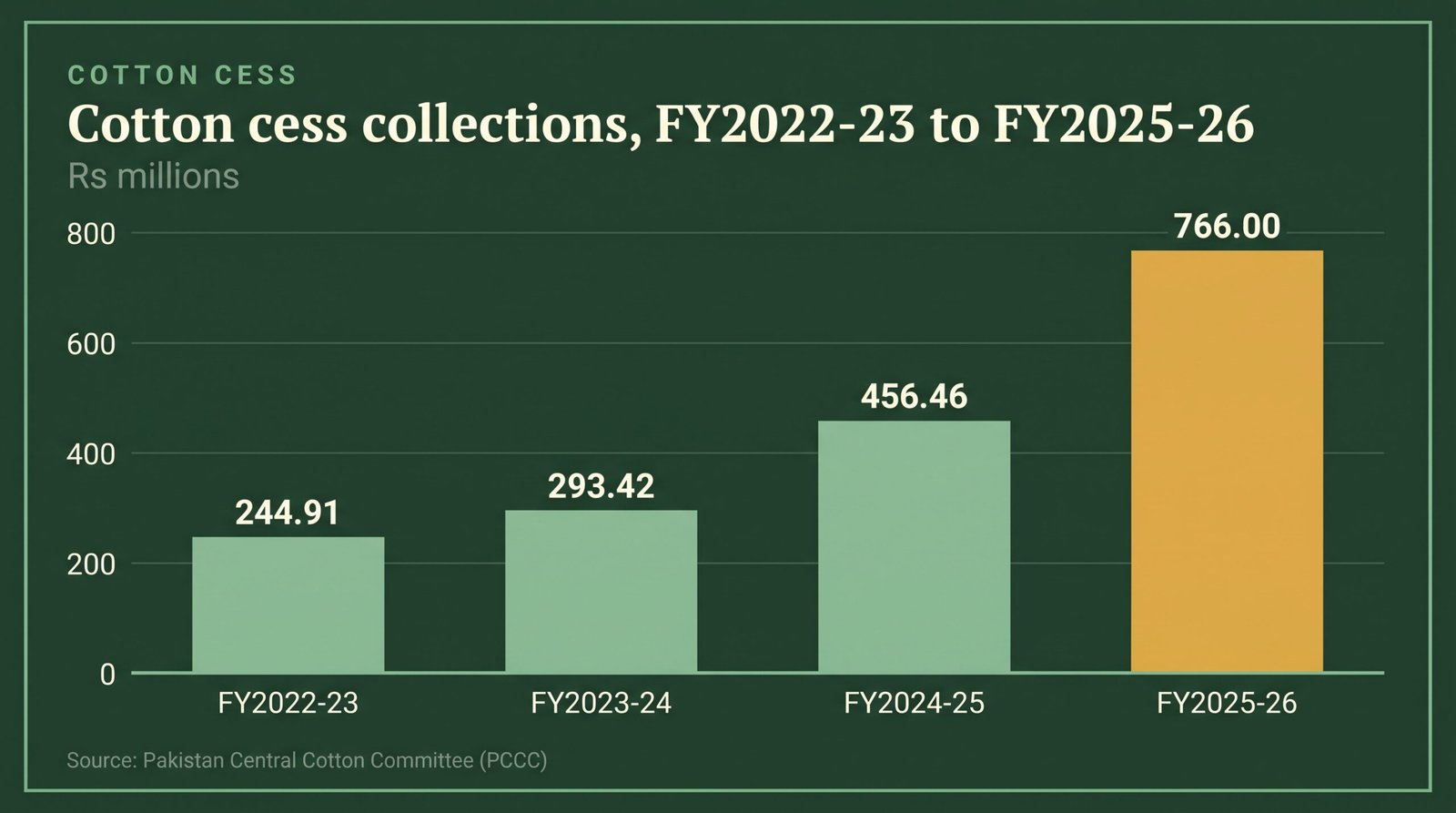
Separate financial records obtained by The Scoop show a substantial increase in reported cotton cess collections.
The collection statement records approximately Rs244.91 million in FY2022–23, Rs293.42 million in FY2023–24, Rs456.46 million in FY2024–25 and Rs766 million in FY2025–26.
The figures indicate that reported annual collections more than tripled between FY2022–23 and FY2025–26.
The increase raises questions about how PCCC’s financial resources were managed during a period when research reports documented operational difficulties and separate allegations emerged concerning delayed payments to employees and pensioners.
However, cess collections alone do not establish the institution’s available cash, expenditure obligations or financial health.
The figures also do not demonstrate that funds were available for every operational requirement.
PCCC may have faced accumulated liabilities, restricted allocations or other financial commitments.
A meaningful assessment requires audited financial statements, bank reconciliations, budget allocations, expenditure records and details of outstanding obligations.
The relevant question is whether the institution’s financial planning adequately supported its research responsibilities and lawful commitments towards employees and pensioners.
Accounts Office Records Payments To CEO
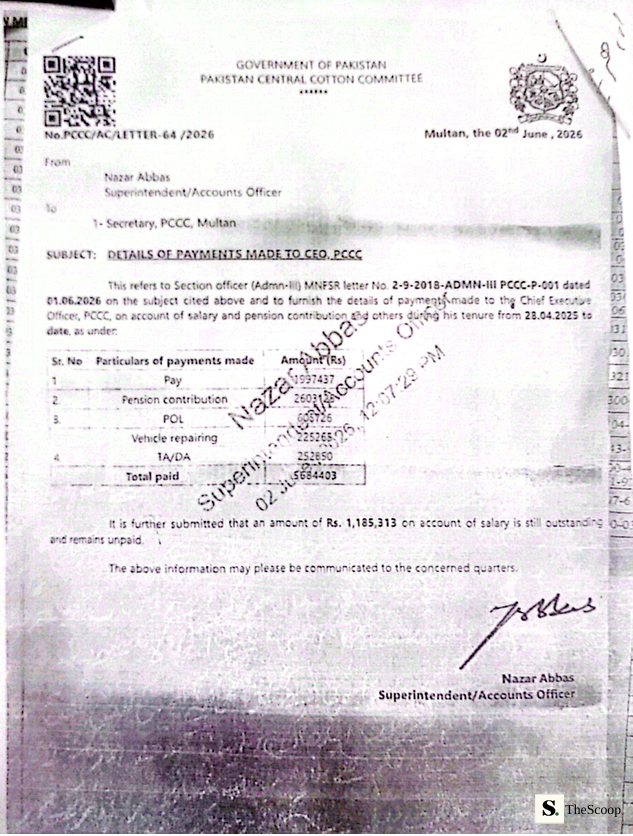
An official communication dated June 2, 2026, issued by Nazar Abbas, Superintendent/Accounts Officer PCCC, provides details of payments recorded against the chief executive’s account.
The letter was addressed to the Secretary PCCC and referred to a request from the Ministry of National Food Security and Research.
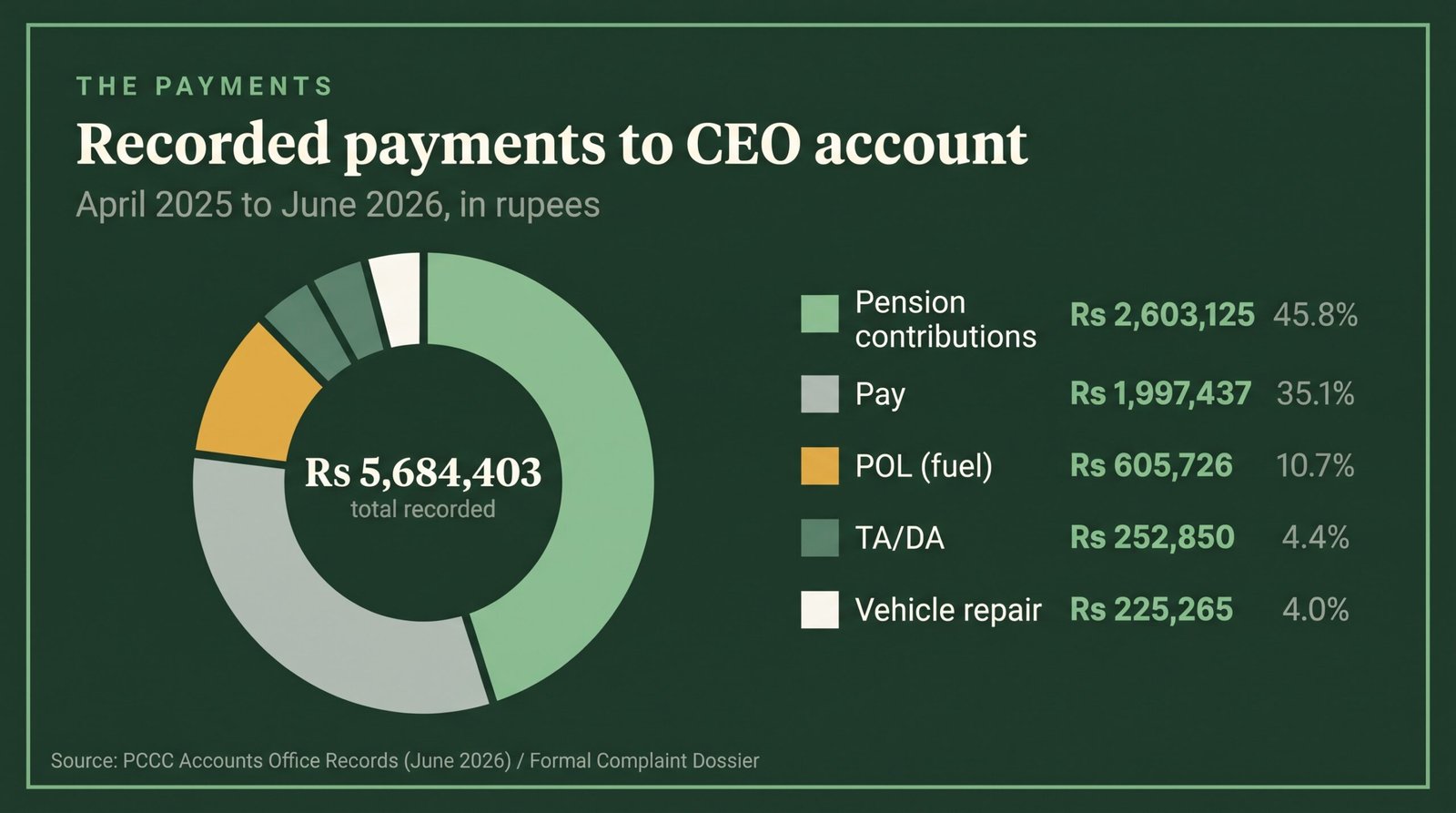
It lists payments under several heads, including salary, pension contribution, POL or fuel expenditure, vehicle repairs and travelling and daily allowances.
The statement also records Rs1,185,313 as outstanding and unpaid on account of salary.
The document provides an accounting record relevant to the complaint’s financial allegations.
However, the existence of these payments does not establish that they were unauthorised or improper.
Nor does the outstanding salary figure establish that the amount was paid.
The complaint questions the propriety of payments and associated financial decisions, but determining whether any irregularity occurred requires examination of the applicable pay entitlements, approvals, vouchers, bank records and service rules.
The amount of Rs1,185,313 relates to the salary balance recorded in the CEO payment statement and should not be confused with separate allegations of salary arrears affecting other PCCC employees.
Complaint Raises Allegations Over Pension-Related Funds
The August 2026 complaint also alleges improper handling of pension-related funds.
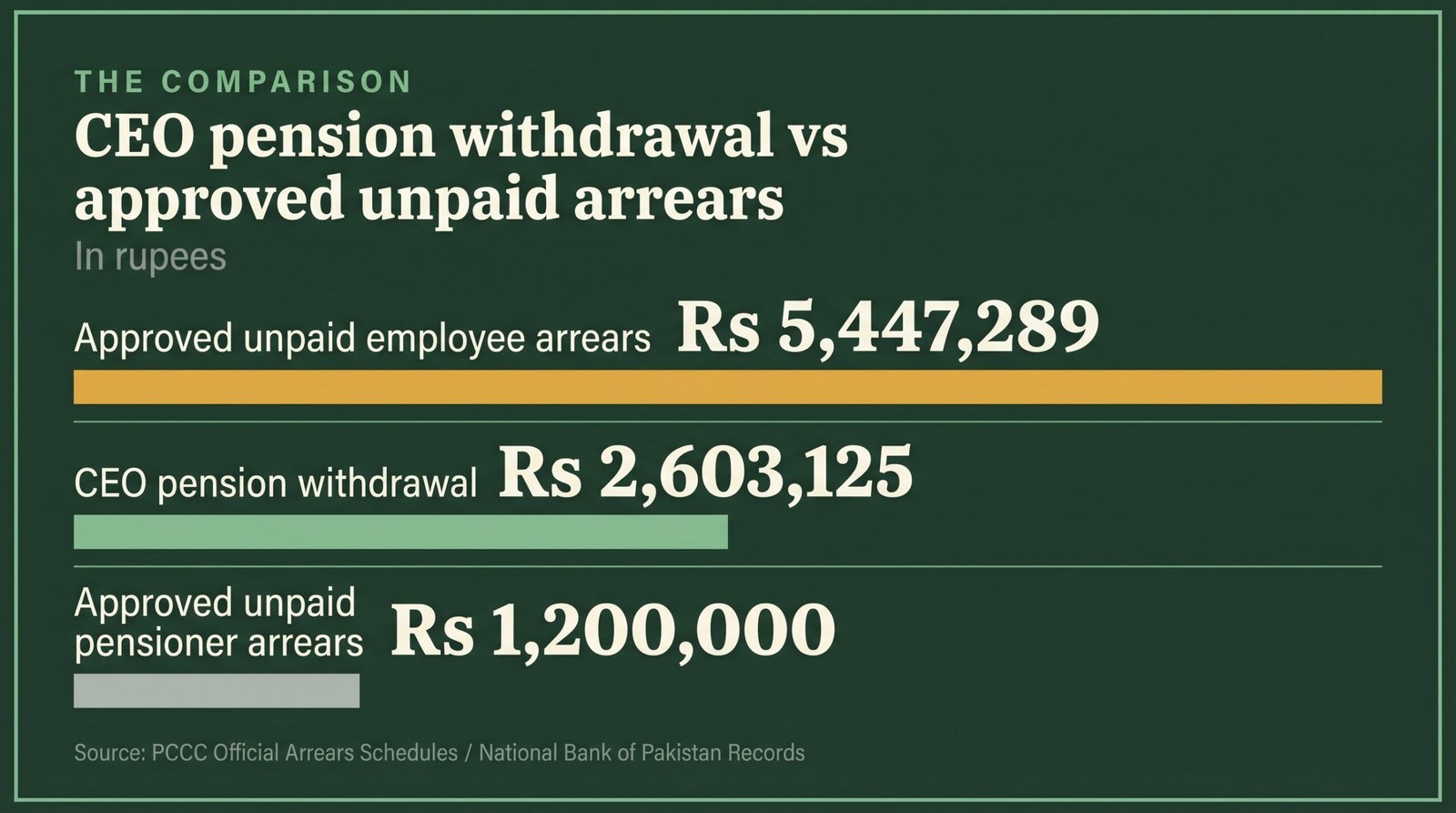
The complainant refers to a transaction of approximately Rs26.03 million and questions the authority under which the funds were withdrawn or utilised.
This allegation requires particular care.
The complaint’s description of the transaction does not, by itself, establish that funds were misappropriated, transferred to Dr Hussain personally or spent for an unauthorised purpose.
The relevant bank records, withdrawal instrument, accounting entries, approvals and pension-fund reconciliation would be necessary to determine the nature and legality of the transaction.
PCCC management should explain the purpose of the transaction, the account from which it originated, the authority approving it and how the amount was recorded in the institution’s accounts.
If the transaction was lawful and properly authorised, the relevant documents should establish that position.
If an audit identifies irregularities, responsibility should be determined through the appropriate legal and administrative processes.
Employee Salary And Pension Arrears Under Scrutiny
The complaint dossier contains schedules relating to employee arrears, pension liabilities and pending payments.
These documents provide additional context for allegations that PCCC has struggled to meet financial obligations towards sections of its workforce.
Separate information obtained by The Scoop alleges that some employees faced salary delays extending to three months.
The precise extent of those alleged delays has not been independently established through complete payroll records.
The schedules in the complaint dossier also require reconciliation with actual payment records before outstanding balances can be conclusively determined.
Nevertheless, the existence of documented arrears schedules raises questions about the institution’s financial planning and payment priorities.
PCCC should disclose the total verified amount of unpaid salaries and pensions, the number of affected employees and pensioners, and the timetable for settling lawful obligations.
It should also explain whether delays resulted from inadequate government funding, accumulated liabilities, administrative decisions or other financial constraints.
Lahore High Court Order Documents Pension Dispute
The complaint dossier includes an order of the Lahore High Court’s Multan Bench dated September 25, 2025, in Writ Petition No. 15529 of 2022.
The case concerns pensionary benefits and arrears claimed by petitioners.
The order records that the petitioners’ grievances had remained unresolved over several years.
It also refers to disciplinary action against persons responsible for cherry-picking in the settlement of pensionary benefits.
The court directed the PCCC chief executive and Secretary Finance to appear personally at the next hearing to assist the court.
The order establishes that the pension dispute had reached judicial proceedings and that the court considered further assistance from senior officials necessary.
However, the order does not establish that Dr Khadim Hussain was convicted of wrongdoing, found personally liable for misappropriation or held in contempt.
The latest status of the proceedings, subsequent compliance reports and any later judicial findings should be obtained before drawing conclusions about continued non-compliance.
Employee Termination Reversed By Federal Ministry
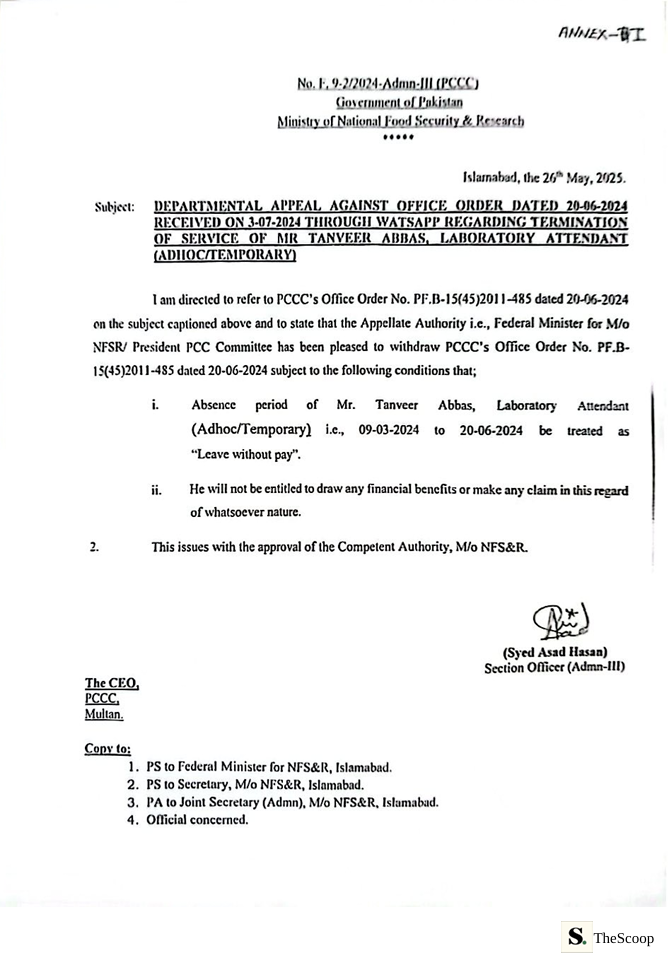
Separate official records reveal a prolonged service dispute involving Tanveer Abbas, an ad hoc Laboratory Attendant at CCRI Multan.
According to the correspondence, Abbas was transferred from CCRI Multan to the Cotton Research Station in Ghotki in March 2024.
His services were subsequently terminated through an order dated June 20, 2024.
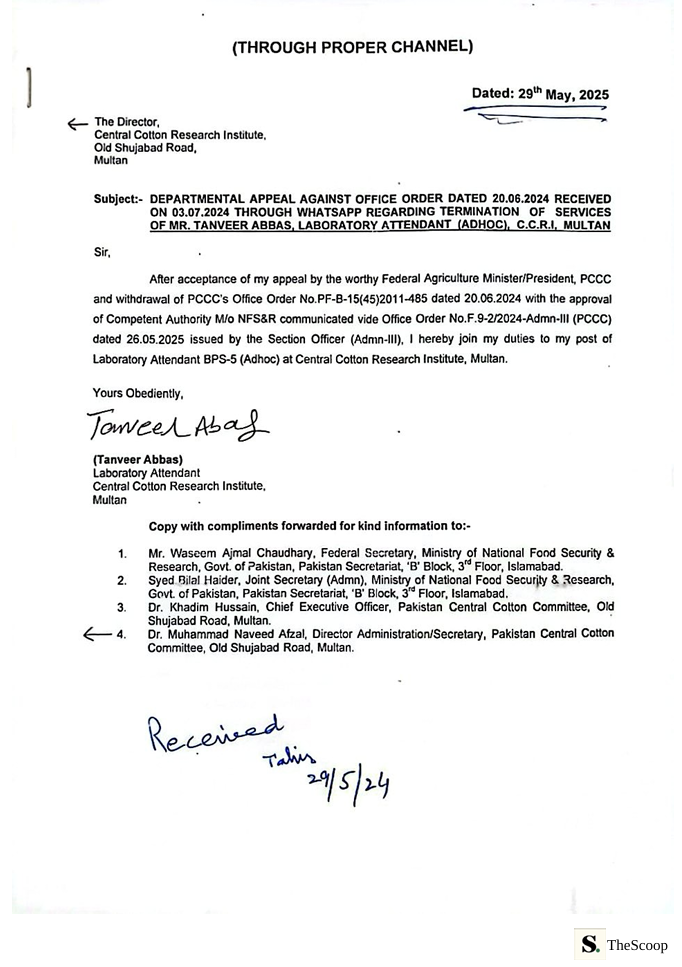
Abbas challenged the decision through a departmental appeal.
On May 26, 2025, the Ministry of National Food Security and Research issued a communication confirming that the competent appellate authority had approved withdrawal of the termination order.
The decision was subject to conditions, including treatment of the specified absence period as leave without pay and exclusion of certain financial claims.
On May 29, 2025, Abbas submitted a joining report to CCRI Multan.
The documents establish that the termination order was withdrawn by the competent authority.
They do not establish that the original termination was motivated by personal retaliation or that Dr Khadim Hussain personally directed it.
October 2026 Orders Renew Administrative Dispute
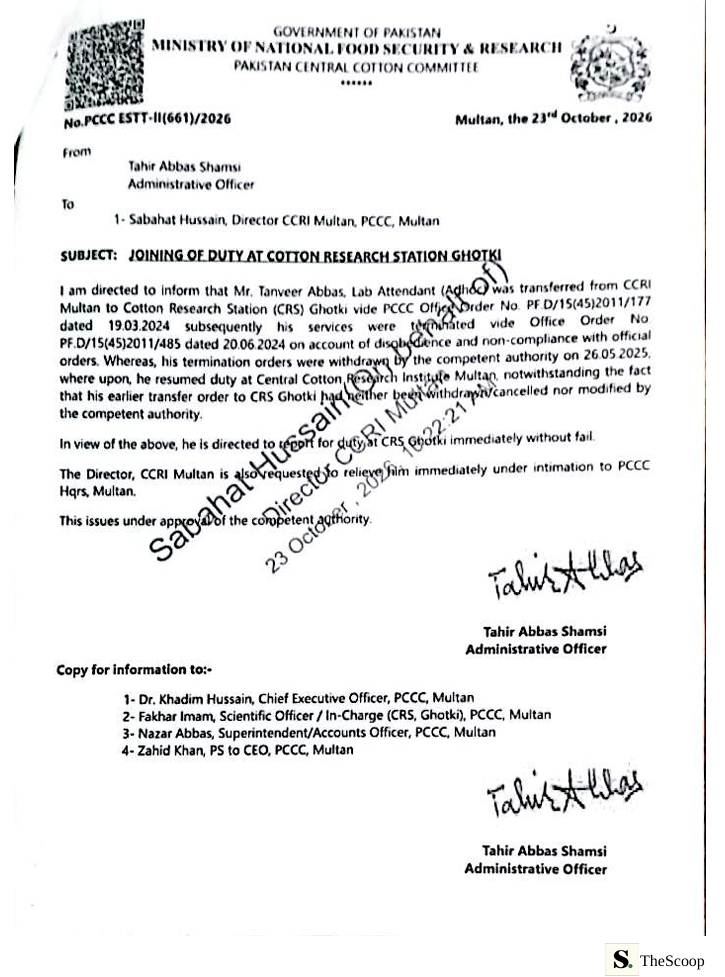
The matter resurfaced through official communications dated October 23, 2026.
A PCCC administrative order directed Tanveer Abbas to report to the Cotton Research Station in Ghotki, maintaining that the original March 2024 transfer order remained effective because it had not been cancelled.
A subsequent order relieved him from CCRI Multan.
The records establish that the institution enforced an earlier transfer following withdrawal of the employee’s termination.
However, they do not establish that the transfer was unlawful.
The case raises questions about the administrative handling of the employee’s posting, the implementation of the appellate decision and the reasons for enforcing the earlier transfer order.
PCCC should provide the relevant service records and explain the legal and administrative basis of the decision.
A separate allegation concerning possible external influence over action involving Abbas has not been independently corroborated and cannot be treated as an established fact.
Why PCCC’s Governance Structure Matters
The April 2025 board minutes show that the institution’s leadership arrangements were discussed against the background of a proposed merger with PARC.
Members were told that temporary arrangements were necessary to maintain administrative and financial operations.
The minutes also record concerns about delayed restructuring and the need for permanent appointments through transparent procedures.
These issues are relevant to the present investigation because unclear leadership arrangements can complicate institutional accountability.
However, the records do not establish that the proposed merger, temporary appointments or subsequent management decisions directly caused the 2026 crop damage.
That connection would require evidence concerning budgets, delegated powers, procurement decisions and operational supervision.
The federal ministry should clarify the present status of the proposed merger, the legal basis of PCCC’s current leadership arrangements and the steps taken to address recommendations from earlier restructuring studies.
Financial Collections Versus Research Performance
The financial and scientific records raise a broader question about institutional priorities.
On one hand, the collection statement records a substantial increase in cotton cess receipts.
On the other, research reports document severe crop damage, shortcomings in pest-monitoring arrangements and a non-functional glasshouse.
These facts do not automatically establish that money was diverted from research or that financial mismanagement caused the operational deficiencies.
Nevertheless, they justify an examination of how research budgets were prepared, approved and spent.
How much funding was allocated to CCRI Multan during FY2025–26?
What proportion was available for crop protection, research equipment, maintenance and seed development?
Were requests for pesticides, monitoring supplies or glasshouse repairs delayed or rejected?
Were funds allocated but not utilised?
And were senior management expenditures approved in accordance with the applicable financial rules?
These questions should be answered through audited records rather than assumptions.
Dr Khadim Hussain’s Leadership Under Scrutiny
For Dr Khadim Hussain, the central issue is the performance and accountability of the institution under his leadership.
The available research reports document serious problems affecting experimental crops and essential research facilities.
The September 16 warning was copied to his office.
The April 2025 board minutes and subsequent government notification provide material relevant to examining the legal basis of leadership arrangements.
The June 2026 accounts statement records payments associated with the chief executive’s account.
The August 2026 complaint raises allegations about his authority and financial decisions.
And the Lahore High Court order confirms that pensionary arrears were the subject of judicial proceedings.
These documents are significant, but they serve different evidentiary purposes.
The research reports establish recorded operational deficiencies.
The board minutes establish decisions and assurances made by committee members.
The accounting statement records payments and an outstanding salary balance.
The complaint contains allegations requiring verification.
The court order records judicial proceedings concerning pensionary benefits.
None of these documents, individually or collectively, establishes that Dr Hussain personally committed corruption, unlawfully appropriated pension funds or deliberately caused damage to research crops.
However, the combination provides substantial grounds for examining his administration and requiring a detailed institutional response.
Questions The Federal Government Must Answer
The Ministry of National Food Security and Research should examine several issues arising from the records.
First, the ministry should establish the actual extent of the experimental crop damage and determine whether failures in pest monitoring, spraying schedules or resource availability contributed to the losses.
Second, it should commission an independent scientific and financial assessment of the damaged breeding material and any resulting disruption to research programmes.
Third, it should examine why the Cytogenetics Section reported longstanding pest-management deficiencies without significant improvement.
Fourth, it should determine why essential glasshouse facilities were not functioning and whether maintenance requests were adequately addressed.
Fifth, it should disclose the legal and administrative basis of Dr Khadim Hussain’s appointment and any continuation of CEO powers.
Sixth, it should reconcile the institution’s cotton cess collections with audited expenditure, outstanding liabilities and research allocations.
Seventh, it should examine the pension-related transaction questioned in the August 2026 complaint and establish whether all relevant approvals and accounting procedures were followed.
Finally, it should clarify the status of employee and pension arrears, the relevant court proceedings and the administrative decisions affecting PCCC personnel.
These questions require a transparent, evidence-based response rather than assumptions of guilt or institutional wrongdoing.
Pakistan’s Cotton Research System Cannot Afford Another Season Of Unanswered Questions
Pakistan’s cotton sector remains important to agricultural livelihoods, textile manufacturing, employment and export competitiveness.
Its long-term productivity depends partly on effective research into improved varieties, seed quality, pest resistance and changing environmental conditions.
The findings at CCRI Multan therefore extend beyond a single research institute.
The reported damage to approximately 43 acres of experimental and breeding crops, combined with warnings about seed quality, recurring pest-management deficiencies and non-functional research infrastructure, raises concerns about the protection of scientific resources.
The administrative and financial controversies surrounding PCCC add another dimension to those concerns.
The institution’s leadership must explain how its resources were managed, how operational deficiencies were addressed and what measures have been taken to protect future research programmes.
Also Read: Zarea’s Rs3 Billion Rights Issue: Why Is A Profitable Company Raising Equity To Repay Sukuk?
Dr Khadim Hussain should be afforded the opportunity to respond to the allegations concerning his appointment, financial decisions and institutional management.
The federal ministry should also disclose the outcome of any inquiries, audits or administrative reviews relating to these matters.
The purpose of accountability is not merely to identify individuals for criticism. It is to establish what went wrong, determine responsibility where supported by evidence and ensure that weaknesses are corrected.
Pakistan cannot afford to allow the institutions responsible for developing its next generation of cotton varieties to deteriorate without explanation.
The central question is whether PCCC’s leadership and the federal government can demonstrate that the documented research failures, financial concerns and administrative disputes have been properly examined — or whether the country’s cotton research system will enter another season with the same questions unanswered.