

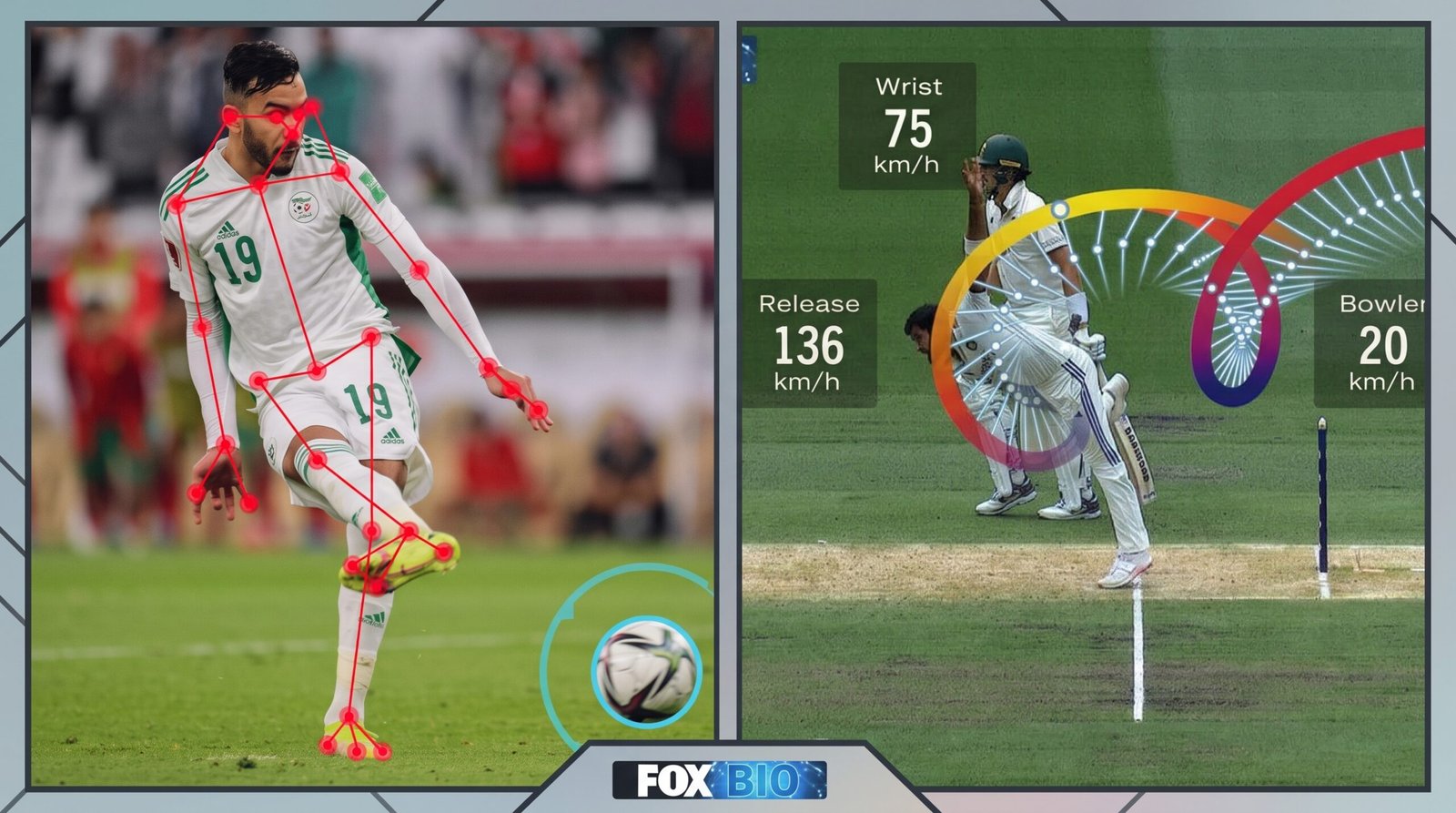
For much of sporting history, performance analysis was something reserved for elite athletes and professional teams. Coaches relied on experience and hours of reviewing match footage to identify weaknesses, refine technique and measure progress. Today, artificial intelligence is changing that process, making it possible to collect and interpret performance data in ways that were difficult to imagine even a decade ago.
What makes this shift particularly interesting is not simply that athletes can access more data, but that technology is beginning to help us understand how performance happens: how a player moves, where their technique breaks down, how consistently they execute a skill and what they might work on next.
In my work in technology, I’ve seen how AI can change the relationship between an athlete and their training. The idea behind much of this innovation is simple; young players should have access to the kind of performance insights and analytical tools traditionally available only to professional athletes. What was once dependent on expensive equipment, specialist facilities and dedicated analysts is increasingly becoming accessible through everyday technology.
AI-powered sports technology platforms are making it possible to track performance, analyse technique and provide insights into accuracy and consistency. The objective is to give athletes and coaches useful information they can act on, rather than relying entirely on observation or memory.
The wider significance lies in the technology behind it. Computer vision allows software to interpret images and video, identify movement and recognise patterns. Combined with machine learning, it can turn ordinary footage into measurable information. A smartphone camera, for instance, can become a tool for tracking a player’s shooting performance without requiring an expensive studio or a complex set-up.
This is particularly important for grassroots sport. Access to sophisticated performance analysis has traditionally depended on a team’s resources, facilities and coaching staff. As AI tools become more accessible, that gap has the potential to narrow. A young athlete training at a local court could begin to receive feedback that was once associated with professional training environments.
Research taking place overseas offers a glimpse of what may be possible. FIFA’s research collaboration with ETH Zurich, one of Switzerland’s leading universities for science and technology, explores how artificial intelligence can generate three-dimensional skeletal tracking from a single broadcast camera. Traditional optical tracking systems often require ten or more cameras positioned around a stadium. The FIFA initiative is investigating whether similar movement information can be extracted from ordinary match footage, potentially making player tracking more accessible. In its first challenge, the winning solution recorded a global average error of 50 centimetres, with a local average error of seven centimetres when measurements were aligned around the hip. These are research benchmarks rather than a finished, universally deployable system, but they demonstrate how quickly the field is progressing.
Cricket is seeing similar developments. A 2026 study published in ‘Scientific Reports’ used deep learning and computer vision to classify batting shots, combining video analysis with AI-based body-pose estimation. The researchers reported 95.61 per cent classification accuracy across 752 test video samples, identifying categories including drives, pulls, cuts, sweeps and flicks. The study demonstrates the potential to analyse batting footage at scale, although classifying a shot is not the same as fully assessing a batter’s technique or providing reliable coaching advice.
Other research is examining the reliability of these tools in real sporting conditions. In a study published in ‘Sports Biomechanics,’ researchers compared the Fulltrack AI application with 3D motion-capture technology to assess how accurately the software could identify bowling line and length. The study analysed 836 cricket deliveries and found strong statistical agreement between the two systems, while also noting measurement limitations that matter when interpreting individual deliveries. This distinction is important: AI-generated data is only useful when we understand how accurately it measures what it claims to measure.
The same principle applies to injury prevention and physical performance. AI can help identify patterns in training loads, movement and recovery, while wearable technology is making more information available to athletes. By bringing together activity, training and recovery data, including information from connected health and fitness platforms, these technologies can give coaches and athletes a more complete picture of performance rather than treating training as an isolated activity.
But the promise of predictive technology needs to be approached rather carefully. Research into AI-powered sports injury prediction has highlighted concerns around data quality, bias and the reliability of results across different athletes and sporting environments. AI may help identify potential warning signs, but it should inform decisions rather than be treated as a definitive forecast.
This is why I believe AI should support coaching, not replace it. A system can identify a recurring movement pattern or flag a change in performance, but it cannot fully understand an athlete’s confidence, motivation, personal circumstances or response to pressure. Those things still require human judgement. The best results come when technology gives coaches better information and allows them to spend more time on the individual athlete.
There is also a growing responsibility to protect the people whose data makes these systems possible. In 2026, the International Olympic Committee introduced a framework for trustworthy AI in sport, setting out principles that include safety, data protection, reliability, transparency, accountability and fairness. These are not abstract concerns, far from it. Athletes need to know what information is being collected and how it is being used.
For countries such as Pakistan, the possibilities are especially significant. We have considerable sporting talent, but access to structured training, specialist coaching and performance analysis is uneven. Technology cannot solve every problem in the sporting ecosystem, nor can it replace investment in facilities and coaching. It can, however, help make better information available to more athletes, including those who are not part of well-funded academies or professional teams.
I see the next phase of sports technology moving towards more integrated and personalised systems. Video analysis, movement tracking, training data and recovery information will increasingly work together. Coaches may be able to follow an athlete’s development over time, identify areas that need attention and adapt training accordingly.
As these tools become more affordable, their value will extend beyond elite sport.
Ultimately, the most interesting question isn’t how much data AI can collect, but what we do with it. Technology should help athletes understand their strengths, work on their weaknesses and make more informed decisions about their development. It should also give coaches another way to see what is happening…without taking away the experience and human connection that make coaching so effective.