

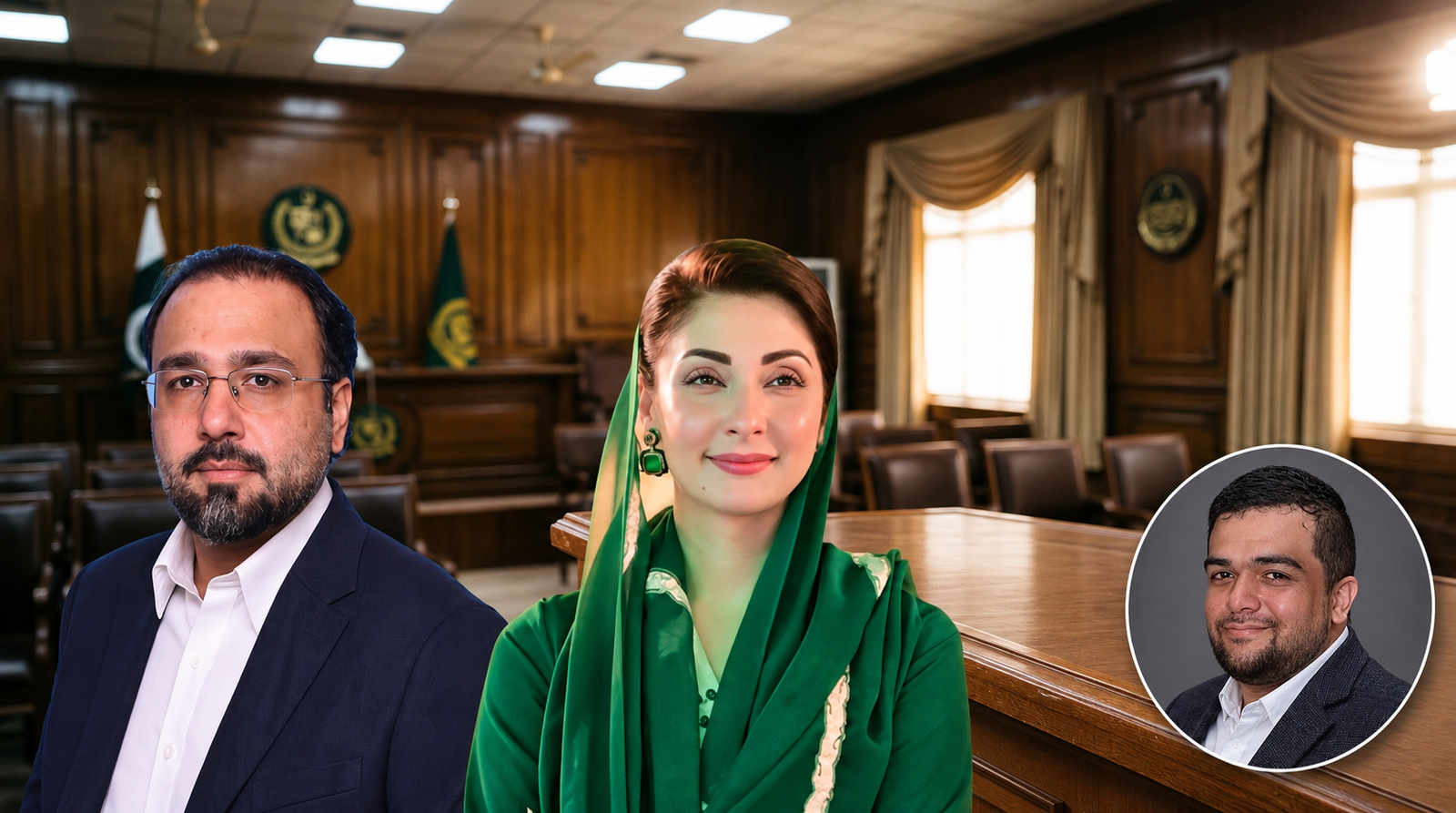
LAHORE, November 4, 2026: The escalating confrontation between Punjab Chief Minister Maryam Nawaz and Federal Minister Chaudhry Salik Hussain has brought questions of corruption, public expenditure and political accountability to the forefront of Punjab’s politics, exposing tensions within the ruling coalition and raising a larger question: can a dispute over government transparency be resolved through a Rs5 billion defamation notice?
The confrontation intensified after Salik Hussain, a senior Pakistan Muslim League-Quaid (PML-Q) leader and Federal Minister for Overseas Pakistanis and Human Resource Development, criticised the Punjab government’s development priorities and spoke of widespread complaints of corruption during a televised interview on November 2.
Maryam Nawaz responded by challenging the federal minister to substantiate his allegations and subsequently issuing a Rs5 billion defamation notice against him, ARY News anchor Naeem Ashraf Butt and the channel’s chairman, Muhammad Iqbal.
Salik has refused to withdraw his remarks, maintaining that corruption exists within Punjab’s administration.
The dispute has developed into more than a disagreement between two political figures. It raises questions about the responsibilities of coalition partners, the evidentiary standards required for allegations against public officials and the transparency of government expenditure.
It also provides an opportunity to revisit earlier allegations concerning Punjab government advertising expenditure investigated by The Scoop in 2024.
A Rs5 Billion Notice And The Politics Of Accountability
Addressing a ceremony in Attock on November 3, Maryam Nawaz challenged Salik Hussain to produce evidence supporting his allegations.
The chief minister maintained that accusations of corruption without credible evidence could damage the reputation of her government and undermine public confidence in provincial institutions.
The subsequent legal notice demanded a retraction, an unconditional apology, correction or removal of the disputed statements and Rs5 billion in damages. It gave the recipients seven days to comply before further legal proceedings could be initiated.
The notice also questioned why Salik had made broad allegations without identifying specific departments, officials, transactions, inquiries or audit findings.
That objection deserves consideration.
Indeed, during the interview, Salik reportedly acknowledged that he did not personally possess evidence substantiating the corruption allegations, although he said he regularly heard complaints about wrongdoing in Punjab.
His subsequent refusal to retract the remarks has intensified the confrontation.
A federal minister making allegations against a provincial government has a responsibility to explain the factual basis of his statements. However, allegations concerning public expenditure can also be examined through official records, procurement documents and independent audits.
The legal and administrative questions are therefore distinct.
A defamation proceeding may determine whether particular statements unlawfully damaged someone’s reputation. It does not automatically resolve separate questions about the authorisation, distribution or utilisation of public funds.
Salik’s Concerns Over Punjab’s Development Priorities
A central element of Salik Hussain’s criticism concerns the distribution of development resources across Punjab.
He alleged that Lahore was receiving a disproportionate share of development expenditure while districts such as Gujrat were not receiving comparable attention.
Salik also questioned what he regarded as excessive government spending, including the use of official aircraft, and called for ministers to be held accountable for their performance.
Punjab Information Minister Azma Bokhari rejected his criticism and cited an allocation of Rs12 billion for development projects in Gujrat.
The competing claims require more than headline budget figures.
An allocation does not necessarily establish how much money has been released, spent or translated into completed projects. Equally, a perceived imbalance does not establish discriminatory spending without examining the province’s overall development programme.
A meaningful assessment would compare district-wise allocations, expenditure, population, infrastructure needs and project completion rates.
These are measurable questions.
Punjab’s government has the right to explain its development priorities. Salik has the right to question them. The evidence required to assess those competing positions lies primarily in the government’s financial and administrative records.
The Scoop’s Rs150 Million Ramazan Negahban Advertising Investigation
The current debate over corruption and transparency also brings renewed relevance to an earlier investigation conducted by The Scoop concerning digital advertising expenditure associated with the Punjab government’s Ramazan Negahban Package.
In 2024, this correspondent published an investigation alleging irregularities in the allocation of approximately Rs150 million in digital advertising business to Channel 7 (Pvt.) Ltd for a campaign conducted between March 15 and March 22 that year.
The investigation, based on information attributed to sources within the Directorate General of Public Relations (DGPR) and the Chief Minister’s Office, alleged that the advertising arrangements had bypassed established departmental procedures.
According to a senior DGPR official quoted in the original report, officials became aware of the disputed advertising arrangements when the company sought payment for the campaign.
The official alleged that the relevant advertising documents lacked the required Special Publicity List (SPL) reference, which the source described as necessary for processing payment.
The investigation further reported that departmental officials requested evidence supporting the advertising expenditure but were allegedly provided screenshots rather than the documentation they considered necessary.
These allegations raised questions about the original authorisation of the campaign, the applicable procurement procedures and the verification of advertising services before payment.
The original investigation also alleged that Punjab Senior Minister Marriyum Aurangzeb had exerted pressure on information department officials to facilitate the disputed payment.
It identified then Secretary Information Syed Danyal Gillani and DGPR Rubina Afzal Khan among the officials whose subsequent removal from their positions was alleged by sources to have been connected to disagreements over the payment.
Those alleged connections were not independently established through an official inquiry in the material available for the present article.
The investigation also named other DGPR officials who, according to its sources, had expressed reservations about approving the expenditure without the documentation they believed was required.
These claims were attributed to sources and did not constitute judicial findings or independently verified conclusions of corruption.
The Scoop has not independently reconfirmed the original procurement records, whether the disputed payment was ultimately released, or whether subsequent proceedings examined the allegations.
Nevertheless, the original investigation identified specific transactions and administrative decisions that could be examined through documentary evidence.
Marriyum Aurangzeb And Azma Bokhari Did Not Respond To Earlier Queries
At the time of its earlier reporting, The Scoop sought responses from Punjab Senior Minister Marriyum Aurangzeb and Information Minister Azma Bokhari concerning allegations surrounding provincial government advertising expenditure.
According to the publication’s account of those approaches, neither minister responded to the questions raised.
The original investigation specifically recorded attempts to contact Marriyum Aurangzeb through telephone and WhatsApp.
The absence of a response did not establish wrongdoing, and it would be incorrect to treat it as an admission that the allegations were true.
However, the questions surrounding the alleged Rs150 million advertising arrangements remain capable of examination through government records.
Who authorised the digital advertising campaign? Which department approved the expenditure? What procurement mechanism was followed? Were the required advertising references and supporting documents issued? Was the payment ultimately released, and if so, through which department?
The Scoop has not obtained updated responses from the ministers or the relevant departments for this article.
These questions concern a specific advertising controversy investigated in 2024. They are not proof of the wider allegations subsequently made by Salik Hussain, nor is there evidence presented here that Salik was referring to this particular transaction.
Their relevance lies in the broader question of how allegations involving public money should be investigated and answered.
From Advertising Expenditure To Wider Questions Of Governance
Government advertising is a legitimate instrument for informing citizens about public programmes, welfare initiatives and administrative services.
However, advertising expenditure also involves public funds and should therefore be subject to clear authorisation, transparent procurement procedures and appropriate verification.
The Ramazan Negahban Package was intended to provide relief to vulnerable households during a period of considerable economic pressure.
Public communication about such programmes may serve a legitimate purpose. Questions about the selection of advertising agencies, the approval of campaigns and the release of payments must nevertheless be assessed under the rules governing public expenditure.
The distinction is important.
An allegation of irregular procurement does not automatically establish corruption. Nor does the fact that a programme served a public purpose remove the obligation to account for how its advertising budget was spent.
The appropriate examination would involve the relevant contracts, approvals, invoices, evidence of campaign delivery and payment records.
If those records establish that procedures were followed, they could help answer the allegations. If they reveal departures from applicable rules, the responsible authorities would need to determine their significance and any appropriate action.
The Deputy Commissioner Controversy
The political confrontation has also become entangled with the appointment of Gujrat’s deputy commissioner.
Maryam Nawaz alleged that Salik Hussain’s criticism was motivated by dissatisfaction over the appointment of an officer in the district.
She maintained that administrative appointments were made on merit and that she would not allow political recommendations to determine the selection of senior officials.
Salik disputed the suggestion that his corruption remarks were prompted by the appointment controversy.
He maintained that the television interview had been recorded approximately three weeks earlier. Reports also quoted him as acknowledging that he had sought an officer capable of handling major development projects, while disputing the allegation that he had demanded the appointment of a particular individual.
These differing accounts have not been conclusively resolved.
The appointment of district administrators should be governed by applicable rules and considerations of administrative competence.
At the same time, a disagreement over an appointment does not independently determine whether separate allegations about government spending are true or false.
The two matters should therefore be assessed on their own evidence.
A Coalition Partner Questioning An Allied Government
The dispute carries particular political significance because Salik Hussain belongs to the PML-Q, which is part of the federal ruling arrangement, while his elder brother, Chaudhry Shafay Hussain, serves as Punjab’s Minister for Industries, Commerce and Investment in Maryam Nawaz’s cabinet.
The confrontation illustrates the complexities of political alliances in which parties cooperate at one level of government while maintaining different political interests and administrative priorities.
Salik’s praise for former chief minister Chaudhry Parvez Elahi has added another dimension to the disagreement.
Maryam Nawaz challenged that assessment, criticising the condition of Gujrat’s infrastructure when she assumed office and highlighting development work undertaken by her administration.
Such competing claims about governance performance are suitable subjects for public debate.
They can be examined through development records, infrastructure assessments and administrative outcomes rather than treated solely as expressions of political loyalty.
Coalition membership does not eliminate a minister’s right to criticise an allied government. It also does not exempt that minister from the responsibility to support serious factual allegations.
Both considerations are relevant to the present dispute.
Can Defamation Proceedings Resolve The Underlying Questions?
Maryam Nawaz’s legal notice places particular emphasis on the absence of documentary evidence accompanying Salik Hussain’s allegations.
That is a substantive issue.
Statements suggesting widespread corruption within a government can carry serious reputational consequences, particularly when made by a serving federal minister.
The public interest in political criticism does not remove the need for accuracy.
At the same time, the outcome of a defamation dispute and the examination of government expenditure are different processes.
The former concerns the legality of statements and any resulting reputational harm. The latter concerns whether public money was authorised, allocated and spent in accordance with applicable rules.
A government can pursue legal remedies against statements it considers defamatory while also making relevant financial and administrative records available for scrutiny.
Those actions are not mutually exclusive.
Similarly, a critic can defend the right to question government conduct while accepting the obligation to identify credible evidence supporting serious allegations.
What The Punjab Government And Salik Hussain Could Disclose
The confrontation has produced several questions that could be addressed through documentary disclosure.
Punjab’s government could publish district-wise development allocations, releases and expenditure figures to clarify competing claims about the distribution of resources.
It could also explain the administrative record surrounding the appointment of Gujrat’s deputy commissioner, including the relevant decision-making process.
The departments concerned could make available the procurement, authorisation and payment records relating to the 2024 Ramazan Negahban digital advertising arrangements previously investigated by The Scoop.
Where complaints or inquiries concerning those arrangements exist, their status and findings could be disclosed in accordance with applicable law.
Salik Hussain, meanwhile, could identify the departments, projects, transactions or complaints underlying his wider allegations and clarify which information is based on his direct knowledge and which is based on accounts provided by others.
These steps would allow the public to examine the competing positions through evidence rather than relying entirely on political statements.
Beyond Salik And Maryam: Punjab’s Larger Accountability Question
The confrontation between Chaudhry Salik Hussain and Maryam Nawaz reflects a recurring difficulty in Pakistan’s political discourse: allegations about governance often become entangled with disputes over loyalty, authority and personal reputation.
Yet the underlying questions concern institutions rather than personalities alone.
Public expenditure should be capable of independent scrutiny. Serious allegations against public officials should be supported by credible evidence. Government responses should address specific concerns through facts and records wherever possible.
The Scoop’s earlier investigation into the alleged Rs150 million Ramazan Negahban advertising arrangements illustrates the importance of distinguishing reported allegations from established findings.
It also identifies a set of questions that can be tested against official documentation.
Salik’s criticism of Punjab’s development priorities presents another opportunity for evidence-based examination, while Maryam Nawaz’s legal response raises legitimate questions about the standards expected of those making public accusations.
The central issue is therefore not simply whether Salik withdraws his remarks or whether the chief minister pursues defamation proceedings.
It is whether the political and legal confrontation leads to greater clarity about the administration of public resources.
A Rs5 billion legal notice may determine how a political allegation is contested. The questions surrounding public expenditure, development priorities and administrative accountability still require examination on their own merits.