

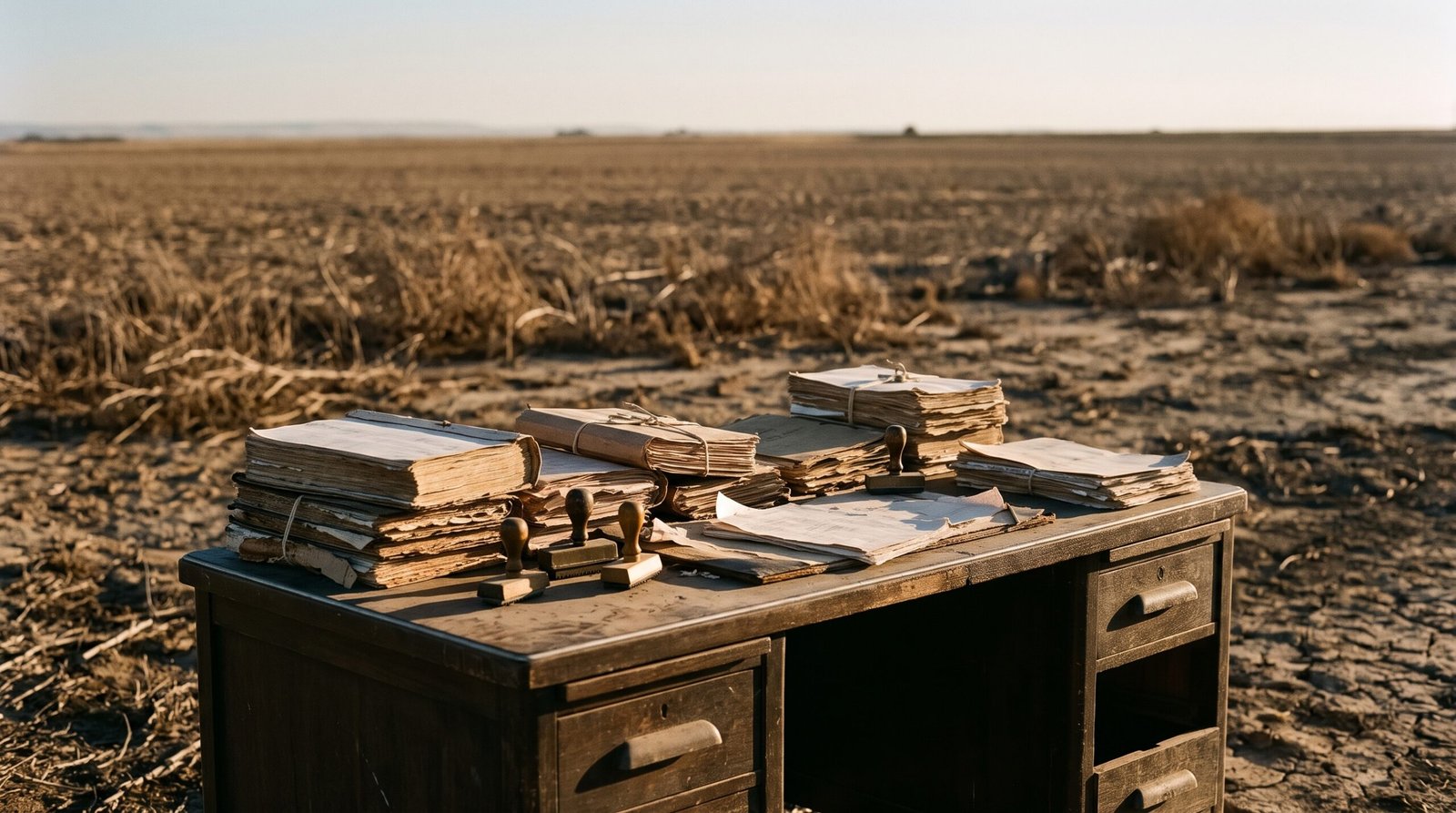
In 1959, a Chinese farming district that produced more grain per head could also suffer more deaths from famine. One would ordinarily expect the better harvest to give its growers a better chance of surviving a shortage. Between the field and the kitchen, however, stood an official estimate of how much grain the district could spare. A family could find itself hungry because its land had earned a reputation for abundance.[1]
Part IV examined how privilege acquires the protection of law. There is a further question. How does an arrangement survive the evidence of the injury it does? Those who defend it need only establish which account of its performance will count as evidence. The cultivator counts the meals left in the house. The official counts the sacks delivered against a target. Both may report their figures honestly. Only one of them gets to declare the policy a success.
In their study of China’s Great Famine of 1959–61, economists Xin Meng, Nancy Qian and Pierre Yared examined differences in mortality across rural regions. The authorities expected more productive districts to surrender a larger share of their grain. When output fell, procurement demands adjusted too slowly. A demand calculated on yesterday’s abundance could leave a productive village with less to eat than a poorer neighbour. The researchers identified this rigidity as a substantial contributor to mortality. Their finding concerns the way a shortage was distributed. An account of the harvest alone cannot explain who went hungry.[1]
Consider what it would have taken to correct the error. Someone would have had to establish how much grain remained after collection, bring that evidence to an authority able to reduce the demand, and secure a decision before the next meal was missed. A subsequent correction to the annual figures would have been of considerable interest to a historian. Its value to the hungry household diminished by the day. Institutions generally keep a record of when they issued an order. How many keep an equally careful record of how long an injured person waited to have it reconsidered?
A public narrative can acquire authority without anybody sitting down to invent a lie. The ministry asks districts for a particular figure because it is the figure for which the minister must answer. The district officer asks the village for the same figure.
Within a year everyone knows a great deal about deliveries and remarkably little about the condition of those delivering. The danger begins when the very consistency of the returns is taken as independent confirmation. A thousand reports may trace their ancestry to one mistaken question.
We can follow a warning in unusual detail in the record of the American space shuttle Challenger. On the evening before the launch in January 1986, engineers at Morton Thiokol were concerned about the behaviour of seals in the booster joints in the predicted cold.
Also Read: Why Civilisations Collapse—IV
The contractor initially recommended against launching below 53 degrees Fahrenheit. Its managers subsequently reversed that recommendation. Engineers continued to object. The officials who made the launch decision received the assent without the history of how it had been obtained. All seven aboard died.[2]
The presidential commission could reconstruct that sequence afterwards because it heard people whose disagreement had disappeared from the decision presented at the time. Think of the difference between the two records.
In one, a contractor authorised a launch. In the other, a contractor authorised a launch over the continuing objections of engineers who understood the joint. For an official deciding whether to proceed, those are materially different facts. A signature had carried the full authority of the organisation upwards while leaving some of its most relevant knowledge behind.
An engineer can be mistaken. So can a farmer. An administration would soon become helpless if every objection automatically overturned a decision. But the official who overrules an objection should have to identify it accurately, give reasons and own the consequences. That modest obligation changes the discussion in the room.
It also gives the next decision-maker something more valuable than the assurance that all concerned were consulted. She can discover what precisely they disagreed about and whether later experience settled the matter.
For readers in Pakistan, consider an ordinary claim of public achievement. A provincial budget provides for a girls’ school. A building is completed, inspected and entered on the list of functioning schools. Each step can withstand an audit of the relevant paperwork. A mother still has a question which none of the certificates answers.
On how many days last month could her daughter go there and find a teacher? A department willing to publish that answer district by district, invite correction from parents and say who must act on it has given the public a means of testing its claim. A photograph of the opening ceremony cannot do that work.
There is a distinction here between a society that suffers an error and one that repeatedly reproduces it. The loss of a spacecraft was a catastrophe. The commission’s public record also shows that a society can preserve the testimony required to challenge an official decision.
Whether it learns depends on what happens to the next engineer who asks for a delay. Likewise, an inquiry into hunger earns its keep when a fresh report from a village can alter the next collection. The institutional achievement is measured at the second decision.
Why does the pattern recur across societies with such different beliefs? Holding office gives people both the means to act and an interest in how their actions are described. Those two functions travel together unless someone deliberately separates them.
Independent statistics, a committee able to call a dissenting witness, a local newspaper with access to the original return and a remedy available in time each make that separation a little more real. None requires the ruler to become unusually virtuous. Each allows somebody outside the chain of command to ask a question the chain has overlooked.
Perhaps the most expensive official story is the one a country tells about its own strength. A government can conceal a bad harvest for a season. It can finance an ambitious undertaking for years by pledging revenues its successors will have to collect. By the time the public sees the full account, the decision may be harder to reverse than a launch on a cold morning. It is to that account that we turn next.
Endnotes
- Xin Meng, Nancy Qian and Pierre Yared, “The Institutional Causes of China’s Great Famine, 1959–1961”, Review of Economic Studies (2015).
- Presidential Commission on the Space Shuttle Challenger Accident, Report, chapter V (1986).
[To be continued]