

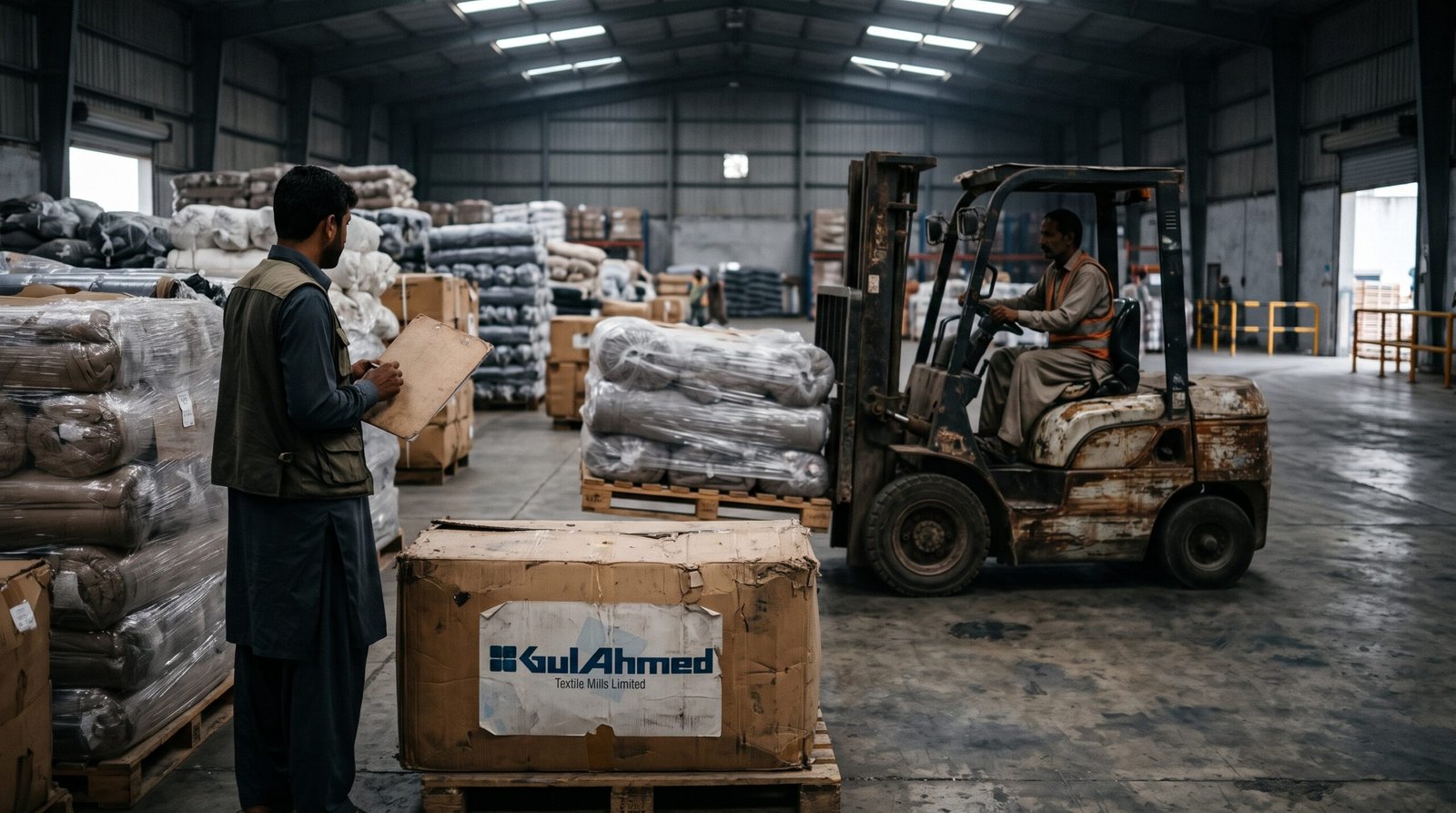
KARACHI, October 29, 2026: Gul Ahmed Textile Mills Limited has reported a 116 per cent year-on-year increase in net profit to Rs505.92 million for the first quarter of the financial year 2026-27, despite a significant contraction in sales and direct exports, highlighting the company’s ongoing efforts to improve profitability through cost optimisation, financial restructuring and a shift towards higher-margin products.
According to the company’s unaudited financial statements for the three months ended September 30, 2026, profit after taxation more than doubled from Rs234.12 million in the corresponding quarter of the previous financial year.
The earnings recovery comes at a challenging time for Pakistan’s textile industry, which continues to face elevated energy costs, expensive financing, volatile raw material prices and subdued demand in major international markets.
The company’s earnings per share increased to Rs0.68 from Rs0.32 a year earlier, reflecting the improvement in profitability.
However, the financial results also reveal underlying operational challenges, particularly declining export revenues, lower production volumes, rising working capital requirements and pressure on operating profitability.
Sales Decline By Rs6.85 Billion As Direct Exports Fall Sharply
Gul Ahmed’s net sales declined by approximately Rs6.85 billion, falling 16.9 per cent to Rs33.73 billion during July-September 2026, compared with Rs40.58 billion in the corresponding period last year.
The decline was primarily attributable to weaker direct export sales, which dropped 28 per cent to Rs21.66 billion from Rs30.04 billion.
In US dollar terms, direct exports contracted by 26.6 per cent, reflecting a substantial reduction in international sales.
The company attributed the decline partly to its deliberate strategy of prioritising profitable orders over sales volumes.
Management explained that it had concentrated production capacity on business that could be priced to reflect higher input costs rather than pursuing additional orders at less attractive margins.
Despite the decline in direct exports, other revenue segments performed positively.
Indirect exports increased approximately four per cent to Rs7.50 billion from Rs7.23 billion, while domestic sales rose 38 per cent to Rs4.57 billion from Rs3.31 billion.
The stronger performance in domestic sales and indirect exports provided some support to overall revenue, although it was insufficient to offset the substantial decline in direct international shipments.
Gross Profit Declines But Profit Margins Improve
Gul Ahmed reported gross profit of Rs3.58 billion, compared with Rs3.97 billion during the corresponding quarter last year, representing a decline of approximately 9.8 per cent.
However, its gross profit margin improved from 9.78 per cent to 10.62 per cent, indicating better profitability relative to each rupee of sales.
The improvement came despite higher fibre prices, increased labour expenses following revisions in minimum wages and reduced production volumes that spread fixed manufacturing overheads across fewer units.
Cost of sales declined to Rs30.15 billion from Rs36.61 billion, a reduction of approximately 17.6 per cent.
Operating profit, however, decreased to Rs1.39 billion from Rs1.69 billion, showing that the recovery in net earnings was not driven by stronger operating profits.
Selling and distribution expenses increased to Rs1.07 billion from Rs907.20 million, while administrative expenses declined to Rs1.03 billion from Rs1.30 billion.
Other income rose significantly to Rs711.76 million from Rs363.14 million, providing additional support to profitability.
The results suggest that reduced financing expenses, higher other income and improved gross margins played important roles in strengthening the company’s bottom line despite weaker operating performance.
Finance Costs Fall 18% As Company Pursues Debt Reduction
One of the notable developments during the quarter was the reduction in Gul Ahmed’s finance costs.
Financing expenses declined approximately 18.3 per cent to Rs1.07 billion from Rs1.31 billion in the corresponding quarter of FY2025-26.
The company attributed the reduction to lower average borrowing rates, greater utilisation of cheaper financing facilities and financial restructuring undertaken during the preceding financial year.
Management identified debt reduction as a central component of its transformation strategy, maintaining that improvements in its financing structure should continue supporting profitability.
Profit before levies and taxation increased approximately 40 per cent to Rs1.03 billion from Rs738.02 million.
After accounting for levies of Rs435.83 million and taxation of Rs91.10 million, the company recorded net profit of Rs505.92 million.
The latest results also represent a significant sequential recovery from the Rs579.5 million loss reported in the immediately preceding quarter, amounting to an earnings improvement of approximately Rs1.09 billion.
Consolidated Profit Rises 108% To Rs640 Million
The group’s consolidated financial statements, which incorporate its subsidiaries, present a broader picture of Gul Ahmed’s performance.
Consolidated profit after taxation increased approximately 108 per cent to Rs639.52 million from Rs307.10 million during the corresponding quarter last year.
Consolidated revenue declined 15.6 per cent to Rs41.14 billion from Rs48.78 billion, while gross profit decreased modestly to Rs6.88 billion from Rs7.04 billion.
Despite the revenue contraction, consolidated operating profit, including other income, increased to Rs2.69 billion from Rs2.56 billion.
Consolidated finance costs declined to Rs1.47 billion from Rs1.76 billion, while earnings per share increased to Rs0.86 from Rs0.41.
The consolidated results indicate that the improvement in profitability extended beyond the parent company’s standalone manufacturing operations, although the group continued to face declining sales.
Operating Cash Flow Turns Negative As Working Capital Requirements Rise
While Gul Ahmed reported stronger profitability, its standalone cash flow statement revealed considerable pressure on working capital.
Net cash used in operating activities reached Rs6.35 billion during the quarter, compared with positive operating cash flow of Rs4.56 billion in the corresponding period last year.
The deterioration was primarily associated with increased inventories and trade receivables.
Stock-in-trade increased to Rs44.63 billion at September 30, 2026, from Rs42.22 billion at the end of June, while trade debts rose to Rs22.40 billion from Rs18.10 billion.
The company recorded a working capital outflow of approximately Rs7.76 billion during the quarter.
Short-term borrowings increased to Rs47.45 billion from Rs40.51 billion over the same period, indicating greater reliance on short-term financing.
Total standalone assets stood at Rs139.37 billion, compared with Rs133.45 billion at June 30, 2026, while shareholders’ equity increased to Rs48.44 billion from Rs47.93 billion.
The figures highlight the distinction between the company’s improved accounting profitability and the cash required to finance its operations.
Gul Ahmed Accelerates Solar, Wind And Battery Storage Investments
A major component of Gul Ahmed’s restructuring strategy involves expanding renewable energy generation and reducing dependence on conventional electricity supplies.
According to the directors’ report, the company’s Landhi manufacturing facility currently operates 20 megawatts of solar power supported by 8.8 megawatt-hours of battery storage.
The company plans to add another 10 megawatts of solar generation and five megawatts of wind power at Landhi by the end of 2026.
At Nooriabad, Gul Ahmed is developing additional renewable energy infrastructure to support the relocation and expansion of spinning operations.
Its Nooriabad-I facility is scheduled to become operational during March-April 2027, supported by 7.5 megawatts of wind power, six megawatts of solar generation and 20 megawatt-hours of battery storage.
A second spinning unit is expected to relocate from Landhi to Nooriabad during June-July 2027.
That facility is planned to operate with approximately 15 megawatts of wind generation, nine megawatts of solar capacity and 20 megawatt-hours of battery storage.
Together, the disclosed renewable energy installations and planned additions represent approximately 72.5 megawatts of solar and wind generation capacity, alongside 48.8 megawatt-hours of battery storage, subject to successful completion of the projects.
The investments are intended to improve energy reliability, reduce manufacturing costs and strengthen the company’s environmental credentials with international customers.
Manufacturing Restructuring To Shift 70% Of Landhi Spinning Load
Gul Ahmed also plans to undertake a substantial reorganisation of its manufacturing footprint.
By the end of 2027, approximately 70 per cent of the spinning load currently located at Landhi is expected to have shifted to Nooriabad.
The relocation will allow renewable energy infrastructure at Landhi to support weaving and processing operations.
Management has indicated that additional capacity investments scheduled for mid-2027 will facilitate the company’s entry into higher-margin product categories.
The company expects the initial benefits of its restructuring programme to emerge during the current financial year, with the full financial impact materialising as the projects are completed.
Spinning capacity utilisation has already reached 100 per cent, according to management.
Fixed-Price Export Contracts Expose Company To Rising Costs
The company’s directors also highlighted the impact of international geopolitical developments on manufacturing costs.
Disruptions associated with the Middle East conflict and restrictions affecting shipping through the Strait of Hormuz have contributed to higher global input and energy prices.
Gul Ahmed explained that its export contracts generally carry fixed prices for periods ranging from six to twelve months.
As a result, increases in raw material and energy costs cannot always be passed on immediately to international customers.
The company said several contracts had already been renegotiated at higher prices, while the remaining contracts were expected to undergo revisions.
Management believes these adjustments should support improved pricing and profitability in subsequent quarters.
However, the actual impact will depend on international demand, input costs and the company’s ability to secure orders at commercially viable prices.
Pakistan’s Textile Exports Rise 5% Despite Industry Challenges
The company’s financial performance comes against a mixed backdrop for Pakistan’s textile sector.
According to figures cited in Gul Ahmed’s directors’ report, Pakistan’s textile exports increased approximately five per cent to $5 billion during the first quarter of FY2026-27, compared with $4.8 billion in the corresponding period last year.
Readymade garment exports increased 16 per cent, while cotton yarn exports rose 25 per cent.
Knitwear exports increased four per cent, bedwear exports remained broadly unchanged and cotton cloth exports declined five per cent.
The figures suggest that export growth remained concentrated in selected product categories rather than reflecting a uniform recovery across the textile value chain.
Gul Ahmed’s own decline in direct exports illustrates the challenges individual manufacturers can face even when aggregate sector exports are increasing.
The directors identified high electricity tariffs, financing costs, volatile fibre prices, duties on imported raw materials and delays in tax refunds as continuing constraints on competitiveness.
Energy Prices And European Demand Remain Major Risks
The company’s management maintained a cautious assessment of international economic conditions.
The directors noted that the European market, a major destination for Pakistan’s home textile exports, continued to experience subdued demand amid elevated energy costs.
They also highlighted inflationary pressures within Pakistan, where higher fuel and electricity prices have increased production costs.
According to the company’s economic assessment, inflation exceeded 10 per cent during the first quarter, while the policy rate remained at 11.5 per cent.
Although remittance inflows have supported external account stability, the company expects financing and energy costs to remain important challenges for exporters.
Against this backdrop, Gul Ahmed intends to maintain its focus on inventory management, working capital discipline, manufacturing efficiency, market diversification and higher-value textile products.
Outlook: Profit Recovery Encouraging, But Sales And Cash Flow Remain Critical
Gul Ahmed’s first-quarter performance represents a significant improvement in profitability, with standalone net earnings more than doubling and consolidated earnings also recording substantial growth.
However, declining sales, weaker direct exports, reduced operating profit at the standalone level and negative operating cash flow indicate that the company’s transformation remains a work in progress.
Its planned renewable energy investments, manufacturing consolidation and expansion into higher-margin product categories could provide longer-term operational benefits, although the scale and timing of those gains remain dependent on execution.
For investors and industry observers, the coming quarters will be important in determining whether the recovery in earnings can be accompanied by stronger revenue growth, improved cash generation and a more sustainable financial position.
The company is chaired by Mohomed Bashir, while Mohammed Zaki Bashir serves as Chief Executive Officer.
The directors’ report, dated October 24, 2026, emphasised management’s commitment to implementing its transformation strategy while navigating a challenging domestic and international operating environment.
The latest financial results demonstrate that Gul Ahmed has made measurable progress in restoring profitability, but sustaining that recovery will require balancing cost reductions and financial restructuring with renewed export growth and improved cash flows.