

LAHORE, October 29, 2026: Sazgar Engineering Works Limited, one of Pakistan’s leading automobile manufacturers, has reported an 8.63 per cent decline in quarterly net profit despite recording a substantial 23.32 per cent increase in revenue, highlighting the growing pressure of taxation, rising operating expenses and regulatory uncertainty on the country’s automotive industry.
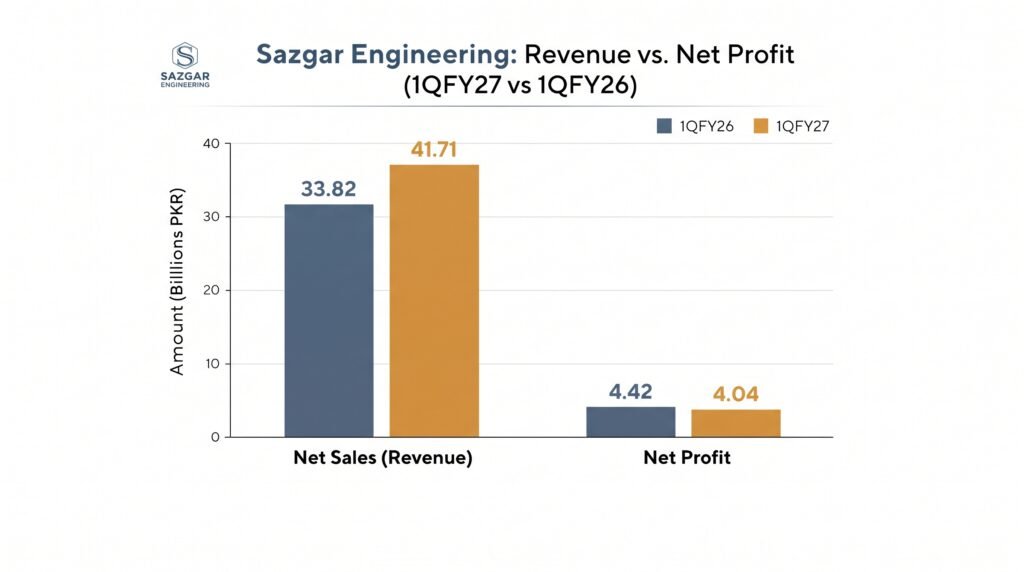
According to the company’s unaudited financial statements for the first quarter ended September 30, 2026, Sazgar posted a net profit of Rs4.04 billion, compared with Rs4.42 billion during the corresponding quarter of the previous financial year.
The decline in profitability came despite net sales increasing to Rs41.71 billion from Rs33.82 billion, representing additional revenue of approximately Rs7.89 billion.
The financial results reveal that while Sazgar maintained strong revenue generation through its diversified automotive portfolio, increased costs and the decision to absorb additional sales tax on hybrid vehicles placed considerable pressure on its earnings.
The company’s earnings per share declined to Rs66.77 from Rs73.07 in the corresponding quarter last year.
Despite the decline in profitability, Sazgar’s Board of Directors announced an interim cash dividend of Rs5 per ordinary share, equivalent to 50 per cent.
Revenue Climbs But Profitability Comes Under Pressure
A detailed examination of Sazgar’s quarterly financial statements reveals a widening gap between revenue growth and profitability.
The company’s net sales increased by approximately Rs7.89 billion, while its cost of sales surged from Rs25.30 billion to Rs33.20 billion, representing an increase of approximately 31.2 per cent.
Consequently, gross profit remained almost unchanged at Rs8.51 billion, compared with Rs8.52 billion in the corresponding period last year.
However, the company’s gross profit margin declined significantly from approximately 25.2 per cent to 20.4 per cent, reflecting increased pressure on its core manufacturing operations.
Operating profit also declined by approximately 9.7 per cent to Rs6.15 billion from Rs6.81 billion.
Profit before taxation fell to Rs6.44 billion from Rs7.24 billion, a decline of approximately 11.1 per cent.
The company’s tax expense decreased to Rs2.41 billion from Rs2.83 billion, partially cushioning the decline in after-tax earnings.
These figures suggest that the principal challenge facing Sazgar during the quarter was not revenue generation but the ability to maintain profitability amid higher costs and changing taxation requirements.
Hybrid Vehicle Sales Tax Increase Hits Margins
One of the most significant developments affecting Sazgar’s quarterly performance was the increase in sales tax on hybrid vehicles.
According to the directors’ review, the sales tax rate on hybrid vehicles increased from the previous rates of 8.5 per cent and 12.75 per cent to 18 per cent.
Rather than passing the additional tax burden on to customers through higher vehicle prices, Sazgar decided to maintain its existing product prices.
The company stated that this decision was intended to preserve market competitiveness and support customer demand during a period of uncertainty.
However, absorbing the additional tax burden adversely affected profitability.
The development highlights a broader challenge for Pakistan’s automotive manufacturers, particularly companies investing in hybrid and other new-energy vehicles.
Higher taxation can create a difficult commercial environment in which manufacturers must choose between increasing prices, potentially weakening demand, and absorbing additional costs at the expense of profit margins.
For Sazgar, the decision helped maintain its market positioning but contributed to the decline in quarterly earnings.
Four-Wheeler Sales Decline Despite Higher Revenue
Sazgar’s four-wheeler business, which represents the overwhelming majority of its revenue, experienced a decline in vehicle sales during the quarter.
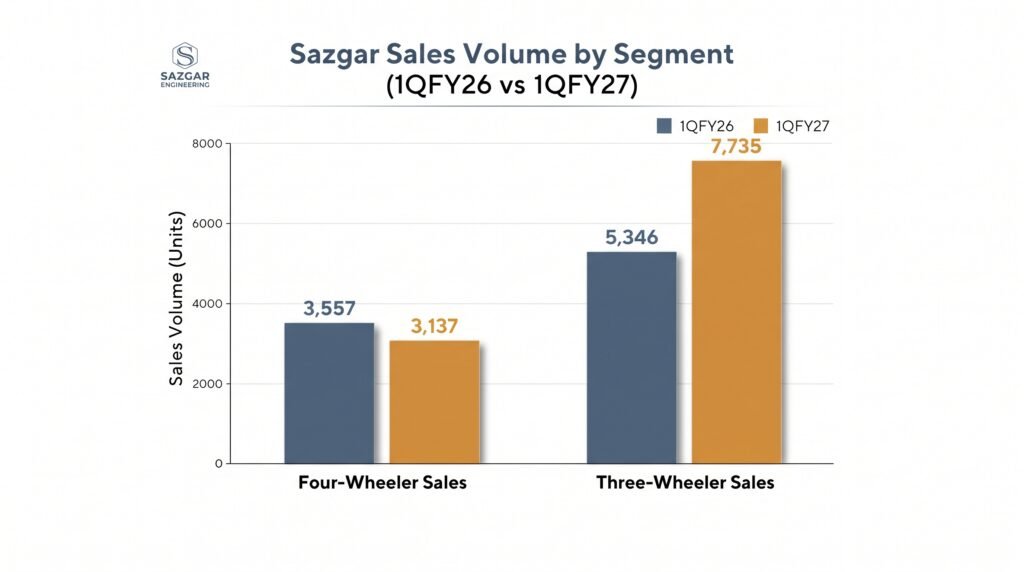
The company sold 3,137 four-wheelers during July–September 2026, compared with 3,557 vehicles during the corresponding period last year.
This represents a decline of 11.81 per cent.
Four-wheeler production also declined by 10.55 per cent, falling from 3,801 units to 3,400 units.
Despite the reduction in sales volumes, revenue from the four-wheeler segment increased to Rs38.44 billion from Rs31.68 billion.
This represents revenue growth of approximately 21.4 per cent.
The company attributed the increase in revenue despite lower vehicle sales to a favourable product mix.
The figures indicate that the composition of vehicles sold helped support revenue even as overall four-wheeler volumes declined.
Four-wheelers contributed approximately 92.2 per cent of Sazgar’s total quarterly revenue, underlining the importance of this segment to the company’s overall financial performance.
Also Read: TRG’s Battle For Control: How Zia Chishti’s Legal Challenges Reshaped A Billion-Rupee Corporate War
Three-Wheeler Business Records Strong Growth
While Sazgar’s four-wheeler segment experienced declining sales volumes, its three-wheeler business delivered a considerably stronger performance.
Three-wheeler sales increased by 44.69 per cent to 7,735 units, compared with 5,346 units during the corresponding quarter last year.
Production also increased by 44.2 per cent, rising to 8,518 units from 5,907 units.
Revenue from the three-wheeler segment increased to Rs3.14 billion from Rs2.02 billion, representing growth of approximately 55.4 per cent.
The performance demonstrates the continuing importance of three-wheelers within Pakistan’s domestic mobility and commercial transport markets.
The company identified the segment as an important contributor to its business and expects it to continue supporting operations during the remaining financial year.
In contrast, the tractor wheel rims business recorded weaker performance.
Sales volumes declined by 21.17 per cent to 7,073 units from 8,973 units, while production fell by 22.24 per cent to 7,581 units.
Revenue from tractor wheel rims remained broadly stable at approximately Rs132.29 million, compared with Rs131.69 million in the previous corresponding quarter.
Marketing Expenses Jump More Than 72%
Another significant development in Sazgar’s quarterly financial performance was the sharp increase in distribution and marketing expenditure.
The company’s distribution and marketing costs increased from Rs964.06 million to Rs1.66 billion, representing growth of approximately 72.4 per cent.
Administrative expenses also increased to Rs218.29 million from Rs206.48 million.
Meanwhile, other operating expenses declined to Rs486.78 million from Rs542.13 million.
Combined operating expenses increased to approximately Rs2.37 billion from Rs1.71 billion.
The substantial increase in marketing and distribution expenditure added to the pressure on operating profitability.
The financial statements also show a sharp increase in finance costs, which rose to Rs333.55 million from Rs79.23 million.
This represents an increase of approximately 321 per cent.
Other income, however, increased to Rs628.66 million from Rs513.72 million, providing some support to overall earnings.
Sazgar’s Assets Reach Rs86.77 Billion
Despite the decline in quarterly profitability, Sazgar’s balance sheet expanded during the period.
Total assets increased to Rs86.77 billion as of September 30, 2026, compared with Rs81.65 billion at the end of June 2026.
This represents an increase of approximately 6.3 per cent within three months.
Shareholders’ equity increased to Rs45.84 billion from Rs43.02 billion.
The company’s unappropriated profits rose to Rs44.68 billion from Rs41.85 billion.
Property, plant and equipment increased to Rs25.99 billion from Rs23.02 billion, reflecting continued investment in the company’s asset base.
Stock-in-trade stood at Rs41.77 billion, compared with Rs42.07 billion at the end of June.
Cash and bank balances increased substantially to Rs18.04 billion from Rs13.98 billion.
The increase in cash reserves indicates that the company maintained a substantial liquidity position despite higher expenditure and pressure on profitability.
However, long-term diminishing musharakah financing increased to Rs7.45 billion from Rs5.19 billion.
The increase in financing, alongside higher property, plant and equipment balances, reflects an expansion in the company’s financing and asset base during the quarter, although the financial statements do not attribute the entire increase to a specific project.
Operating Cash Flow Declines Sharply
Sazgar’s cash flow statement presents another important aspect of its quarterly performance.
Net cash generated from operating activities declined to Rs4.15 billion from Rs15.33 billion in the corresponding quarter last year.
The decline was influenced by changes in working capital, particularly movements in trade and other payables.
Cash generated from operations before finance costs, taxation and employee benefit payments amounted to Rs5.90 billion, compared with Rs18.09 billion in the previous corresponding quarter.
At the same time, the company substantially increased its investment in property, plant and equipment.
Cash spent on the acquisition of property, plant and equipment reached Rs3.25 billion, compared with approximately Rs966.49 million in the corresponding period last year.
Net cash used in investing activities consequently increased to Rs3.23 billion from Rs967.39 million.
The company also received approximately Rs2.59 billion in proceeds from long-term financing during the quarter.
Despite these movements, cash and cash equivalents increased by approximately Rs4.06 billion during the three-month period.
Auto Policy Delay Creates Uncertainty For Manufacturers
Beyond the financial results, Sazgar’s directors expressed serious concerns regarding the delayed finalisation of Pakistan’s Automotive Policy 2026–31.
According to the company, uncertainty surrounding the policy framework has affected customer confidence, vehicle bookings and investment decisions across the automotive sector.
The directors observed that the new-energy vehicle segment experienced a slowdown as prospective customers adopted a cautious approach while awaiting clarity on taxation, customs duties, incentives and regulatory requirements.
This uncertainty affected booking activity and the conversion of customer enquiries into actual vehicle sales.
The company also stated that delays in the policy framework complicated production scheduling, new-model launches and decisions regarding manufacturing capacity expansion.
The directors emphasised that the timely announcement of a clear and consistent automotive policy would be important for restoring confidence among manufacturers and consumers.
Imported Vehicles Could Threaten Local Manufacturing
Sazgar also raised concerns about the reduction in customs duties on imported completely built-up vehicles, which took effect in July 2026.
According to the directors’ review, the reduction in duties, combined with uncertainty surrounding the Automotive Policy 2026–31, has created questions about the future competitiveness of locally manufactured vehicles.
The company warned that without an adequate tariff differential and appropriate policy support, domestic manufacturers could face increasing competitive pressure from imported vehicles.
The directors identified several potential consequences, including declining local production, reduced investment, job losses and possible closure of manufacturing facilities.
These concerns underline the importance of tariff policy for Pakistan’s automotive manufacturing sector, particularly as international brands expand their presence in the domestic market.
The company called for a balanced policy framework capable of supporting domestic manufacturing while providing clarity to investors and consumers.
Pakistan’s Auto Industry Records 27.71% Sales Growth
Interestingly, Sazgar’s concerns about policy uncertainty emerged during a quarter in which Pakistan’s broader automotive industry recorded sales growth.
According to industry figures cited in the directors’ review, overall automotive sales volumes increased by 27.71 per cent during the quarter.
Four-wheeler sales, excluding tractors, increased by 20.57 per cent.
Two-wheeler sales recorded growth of 28.13 per cent, while three-wheeler sales increased by 40.60 per cent.
Tractor sales also recovered, recording growth of 37.84 per cent.
However, the directors noted that the new-energy vehicle segment experienced weaker market conditions due to uncertainty surrounding the forthcoming automotive policy.
The divergence between overall industry growth and Sazgar’s declining four-wheeler sales highlights the different demand conditions facing individual vehicle categories and manufacturers.
Company Remains Optimistic About Hybrid And Electric Vehicles
Despite the challenges, Sazgar expressed cautious optimism about the longer-term prospects of Pakistan’s automotive industry.
The company believes that demand for affordable mobility, combined with increasing interest in hybrid, plug-in hybrid and electric vehicles, will create opportunities for product diversification and technological advancement.
According to the directors, Sazgar intends to continue strengthening its four-wheeler portfolio while responding to changing market conditions and customer preferences.
Its existing range of petrol, hybrid, plug-in hybrid and electric vehicles, together with planned product launches, is expected to help the company address emerging market opportunities.
The company also intends to strengthen its three-wheeler business through improvements in product quality, reliability, cost competitiveness, dealer support and after-sales services.
Opportunities to expand in domestic and export markets will also remain part of its business strategy.
Outlook Hinges On Taxation, Tariffs And Consumer Confidence
Sazgar’s first-quarter results present a mixed picture of Pakistan’s evolving automotive industry.
On one hand, the company recorded strong revenue growth, maintained substantial cash reserves, expanded its asset base and achieved impressive growth in three-wheeler sales.
On the other, declining four-wheeler volumes, higher operating and financing expenses, increased hybrid vehicle taxation and regulatory uncertainty weighed on profitability.
The company’s decision to absorb the additional sales tax on hybrid vehicles illustrates the commercial pressures facing manufacturers seeking to maintain competitiveness without imposing further price increases on consumers.
For the remaining financial year, Sazgar’s performance will depend partly on market demand, the cost environment and the government’s decisions regarding the Automotive Policy 2026–31.
The directors maintained that a predictable policy framework, competitive tariff structure and appropriate support for local manufacturing would be essential for sustaining investment, employment and technological development.
With quarterly revenue exceeding Rs41 billion and assets approaching Rs87 billion, Sazgar remains a significant participant in Pakistan’s automotive manufacturing industry.
However, its latest financial results demonstrate that rising sales revenue does not necessarily translate into higher profitability, particularly when taxation, operating costs and regulatory uncertainty place additional pressure on manufacturers.
The coming quarters will therefore be important in determining whether Sazgar can translate its expanding revenue base and diversified vehicle portfolio into stronger earnings while adapting to Pakistan’s changing automotive market.