

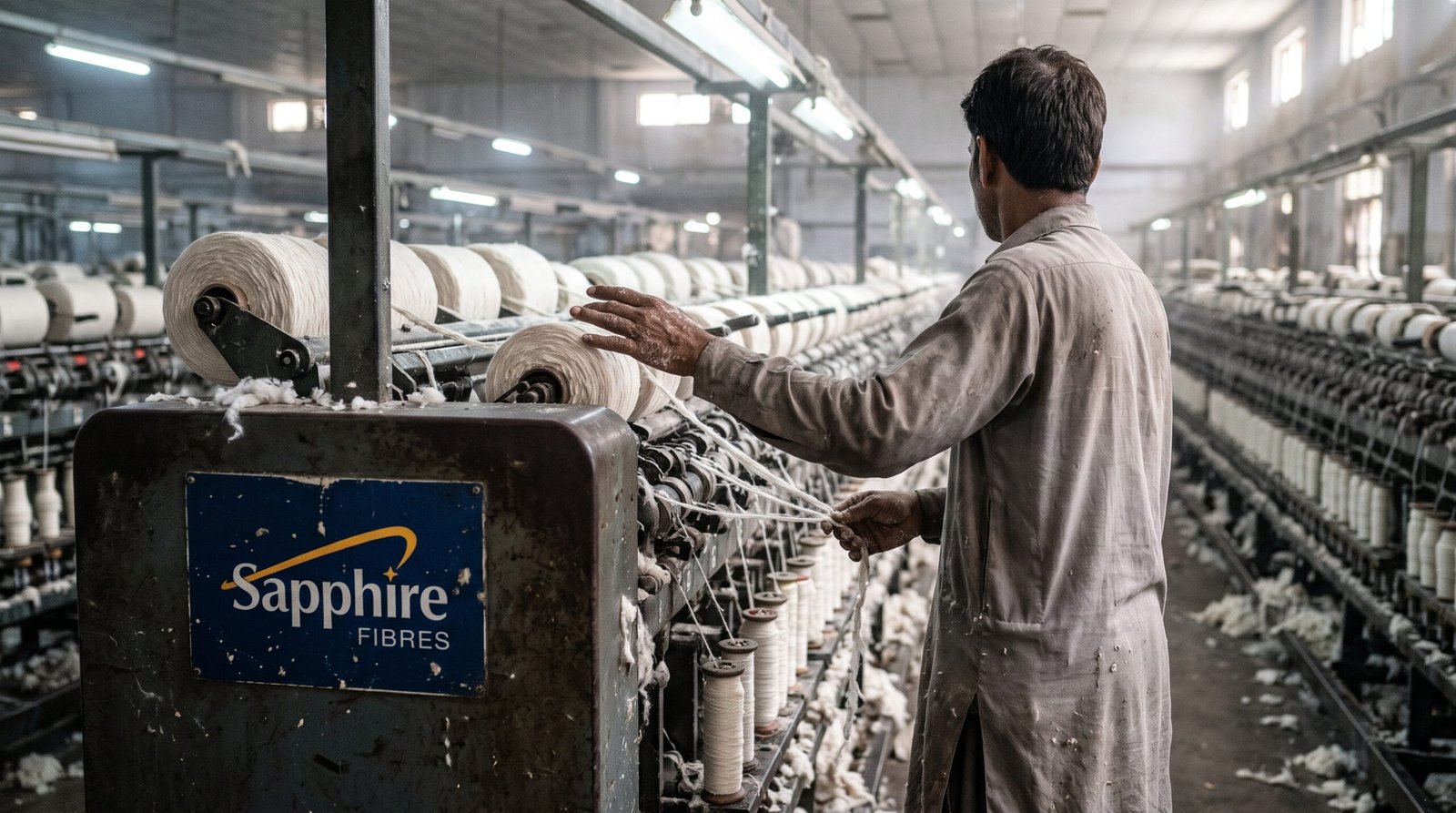
Sapphire Fibres Limited has reported a significant improvement in its financial performance for the first quarter of the financial year 2026–27, posting a consolidated profit after taxation of Rs1.70 billion compared with Rs1.18 billion during the corresponding period last year, as stronger sales, improved gross profitability and higher other income helped the textile manufacturer navigate persistent financial and operational pressures.
According to the unaudited financial results submitted to the Pakistan Stock Exchange (PSX) on Thursday, the company’s consolidated revenue surged approximately 57 per cent to Rs21.88 billion during the quarter ended September 30, 2026, compared with Rs13.96 billion in the same period of 2025.
The financial statements reveal a particularly strong turnaround in the company’s standalone operations, where profit after taxation reached Rs2.87 billion against a loss of Rs134.24 million in the corresponding quarter last year.
The results were approved by the company’s Board of Directors at a meeting held on October 29, 2026, in Lahore.
The substantial difference between standalone and consolidated profitability highlights the importance of examining the group’s overall financial position rather than relying exclusively on the earnings of its principal operating entity.
Consolidated Revenue Jumps 57% As Gross Profit Expands
Sapphire Fibres recorded consolidated sales of approximately Rs21.88 billion during the July–September quarter, representing an increase of around Rs7.92 billion over the corresponding period last year.
The company’s cost of sales increased to Rs18.51 billion from Rs13.97 billion, reflecting higher production and operating costs associated with its business activities.
Despite the increase in costs, gross profitability improved substantially.
Consolidated gross profit stood at approximately Rs3.38 billion compared with a marginal gross loss of around Rs74 million during the same quarter last year.
The improvement indicates that revenue growth outpaced the increase in direct costs, resulting in a considerable recovery in the company’s gross margins.
Based on the reported figures, the consolidated gross profit margin improved to approximately 15.4 per cent, compared with a slightly negative margin in the corresponding period.
This development represents one of the most important features of the quarterly results, suggesting that the company achieved stronger gross-level profitability despite the broader cost pressures affecting Pakistan’s textile and manufacturing sectors.
However, the financial statements do not separately quantify how much of this improvement resulted from higher production volumes, pricing adjustments, changes in product mix or movements in raw material costs.
Standalone Operations Stage Dramatic Turnaround
The company’s standalone financial results present an even more pronounced recovery.
Sapphire Fibres reported standalone sales of Rs17.94 billion for the quarter ended September 30, 2026, compared with Rs11.69 billion during the corresponding period last year.
This represents an increase of approximately 53.5 per cent.
Standalone gross profit reached approximately Rs1.98 billion, compared with Rs638.82 million in the corresponding quarter of 2025.
The improvement reflects stronger revenue generation alongside an expansion in gross profitability.
The company’s standalone profit from operations rose to approximately Rs4.53 billion from Rs778.31 million during the same period last year.
One of the major contributors to this increase was other income, which rose sharply to approximately Rs3.51 billion from Rs873.28 million.
This increase is particularly significant because other income accounted for a substantial proportion of standalone operating profitability during the quarter.
Consequently, while the company’s core manufacturing operations demonstrated an improvement in gross profitability, the overall earnings recovery also benefited considerably from income generated outside its principal sales activities.
The standalone profit before final taxation and income tax reached approximately Rs3.66 billion, compared with a loss of Rs228.51 million in the corresponding quarter.
After accounting for taxation, standalone profit stood at Rs2.87 billion, reversing the Rs134.24 million loss recorded a year earlier.
Other Income Plays Major Role In Earnings Recovery
A closer examination of Sapphire Fibres’ financial statements indicates that other income was an important contributor to the improvement in profitability.
On a consolidated basis, other income increased to approximately Rs547.92 million from Rs436.22 million during the corresponding period last year.
However, the impact was considerably larger in the standalone financial statements, where other income increased by approximately Rs2.64 billion.
This distinction is important because standalone and consolidated financial statements apply different accounting treatments to investments, subsidiaries and other group-related activities.
The reported figures therefore require separate consideration when assessing the sustainability of the company’s earnings.
Although the increase in standalone other income significantly strengthened profitability, the condensed financial results do not provide sufficient detail to attribute the entire increase to a particular investment, dividend stream or transaction.
Investors assessing the company’s recurring earnings capacity may therefore need to distinguish between improvements in textile-related gross profitability and income arising from other sources.
Finance Costs Remain A Significant Burden
Despite the improvement in profitability, Sapphire Fibres continued to face substantial finance costs.
On a consolidated basis, finance costs increased to approximately Rs917.59 million during the quarter from Rs651.37 million in the corresponding period last year.
This represents an increase of approximately 40.9 per cent.
The higher financing burden reduced the benefit of the company’s stronger operating performance.
Standalone finance costs, meanwhile, stood at approximately Rs664.66 million, compared with Rs549.80 million in the corresponding period.
The increase highlights the continuing significance of borrowing costs for the company’s earnings.
Finance costs remain an important consideration for textile manufacturers, particularly businesses requiring substantial working capital to finance raw material purchases, inventories, production and export-related operations.
While Sapphire Fibres generated sufficient reported operating profit to absorb its quarterly finance costs, the increase in financing expenses illustrates the importance of debt management and cash-flow generation.
Consolidated Profit Reaches Rs1.70 Billion
Following the improvement in revenue and gross profitability, Sapphire Fibres reported consolidated profit before taxation of approximately Rs2.19 billion.
The corresponding figure for the same period last year was approximately Rs1.75 billion.
After taxation of approximately Rs493.49 million, consolidated profit after taxation reached Rs1.70 billion.
Of this amount, approximately Rs1.64 billion was attributable to shareholders of the parent company, while Rs62.59 million was attributable to non-controlling interests.
The distinction is important because the total consolidated profit includes earnings attributable to shareholders outside the parent company’s ownership interest.
Earnings per share attributable to shareholders of Sapphire Fibres Limited increased to Rs65.88 from Rs55.05 in the corresponding quarter last year.
This represents an improvement of approximately 19.7 per cent.
In contrast, standalone earnings per share reached Rs115.23, compared with a loss per share of Rs6.49 during the same period last year.
The difference between the two earnings-per-share figures reflects the separate financial reporting bases and should not be interpreted as contradictory performance indicators.
Share Of Associates Remains An Important Earnings Component
The consolidated profit and loss statement also records a share of profit from associated companies of approximately Rs1.58 billion.
This contribution forms an important component of the group’s overall profitability.
The figure highlights the significance of Sapphire Fibres’ investments and associated business interests in determining consolidated earnings.
Consequently, the company’s financial performance cannot be assessed exclusively through its direct textile manufacturing activities.
Its consolidated results reflect the combined influence of manufacturing operations, financing expenses, other income and contributions from associated companies.
The quarterly figures demonstrate that investment-related earnings remain material to the company’s financial position.
Balance Sheet Shows Substantial Asset Base
According to the consolidated statement of financial position, Sapphire Fibres reported total assets of approximately Rs163.82 billion as of September 30, 2026.
The company’s asset base includes substantial property, plant and equipment, long-term investments, inventories, trade debts and other current assets.
Non-current assets stood at approximately Rs90.19 billion, while current assets amounted to approximately Rs73.63 billion.
The composition of the balance sheet illustrates the capital-intensive nature of the company’s operations and the importance of its long-term investment portfolio.
On a standalone basis, the company’s total assets stood at approximately Rs117.10 billion at the end of September 2026.
The difference between consolidated and standalone assets reflects the broader group structure captured in consolidated financial reporting.
Inventories And Receivables Highlight Working Capital Requirements
The company’s balance sheet also indicates significant funds tied up in inventories and trade receivables.
These balances are particularly relevant for a textile business, where working capital requirements can fluctuate depending on production cycles, raw material procurement, sales arrangements and customer payment periods.
Although the quarterly results demonstrate stronger profitability, the management of inventories and receivables remains important for maintaining liquidity.
Higher sales can increase working capital requirements even when profitability improves.
The company’s financial position therefore needs to be assessed alongside cash-flow performance rather than solely through reported earnings.
Cash Flows Provide Another Measure Of Financial Strength
The consolidated cash-flow statement presents an additional perspective on Sapphire Fibres’ quarterly performance.
While the company reported consolidated profit after taxation of Rs1.70 billion, operating cash flows were affected by movements in working capital, financing payments and taxation.
The cash-flow statement also records investment-related transactions and financing activities during the quarter.
These movements underline the distinction between accounting profitability and cash available to the business.
For a manufacturing group with substantial inventories, investments and financing requirements, cash conversion remains an important measure of financial resilience.
The company’s ability to translate stronger sales and profitability into sustained operating cash generation will be a key consideration in subsequent reporting periods.
Other Comprehensive Income Reflects Investment Valuation Movements
Sapphire Fibres’ consolidated statement of comprehensive income reveals that changes in investment valuations affected the broader measure of profitability.
The company reported consolidated other comprehensive losses during the quarter, reflecting movements in financial assets measured at fair value through other comprehensive income.
As a result, total comprehensive income differed from the profit recorded in the consolidated profit and loss statement.
These adjustments do not necessarily represent realised operating losses but affect the broader accounting measurement of shareholders’ financial interests.
The distinction is particularly relevant for companies maintaining substantial investment portfolios, where market valuations can influence reported equity and comprehensive income independently of manufacturing performance.
Also Read: Ghandhara Industries’ Profit Surges 65% To Rs2.59 Billion As Sales Hit Rs18.89 Billion
Textile Sector Challenges Remain Relevant
Sapphire Fibres’ quarterly results come against the backdrop of continuing challenges for Pakistan’s textile industry, including energy costs, financing requirements, international competition and the need to improve productivity.
The company’s strong revenue growth and recovery in gross profitability provide an encouraging indication of improved financial performance during the opening quarter of FY2027.
However, the results should not automatically be interpreted as evidence of a similar recovery across the entire textile industry.
Individual manufacturers differ in their product portfolios, export exposure, financing structures, operational efficiency and investment holdings.
Sapphire Fibres’ substantial contributions from other income and associated companies further distinguish its financial profile from businesses relying predominantly on textile manufacturing earnings.
What The Results Mean For Investors
The quarterly results present several important developments for shareholders and market observers.
First, consolidated revenue growth of approximately 57 per cent demonstrates a substantial expansion in the company’s reported business activity.
Second, the recovery in gross profitability indicates that the company achieved a stronger relationship between sales and direct production costs.
Third, the standalone profit turnaround was particularly significant, with earnings rising from a loss of Rs134.24 million to a profit of Rs2.87 billion.
Fourth, the continued importance of other income and associated companies suggests that the sustainability of group earnings depends on more than the performance of the textile manufacturing business alone.
Finally, higher finance costs and working capital requirements remain important factors that could influence profitability and liquidity in the coming quarters.
Outlook: Sustainability Of Earnings Recovery Will Be Key
Sapphire Fibres Limited has begun FY2027 with substantially improved financial results, supported by higher revenue, stronger gross profitability and significant contributions from other income and investments.
The company’s consolidated profit of Rs1.70 billion and standalone profit of Rs2.87 billion represent important improvements in its quarterly financial performance.
Nevertheless, the sustainability of this recovery will depend on several factors, including the company’s ability to maintain sales momentum, preserve gross margins, control finance costs and generate sufficient operating cash flows.
The contribution of associated companies and other income will also remain important in determining the direction of consolidated earnings.
For shareholders, the central question in the coming quarters will be whether Sapphire Fibres can maintain its stronger manufacturing profitability while managing financing pressures and the effects of movements in its investment portfolio.
The results indicate a meaningful improvement in financial performance, although the durability of that improvement will become clearer as the financial year progresses.