

A prolonged struggle for control of TRG Pakistan Limited has taken another significant turn after a Karachi civil court rejected the company’s attempt to prevent the Securities and Exchange Commission of Pakistan (SECP) from proceeding with regulatory notices, adding to a series of judicial developments that have altered the legal landscape surrounding former chief executive Zia Chishti’s battle over the company’s governance.
The latest decision, delivered on October 24, does not directly adjudicate Chishti’s claims or award him control of TRG Pakistan. Nevertheless, viewed alongside earlier proceedings involving Greentree Holdings and disputed voting rights, it highlights the mounting legal and regulatory challenges facing the company’s existing governance arrangements.
At stake is far more than a corporate boardroom dispute.
TRG Pakistan, a listed investment company with exposure to international technology and business services businesses, reported assets of approximately Rs 46.69 billion at the end of June 2025. Its international investment structure, substantial shareholder blocs and complex litigation history have turned the company into a significant test case for Pakistan’s corporate governance framework.
The controversy has involved allegations of improper shareholding arrangements, disagreements over the legitimacy of voting rights, disputes over board elections, challenges to regulatory authority and proceedings extending beyond Pakistan’s borders.
Chishti, who was previously associated with the development of TRG’s international technology businesses, has challenged arrangements that he contends have affected the lawful exercise of shareholder rights.
TRG Pakistan and associated entities have contested his legal arguments and defended their investment and governance structures.
The central issue is whether the courts’ interventions will ultimately deliver greater clarity over corporate control and ensure that all shareholders can exercise their rights under the law.
Latest Court Ruling: TRG Fails To Block SECP Proceedings
The latest development arose from a four-year-old legal challenge initiated by TRG Pakistan against the SECP.
In an order dated October 24, 2026, Senior Civil Judge-VI Karachi (South) allowed the regulator’s application under Order VII Rule 11 of the Code of Civil Procedure, 1908, and rejected TRG Pakistan’s plaint in Civil Suit No. 2001 of 2025.
The litigation originated before the Sindh High Court in 2022 before being transferred to the civil court.
TRG had challenged multiple show-cause notices and regulatory communications issued under Sections 86, 178 and 179 of the Companies Act, 2017.
The company maintained that the notices arose from complaints submitted by two non-executive directors whom it considered conflicted.
It alleged that the complaints were frivolous, motivated by improper intentions and intended to facilitate a hostile takeover.
TRG consequently sought a declaration that the notices were unlawful and a permanent injunction preventing the regulator from pursuing coercive action.
The SECP argued that the notices were preliminary steps in the statutory regulatory process rather than final determinations of wrongdoing.
The court accepted the regulator’s position.
It concluded that TRG’s challenge was premature, that the special statutory framework provided the appropriate remedies and that the allegations of bad faith had not been sufficiently particularised.
The judgment reinforces a fundamental principle: a listed company cannot ordinarily prevent a regulator from performing its statutory functions simply by challenging the issuance of show-cause notices.
However, the court did not determine that TRG had committed any regulatory violation.
The company remains entitled to answer the notices and pursue the review and appeal mechanisms available under the law.
Why The Decision Matters To The Wider TRG Conflict
Although the latest case was formally between TRG Pakistan and the SECP, its significance extends to the wider struggle over corporate governance.
For several years, the company has faced litigation involving substantial shareholders, voting arrangements and board elections.
The October decision removes one procedural obstacle to regulatory scrutiny of the disputed notices.
It also comes after earlier judicial proceedings in which Chishti successfully challenged the treatment of a major shareholding bloc connected with Greentree Holdings.
These are legally distinct cases, and the October ruling should not be presented as a judgment in Chishti’s favour.
Nevertheless, the combined developments make the governance dispute increasingly consequential.
They also demonstrate that questions raised by shareholders and directors cannot necessarily be resolved through internal corporate decisions alone when statutory rights and regulatory obligations are contested.
Greentree: The Shareholding Dispute That Changed The Balance
The most consequential legal development involving Chishti arose from the ownership and voting status of shares held by Greentree Holdings Limited.
Greentree, a Bermuda-incorporated entity associated with TRG International, held approximately 162.01 million shares in TRG Pakistan.
The holding represented approximately 29.71 per cent of the company’s issued share capital.
The controversy concerned whether the acquisition and holding of those shares through the international corporate structure complied with the legal requirements governing a company’s acquisition of its own shares.
Chishti challenged the arrangement before the Sindh High Court.
His case raised questions about the relationship between TRG Pakistan, TRG International and Greentree, including whether the shares should be treated as treasury shares rather than ordinary voting shares.
In June 2025, the Sindh High Court ruled against the disputed arrangement and directed that the relevant shares be treated as treasury shares.
The court also addressed the need for director elections.
This was a substantial legal success for Chishti’s challenge.
It did not automatically place him in control of TRG Pakistan, but it altered the legal treatment of a major block of shares and potentially changed the voting balance among other shareholders.
TRG Pakistan and associated entities disputed the judgment and pursued appeals.
Supreme Court Intervention Strengthens The Legal Significance
The dispute subsequently reached the Supreme Court of Pakistan.
On May 11, 2026, a three-member bench dismissed appeals filed by Greentree Holdings, TRG International and TRG Pakistan against the Sindh High Court ruling.
The decision was a major development in the litigation because it left the lower court’s treatment of the disputed shares undisturbed in those proceedings.
For Chishti, whose challenge had questioned the legality of the arrangement, the outcome represented a significant judicial success.
Its practical importance lies in the voting consequences.
Where shares are legally treated as treasury shares, their voting rights are restricted under the applicable corporate framework.
Removing a block representing nearly 30 per cent of issued capital from ordinary voting calculations can materially change the relative influence of the remaining shareholders.
However, the precise voting position must be determined from the operative court orders, the company’s current share register and the implementation of those decisions.
The Supreme Court’s intervention did not itself establish that Chishti had acquired a controlling interest.
TRG International’s Objections Cannot Be Ignored
TRG International strongly opposed the consequences of the Greentree ruling.
In statements disclosed through the Pakistan Stock Exchange, it expressed concern that the judicial treatment of the shares could undermine approximately $90 million in foreign investment.
The company also questioned the broader implications for international investment structures and corporate governance.
Its position was that the relevant legal and corporate relationships had not been properly interpreted.
Those arguments form an important part of the record.
A judicial outcome favourable to one shareholder’s legal challenge does not necessarily mean that every allegation made by that shareholder has been established.
Equally, the fact that TRG International disagreed with the ruling does not diminish the legal significance of the courts’ decisions.
The dispute must be assessed by distinguishing established judicial findings from the competing parties’ commercial interpretations.
Also Read: Field Marshal Asim Munir And Pakistan’s Search For Security, Stability And Strategic Influence
Who Really Holds The Voting Power?
The dispute over Greentree becomes particularly significant when examined alongside TRG Pakistan’s shareholder structure.
Court records from 2025 identified the following substantial holdings:
|
Shareholder |
Historical shares |
Percentage |
|
Greentree Holdings |
162,010,636 |
29.71% |
|
Zia Chishti |
87,915,789 |
16.12% |
|
Sarah Jennifer Poberskin |
32,098,400 |
5.89% |
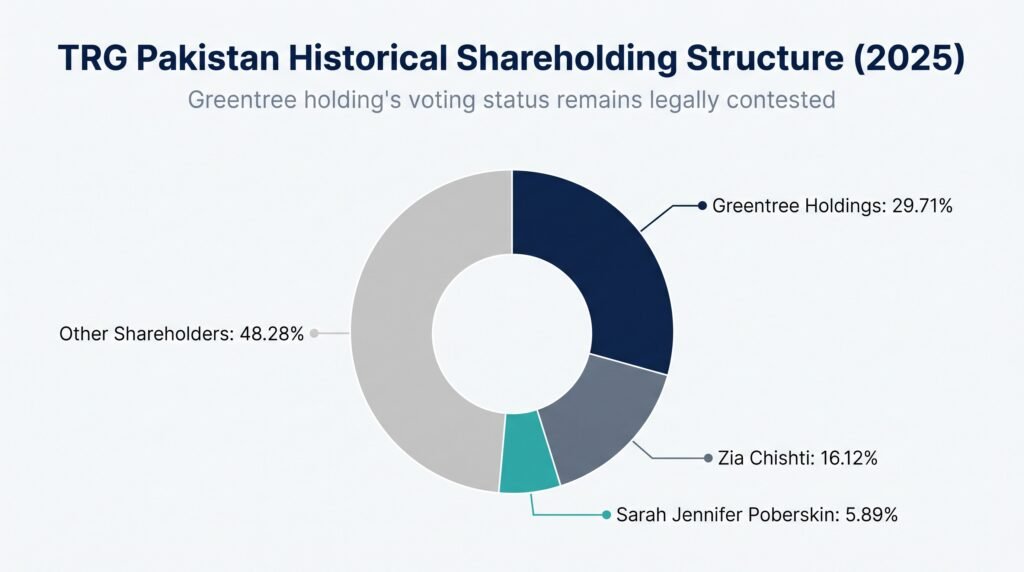
These figures represent positions recorded during earlier litigation, not a confirmed October 2026 beneficial ownership register.
They nevertheless illustrate the scale of the contested shareholdings.
If the approximately 29.71 per cent Greentree block is excluded from ordinary voting, the relative weight of the remaining eligible shares increases.
For illustration, a holding equivalent to 16.12 per cent of total issued capital would represent approximately 22.9 per cent of the remaining shares if the entire Greentree block were excluded and no other adjustments applied.
This is a mathematical illustration, not a finding about Chishti’s current voting entitlement.
The legal and commercial importance of the Greentree ruling therefore extends beyond the treatment of a single shareholder.
It affects the framework within which directors may be elected and major corporate decisions may be influenced.
JS Group Emerges As Another Major Shareholder
The JS Group has also become a major participant in TRG Pakistan’s evolving ownership landscape.
In May 2026, JS Bank acquired approximately 81.36 million TRG Pakistan shares through enforcement of security.
The acquisition represented around 14.92 per cent of the company’s issued share capital.
Following the transaction, the combined holding attributed to JS Group entities was reported at approximately 159.98 million shares, equivalent to about 29.33 per cent.
The transaction added another significant dimension to the contest for shareholder influence.
TRG Pakistan had previously raised allegations that certain JS Group entities, Chishti and his spouse were acting in concert in circumstances that could trigger takeover-related obligations.
Those allegations were contested and have not been established as findings of wrongdoing in the proceedings described here.
The distinction is important.
The existence of parallel interests among shareholders does not, by itself, establish a legally recognised acting-in-concert arrangement.
Such a determination requires examination under the relevant securities legislation and applicable regulatory standards.
In separate litigation involving JS Group-related parties, TRG’s civil suit faced jurisdictional objections.
A Karachi civil court rejected the plaint in December 2025, and an appellate court upheld that outcome in July 2026.
The decisions highlighted the importance of pursuing securities disputes through the remedies provided by the statutory framework.
Billions At Stake: TRG’s Financial Position
The prolonged litigation concerns a company with substantial investment assets.
According to TRG Pakistan’s audited financial statements for the year ended June 30, 2025, total assets increased to approximately Rs 46.69 billion from Rs 40.58 billion in the preceding financial year.
Long-term investments increased to approximately Rs 46.65 billion, while shareholders’ equity rose to Rs 37.93 billion.
The company also reported a profit after taxation of approximately Rs 3.92 billion for FY2025, following a loss of approximately Rs 30.85 billion in FY2024.
These figures demonstrate both the scale of the company’s investment exposure and the volatility associated with its valuation model.
TRG Pakistan’s Financial Performance
|
Indicator |
FY2024 |
FY2025 |
|
Total assets |
Rs 40.58bn |
Rs 46.69bn |
|
Long-term investments |
Rs 40.54bn |
Rs 46.65bn |
|
Shareholders’ equity |
Rs 33.29bn |
Rs 37.93bn |
|
Profit/(loss) after tax |
(Rs 30.85bn) |
Rs 3.92bn |
|
Deferred tax liabilities |
Rs 6.74bn |
Rs 7.66bn |
|
Cash and bank balances |
Rs 31.65m |
Rs 27.16m |
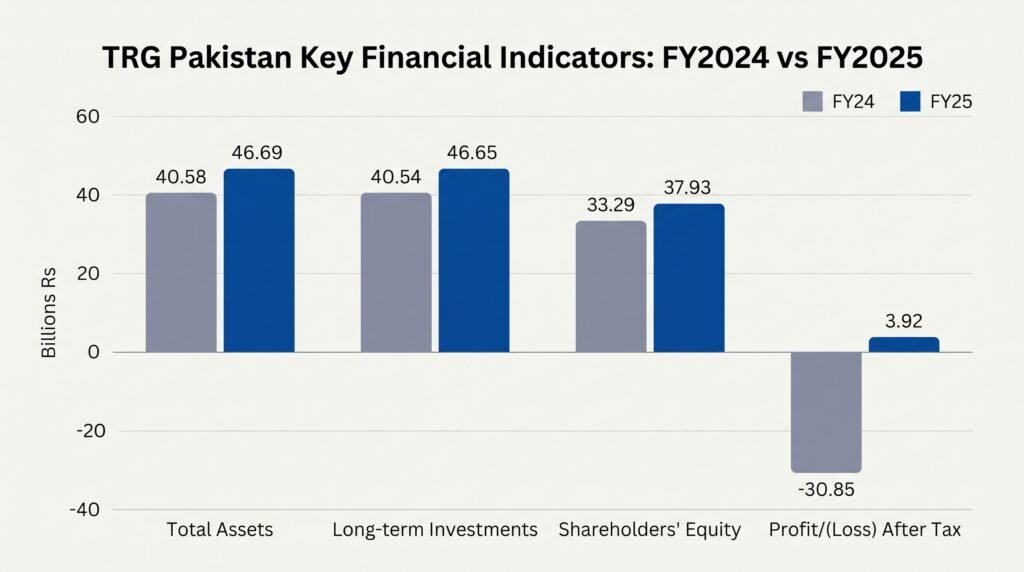
The figures are historical and should not be confused with the company’s financial position at the end of October 2026.
The company’s more recent quarterly results also illustrate the importance of valuation movements.
PSX financial data records a profit of approximately Rs 6.87 billion in the September 2025 quarter, followed by losses of approximately Rs 2.62 billion and Rs 8.96 billion in the December 2025 and March 2026 quarters respectively.
The three reported quarterly figures together imply a loss of approximately Rs 4.72 billion for the nine-month period, subject to reconciliation with the company’s published interim statements.
Such volatility reinforces why shareholders have an interest in the transparency and oversight of the underlying investment portfolio.
The Rs 9.2 Billion Accounting Question
One of the most significant potential consequences of the Greentree litigation concerns the accounting treatment of the disputed investment.
TRG Pakistan’s 2025 annual report indicated that implementation of the Sindh High Court judgment could result in an approximately Rs 9.2 billion reduction in shareholders’ equity.
Compared with the company’s FY2025 equity of Rs 37.93 billion, that amount represented approximately 24.3 per cent.
The potential adjustment is therefore material.
However, it would be inaccurate to describe the entire amount as a proven loss caused by wrongdoing or as money recovered through Chishti’s litigation.
It represents a possible accounting consequence described in company disclosures.
The actual financial impact depends on the final treatment of the investment, subsequent accounting entries and the implementation of the relevant judicial decisions.
For shareholders, the issue demonstrates why disputes over ownership structures can have implications extending beyond voting rights.
They can affect reported investment values, equity balances and the interpretation of financial statements.
From Global Technology Investments To A Domestic Governance Battle
TRG Pakistan’s corporate history makes the dispute particularly notable.
Incorporated in December 2002, the company developed an investment model focused on international technology and IT-enabled services businesses.
Through The Resource Group International Limited, it gained exposure to companies including IBEX and Afiniti.
IBEX operates in the customer experience and business process outsourcing sector, while Afiniti has developed artificial intelligence-based technology for improving business-customer interactions.
The investments illustrate the international ambitions associated with TRG’s business model.
They also explain why the dispute has attracted attention beyond Pakistan.
The underlying corporate structure involves entities incorporated in different jurisdictions, international investments and contractual arrangements that have generated litigation in both Pakistani and American courts.
Chishti’s earlier association with the development of these businesses is part of that history.
However, his entrepreneurial record and his present legal claims are separate matters. The merits of the latter must be assessed through the documentary record rather than through his reputation or past achievements.
The American Litigation: A More Complicated Record
The international proceedings also demonstrate why the wider TRG dispute cannot be reduced to a series of victories for either side.
In June 2025, TRG Pakistan disclosed that a United States federal court had confirmed an arbitration award involving contractual obligations attributed to Chishti in favour of TRG International.
That development was favourable to TRG International’s position in the relevant proceedings.
Separately, in July 2026, a United States federal court declined to grant an injunction sought by TRG Pakistan and TRG International to prevent Chishti-initiated proceedings from continuing in Pakistan.
The latter decision allowed the relevant Pakistan-based litigation to proceed without the requested American restraint.
However, refusal of an injunction does not establish that the underlying claims are meritorious.
Similarly, confirmation of an arbitration award in the United States does not determine every dispute over Pakistani company law.
The proceedings concern different legal questions and must be interpreted within their respective jurisdictions.
The Question Of Board Elections
One of the most persistent issues in the TRG controversy has been the election of directors.
For listed companies, board elections are a fundamental mechanism through which shareholders exercise their rights.
Directors are responsible for oversight of financial reporting, management accountability, investment decisions and related-party transactions.
Where a substantial voting bloc is disputed, uncertainty over board elections can become especially consequential.
In June 2025, the Islamabad High Court addressed the SECP’s powers under Section 147 of the Companies Act, 2017 concerning the calling of a shareholders’ meeting for director elections.
The proceedings reflected the difficulties arising when shareholder disagreements obstruct ordinary governance processes.
TRG’s annual report also disclosed that litigation concerning annual general meetings had affected the adoption of earlier financial statements by shareholders.
The larger issue is whether the company’s board can ultimately be constituted through an election process that complies with the law and reflects the voting rights of eligible shareholders.
This question is particularly important following the judicial decisions concerning Greentree.
What The SECP Must Now Decide
The October 2026 judgment restores the regulatory process as the appropriate forum for addressing the disputed show-cause notices, subject to any subsequent appellate intervention.
The regulator must assess the matters within its statutory jurisdiction, consider the company’s responses and determine whether any enforcement action is justified.
It cannot assume that allegations are proven merely because TRG’s civil suit was rejected.
Nor should the company assume that the notices have been invalidated simply because it disputes the motives of those who initiated complaints.
The legal framework provides mechanisms for regulatory review and appeal.
For Pakistan’s capital markets, the important question is whether those mechanisms can resolve disputes involving influential shareholders and substantial financial interests in a manner that is transparent, timely and consistent with the law.
The Market’s Assessment Of TRG
As of October 27, 2026, TRG Pakistan’s share price stood at Rs 54.71 on the Pakistan Stock Exchange.
With approximately 545.39 million issued shares, this implied a market capitalisation of around Rs 29.84 billion.
The company’s reported free float was approximately 65 per cent.
The share price had declined by approximately 24.33 per cent over the preceding year, according to PSX data available on October 28.
These market figures provide context for the dispute but do not establish that litigation alone caused the decline.
TRG’s valuation is influenced by its underlying international investments, financial results, currency movements, market sentiment and governance-related uncertainties.
Nevertheless, the divergence between its historical book equity and market capitalisation raises legitimate questions about how investors assess the company’s assets and associated risks.
For minority shareholders, clarity over the legal ownership structure and the future board is relevant to that assessment.
A Corporate Battle With Wider Implications
The TRG dispute has developed into a broader test of corporate governance in Pakistan.
On one side are Chishti’s challenges to arrangements affecting shareholder voting and board representation, some of which have succeeded before the courts.
On the other are TRG Pakistan and associated entities, which have defended their corporate structures, disputed allegations against them and raised concerns about the commercial consequences of the litigation.
The courts have addressed specific questions arising from these disputes.
They have not delivered a single judgment resolving every aspect of the corporate conflict.
The distinction matters because judicial findings must not be expanded beyond their actual legal scope.
What can be established is that Chishti’s challenge to the Greentree arrangement resulted in significant judicial intervention, including the Supreme Court’s dismissal of appeals against the relevant ruling.
It is also established that TRG Pakistan has now failed in its attempt to prevent the SECP from pursuing the disputed regulatory notices through the statutory process.
Taken together, these developments have altered the legal circumstances in which the company’s ownership and governance questions must be resolved.
Can TRG Move Beyond Its Boardroom War?
After years of litigation, the future of TRG Pakistan remains dependent on several unresolved questions.
The company must address the consequences of the Greentree rulings, establish clarity over voting rights and board representation, and respond to the outstanding regulatory proceedings.
It must also continue managing its investment interests while ensuring that financial disclosures accurately reflect material developments.
For Chishti, the legal successes concerning Greentree have strengthened the significance of his challenge to the disputed governance arrangements.
However, those successes should not be confused with a final determination that he controls TRG Pakistan or that all allegations advanced by him have been established.
For the company’s existing leadership and associated entities, the challenge is to demonstrate compliance with the applicable legal framework while protecting the legitimate interests of shareholders.
For the SECP, the dispute presents an opportunity to exercise its statutory responsibilities through a process that is independent, reasoned and subject to judicial scrutiny.
Ultimately, the TRG saga is about more than one entrepreneur’s dispute with a listed company.
It concerns the integrity of shareholder voting, the legal limits of corporate structures, the authority of regulators and the ability of Pakistan’s courts to resolve complex commercial disputes.
Zia Chishti’s legal challenges have already helped reshape the terms of the contest. Whether that produces a lasting change in TRG Pakistan’s leadership, or a more stable governance framework for all shareholders, remains to be determined.