

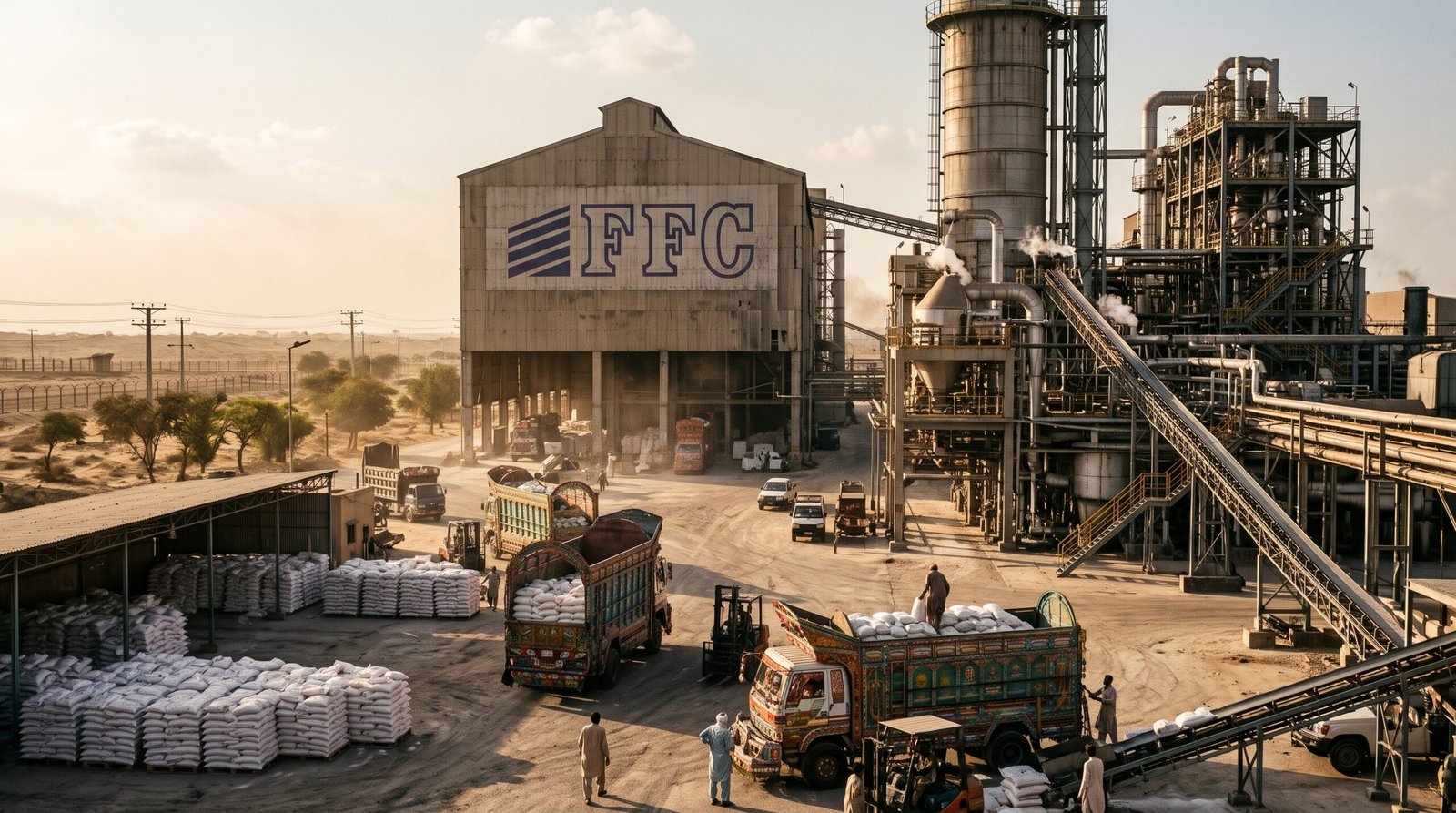
Fauji Fertilizer Company Limited (FFC), one of Pakistan’s largest fertiliser manufacturers, has reported a consolidated profit after tax of approximately Rs71 billion for the nine months ended September 30, 2026, representing a 13 per cent year-on-year increase, as stronger urea sales, higher investment income and improved profitability helped the company navigate persistent challenges in the country’s fertiliser industry.
According to financial results and operational disclosures submitted to the Pakistan Stock Exchange (PSX) on Wednesday, the company’s aggregate revenue increased by 16 per cent to Rs327 billion during the January–September period, primarily driven by higher urea sales volumes.
The Board of Directors, which met in Rawalpindi on October 28, also recommended an interim cash dividend of Rs18.50 per share, equivalent to 185 per cent, for the quarter ended September 30, 2026.
The latest dividend comes in addition to interim dividends of Rs23 per share already announced during the year, taking the cumulative declared dividend to Rs41.50 per share, equivalent to 415 per cent.
The results underline FFC’s ability to sustain profitability despite fluctuations in fertiliser demand, production constraints, rising input costs and uncertainties surrounding agricultural purchasing power.
Profitability Improves As Nine-Month Earnings Strengthen
FFC’s consolidated financial statements show that the company generated approximately Rs70.8 billion in profit attributable to its shareholders during the first nine months of 2026, compared with approximately Rs61.6 billion during the corresponding period last year.
Consolidated earnings per share increased to Rs48.77 from Rs43.20, reflecting stronger earnings attributable to ordinary shareholders.
On a standalone basis, FFC reported profit after tax of approximately Rs64.2 billion for the nine-month period, compared with Rs58.0 billion during the same period in 2025.
Standalone earnings per share increased to Rs44.59 from Rs40.50.
The distinction between standalone and consolidated earnings is important because FFC’s consolidated results incorporate the financial performance of subsidiaries and the company’s share of earnings from associates and joint ventures.
The company’s consolidated profit performance was supported by stronger operating activity, improved investment income and contributions from associated businesses.
Revenue Climbs To Rs327 Billion On Stronger Urea Sales
FFC’s aggregate revenue increased by 16 per cent to approximately Rs327 billion during the first nine months of 2026, reflecting higher fertiliser sales volumes and the company’s extensive distribution network.
The company’s standalone net turnover reached approximately Rs327.3 billion during the period, compared with Rs282.1 billion in the corresponding nine months of 2025.
This represents an increase of approximately Rs45 billion in revenue.
The increase was primarily supported by higher urea sales volumes, while the company’s operating performance also benefited from efforts to manage costs amid persistent inflationary pressures.
However, the revenue expansion did not eliminate challenges associated with production costs, natural gas availability and the changing dynamics of the domestic fertiliser market.
FFC acknowledged that the fertiliser industry continued to face pressure from escalating operating costs, making cost optimisation a central component of its operational strategy.
The company stated that it had undertaken effective cost-control measures to partly counter inflationary pressures and achieve its operational and financial targets for 2026.
Also Read: Kohinoor Spinning Mills Reports Rs 23.51 Million Quarterly Loss As Financial Crisis Deepens
Urea Sales Rise 11% As Company Strengthens Market Position
One of the most significant developments in FFC’s operational performance was the increase in urea sales during the nine-month period.
According to the company’s disclosure, urea offtake increased to 2.160 million tonnes, compared with 1.955 million tonnes during the corresponding period last year.
This represents growth of approximately 205,000 tonnes, or 11 per cent.
The improvement reflects stronger sales volumes during a period when the broader domestic fertiliser market experienced only modest growth.
Pakistan’s domestic urea market increased to 4.404 million tonnes during the nine months ended September 2026, compared with 4.205 million tonnes during the corresponding period in 2025.
The industry-wide increase amounted to approximately 199,000 tonnes.
FFC’s reported urea offtake represented approximately 49 per cent of the domestic market volume during the period, although this comparison should not be treated as a formally reported market-share figure without accounting for differences in company and industry reporting classifications.
The company’s sales performance suggests that FFC remained a major force in Pakistan’s fertiliser supply chain, benefiting from its production infrastructure, distribution capabilities and established relationships with agricultural consumers.
Fertiliser Production Reaches 1.914 Million Tonnes
FFC disclosed that its manufacturing plants at Goth Machhi and Mirpur Mathelo collectively produced 1.914 million tonnes of prilled urea during the first nine months of 2026.
Production increased by 2 per cent compared with the corresponding period last year.
The improvement was achieved despite operational constraints affecting parts of the fertiliser manufacturing industry.
However, the company reported that gas shortages resulted in a decline in production at its Granular Urea facility.
Granular urea production decreased by 15 per cent to 281,000 tonnes during the period.
The decline illustrates the continuing importance of uninterrupted natural gas supplies for Pakistan’s fertiliser manufacturers.
Natural gas is a critical feedstock in urea manufacturing, and interruptions can directly affect production efficiency, capacity utilisation and the availability of fertiliser for agricultural consumption.
For a country whose agricultural productivity depends heavily on timely fertiliser availability, sustained gas shortages remain a structural concern for the industry.
DAP Market Contracts As Prices And Supply Constraints Bite
While urea sales improved, Pakistan’s diammonium phosphate (DAP) market faced a more challenging environment.
FFC reported that domestic DAP market volumes declined by 3 per cent to approximately 775,000 tonnes during the first nine months of 2026.
The company attributed the decline to lower indigenous production and reduced imports.
Supply constraints, together with rising phosphoric acid prices, resulted in lower domestic DAP production.
At the same time, escalating international prices contributed to reduced DAP imports.
The combined impact created a difficult operating environment for phosphate fertilisers, which play an important role in crop development and agricultural productivity.
FFC disclosed that DAP production declined to 586,000 tonnes during the nine-month period, compared with 622,000 tonnes during the corresponding period last year.
This represents a reduction of approximately 36,000 tonnes.
The company attributed the decline primarily to constraints in the availability of raw materials.
The developments highlight the vulnerability of Pakistan’s fertiliser sector to international commodity prices and imported raw-material availability.
Unlike urea, which benefits from significant domestic manufacturing capacity, phosphate fertiliser production remains particularly sensitive to imported inputs and fluctuations in global prices.
Investment Income Provides Additional Earnings Support
Another important contributor to FFC’s financial performance was higher investment income.
The company reported investment income of approximately Rs7.5 billion during the nine-month period, compared with Rs5.0 billion during the corresponding period last year.
The increase of approximately Rs2.5 billion provided an additional contribution to profitability.
Investment income can provide an important supplementary earnings stream for companies with substantial financial resources and diversified investments.
For FFC, the improvement helped support overall earnings during a period characterised by inflationary pressures and uneven fertiliser market conditions.
The company’s consolidated financial performance also benefited from improved profitability in subsidiaries and associates.
These contributions helped lift consolidated profit after tax beyond the company’s standalone earnings.
FFC Announces Rs18.50 Per Share Cash Dividend
In a development likely to attract attention from shareholders, FFC’s Board of Directors recommended an interim cash dividend of Rs18.50 per share for the quarter ended September 30, 2026.
The dividend represents 185 per cent of the company’s share face value.
Combined with interim dividends of Rs23 per share previously announced during 2026, cumulative dividends declared for the year have reached Rs41.50 per share.
The recommended entitlement will be paid to shareholders whose names appear in the company’s Register of Members on November 8, 2026.
The company’s share transfer books will remain closed from November 9 to November 17, 2026, both days inclusive.
Transfers received by the company’s share registrar, CDC Share Registrar Services Limited, by the close of business on November 8 will be considered for determining entitlement.
The dividend announcement reflects the company’s continued emphasis on shareholder distributions alongside its operating and investment activities.
Also Read: TRG’s Battle For Control: How Zia Chishti’s Legal Challenges Reshaped A Billion-Rupee Corporate War
Financial Position Reflects Large-Scale Operations
FFC’s consolidated statement of financial position shows that the company maintained a substantial asset base at the end of September 2026.
The company’s financial position reflects its manufacturing infrastructure, inventories, investments, receivables and other assets associated with large-scale fertiliser operations.
Its financial statements also show significant borrowing and other liabilities, which need to be assessed alongside cash balances, short-term investments, operating cash generation and the company’s capital expenditure requirements.
The nine-month consolidated cash flow statement indicates that the company generated substantial cash from operating activities.
However, investment expenditure, financing activities and dividend payments also affected cash movements during the period.
The financial disclosures suggest that FFC’s future cash requirements will remain influenced by capital investment, working capital management, production requirements and shareholder distributions.
Sona Centre Initiative Expands Direct Farmer Outreach
Beyond financial performance, FFC highlighted the expansion of its Sona Centre initiative, which seeks to improve farmers’ access to agricultural inputs and related services.
According to the company’s disclosure, the initiative continued to expand its outreach by providing farmers with fertilisers, nutrients and pesticides at prescribed retail prices.
The programme represents an important element of FFC’s engagement with Pakistan’s agricultural sector.
Direct access to fertiliser products and agricultural inputs can help farmers manage procurement requirements and improve access to essential crop nutrients.
The initiative also strengthens FFC’s relationship with end consumers in a market where distribution efficiency and timely product availability remain important competitive factors.
Pakistan’s Agricultural Economy Remains Central To FFC’s Outlook
FFC’s performance must also be viewed in the wider context of Pakistan’s agricultural economy.
Fertiliser consumption is closely linked to crop cultivation patterns, farmers’ purchasing power, commodity prices, irrigation availability and government agricultural policies.
Urea remains one of the country’s most widely used fertilisers, making its availability and affordability important considerations for major crops, including wheat, rice, cotton and sugarcane.
The increase in domestic urea demand during the first nine months of 2026 provides a positive indicator for fertiliser consumption.
However, the contraction in the DAP market suggests that different fertiliser segments continue to experience contrasting demand and supply conditions.
Higher international prices and raw-material constraints could continue to influence phosphate fertiliser availability and affordability.
Similarly, uninterrupted natural gas supplies will remain essential for maintaining domestic urea production.
Cost Management Emerges As A Strategic Priority
FFC’s disclosure indicates that cost management has become increasingly important amid inflationary pressures and rising operating expenses.
The company stated that it had implemented effective cost controls to partly offset the impact of inflation.
For fertiliser manufacturers, cost pressures extend beyond raw materials and energy to include transportation, maintenance, labour, financing and distribution.
These pressures can affect operating margins even when sales volumes increase.
FFC’s ability to generate higher earnings during the nine-month period suggests that stronger sales, investment income and contributions from associated businesses helped offset some of these challenges.
Nevertheless, continued cost discipline will remain important for sustaining profitability.
What The Results Mean For Investors
For investors, FFC’s latest financial performance presents several important developments.
First, the 13 per cent increase in consolidated profit after tax demonstrates earnings growth despite a challenging operating environment.
Second, the 16 per cent increase in aggregate revenue indicates stronger business activity, supported particularly by urea sales.
Third, the 11 per cent rise in urea offtake suggests that FFC continued to benefit from demand for its principal fertiliser product.
Fourth, the improvement in investment income and contributions from associated businesses provided additional earnings support.
Finally, the interim cash dividend of Rs18.50 per share reinforces the company’s shareholder distribution policy.
However, investors will also need to monitor gas availability, phosphate fertiliser production, international raw-material prices, operating expenses and the sustainability of agricultural demand.
These factors could influence the company’s earnings trajectory in the coming quarters.
Outlook: Strong Earnings But Industry Challenges Persist
FFC’s financial results for the nine months ended September 30, 2026, demonstrate the company’s ability to generate substantial profits and maintain higher sales volumes despite operational and market challenges.
The increase in consolidated profit to approximately Rs71 billion, aggregate revenue growth to Rs327 billion and higher urea offtake underline the scale of the company’s operations.
At the same time, gas shortages, lower DAP production and higher international raw-material prices illustrate the structural challenges facing Pakistan’s fertiliser industry.
The company’s focus on cost optimisation, investment income, operational efficiency and farmer outreach could remain important in sustaining its performance.
As Pakistan’s agricultural sector continues to navigate changing economic conditions, FFC’s financial strength and manufacturing capacity are likely to remain significant factors in the country’s fertiliser supply landscape.
For shareholders, the latest results offer a combination of higher earnings, growing sales volumes and substantial dividend distributions. For the wider agricultural economy, they highlight both the resilience of domestic fertiliser manufacturing and the continuing need to address energy and raw-material supply constraints.