

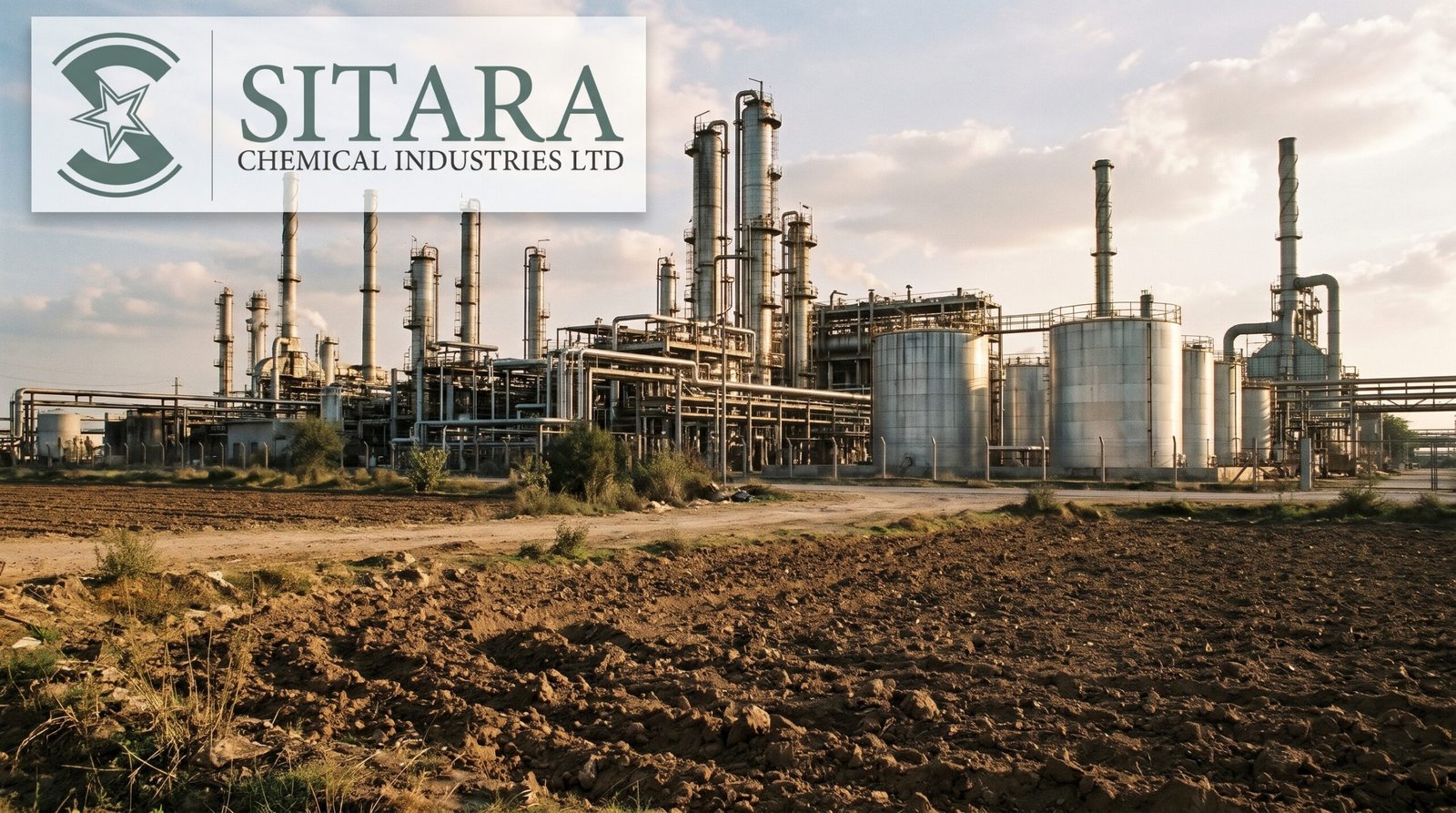
Sitara Chemical Industries Limited has secured shareholders’ approval to sell approximately 3,306 kanal of freehold agricultural land near Faisalabad, paving the way for a potentially significant asset monetisation exercise aimed at strengthening the company’s financial position, reducing borrowings and financing future industrial expansion.
According to a regulatory disclosure submitted to the Pakistan Stock Exchange (PSX) on October 27, shareholders authorised the company’s board of directors to dispose of the agricultural land, classified as investment property, through cash transactions or arrangements involving a combination of cash and developed plots.
The decision was taken at the company’s Annual General Meeting (AGM), held in Karachi on October 27, 2026, with shareholders participating both physically and through video link.
The approved resolution represents a potentially important development in the company’s capital allocation strategy, allowing management to unlock value from non-core property assets and redirect the proceeds towards industrial operations, expansion projects and other strategic requirements.
Over 3,300 Kanal of Agricultural Land Approved for Sale
The most significant decision at the AGM concerned the proposed disposal of approximately 3,306 kanal of agricultural land situated in the vicinity of Faisalabad.
The landholding is equivalent to approximately 413.25 acres, based on the conventional conversion of eight kanal to one acre, making it a substantial property asset.
According to the company’s resolution, the disposal will remain subject to requisite regulatory approvals and may be undertaken against cash consideration, partly in cash and partly in developed plots, or through other arrangements described in the accompanying statement of material facts.
The resolution does not disclose the property’s valuation, expected sale proceeds, identity of prospective buyers or a timeline for completing the transaction.
Consequently, the financial impact of the proposed disposal cannot yet be quantified from the AGM disclosure alone.
However, the scale of the landholding makes the proposed transaction noteworthy, particularly because the board has been given broad authority to negotiate terms and secure what the company considers the best available market price.
The eventual consideration will depend on factors including the property’s exact location, land classification, accessibility, development potential, prevailing market conditions and the structure of any negotiated agreement.
Sale Proceeds Earmarked for Debt Repayment and Industrial Expansion
The company has outlined several possible uses for the proceeds generated through the land disposal.
According to the approved resolution, funds may be utilised for repayment of loans, financing new projects and business initiatives, capacity enhancement, expansion and balancing, modernisation and replacement (BMR) of existing plant and machinery.
The company may also allocate proceeds towards other capital expenditure requirements or strategic investments approved and recommended by its board of directors.
The inclusion of loan repayment among the stated objectives is particularly relevant for investors assessing the company’s future financial position.
Reducing borrowings could potentially lower finance costs and strengthen the balance sheet, depending on the amount realised, the debt actually repaid and prevailing financing arrangements.
Similarly, directing funds towards plant modernisation and capacity enhancement could improve operational efficiency and support future growth, although the commercial benefits would depend on the projects selected and their execution.
The resolution does not specify how much of the expected proceeds would be allocated to debt repayment compared with new investment.
It also does not identify any particular expansion project or provide estimates of additional production capacity.
Also Read: Idrees Textile Mills Temporarily Suspends Production To Implement Restructuring Plan
Strategic Shift Towards Unlocking Property Value
The proposed disposal reflects a broader corporate finance approach in which industrial companies seek to release capital tied up in investment properties and redeploy it into operating businesses.
For Sitara Chemical, selling agricultural land could provide an alternative source of financing without necessarily requiring additional borrowing or issuing new shares.
This approach could be particularly useful where management identifies opportunities for modernisation, capacity enhancement or diversification but wishes to manage its exposure to financing costs.
Nevertheless, the eventual economic benefit will depend on whether the land is sold at an attractive valuation and whether the proceeds generate stronger returns through debt reduction or reinvestment.
The transaction could also have accounting implications, including a potential gain or loss on disposal, depending on the property’s carrying value, the final consideration and applicable accounting treatment.
Any such impact would become clearer once the company announces the transaction’s financial details.
Importantly, shareholder approval authorises the proposed disposal but does not establish that a sale agreement has been executed or that any proceeds have already been received.
Board Given Extensive Powers to Negotiate and Execute Transaction
Shareholders have granted the board of directors wide-ranging authority to implement the proposed land sale.
The approved resolution allows the board to negotiate with interested parties, obtain quotations, finalise commercial terms and determine arrangements considered beneficial to the company and its shareholders.
The board may sell the property to individuals, firms, partnerships, banks, private companies, public limited companies or other organisations.
It has also been authorised to delegate relevant powers to the company’s chief executive officer or other officers for completing the transaction.
These powers include negotiating agreements, executing sale deeds, preparing conveyance documents, representing the company before relevant registration authorities and receiving sale consideration.
The board and authorised officers may also undertake necessary regulatory filings with the Securities and Exchange Commission of Pakistan, the Pakistan Stock Exchange and other relevant authorities.
The broad mandate gives management flexibility in negotiating the transaction, although the ultimate terms and financial implications will remain important considerations for shareholders.
Shareholders Approve Annual Financial Statements
In addition to the proposed land disposal, shareholders approved the company’s annual audited financial statements for the financial year ended June 30, 2026.
The approval also covered the directors’ and auditors’ reports accompanying the financial statements.
The adoption of the accounts formally completes an important part of the company’s annual reporting process.
However, the AGM resolutions submitted to the exchange do not provide detailed figures for revenue, profitability, total assets, outstanding borrowings or operating cash flows.
These figures would be necessary to determine the scale of the proposed asset disposal relative to the company’s financial position and to assess how substantially the transaction might influence future leverage and investment capacity.
Dividend Approved, but Regulatory Filing Contains Discrepancy
Shareholders also approved a final cash dividend, although the AGM disclosure contains an inconsistency in the stated amount.
Under Agenda Item 2, the proposed dividend is described as Rs 13 per share, equivalent to 130 per cent.
However, the corresponding approved resolution states a final cash dividend of Rs 10 per share while also describing it as 130 per cent.
The two figures are inconsistent, assuming the conventional Rs 10 face value per share.
A dividend of Rs 13 per share would represent 130 per cent of face value, whereas Rs 10 per share would represent 100 per cent.
The discrepancy requires clarification from the company or reference to its separate dividend entitlement announcement before the final approved amount can be stated conclusively.
The dividend decision nevertheless indicates that the company has sought to provide a cash distribution to shareholders alongside its plans for asset monetisation and future investment.
Also Read: Jahangir Siddiqui & Co. Approves Rs86.96 Million Strategic Investment in EFU Life Assurance
External Auditors Appointed for FY2027
Shareholders approved the appointment of M/s Yousuf Adil, Chartered Accountants, as the company’s external auditors for the financial year ending June 30, 2027.
The appointment was made on the recommendation of the board of directors.
Shareholders also authorised the board to determine the auditors’ remuneration.
The decision forms part of the company’s statutory corporate governance and financial reporting obligations.
Implications for Shareholders and Future Investment
For investors, the proposed land sale raises several important questions regarding valuation, financial strategy and future capital allocation.
The most immediate issue is the potential market value of the 3,306-kanal property and the amount that Sitara Chemical may ultimately realise from its disposal.
The company’s disclosure does not provide sufficient information to calculate a reliable transaction value.
A second consideration is the extent to which the proceeds could reduce outstanding debt and associated finance costs.
If a meaningful portion of the consideration is used to retire borrowings, the company could potentially improve its financial flexibility and redirect future cash flows towards productive investment.
A third issue concerns the commercial viability of new projects, plant upgrades and expansion initiatives that management may finance through the transaction.
Shareholders will be interested in whether these investments improve operating margins, increase production efficiency or generate sustainable returns over the medium to long term.
The possibility of receiving developed plots as part of the consideration also introduces a different dimension to the proposed transaction.
Unlike an entirely cash-based sale, an arrangement involving developed plots could leave the company holding property assets whose liquidity and future value would depend on market conditions.
Such arrangements would require careful assessment of valuation, documentation and commercial risk.
What Happens Next?
With shareholders having approved the disposal, attention will now turn to the company’s efforts to identify buyers, negotiate commercial terms and obtain any necessary approvals.
Further disclosures may clarify the land’s valuation, the proposed purchaser, transaction structure, expected completion date and the intended allocation of sale proceeds.
The final financial implications will depend on the actual consideration received, transaction-related costs and the company’s subsequent capital allocation decisions.
For now, the October 27 AGM resolution marks a significant step towards monetising a substantial agricultural landholding.
The central question for Sitara Chemical’s shareholders is whether converting more than 413 acres of investment property into cash, developed plots or a combination of both will ultimately deliver stronger financial performance, lower debt and sustainable industrial growth.
The answer will become clearer once the company discloses the transaction’s value and demonstrates how the proceeds are deployed.