

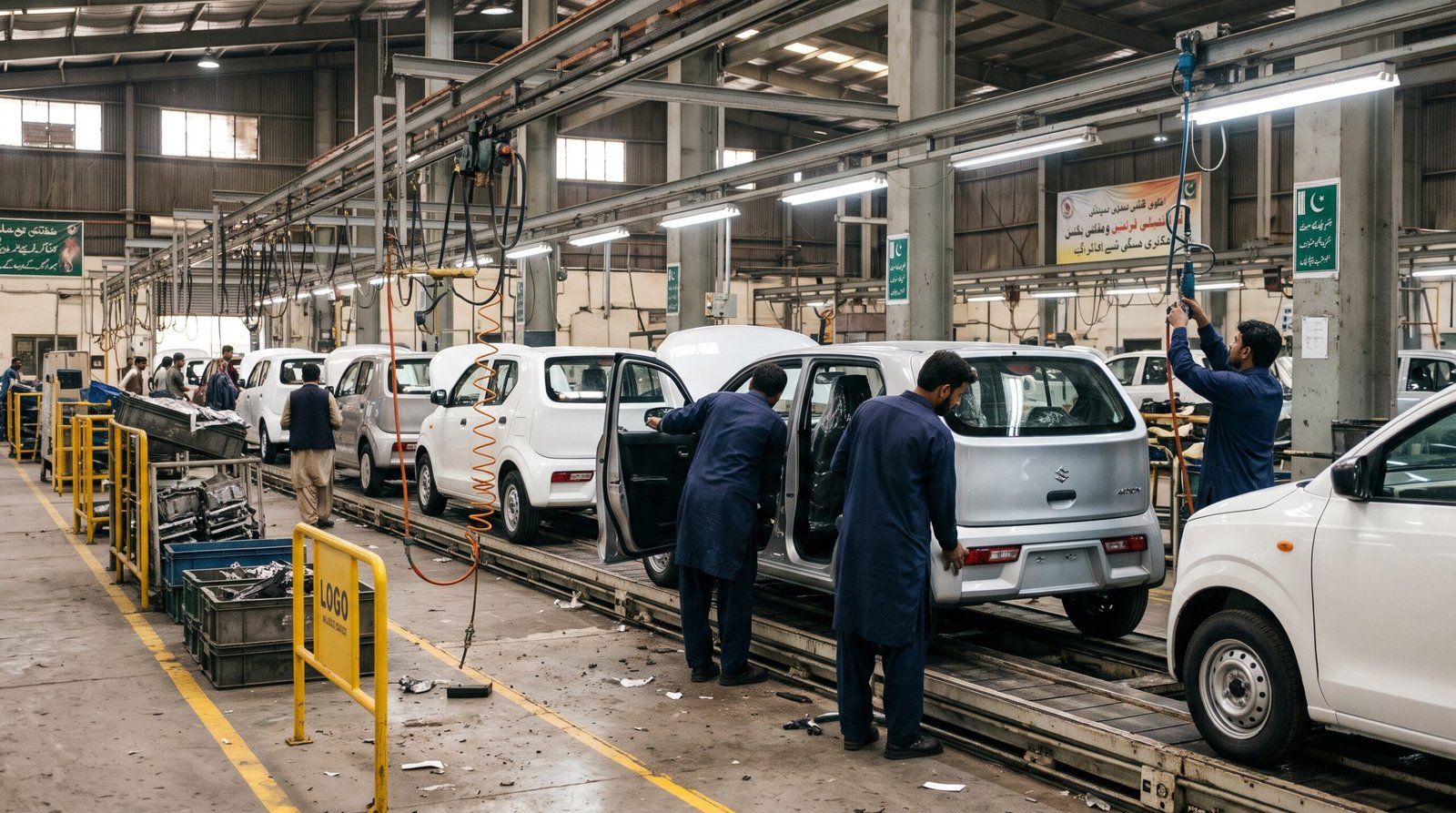
The federal government has initiated a sweeping overhaul of its automotive sector, executing a five-year tariff reduction framework designed to aggressively compress Pakistan’s import bill, lower domestic production costs, and force manufacturers into compliance with stringent export and localization mandates.
Information Minister Attaullah Tarar and Adviser to the Prime Minister for Industries and Production Haroon Akhtar Khan delivered the policy directive on Saturday in Islamabad. The framework isolates six core priorities: reducing vehicle acquisition costs for middle-income demographics, forcing export promotion, mandating local manufacturing integration, enforcing UN-aligned safety protocols, accelerating electric vehicle (EV) penetration, and ensuring fiscal transparency.
Acting on explicit directives from Prime Minister Shehbaz Sharif to deflate the consumer cost of mobility, the government will structurally dismantle the existing tariff barriers. The import duties levied on “completely built units (CBUs)”, local assembly infrastructure, and raw components will face gradual, annualized reductions over a five-year horizon.
“You will see that prices of cars will come down … the manufacturing cost of automakers will come down,”
Adviser to the Prime Minister Haroon Akhtar Khan stated, confirming that the deflationary impact would apply universally to the passenger market, strictly excluding luxury segments.
To bridge the nation’s trade deficit, the framework weaponsizes a rigid reward-and-penalty mechanism for domestic automakers. Assembly operators will be legally bound to meet designated localization metrics. Compliant manufacturers will secure a 5% “Duty Drawback on Local Taxes and Levies (DLTL)”, which scales up by an additional 10% as corporate export volumes expand. Failure to meet both domestic supply quotas and external export targets will trigger institutional penalties and total disqualification from the DLTL rebate program.
Also Read: NEPRA Hikes Incremental Electricity Rate To Rs25.30 Amid Dissent Over Cost Calculation Failures
The policy further integrates 45 distinct vehicular safety benchmarks aligned with the United Nations’ WP.29 regulatory code. Capitalizing on this upgrade, Akhtar Khan asserted that hardware meeting these parameters will rank globally among the safest operational vehicles.
To aggressively engineer a pivot away from internal combustion, the state aims to transition 30% of all new vehicular sales to electric power by 2030. The government will utilize aggressive tax suppression to stimulate this shift, pending final clearance from the International Monetary Fund (IMF).
| Vehicle Powertrain Category | Proposed Sales Tax Rate |
| Fully Electric Vehicles (EVs) | 1% |
| Range-Extended Electric Vehicles (REEVs) | 6% |
| Hybrid Electric Vehicles (HEVs) | 9% |
Electric units carrying a retail value up to $50,000 will be entirely exempt from capital value tax (CVT), withholding tax, and federal excise duty (FED). Assets breaching this ceiling will be legally classified as luxury imports and subjected to the maximum standard tax brackets.
Simultaneously, the State Bank of Pakistan is recalibrating its consumer credit parameters to underwrite EV adoption. The central bank will expand the maximum capital financing limit for EV acquisitions from Rs3 million to Rs10 million, while extending the mandatory repayment tenure from three to five years.
To combat range anxiety and commercial bottlenecks, the state will directly deploy capital to cover the viability gap hindering private charging station operators. Customs duties on imported charging infrastructure have been entirely abolished, while the associated sales tax is capped at 1%.
To sustain IMF-mandated revenue neutrality, the financial incentives under this framework are explicitly funded by penalizing traditional displacement. Additional tax burdens will be aggressively levied against internal combustion engine (ICE) vehicles exceeding 1,000cc. Vehicles falling below the 1,000cc threshold—the dominant transport medium for the working and middle classes—will maintain their current tax exemptions. Capital extracted from the heavy ICE segment will be redirected to underwrite the DLTL export rebates and domestic research initiatives.
Data indicates immediate market responsiveness to recent policy signals. Following the enactment of the “New Energy Vehicle (NEV) Policy 2025-30”, domestic sales of electric two-wheelers surged to 240,000 units in FY2025-26, up from 60,000 in FY2024-25.
Information Minister Attaullah Tarar characterized this localized transition to electric two-wheelers as a “need of the time” to hedge the domestic consumer market against global petroleum volatility. Tarar maintained that forcing localization and value addition within the industrial base remains the state’s primary lever for employment generation and long-term carbon deficit reduction.