

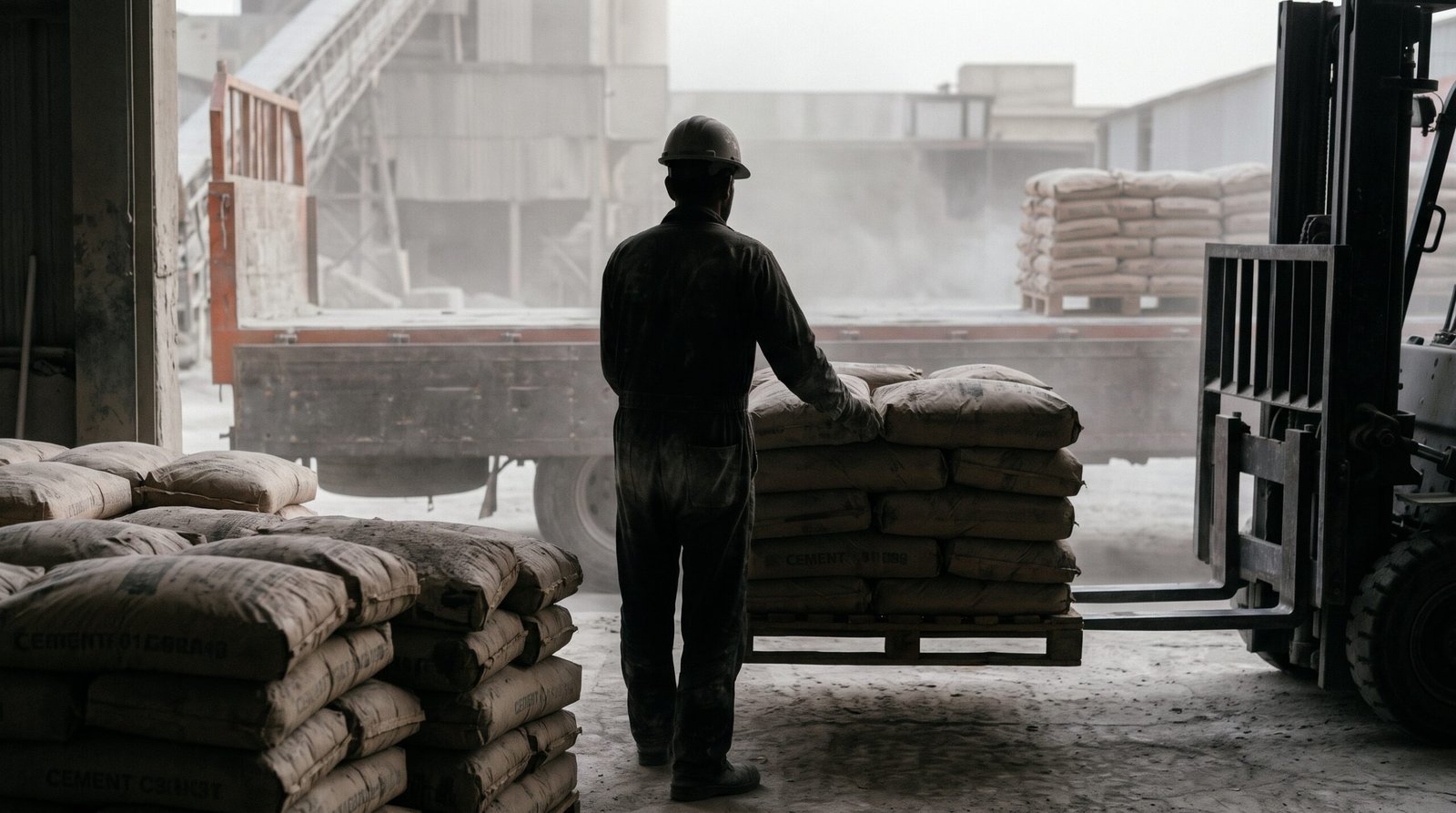
Pakistan’s national cement dispatches surged to 4.8 million tonnes in October 2026, marking the highest volume for this specific month in five years. According to a comprehensive research report published by AKD Securities, the industry recorded a marginal 0.4% year-on-year increase as a robust recovery in domestic sales successfully offset a notable decline in international exports.
Domestic cement dispatches rose by 1% year-on-year to reach 4 million tonnes, establishing their highest level since June 2022. Conversely, export volumes contracted by 4% to 0.8 million tonnes.
The increase in localized sales was driven by recovering domestic construction activity following monsoon-related disruptions in August. However, the annualized growth rate remained mechanically modest due to the unusually high statistical base recorded in October 2025, a period when domestic dispatches temporarily spiked by 15% driven by post-flood reconstruction demands.
On a month-on-month basis, total cement dispatches increased by 4%, anchored by a 7% rise in domestic sales, while exports declined by 8%. Operational momentum accelerated throughout the month, with average daily domestic dispatches in northern Pakistan increasing to approximately 110,000 tonnes in October from 105,000 tonnes in September.
Regional data reveals a stark divergence in operational performance between the northern and southern manufacturing hubs.
In northern Pakistan, domestic cement dispatches remained entirely flat year-on-year at 3.4 million tonnes, despite registering a 7% monthly increase against September. More critically, northern cement exports cratered to zero from approximately 0.1 million tonnes in October 2025, entirely paralyzed by the continued closure of the Pakistan-Afghanistan border.
In contrast, southern Pakistan demonstrated robust growth. Southern domestic sales rose 7% year-on-year to 0.6 million tonnes. Furthermore, southern cement exports increased by 12% year-on-year to approximately 0.8 million tonnes, fueled by sustained overseas demand serviced via seaborne shipping routes.
“The absence of northern exports more than offset the increase in southern shipments, resulting in an overall 4% annual decline in cement exports.”
Over the broader four-month timeline of FY2026-27 (July-October 2026), total industry dispatches increased 3% year-on-year to 18 million tonnes. Domestic dispatches climbed 6% to 14.9 million tonnes, while cumulative exports dropped 10% to 3.1 million tonnes. During this period, northern exports were entirely eliminated, a stark contrast to the 0.8 million tonnes recorded during the first four months of FY2025-26.
These regional disparities directly impacted “capacity utilisation”. Industry-wide utilization stood at 67% in October 2026, increasing by 0.5 percentage points from September (66%) but remaining broadly unchanged year-on-year.
Northern manufacturers operated at a depressed 60% capacity utilisation, declining 1.9 percentage points year-on-year due to the evaporated export market. Conversely, southern manufacturers operated at an intense 93% capacity utilisation, surging 6.9 percentage points compared with October 2025.
Also Read: Who holds the workers’ money?
To defend against escalating macroeconomic pressures, cement manufacturers have aggressively increased selling prices. Average cement prices have jumped by 12%, or Rs167 per bag, since the outbreak of the Middle East conflict. This pricing power has allowed the sector to absorb the impact of rising global coal and fuel costs, pushing third-quarter gross margins to 35.1% and lifting overall sector profitability by 17% year-on-year.
“Gross margins are projected to remain broadly stable over the full year because of the industry’s ability to pass increased costs on to customers through higher cement prices.”
However, international coal prices remain the sector’s primary operational risk. A “sensitivity analysis” conducted by AKD Securities highlights how escalating international coal prices could rapidly deteriorate corporate earnings if global supply chains tighten.
| Cement Manufacturer | Base EPS ($85/Tonne) | EPS At $100/Tonne | EPS At $110/Tonne | EPS At $120/Tonne | Max Projected Decline |
| Lucky Cement | Rs71.9 | Rs69.8 | Rs68.3 | Rs66.9 | 7.0% |
| DG Khan Cement | Rs29.2 | Rs24.8 | Rs22.3 | Rs19.7 | 32.3% |
Other major manufacturers show similar vulnerability to the $120 per tonne stress-test scenario. Fauji Cement’s projected earnings per share (EPS) would decline from Rs7.7 to Rs6.1 (a 20.6% reduction). Maple Leaf Cement Factory’s EPS would fall from Rs12.2 to Rs9.4 (a 22.9% reduction). Pioneer Cement, Cherat Cement, and Kohat Cement would face projected earnings declines of 27.7%, 19.2%, and 15.7%, respectively.
Lucky Cement remains the most insulated against global coal shocks among the tracked equities.
Looking forward, analysts project domestic cement dispatches to increase by approximately 8% year-on-year during FY2026-27, contingent upon the stabilization of construction costs, improved financing rates, and easing geopolitical tensions. Consequently, AKD Securities maintained an “overweight” investment stance on Pakistan’s cement sector, underpinned by recovering domestic demand and declining corporate debt levels.