

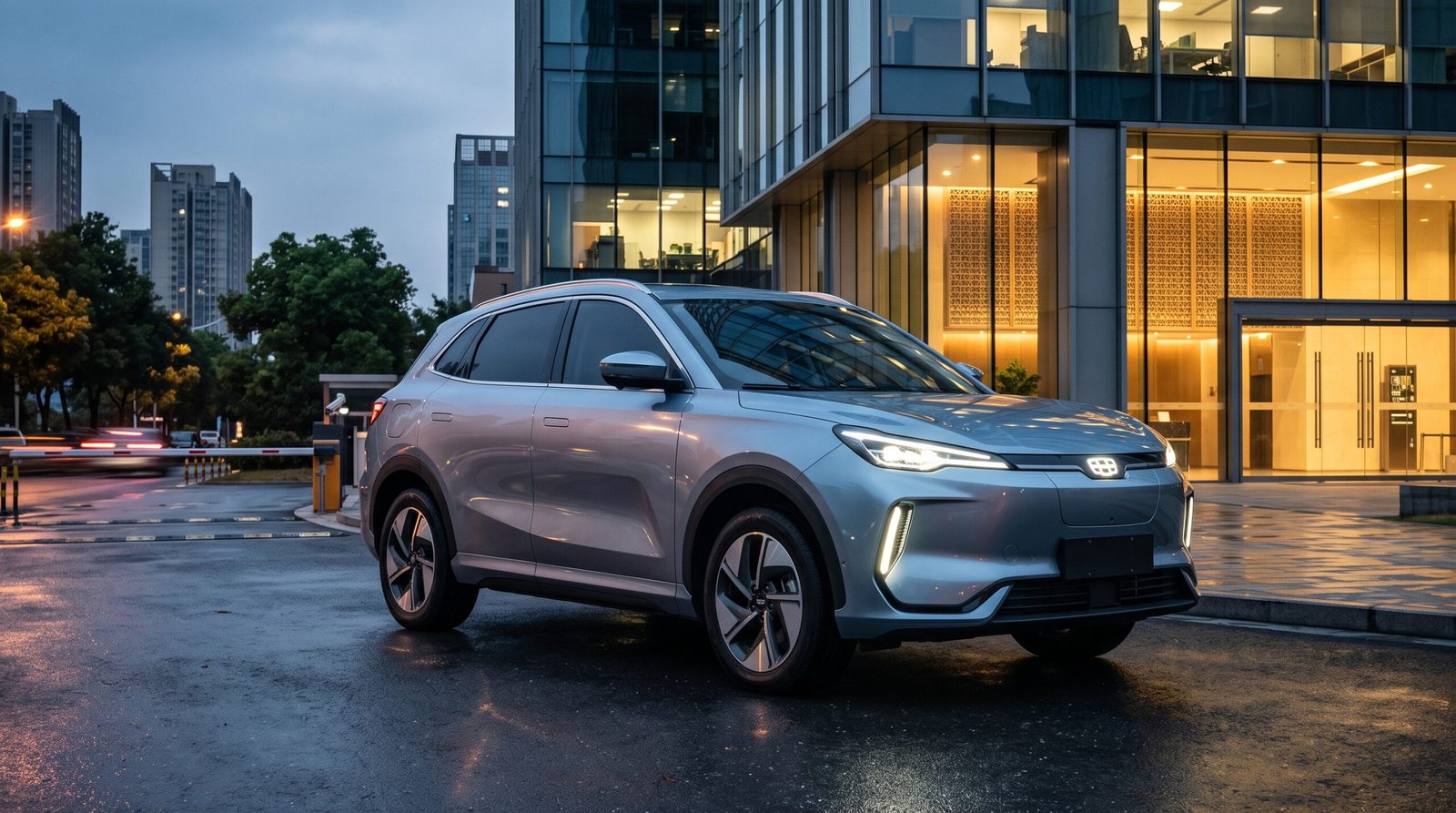
Chinese automotive giant Geely is preparing to enter Pakistan’s increasingly competitive electric and hybrid vehicle market with three models — the EX2 electric hatchback, EX5 electric SUV and Starray EM-i plug-in hybrid — through its local partner, Bestway Automotive.
The company has indicated 24 October 2026 as a significant date for its Pakistan debut, although it has not publicly clarified whether the occasion will mark a formal launch, vehicle unveiling or opening of bookings.
A Geely team member has confirmed to The Scoop that the EX2, EX5 and Starray are the three vehicles scheduled for introduction.
However, official Pakistani prices, variants, delivery timelines and warranty packages have not yet been disclosed.
Geely’s entry comes as Chinese manufacturers increasingly challenge established Japanese and Korean automotive brands, particularly in the growing SUV, electric vehicle and plug-in hybrid segments.
The question is whether Geely can translate its global manufacturing capabilities into a sustainable business in Pakistan, where vehicle prices, consumer purchasing power, after-sales support and resale values remain decisive factors.
Geely EX2: A Compact Electric Car With Mass-Market Ambitions
The Geely EX2 is a compact, fully electric hatchback designed primarily for urban mobility.
International specifications for its higher-battery variant include:
- Battery capacity: 39.4 kWh
- Motor output: 114 horsepower
- Torque: 150 Nm
- Claimed driving range: Up to 410 kilometres under China’s CLTC testing cycle
- Drivetrain: Rear-wheel drive
- Length: 4,135 mm
- Wheelbase: 2,650 mm
The EX2 could compete against compact electric vehicles such as the MG Binguo EV, GAC AION UT and BYD Atto 2.
Published Pakistani market listings place the MG Binguo EV at approximately Rs 5.70 million, the GAC AION UT at Rs 6.40 million and the BYD Atto 2 at Rs 7.29 million.
These prices provide a reference point for the segment rather than an indication of Geely’s eventual pricing.
If Geely can position the EX2 competitively, the hatchback could attract urban households seeking an alternative to conventional petrol-powered cars.
However, the commercial prospects of the EX2 will depend on its actual Pakistani price, battery warranty, charging arrangements and the availability of reliable after-sales services.
Geely EX5: Entering The Competitive Electric SUV Segment
The EX5 is a fully electric family SUV and represents Geely’s entry into one of Pakistan’s increasingly contested automotive categories.
International specifications include:
- Battery capacity: Approximately 60.2 kWh
- Motor output: 218 horsepower
- Torque: 320 Nm
- Claimed driving range: Up to 530 kilometres under CLTC testing
- Drivetrain: Front-wheel drive
- Length: 4,615 mm
- Wheelbase: 2,750 mm
Some international versions carry a WLTP driving-range rating of approximately 410–430 kilometres, illustrating the importance of distinguishing between different testing standards.
The EX5 could compete with electric SUVs including the BYD Atto 3, GAC AION V, Jaecoo J6 and Omoda E5.
Published market listings place the BYD Atto 3 at approximately Rs 8.99 million, GAC AION V at Rs 8.90 million and Jaecoo J6 at Rs 8.80 million.
Geely’s pricing will determine whether the EX5 competes directly with these vehicles or targets a different customer segment.
For Pakistani consumers, cabin space, battery performance, charging speed, warranty coverage and resale value could prove just as important as horsepower and claimed range.
Starray EM-i: Geely’s Plug-In Hybrid Alternative
Unlike the EX2 and EX5, the Starray EM-i combines a petrol engine with an electric motor and rechargeable battery.
International specifications for one version include:
- Engine: 1.5-litre petrol
- Battery capacity: 18.4 kWh
- Combined output: Approximately 260 horsepower
- Combined torque: 387 Nm
- Claimed electric-only range: Up to 105 kilometres under NEDC testing
- Length: Approximately 4,740 mm
International specifications and battery options vary between markets, while the Pakistani configuration remains unconfirmed.
The Starray EM-i could appeal to buyers interested in electric driving without depending entirely on public charging infrastructure.
Its potential competitors include plug-in hybrid SUVs offered by Haval, Chery, Jaecoo and MG.
Pakistan’s uneven charging network could make plug-in hybrids attractive to consumers who regularly travel between cities.
However, their operating-cost advantages depend heavily on driving patterns and regular battery charging.
The Price Battle: Where Will Geely Position Its Cars?
Geely’s official Pakistani prices remain undisclosed as of 22 October.
Nevertheless, the prices of competing vehicles provide an indication of the market segments the company may target.
|
Vehicle |
Published Pakistan Price |
|
MG Binguo EV |
Rs 5.70 million |
|
GAC AION UT |
Rs 6.40 million |
|
BYD Atto 2 |
Rs 7.29 million |
|
Jaecoo J6 |
Rs 8.80 million |
|
GAC AION V |
Rs 8.90 million |
| BYD Atto 3 |
Rs 8.99 million |
Note: These are published reference prices for competing vehicles, not official Geely prices. Prices may vary by variant and subsequent revisions.
The figures illustrate the competitive environment Geely faces.
The EX2 will need to offer a convincing balance between affordability, battery range and equipment.
The EX5 will enter a market where several manufacturers already offer electric SUVs with extensive technology packages.
Meanwhile, the Starray EM-i will compete for customers considering hybrid and plug-in hybrid SUVs.
Pricing could ultimately determine whether Geely becomes a volume-oriented manufacturer or concentrates on comparatively higher-income buyers.
Bestway Automotive And The Local Assembly Strategy
Geely’s entry into Pakistan is being facilitated by Bestway Automotive, a subsidiary of the Bestway Group.
Under an agreement announced in July 2026, Bestway Automotive became Geely’s authorised distributor in Pakistan, with responsibilities extending to vehicle distribution and assembly.
The initial vehicles are expected to arrive as completely built units, with local assembly planned subsequently at Bestway’s automotive facility in Karachi.
This arrangement could allow Geely to establish a market presence before expanding domestic production.
However, the company has not publicly announced a definitive local assembly commencement date, annual production capacity or detailed localisation targets.
The economic importance of local assembly extends beyond vehicle prices.
Sustained manufacturing operations could create opportunities for domestic parts suppliers, technical employment and automotive investment.
Yet achieving economies of scale remains challenging in a market where overall passenger-vehicle volumes are relatively limited.
For Bestway Automotive, the central challenge will be converting Geely’s international reputation into sufficient domestic demand to justify long-term investment.
Chinese Manufacturers Are Reshaping Pakistan’s Automotive Market
Pakistan’s automotive industry has historically been dominated by Japanese manufacturers, particularly Suzuki, Toyota and Honda.
Korean manufacturers subsequently expanded consumer choice, while Chinese brands have increasingly introduced SUVs, crossovers, hybrids and electric vehicles.
BYD, Chery, GAC, Deepal, Haval, Jaecoo and other brands are competing across different price categories.
Their expansion has increased the range of technologies available to consumers, including battery-electric vehicles, conventional hybrids and plug-in hybrids.
However, the presence of more manufacturers does not automatically translate into proportional market growth.
Automotive companies require sustainable sales volumes, dependable supply chains, dealership networks and after-sales operations.
Pakistan’s relatively limited market size means competition could intensify considerably if several manufacturers target similar customer segments.
Geely’s arrival will add another internationally established manufacturer to this contest.
Can Electric Vehicles Become Mainstream In Pakistan?
Electric vehicles offer the potential for lower energy costs per kilometre, particularly for owners with access to economical home charging.
However, their adoption faces several practical barriers.
Charging infrastructure remains uneven, while electricity tariffs, installation costs and the availability of reliable charging facilities influence ownership decisions.
Long-distance travel presents additional challenges for motorists unfamiliar with electric vehicle charging requirements.
Battery warranties and resale values also remain important considerations.
For Geely, providing clear information about battery durability, real-world driving ranges and after-sales support will be essential.
The EX2 and EX5 may appeal to consumers seeking lower running costs, while the Starray EM-i offers an alternative for buyers unwilling to rely exclusively on electric propulsion.
Nevertheless, the financial advantages of each technology must be assessed against actual purchase prices, energy costs, maintenance expenses and depreciation.
The Challenge Of Localisation And Market Saturation
Pakistan’s growing number of automotive entrants raises questions about the sustainability of the industry’s expansion.
Greater competition can encourage innovation, improved specifications and more choices for consumers.
However, local assembly plants require sufficient production volumes to justify investment.
If market demand is divided among too many manufacturers, some companies may struggle to achieve the scale necessary for profitable operations.
Geely’s partnership with Bestway could provide an advantage through existing industrial infrastructure and local business experience.
But the partnership alone does not guarantee success.
The company will need to establish competitive pricing, a reliable dealership network, strong technical support and sustained consumer confidence.
These factors will become particularly important once the initial excitement surrounding the launch subsides.
What Will Determine Geely’s Success?
Geely’s anticipated introduction on 24 October will mark an important development in Pakistan’s evolving automotive market.
The EX2, EX5 and Starray EM-i represent three distinct approaches to electrified mobility.
Their success, however, will depend on more than international specifications or brand recognition.
Official Pakistani prices, financing arrangements, warranties, delivery schedules and local assembly commitments will provide the first meaningful indicators of the company’s commercial strategy.
For consumers, the expansion of competition could eventually create opportunities for better-equipped vehicles and more competitive prices.
For manufacturers, it also means greater pressure to differentiate products and deliver reliable ownership experiences.
Geely is entering a market where Chinese automotive brands are no longer newcomers but increasingly established competitors.
The challenge is therefore not simply introducing another three vehicles.
It is establishing a commercially sustainable position in a market where affordability, reliability, localisation and customer confidence will ultimately determine which manufacturers succeed.
Geely’s announcement may attract considerable attention on 24 October, but its real test will begin when Pakistani consumers can compare actual prices, take deliveries and evaluate the ownership experience.