

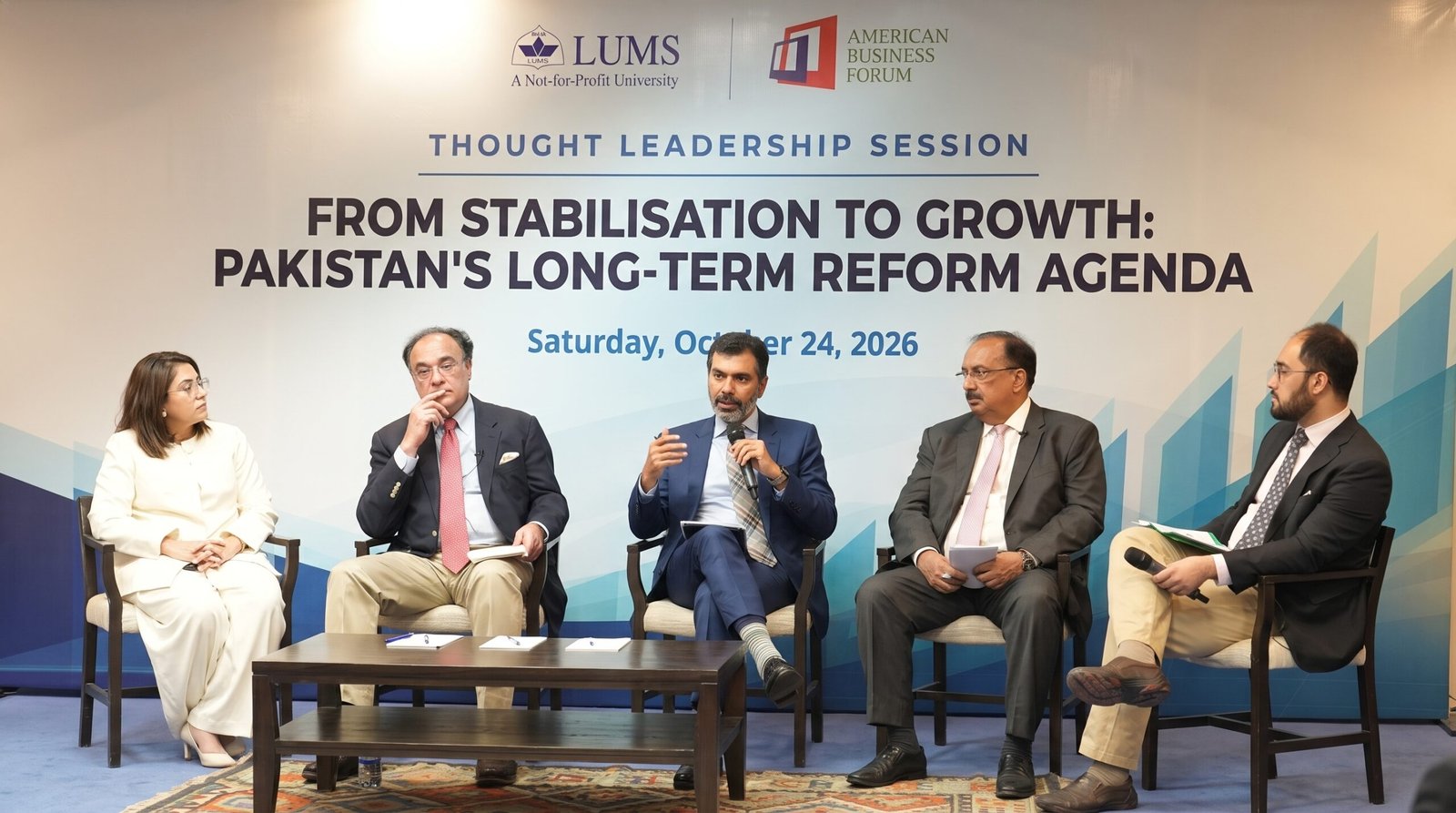
Federal Finance Minister Senator Muhammad Aurangzeb has declared that Pakistan must urgently pivot from macroeconomic stabilisation to export-led growth, higher industrial productivity, and robust private-sector investment to permanently break its recurring cycle of economic crises. Speaking on Saturday at a high-level policy dialogue titled “From Stabilisation to Growth: Pakistan’s Long-Term Reform Agenda,” co-hosted by the Lahore University of Management Sciences (LUMS) and the American Business Forum (ABF), Aurangzeb explicitly warned that reverting to import-heavy, consumption-led growth models would erase recent gains and set the national economic recovery back by four to five years.
The policy session, opened by ABF President Osman Khalid Waheed, convened leading economic policymakers, corporate leaders, and academics to chart a sustainable trajectory for Pakistan’s economy beyond immediate crisis management.
Macroeconomic Stabilisation and the Twin Deficits
Detailing the government’s recent fiscal trajectory, Aurangzeb noted substantial progress in restoring macroeconomic stability under stringent fiscal constraints. The country’s twin deficits have seen a dramatic contraction, dropping from 12.5 per cent of Gross Domestic Product (GDP) at the onset of the reform process to just 2.6 per cent by the close of the last fiscal year. This fiscal tightening drove the budget deficit to a 22-year low, while the current account deficit was successfully compressed to approximately 0.1 per cent of GDP.
This stabilisation phase has directly bolstered the external account. Foreign exchange reserves, which had plummeted to barely two weeks of import cover at the height of the balance-of-payments crisis, have now been rebuilt to cover more than three months of imports. These improved external buffers have subsequently earned Pakistan three consecutive credit-rating upgrades since April of last year, signalling restored confidence among multilateral lenders and international markets.
Private-Sector Leadership and Export Competitiveness
Despite these short-term fiscal victories, the finance minister stressed that stabilisation alone cannot deliver sustainable, inclusive growth without executing deep structural changes. The government is actively shifting away from heavy state intervention towards a model where the private sector dictates economic activity, positioning the state strictly as a regulatory enabler.
To operationalise this shift, administrative control over the Rs40 billion Export Development Fund has been transferred from bureaucratic ministries directly to private-sector stakeholders, empowering exporters to allocate resources based on genuine market needs. Aurangzeb highlighted the targeted expansion of the Information Technology sector, noting that IT services exports have surged from under $1 billion to $4.6 billion, with official projections targeting $5.5 billion for the current fiscal year. To further incentivise the export base, the government is providing targeted financing at 4.5 per cent and offering surplus electricity to industrial consumers at Rs23 per unit.
Reforms in tariff policy are simultaneously being implemented to lower the cost of imported raw materials and intermediate goods, pushing domestic industries away from a reliance on prolonged state protection and towards genuine international competitiveness.
Privatisation and Sectoral Reforms
Addressing the heavy fiscal drain of state-owned enterprises (SOEs), Aurangzeb confirmed that the federal government is aggressively pursuing privatisation frameworks. The administration is currently processing bids for three major power distribution companies (DISCOs), a critical structural benchmark aimed at stemming the accumulation of circular debt in the energy sector. Furthermore, the minister pointed to the agricultural sector, where livestock and dairy currently account for 63 per cent of agricultural GDP, noting that specialised reforms in these areas are necessary to boost rural productivity and exportable surpluses.
Expert Perspectives on Capacity and Inclusion
Former State Bank of Pakistan Governor Dr Reza Baqir expanded on the limitations of monetary mechanisms, cautioning that exchange-rate adjustments and currency depreciation cannot deliver sustained export growth without parallel investments in domestic productive capacity. While goods exports have recovered to a rolling 12-month average of $33 billion to $34 billion and services exports have doubled over the past five years, Baqir advocated for innovative frameworks where the government can share in the financial gains of publicly supported businesses without interfering in their corporate governance or shielding them from market competition.
Salman Burney, vice-chair of Habib Group and former managing director of GSK Pakistan, observed that recent macroeconomic pressures have forced domestic businesses to optimise energy efficiency and streamline productivity. He urged Pakistani corporations to identify specific sectors offering genuine global competitive advantages and to aggressively direct capital towards international market expansion.
Addressing demographic and social fundamentals, Oraan Founder and CEO Halima Iqbal highlighted the critical need for financial inclusion and female workforce participation. Expanding women’s education and formal economic integration remains central to maximising national output, a point echoed by Aurangzeb, who grouped female participation alongside climate change adaptation and population management as unavoidable pillars for long-term growth.
The session, moderated by Dr Ali Hasanain, Associate Professor at LUMS’s Department of Economics, concluded that Pakistan must rigorously target an annual economic growth rate of at least 7 per cent to absorb its growing workforce. Achieving this requires the unwavering execution of the structural reforms currently underway, ensuring the transition from fragile stabilisation to resilient, private-sector-led prosperity.