

LAHORE: The Pakistan Sugar Mills Association (PSMA) has welcomed the federal government’s decision to deregulate the sugar industry and pressed for additional export quotas to ease liquidity pressures, even as sugarcane growers in South Punjab voiced sharp reservations over the absence of a government-notified procurement price ahead of the upcoming crushing season.
Addressing a press conference in Lahore, PSMA Chairperson Asim Ghani Usman said deregulation would help transition the sugar sector into a formal, export-oriented industry while strengthening financial returns for farmers. He urged the federal cabinet to promptly ratify the Economic Coordination Committee’s (ECC) decision permitting the export of 416,000 tonnes of sugar and called for the restoration of land routes to facilitate cross-border shipments. According to Usman, export proceeds would bolster mills’ cash flows, support timely payments to growers, and generate foreign exchange for the economy, adding that the industry had already cleared roughly 99 per cent of payments owed to farmers for their sugarcane crop.
PSMA Cites 800,000-Tonne Surplus in Push for Additional Quotas
PSMA Senior Vice Chairman Muhammad Rafiq underscored that the industry continues to hold surplus stocks of 800,000 tonnes despite the recent export clearance, arguing that further export approvals are warranted as the new crushing season approaches. While noting that the government has retained certain regulatory safeguards under the new framework, Rafiq said authorities have indicated that complete deregulation could be achieved within three years or sooner.
Defending the shift away from state-fixed rates, Rafiq credited provincial governments with liberalising sugarcane prices two years ago, maintaining that market-based pricing had allowed growers to secure fairer returns. Addressing concerns that deregulation and exports could drive up domestic retail sugar prices, he contended that higher prices would ultimately pass through to benefit farmers as well.
Former PSMA Chairperson Zaka Ashraf echoed that view, describing deregulation as the fulfilment of a longstanding industry demand whose implementation would serve both growers and the broader economy. The policy also received backing from PSMA South Zone Vice Chairman Aslam Faruque and North Zone Vice Chairman Khan Muhammad Ashraf. Claiming that Pakistan currently produces the cheapest sugar in the world, Khan Muhammad Ashraf argued that the quality of domestic output makes it competitive internationally and that securing stronger export prices would enable mills to offer better returns to growers.
Also Read: Pakistan’s Active Income Taxpayer Base Jumps 25% To Cross 8 Million Mark
South Punjab Growers Flag Missing Support Price Ahead of Crushing
On the ground in South Punjab—where sugarcane cultivation has expanded rapidly alongside the growth of milling capacity—farmers painted a far more cautious picture. Growers expressed concern that the government has once again left them without a notified minimum procurement price as the crushing season nears.
Data from Rahim Yar Khan, a major sugarcane hub, illustrates the scale of the crop’s footprint. Deputy Director Agriculture Dr Masood Saleem confirmed that sugarcane has been cultivated across 673,000 acres in the district this year, accounting for nearly half of its total cultivated area of 1.36 million acres. By comparison, cotton covers 377,000 acres, rice occupies 122,000 acres, mango orchards span 55,000 acres, and citrus and other fruit orchards account for approximately 4,500 acres. The district houses eight sugar mills, including one at Channi Goth along the Bahawalpur–Rahim Yar Khan boundary and another near the Sindh–Punjab border, with the remaining units spread across its four tehsils.
Representatives of Kissan Ittehad pointed out that the government neither fixed a per-maund sugarcane price last year nor announced one for the current season despite the imminent start of crushing, leaving growers exposed to market volatility.
Questions Mount Over Rs2.69 Billion in Annual Sugar Cess Collections
Beyond procurement pricing, growers have raised pointed questions regarding the transparency and utilisation of funds collected under the sugar cess, which is levied at Rs2.50 per maund each on farmers and sugar mills. Based on an estimated average yield of 800 maunds per acre across Rahim Yar Khan’s sugarcane acreage, farmers calculate that annual cess collections from growers alone could reach approximately Rs1.35 billion, with matching contributions from mills lifting the combined figure to nearly Rs2.69 billion.
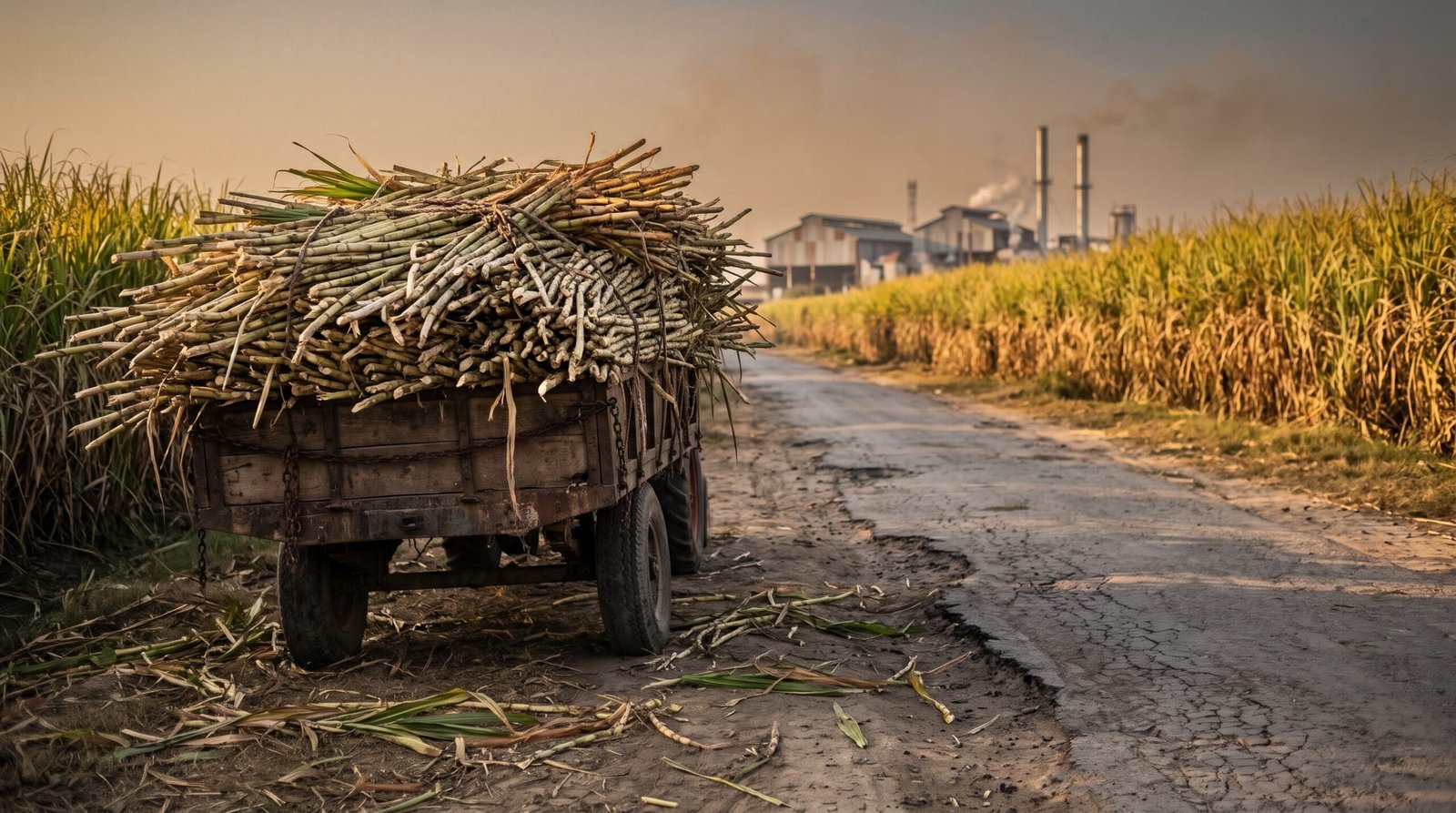
Farmer representatives questioned why rural link roads across the district remain in severe disrepair despite these substantial collections, noting that several key arteries have remained damaged for nearly two decades. Complaining that roads worn down by heavily loaded sugarcane trailers are routinely left unrepaired, growers demanded that the government disclose how the collected cess funds are being spent.
Kissan Ittehad also criticised authorities for failing to consult farmers’ organisations on sugarcane pricing and cess allocation, renewing its call for the creation of a separate South Punjab province to ensure that locally generated agricultural revenues are reinvested directly into regional infrastructure and development.