

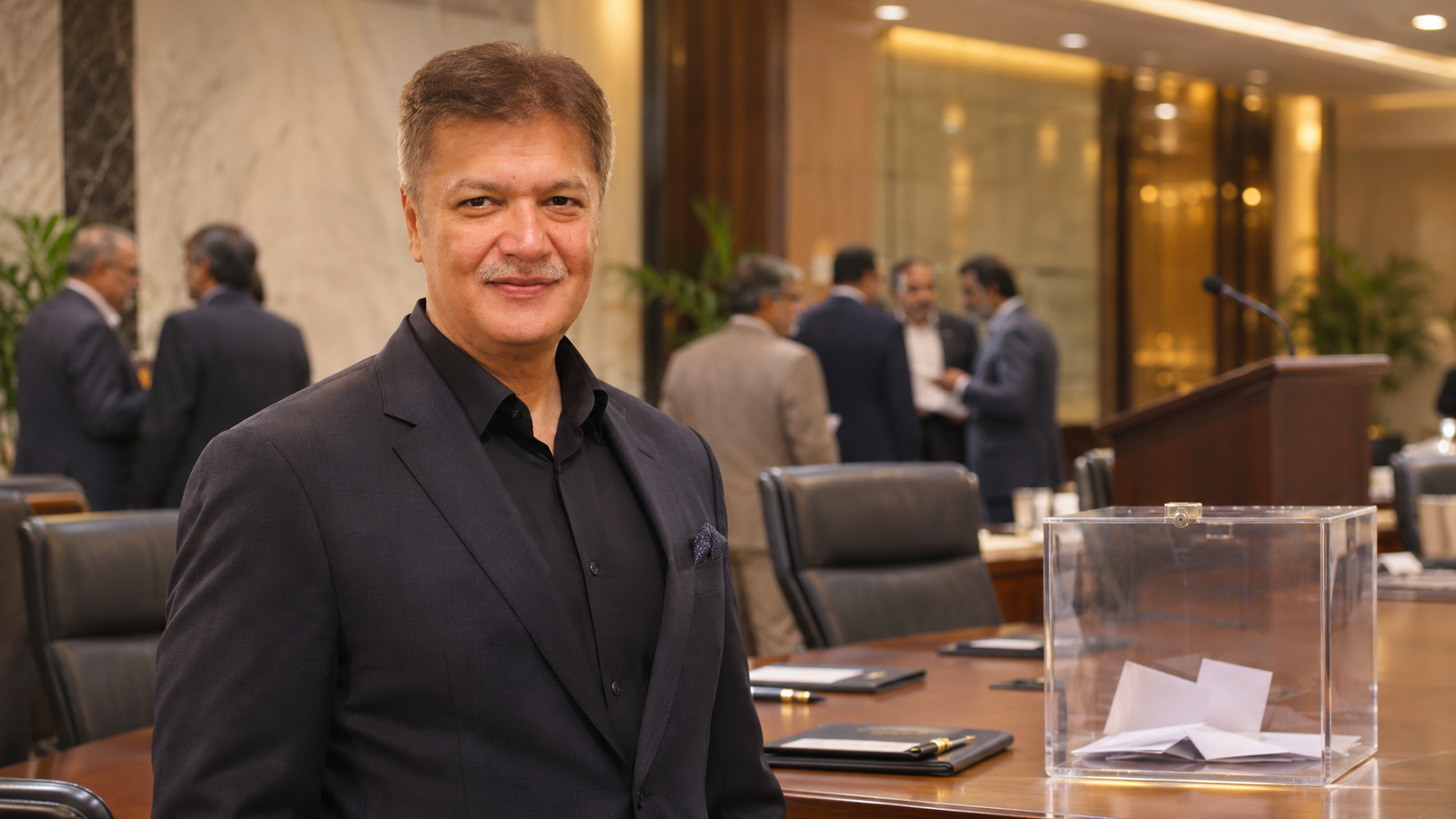
KARACHI, November 28, 2026: Prominent industrialist, former Punjab caretaker minister and United Business Group (UBG) Patron-in-Chief S.M. Tanveer has emerged as the overwhelming favourite to become the next President of the Federation of Pakistan Chambers of Commerce and Industry (FPCCI), with preliminary electoral estimates suggesting that more than 300 of approximately 400 votes representing chambers of commerce and trade associations across Pakistan are committed to supporting his candidature.
In what could prove to be the most decisive factor in the forthcoming elections, 16 out of 17 chambers of commerce in Sindh are understood to have unanimously extended their support to Tanveer, with his rival, Zubair Motiwala, reportedly drawing provincial chamber-level backing primarily from his own nominating chamber.
The development assumes particular significance as the FPCCI presidency for the 2027–28 term falls to Sindh under the federation’s provincial rotation system.
With elections scheduled for December 17, 2026, Tanveer appears poised to secure a commanding mandate, potentially winning more than 75 per cent of the nationwide electoral vote.
Sindh’s Overwhelming Mandate Strengthens Tanveer’s Candidature
The reported support of 16 out of 17 Sindh chambers, representing more than 94 per cent of the province’s chambers, is arguably the most significant political development in the race for the FPCCI presidency.
While the provincial rotation system ensures geographical representation within the federation’s leadership, the overwhelming backing from Sindh’s own business institutions provides Tanveer with a compelling case for leading the country’s apex business body.
It also presents a fundamental challenge to the narrative advanced by his opponents regarding Sindh’s representation.
If the overwhelming majority of Sindh’s chambers themselves have chosen to stand behind Tanveer, it becomes increasingly difficult to question the representative strength of his candidature.
The reported consolidation of provincial support suggests that Sindh’s organised business community is prioritising leadership capabilities, economic vision and institutional effectiveness over traditional group loyalties.
For Motiwala, the apparent lack of comparable support among Sindh’s chambers represents a significant electoral challenge, particularly when the presidency is specifically allocated to the province for the upcoming term.
A Nationwide Coalition of Business Leaders
Tanveer’s electoral strength is not confined to Sindh. His candidature enjoys extensive backing across Punjab, Khyber Pakhtunkhwa, Balochistan and Islamabad, encompassing industrialists, exporters, traders and representatives of numerous economic sectors.
The Korangi Association of Trade and Industry (KATI), United Business Group and Pakistan Business Forum have publicly endorsed his candidature.
The unconditional support announced by the Businessmen Progressive Panel (BMPP), led by Saquib Fayyaz Magoon, has further strengthened his electoral position.
Former caretaker federal commerce minister and All Pakistan Textile Mills Association (APTMA) Patron-in-Chief Dr Gohar Ejaz’s endorsement has also provided considerable momentum to Tanveer’s campaign.
The convergence of influential business leaders and representative organisations behind a single candidate reflects a broader desire for unified private-sector leadership at a time when Pakistan’s economy faces considerable structural challenges.
Tanveer Versus Motiwala: An Increasingly One-Sided Contest
Zubair Motiwala, a former president of the Karachi Chamber of Commerce and Industry (KCCI) and an experienced business leader, is contesting under the banner of the newly formed Pakistan Businessmen Alliance (PBA).
The alliance between the Businessmen Group (BMG) and Businessmen Panel (BMP), announced by Motiwala and Mian Anjum Nisar, represents an attempt to challenge UBG’s influence within the federation.
The opposition has raised questions regarding Tanveer’s eligibility under the provincial rotation framework and has called for greater transparency in the electoral process. Tanveer’s supporters, however, have defended his longstanding business and institutional associations with Karachi.
The reported backing of 16 Sindh chambers provides a particularly powerful response to the political debate surrounding his provincial representation, although formal eligibility remains a matter for the relevant electoral authorities.
While Motiwala retains experience and standing within the business community, Tanveer’s extensive coalition and projected electoral numbers place him in a substantially stronger position.
A Leader Who Understands Industrial Pakistan
Tanveer’s candidature comes at a critical juncture for Pakistan’s economy.
The manufacturing sector continues to grapple with expensive energy, taxation pressures, financing costs, regulatory uncertainty and declining competitiveness in international markets.
Tanveer has consistently advocated regionally competitive electricity tariffs, affordable industrial financing, taxation reforms and policies encouraging export-oriented manufacturing.
His experience as Punjab’s caretaker minister for industries and energy has also provided him with valuable insight into government decision-making and the practical challenges of economic policymaking.
This combination of industrial experience, administrative exposure and nationwide business engagement distinguishes his candidature.
Pakistan needs an FPCCI president capable of moving beyond ceremonial representation and engaging effectively with the government on substantive economic reforms.
Tanveer appears particularly well positioned to fulfil that responsibility.
Moving Beyond Traditional Business Advocacy
One of the strongest arguments in favour of Tanveer’s candidature is his involvement in developing comprehensive economic policy alternatives.
Earlier this year, FPCCI, in collaboration with the Economic Policy and Business Development think tank, unveiled a shadow federal budget, alternative economic survey, taxation reform proposals and a five-year development framework.
Tanveer was among the prominent business leaders involved in presenting these proposals alongside Dr Gohar Ejaz and incumbent FPCCI President Atif Ikram Sheikh.
The initiative demonstrated the private sector’s ability to contribute meaningfully to national economic planning through research, consultation and practical recommendations.
Tanveer and his alliance are also preparing a 100-day economic action programme, focusing on strengthening FPCCI’s institutional capacity, assembling an effective economic team and addressing challenges confronting Pakistan’s business community.
Such an approach could transform FPCCI into a substantially more influential stakeholder in national economic policymaking.
Carrying Forward the Legacy of S.M. Muneer
Tanveer carries the legacy of his late father, S.M. Muneer, one of Pakistan’s most respected business leaders, a former FPCCI president and a central figure in the establishment of UBG.
However, Tanveer has established his own identity through sustained economic advocacy, industrial leadership and his ability to unite diverse business interests.
His reported success in securing overwhelming support from Sindh’s chambers, alongside nationwide electoral commitments, reflects his growing influence across Pakistan’s organised business community.
His candidature represents both continuity of an established leadership tradition and an opportunity to redefine the federation’s role in shaping Pakistan’s economic future.
December 17: A Landslide in the Making
With more than 300 votes reportedly committed out of an estimated electoral college of 400 and the backing of 16 out of 17 Sindh chambers, Tanveer enters the final phase of campaigning with a formidable advantage.
Although the final verdict will only emerge through the ballot box, the prevailing electoral landscape points towards a potentially decisive victory.
A commanding mandate would provide Tanveer with the institutional strength to represent Pakistan’s private sector more effectively in negotiations with the government.
At a time when Pakistan urgently needs industrial revival, export expansion, employment generation and investment-led economic growth, FPCCI cannot afford fragmented or ineffective leadership.
It requires a president with national credibility, regional legitimacy, industrial expertise and a clear economic vision.
S.M. Tanveer appears to possess all four.
The December 17 elections could, therefore, mark not merely the elevation of another business leader to the FPCCI presidency, but the beginning of a more assertive, united and economically influential federation.
For Tanveer, the reported numbers suggest that the question is increasingly not whether he can win, but how decisive his victory could be.