

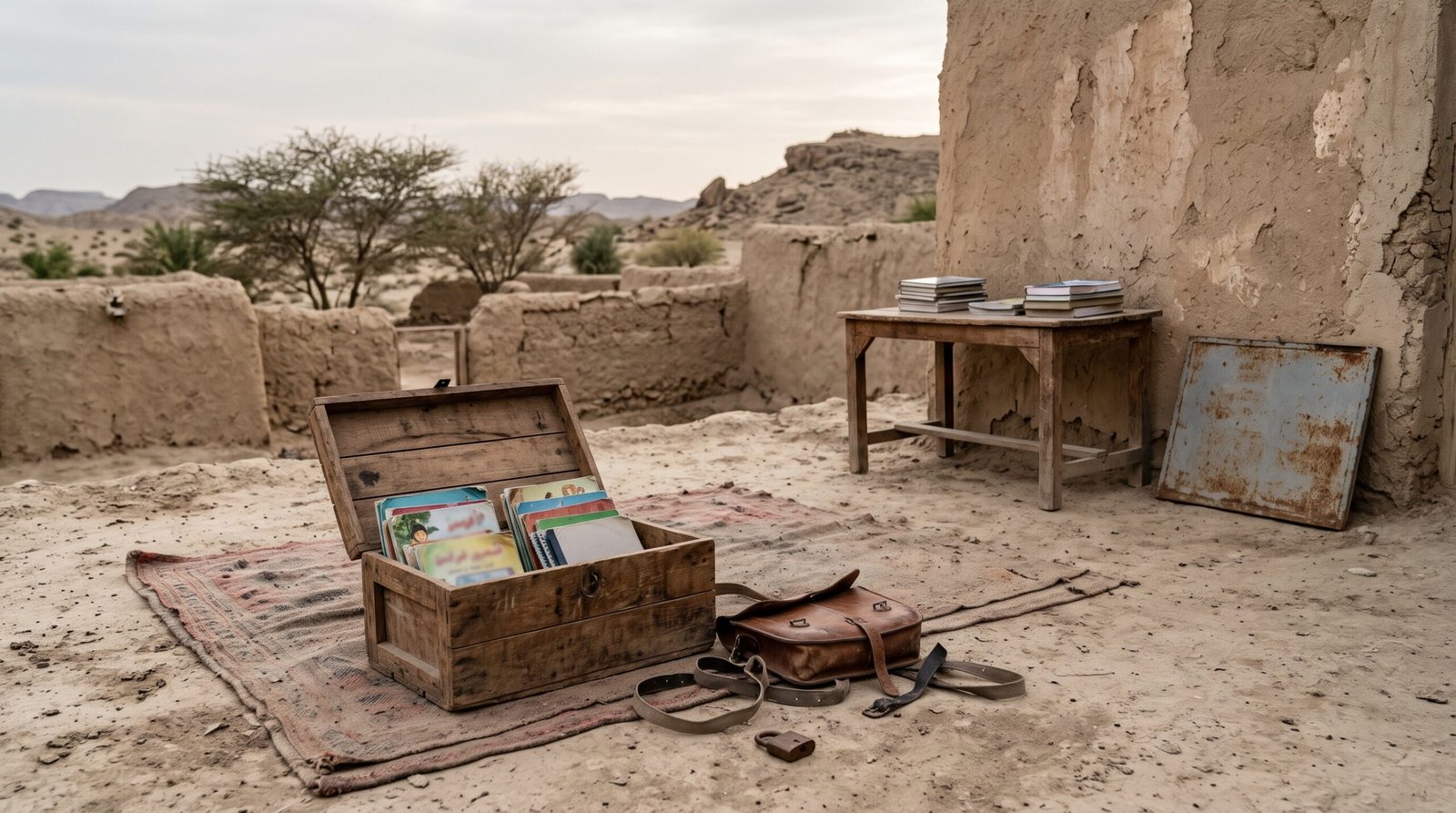
In April 2021, nine-year-old Ambareen Imran explained to a Reuters reporter in Mand, Balochistan, why she liked picture books. The illustrations helped her follow the story. The books had reached her village on the back of Roshan, a camel whose owner usually carried firewood. Children could borrow a book and exchange it on his next visit. Of all the people qualified to pronounce on the reading habits of Pakistanis, Ambareen had one advantage. Somebody had brought her a choice of books and asked what she thought of them.¹
When adults say that Pakistan has lost the habit of reading, it is worth asking when a child in their own neighbourhood last had that choice. A schoolbook must be covered by a certain date. An examination rewards the answer the examiner expects. A borrowed book offers a rarer freedom. A girl may return it unfinished, ask for another by the same writer, or discover that she disagrees with somebody whose words have made it into print. A librarian who remembers what she asked for last week can do a great deal for her education.
The national evidence gives that librarian a formidable task. The Annual Status of Education Report 2025 surveyed 138 districts. Among the Class V children assessed, 52.3 percent could read a Class II story in the Urdu, Sindhi or Pashto assessment. In Class III, 12.4 percent could do so. There is a revealing detail in the tables. Only children who could read the story were subsequently asked questions about its meaning. A child who understood a story when a parent told it might have plenty to say and still never reach the question. The survey measures an important skill. It gives nobody grounds to conclude that the other children lack curiosity.²
Consider what a district education committee could learn from those findings. It could ask a teacher to bring the actual story to a meeting. Members could read what a ten-year-old is expected to read and hear how a teacher helps a pupil who recognises individual words but loses the thread of a sentence. Parents might explain which language the child hears at home and whether there is anything to read in it. A budget discussion that ordinarily begins with the number of classrooms could then reach a different decision. One school might need a teacher who can work with early readers. Another might need books children can take home. The evidence would justify a different use of money in each.
A public library can make a similar inquiry without commissioning a survey. What time does it close? Could a girl who helps at home after school get there and back before dark? May an apprentice borrow a repair manual overnight? Which books did people request last month that the shelves could not supply? These questions put a modest duty on elected councils. Before approving another building, give the librarian an acquisitions budget, a say in the choice of languages, and hours that suit the people who will use it. In a scattered settlement, the recurring cost of getting books to readers may be the best item in the budget. Roshan’s journeys in Kech made precisely that expenditure visible.
The obligation to read grows heavier with the authority of the reader. In the previous Part II, an imaginary inventor had an order for ten pumps and needed a bank to finance the motors and wire. Suppose she now takes the results of her field trial to an engineering university. The farmer says his electricity bill fell.
An engineer asks whether the new pump lifted the same quantity of water through the same height. The farmer knows that the water level in the well changes during the season. The inventor needs both observations before she can defend her claim. A university earns its place in that conversation by putting a meter, a technician and a few afternoons of laboratory time at their disposal. ³
The encounter might even uncover an error. A pump that uses fewer units of electricity while delivering much less water could leave the farmer worse off. Publishing that result would save another farmer the cost of a mistaken purchase and give the inventor a chance to improve her design. A university that credits its students and technicians for such work teaches a form of intellectual honesty that an annual tally of patents can easily miss. It also gives a farmer who may never read an engineering journal a reason to listen the next time its authors speak.
Parliament has a corresponding opportunity. Under Rule 227(3) of the National Assembly’s Rules of Procedure, a committee may hear expert evidence, invite people with a special interest in the matter before it and hold a public hearing. A chairperson wishing to hear a village teacher, librarian or pump mechanic already has the means to do so.
The more consequential decision comes after the witness goes home. Does the committee record which recommendation it accepted, which it declined and why? A courteous hearing followed by silence teaches citizens how little to expect from the next invitation. A reasoned refusal at least gives them something they can examine and contest.⁴
This matters in the present debate over new provinces. A resident of southern Punjab who spends a day travelling to obtain a decision has a serious grievance. So does a family in a producing district that cannot discover what its gas field earned or where the money went. Neither owes anyone an apology for raising the question.
An assembly could invite both to testify. It might find that the first difficulty requires an office with real powers closer to home, while the second requires disclosure of accounts and an enforceable claim on revenue. Those who favour a new boundary and those who oppose it would then owe the witnesses an explanation of how their respective proposals would help. Such a proceeding would also give the country’s civil and military leadership a better account of provincial grievances than any briefing prepared entirely in the capital.
A useful centenary commitment could begin next year. Let each participating district library publish what readers requested and what it obtained. Let a public university report the questions local people brought it and the findings they received. Let an assembly committee put its response beside the evidence citizens gave. Each record could be short, available in the language in which people gave their evidence, and open to correction. Over time a parent, a farmer or a voter would be able to point to a decision and say what changed because somebody listened.
In 2047 Ambareen will be old enough to have children who choose their own books. A fair question for Pakistan on its hundredth birthday will be whether a child in Mand can still tell a grown-up what she wants to read and be sure of another visit. There is an equally fair question for those entrusted with public money. When a citizen asks what became of the wealth beneath her district, will anyone bring her the accounts and stay to hear her questions? That is where the next instalment begins.
Next: What the producing provinces are owed.
Notes:
- Reuters, “Roshan the camel brings books to homeschooling children in Balochistan”, Dawn, April 2021.
- Idara-e-Taleem-o-Aagahi, Annual Status of Education Report, Pakistan 2025, national findings and class-wise language learning tables. Comprehension questions were conditional on reading the story.
- Dr Ikramul Haq, “Who gets Pakistan’s savings?”, The Scoop, Part II of Pakistan at 100. The pump trial is illustrative.
- National Assembly of Pakistan, Rules of Procedure and Conduct of Business, Rule 227(3).
Disclaimer: The views and opinions expressed in this article are solely those of the author(s) and do not necessarily reflect the editorial position, values or beliefs of The Scoop or its management.
The Scoop firmly believes in freedom of speech, intellectual diversity and the open exchange of ideas. As an independent media platform, we remain committed to providing space for differing perspectives, including those that may challenge or contradict our own views.
Publication does not constitute endorsement. Our commitment to freedom of expression and independent journalism extends beyond opinions with which we agree.