

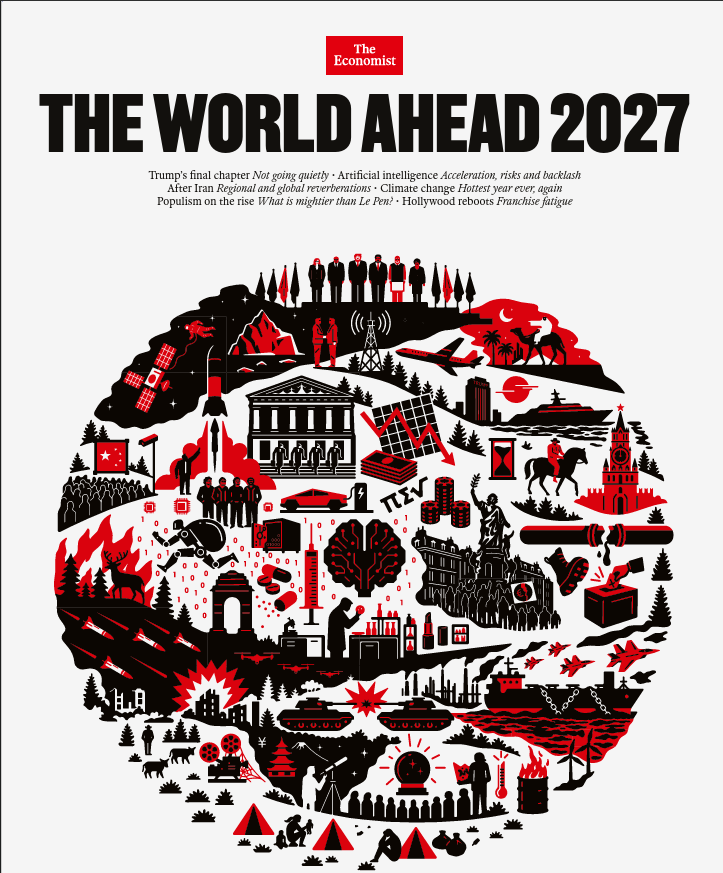
Every November, a single magazine cover becomes the subject of extraordinary international fascination. Political analysts examine its illustrations, investors search for economic signals, geopolitical observers study its symbolism, and millions of people attempt to decipher what they believe could be warnings about the future.
The publication is The Economist, and its annual forecasting edition, The World Ahead, has become one of the most closely scrutinised publications of its kind.
Its latest edition, The World Ahead 2027, unveiled in November 2026, is arguably among its most unsettling visual compositions.
Designed by American artist Cleon Peterson, the cover presents a world dominated by three colours: red, black and white. Six political figures stand above a circular composition filled with military aircraft, missiles, burning forests, collapsing financial graphs, artificial intelligence, political demonstrations, surveillance cameras, pharmaceutical products, damaged energy infrastructure and displaced human beings.
Almost every major symbol corresponds to an emerging political, economic, technological or environmental challenge.
The Scoop has examined the original cover, the accompanying 108-page publication, its historical forecasting record and independent international assessments to understand what the illustration could mean — and, more importantly, what it could mean for Pakistan.
The result is a portrait of a world in which political power is shifting, economic vulnerabilities are accumulating and technological advancement is increasingly outpacing the institutions responsible for managing it.
Why The Economist’s Covers Command Global Attention
Founded in 1843, The Economist has developed considerable influence among policymakers, financial institutions, business executives, diplomats and international intellectual circles.
Its annual forecasting publication, previously titled The World In, brings together journalists, economists, political leaders, scientists, historians and corporate executives to examine developments likely to shape the coming year.
Over the decades, several of its forecasts have appeared remarkably prescient.
Its discussions about monetary transformation, technological disruption, changing political leadership and geopolitical instability have frequently anticipated subjects that subsequently dominated international headlines.
However, its reputation has also encouraged retrospective interpretations that sometimes attribute predictions to the magazine that it never explicitly made.
To understand the significance of its 2027 cover, it is necessary to revisit both its forecasting successes and its failures.
The 1988 Phoenix Cover: Did The Economist Predict Bitcoin?
On January 9, 1988, The Economist published one of its most controversial covers under the headline Get Ready for a World Currency.
The illustration depicted a phoenix rising from burning national currencies, wearing a golden coin bearing the year 2018.
The accompanying article suggested that increasing financial integration could eventually create conditions for a common international currency known as the Phoenix.
Twenty years later, in October 2008, Bitcoin’s white paper appeared. The cryptocurrency began operating in January 2009, eventually developing into a globally recognised financial asset.
On January 10, 2024, the United States Securities and Exchange Commission approved the listing and trading of spot Bitcoin exchange-traded products, marking a significant milestone in the institutional acceptance of cryptocurrencies.
The world has also witnessed the emergence of central bank digital currencies, stablecoins and increasingly sophisticated digital payment infrastructure.
The Economist did not specifically predict Bitcoin. Its original concept concerned a common international currency rather than a decentralised digital asset.
Nevertheless, the 1988 cover demonstrated an early recognition that technological advancement and international financial integration could fundamentally challenge existing monetary arrangements.
That debate, nearly four decades later, remains highly relevant.
The Coronavirus Pandemic: Prediction or Retrospective Interpretation?
The Economist’s covers published around 2019 and 2020 have frequently been associated with the coronavirus pandemic.
Its annual forecasting edition for 2020, released before Covid-19 became a recognised global emergency, featured an eye-test-inspired illustration containing references to political leaders, economic risks and international developments.
Within months, the world experienced lockdowns, unprecedented public health emergencies, disrupted supply chains, economic contraction and enormous government intervention.
The circumstances prompted widespread speculation that the magazine had anticipated the pandemic.
However, The Economist’s own retrospective assessment in its 2021 edition acknowledged that the coronavirus outbreak had taken its editorial team by surprise.
The pandemic was therefore not a documented forecasting success.
The distinction matters because an examination of the magazine’s genuine predictions provides a considerably stronger foundation for evaluating its credibility than attributing supernatural significance to ambiguous illustrations.
The Predictions That Actually Came True in 2026
Perhaps the most compelling evidence of The Economist’s forecasting capabilities can be found on page 70 of its latest edition, where editor Tom Standage reviews the publication’s predictions for 2026.
Its previous edition had identified the possibility of American intervention against Venezuelan President Nicolás Maduro.
Standage recalls that the magazine had specifically considered whether Donald Trump might authorise an operation against the Venezuelan leader.
Maduro’s capture in January 2026 subsequently corresponded with that warning.
The publication also correctly identified several other developments, according to its retrospective assessment:
- The possibility of Viktor Orbán losing power in Hungary.
- The continuation of the Russia-Ukraine conflict.
- Mojtaba Khamenei as a potential successor to Iran’s supreme leader.
- Disruption to international shipping through the Strait of Hormuz.
- Judicial restrictions on Donald Trump’s tariff-setting authority.
- Growing public resistance to artificial intelligence alongside continued technological advancement.
However, its biggest forecasting failure was the outbreak of the 2026 war involving Iran.
The publication had expected Trump to resist pressure for another military confrontation with Tehran. That assessment proved incorrect.
Meanwhile, the professional forecasters associated with Good Judgment, whose predictions are published in The Economist, received a score of six out of nine for their 2026 forecasts, including partial credit.
The lesson is clear: The Economist is capable of identifying significant emerging risks, sometimes with remarkable precision, but it remains vulnerable to unexpected events and political decisions.
Its 2027 cover must be examined in that context.
Decoding the 2027 Cover, Symbol by Symbol
Six Leaders Standing Above the World
Perhaps the most striking feature of the cover is the presence of six political figures standing on a platform at the very top of the illustration.
National flags surround them, while the world beneath appears increasingly unstable.
Their elevated position creates a powerful visual distinction between those who exercise political authority and those who experience the consequences of political decisions.
Several interpretations have circulated concerning the figures’ identities. Among the political personalities discussed are Donald Trump, Xi Jinping, Vladimir Putin, Narendra Modi, Marine Le Pen and Japanese Prime Minister Sanae Takaichi.
Other interpretations offer alternative names.
The Economist has not released an authoritative identification of all six figures. Nevertheless, the publication’s extensive coverage of these political personalities makes their respective roles particularly relevant to understanding its geopolitical outlook.
Donald Trump: The Beginning of the End of Trumpism
Donald Trump’s political future represents one of the central themes of the entire publication.
The Economist believes 2027 will mark the beginning of an increasingly visible transition towards a post-Trump America, even though his presidential term is scheduled to continue until January 2029.
Following the Republican setbacks in the 2026 midterm elections, the magazine expects Trump to encounter greater congressional resistance, political investigations and institutional challenges.
Rather than becoming an inactive president, however, Trump could increasingly rely on executive authority, confrontational rhetoric, protectionist trade policies and unpredictable foreign policy decisions.
The publication anticipates a struggle within the Republican Party over who will inherit Trump’s political movement.
Vice-President JD Vance and other Republican presidential hopefuls could increasingly position themselves for the 2028 presidential election.
For international markets and foreign governments, the resulting uncertainty could be considerable.
America’s relations with China, Russia, Europe and the Middle East could increasingly reflect the competing priorities of a president attempting to preserve his political legacy and institutions preparing for a future beyond him.
Trump Tower, the Red Sun and the Cowboy
On the upper-right side of the cover stands a tower prominently bearing Trump’s name. Nearby are a red sun, a luxury vessel and a mounted figure wearing a cowboy hat.
The Trump-branded tower is among the cover’s least ambiguous political references.
It could reflect the magazine’s expectation that Trump will increasingly focus on grand construction projects, personal legacy and the projection of power as his political influence comes under pressure.
The red sun invites interpretations concerning the approaching end of a political era, although its precise meaning remains unconfirmed.
The luxury vessel could also be read as a reference to concentrated wealth, the political influence of billionaires and the relationship between corporate power and government.
Interestingly, the cowboy imagery may have a cultural explanation as well.
On page 42, The Economist examines the growing international popularity of American cowboy culture, including Western-themed entertainment, country music and fashion.
The illustration may therefore combine American political symbolism with one of the publication’s more unexpected cultural forecasts.
Marine Le Pen: A Political Earthquake in Europe?
The potential rise of Marine Le Pen and France’s National Rally is one of The Economist’s most consequential political forecasts for 2027.
France is scheduled to hold its presidential election in two rounds on April 18 and May 2, 2027.
President Emmanuel Macron is constitutionally barred from seeking a third consecutive term.
The publication believes a victory for the populist right could fundamentally alter France’s relationship with Germany, European institutions and the broader international order.
The Franco-German partnership has traditionally provided the political foundation of the European Union.
A French government adopting a more nationalist, Eurosceptic and protectionist approach could create considerable friction within the bloc.
The consequences could extend to European defence policy, immigration, trade negotiations and continued financial assistance to Ukraine.
Financial markets are also watching France’s increasingly difficult fiscal position.
A political confrontation over public expenditure, taxation or European fiscal rules could intensify pressure on French government bonds and potentially create wider instability across the eurozone.
The Economist’s professional forecasters assign a 55 per cent probability to a National Rally candidate winning the French presidential election.
That makes it a serious possibility, but by no means an inevitable outcome.
Vladimir Putin: Russia’s Long War and the Kremlin Clock
A prominent red tower resembling the Kremlin’s Spasskaya Tower appears on the right side of the cover.
The structure’s clock and red star are powerful references to Russian political authority.
Nearby, the illustration contains an hourglass, military equipment and armed confrontation.
Taken together, these symbols suggest that time, political endurance and military pressure could remain central to Russia’s geopolitical calculations.
The Economist remains pessimistic about the prospects of a durable settlement to the Russia-Ukraine conflict.
Russia’s ability to sustain its military commitments, Europe’s willingness to continue supporting Ukraine and Washington’s changing foreign policy priorities will remain important variables.
The publication also anticipates continuing competition between Russia and Western governments across security, energy and diplomatic affairs.
A prolonged confrontation could accelerate European defence spending and place additional pressure on already strained public finances.
Professional forecasters featured in the magazine assign a 57 per cent probability to Russia and Ukraine not announcing a ceasefire intended to last at least eight days before April 24, 2028.
That forecast illustrates the depth of pessimism surrounding prospects for peace.
Xi Jinping: China’s Growing Power and the Battle for Taiwan
China occupies a prominent position within the magazine’s visual and editorial landscape.
The Chinese flag, a crowd under surveillance, technological imagery and military symbols all appear within the illustration.
The Economist anticipates that Xi Jinping will consolidate his leadership at the Communist Party’s next congress in 2027.
China’s technological ambitions, manufacturing dominance, military modernisation and competition with the United States are likely to define international affairs throughout the coming year.
The year 2027 also carries particular significance because it marks the centenary of the People’s Liberation Army.
Western intelligence assessments have previously identified 2027 as an important military-readiness milestone concerning Taiwan.
However, readiness must not be confused with an actual decision to invade.
The United States intelligence community’s March 2026 Annual Threat Assessment stated that Chinese leaders did not currently intend to launch an invasion of Taiwan in 2027 and had no fixed timetable for achieving unification.
Beijing could nevertheless continue to exert diplomatic, economic and military pressure.
Any serious escalation would have profound consequences for global commerce, particularly because Taiwan plays a critical role in advanced semiconductor manufacturing.
A disruption to semiconductor supplies could affect automotive production, telecommunications, artificial intelligence, consumer electronics and defence industries worldwide.
The competition over Taiwan is therefore not merely territorial.
It is increasingly connected to the struggle for technological supremacy in the twenty-first century.
Narendra Modi: Is India Approaching the End of an Era?
For Pakistan and South Asia, one of the most significant aspects of The Economist’s 2027 outlook concerns the political future of Indian Prime Minister Narendra Modi.
A monument resembling India Gate appears within the cover’s central-left area, although its intended identity has not been officially established.
More significant than the visual resemblance, however, is the publication’s detailed assessment of India’s political trajectory.
On page 53, in an article titled Succession à la Modi, The Economist’s South Asia bureau chief, Tom Sasse, examines whether the Indian prime minister’s political dominance is beginning to weaken.
The publication identifies the 2027 Uttar Pradesh state elections as a potentially decisive moment for Modi, the Bharatiya Janata Party and the future of Indian politics.
Uttar Pradesh has approximately 240 million inhabitants and sends 80 representatives to India’s 543-seat Lok Sabha.
Its importance extends beyond electoral arithmetic.
Nine of India’s fourteen prime ministers since independence have represented constituencies in Uttar Pradesh, according to the magazine.
The state is also central to the BJP’s Hindu nationalist political identity.
Modi’s parliamentary constituency is Varanasi, while Uttar Pradesh is home to Ayodhya and the Ram temple, one of the most politically consequential projects associated with his premiership.
A setback in Uttar Pradesh could therefore represent considerably more than a routine electoral defeat.
The BJP’s Declining Parliamentary Dominance
The BJP’s performance in India’s previous three parliamentary elections demonstrates how its political position has changed.
In 2014, the party secured 282 seats.
In 2019, it increased its parliamentary strength to 303 seats.
However, in 2024, its representation declined to 240 seats, leaving it below the 272-seat threshold required for an outright parliamentary majority.
The loss of 63 seats forced Modi to become more dependent on coalition partners.
Uttar Pradesh contributed significantly to that setback.
In the 2024 general election, the BJP secured 33 of the state’s parliamentary seats, while the opposition Samajwadi Party won 37.
The Economist nevertheless acknowledges that Modi remains a formidable electoral force and that the BJP has also achieved subsequent political successes.
The question is whether these successes can sufficiently compensate for growing concerns over employment, living costs, economic inequality and public frustration among India’s increasingly aspirational younger population.
India’s economic expansion remains significant, but strong headline growth does not automatically guarantee widespread prosperity or political stability.
Amit Shah Versus Yogi Adityanath: The Battle to Succeed Modi
Perhaps the most consequential aspect of The Economist’s assessment is its discussion of a potential succession contest within the BJP.
Two political personalities occupy particularly important positions in that debate: Indian Home Minister Amit Shah and Uttar Pradesh Chief Minister Yogi Adityanath.
Shah is widely regarded as one of the BJP’s principal organisational strategists and a central figure within Modi’s political establishment.
Adityanath commands substantial popularity among sections of the Hindu nationalist electorate and has developed a political identity of his own.
The Economist suggests that the outcome of the Uttar Pradesh election could significantly influence their respective political futures.
A BJP victory could strengthen Modi’s position and enhance Adityanath’s long-term succession prospects.
A defeat could accelerate discussions surrounding Modi’s eventual departure while potentially strengthening Shah’s position within the party.
The result could have consequences for India’s domestic policies, religious minorities, foreign relations and relations with Pakistan.
A period of intensifying political competition could also encourage harder nationalist rhetoric as rival leaders attempt to consolidate their support bases.
The magazine is not predicting the inevitable downfall of India. It is examining the possibility of a decline in the political dominance of the man who has governed it since 2014.
That distinction is essential.
India’s Space Ambitions Face a Reality Check
Another noteworthy forecast concerning India appears on page 23.
Professional forecasters associated with Good Judgment assign a 99 per cent probability to India failing to successfully launch a crew into orbit before November 1, 2027.
India’s Gaganyaan programme represents a significant component of its ambition to establish itself among the world’s leading space powers.
The forecast suggests considerable scepticism regarding whether the country can achieve this particular milestone within the specified timeframe.
Such a delay would not invalidate India’s considerable scientific achievements, but it demonstrates the difference between strategic ambition and technological execution.
For a government that has increasingly associated national prestige with major technological accomplishments, delays could carry symbolic and political consequences.
Sanae Takaichi: Japan’s Strategic Transformation
Japan is another country whose significance could increase considerably in 2027.
The cover contains a traditional East Asian-style pagoda, mountainous imagery and the Japanese yen symbol.
These visual references correspond with several important themes concerning Japan’s evolving international role.
On page 56, Japanese Prime Minister Sanae Takaichi contributes an article outlining Japan’s vision for a free and open Indo-Pacific.
She identifies intensifying geopolitical competition, technological advancement, energy insecurity and the growing influence of the Global South as forces reshaping international affairs.
Japan intends to strengthen its economic security, technological infrastructure, international partnerships and supply-chain resilience.
Its strategic importance is particularly evident in semiconductor manufacturing, robotics, advanced materials, maritime security and relations with the United States.
Growing tensions involving China and Taiwan could accelerate Japan’s transformation into a more assertive regional security actor.
Meanwhile, the yen symbol may also reflect concerns regarding monetary policy, currency volatility and the consequences of rising borrowing costs in one of the world’s most heavily indebted advanced economies.
The Handshake: A World Searching for New Alliances
Immediately beneath the political figures at the top of the cover, two red silhouettes can be seen shaking hands.
Diplomatic agreements, geopolitical realignments and emerging strategic partnerships are plausible interpretations of this symbol.
The post-Second World War international order has historically relied on relatively established alliances and institutions.
That structure is increasingly being challenged by China’s rise, Russia’s confrontation with the West, America’s changing international priorities and growing regional competition.
Countries are consequently seeking greater flexibility in their foreign relations.
Traditional alliances may remain important, but governments could increasingly pursue partnerships based on immediate security, energy, commercial and technological interests.
For Pakistan, this emerging environment presents both diplomatic opportunities and considerable strategic challenges.
The Classical Financial Building: Is the Banking System Under Threat?
A prominent classical building with columns, accompanied by formally dressed figures, appears towards the upper-left centre of the cover.
The structure resembles the architectural style commonly associated with central banks, financial institutions and government buildings.
Its proximity to falling market graphs, stacks of banknotes, financial calculations and electronic technology makes an economic interpretation particularly compelling.
The Economist identifies rising sovereign debt, higher borrowing costs and financial instability as major concerns for 2027.
For decades, governments across advanced economies accumulated substantial financial obligations while benefiting from relatively inexpensive borrowing.
That environment is changing.
Governments must now contend with ageing populations, increasing healthcare costs, rising defence expenditure, energy insecurity and growing pressure to finance infrastructure and technological advancement.
At the same time, investors are demanding higher returns for holding government debt.
This raises a fundamental question: how long can governments continue to accumulate financial obligations without triggering a crisis of confidence?
The cover does not necessarily predict the collapse of a particular bank.
It warns more broadly of vulnerabilities within the international financial architecture.
The Falling Graph, Banknotes and Casino-Like Chips
A sharply declining red graph is among the most unmistakable symbols on the cover.
Beneath it appear stacks of money, circular chips and mathematical calculations.
Together, these illustrations could represent market volatility, excessive financial speculation, mounting debt and the possibility of a significant correction in asset prices.
The casino-like appearance of the chips is particularly interesting.
It may be interpreted as a commentary on financial markets increasingly driven by speculative expectations rather than the underlying economic performance of businesses.
The enormous investment flowing into artificial intelligence has raised questions regarding whether future commercial returns can justify present valuations.
Technology companies are spending heavily on data centres, advanced processors, electricity infrastructure and computing capacity.
Some are financing this expansion through increasingly complex borrowing arrangements.
If investors become less confident about expected profitability, the resulting correction could extend beyond technology companies to financial institutions, pension funds and broader equity markets.
The Economist devotes substantial attention to these risks in its finance and economics section, including articles examining the possibility of another financial crash and a reckoning over public debt.
The warning is not that a global financial collapse is inevitable.
It is that the combination of excessive optimism, expensive money and mounting financial obligations creates an increasingly fragile environment.
Could 2027 Become Another 2008?
The global financial crisis of 2008 demonstrated how vulnerabilities concentrated within a particular sector could spread rapidly across the international financial system.
A similar transmission mechanism could emerge if a significant correction in artificial intelligence-related assets coincides with sovereign debt pressures or renewed inflation.
Higher government bond yields would increase borrowing costs for corporations and households.
Companies could postpone investment, consumers could reduce expenditure, and heavily indebted governments could find themselves with limited capacity to respond.
Emerging economies would be particularly vulnerable to capital outflows, currency depreciation and increasingly expensive external financing.
Pakistan, where fiscal stability and access to international financing remain closely interconnected, would not be insulated from such developments.
A financial shock originating in New York, Paris or another major financial centre could ultimately affect the cost of borrowing in Islamabad.
The Circuit-Board Brain: Artificial Intelligence Becomes the Centre of Power
At the very centre of the cover appears one of its most prominent symbols: a human brain transformed into an electronic circuit.
Its placement is particularly revealing.
Artificial intelligence is not confined to a small section of the illustration. It occupies a central position around which political, financial, military and scientific developments appear to converge.
The Economist anticipates that AI will increasingly become a fundamental component of national power.
Economic productivity, scientific innovation, military capabilities, information systems and financial competitiveness could increasingly depend on access to sophisticated artificial intelligence.
The competition between the United States and China is consequently evolving beyond traditional trade disputes.
It increasingly concerns the ownership and control of semiconductor technology, computing infrastructure, data, advanced scientific research and energy resources.
Countries capable of successfully integrating AI into their economies could achieve substantial competitive advantages.
Those unable to adapt could become increasingly dependent on foreign technology providers.
The Robot, Binary Numbers and Microchips
Surrounding the electronic brain are robotic imagery, semiconductor chips and streams of binary code.
These symbols indicate that the coming phase of technological disruption could extend considerably beyond conventional chatbots and software applications.
The Economist examines the growing possibility of autonomous AI agents, increasingly sophisticated humanoid robots and artificial intelligence systems capable of assisting in the development of more advanced models.
AI agents could transform how companies organise administrative work, customer service, accounting, research, software development and business operations.
Humanoid robots could increasingly influence manufacturing, logistics and other industries requiring physical labour.
However, technological advancement may also create greater economic concentration.
A relatively small number of corporations already control significant portions of global cloud infrastructure, semiconductor supply chains and advanced AI development.
The four formally dressed figures standing near microchips may invite interpretations concerning the concentration of technological and corporate influence, although their identities and intended symbolism remain unconfirmed.
The central issue is whether AI’s economic benefits will become widely distributed or increasingly concentrated among a small number of corporations and countries.
Artificial Intelligence and the Threat to Employment
For countries such as Pakistan and India, the expansion of artificial intelligence carries particularly important implications.
Both countries have substantial populations of young people seeking employment, alongside growing information technology and business outsourcing industries.
AI could increase productivity and create new economic opportunities.
However, it could also reduce demand for certain routine administrative, technical and customer-service functions.
The Economist does not endorse the most extreme predictions of immediate mass unemployment. Its editors argue that some existing fears concerning job losses are not yet supported by sufficient evidence.
Nevertheless, the organisation of work is changing.
Pakistan’s technology sector must consequently move beyond dependence on relatively low-cost labour.
Investment in advanced programming, cybersecurity, data science, specialised research and AI-enabled business services will become increasingly important.
Countries that merely consume artificial intelligence could find themselves at a disadvantage compared with those that develop commercially valuable applications around it.
The Surveillance Camera and Communications Tower
A surveillance camera appears beside the Chinese flag and a large crowd. A communications tower transmitting signals is positioned towards the upper centre.
These illustrations may reflect the growing strategic importance of communications infrastructure, digital surveillance and information security.
Governments and corporations possess increasingly sophisticated capabilities to collect, process and analyse enormous quantities of information.
Artificial intelligence could significantly expand those capabilities.
Facial recognition, automated monitoring, predictive analytics and advanced communications systems are likely to become increasingly integrated into public administration, commercial activity and national security.
These technologies offer potential benefits but also raise concerns about privacy, civil liberties and the concentration of institutional power.
Meanwhile, cyberattacks targeting critical infrastructure, financial institutions, government departments and communications networks could become increasingly damaging.
The Economist expects more capable AI systems to intensify these cybersecurity challenges.
The security of a country’s digital infrastructure may increasingly become as important as the security of its physical borders.
The Electric Vehicle and Charging Station: The Automotive Industry’s Great Disruption
A red electric vehicle connected to a charging station appears directly beneath the financial building.
The symbol points towards a major transformation in the international automotive industry.
Chinese manufacturers have emerged as powerful competitors in electric vehicles, battery technology and increasingly software-driven transportation systems.
Traditional automotive manufacturers in Europe, Japan and the United States face mounting pressure to adapt.
China’s expansion is no longer limited to exporting vehicles manufactured domestically.
The Economist examines the growing international presence of Chinese automotive factories, which could fundamentally alter global manufacturing supply chains.
For Pakistan, this transformation presents both an opportunity and a warning.
The country could benefit from investment in electric mobility, local manufacturing, charging infrastructure and associated technology.
However, a poorly designed transition could increase dependence on imported vehicles while weakening existing domestic manufacturing and automotive component industries.
Pakistan must ensure that its automotive policies encourage technology transfer, industrial development and meaningful localisation rather than simply facilitating the replacement of one category of imports with another.
The Crescent Moon, Camel and Desert: A Changing Middle East
Towards the upper-right section of the illustration, a red desert landscape contains a camel, palm trees and a crescent moon.
The symbols strongly suggest the Middle East.
The region occupies a central position in The Economist’s geopolitical outlook, particularly because of the consequences of the 2026 conflict involving Iran.
The publication anticipates that 2027 could bring fewer large-scale confrontations without necessarily delivering lasting peace.
Traditional security arrangements are increasingly being reconsidered.
Gulf governments may seek additional strategic partnerships, diversify their security relationships and reduce their exposure to disruptions originating from regional conflicts.
Saudi Arabia and the United Arab Emirates could increasingly pursue their own priorities.
Iran, meanwhile, may remain politically resilient despite severe economic and diplomatic pressure.
The region could therefore become more fragmented, with countries pursuing flexible arrangements rather than relying exclusively on the security architecture that historically dominated the Middle East.
The Broken Oil Pipeline and Chained Tanker
Perhaps the most alarming economic symbolism appears on the cover’s right-hand side.
A broken pipeline releases dark droplets, while below it a large ship appears wrapped in chains and surrounded by red waters.
These images correspond closely with the publication’s warnings about energy insecurity and the Strait of Hormuz.
The narrow maritime passage is critical to international oil and gas supplies.
Disruption to shipping through Hormuz could affect energy markets across Asia, Europe and beyond.
The economic consequences would extend well beyond higher petrol and electricity prices.
Natural gas is essential to fertiliser production, and disruptions to its supply can increase agricultural costs and threaten food security.
Higher shipping insurance, transportation expenses and commodity prices could intensify inflation across developing countries.
Professional forecasters featured in The Economist assign an 81 per cent probability that the seven-day moving average of ships passing through the Strait of Hormuz will not reach 50 before November 1, 2027.
This narrowly defined forecast reflects considerable pessimism regarding the normalisation of maritime traffic.
For Pakistan, a prolonged disruption would have serious implications for the import bill, foreign exchange reserves, industrial production, household expenditure and agricultural costs.
Iran: Economic Pressure Without Political Collapse?
Despite the devastating consequences of conflict, The Economist does not expect Iran’s political system to collapse automatically.
Its Middle East coverage examines the possibility that Iran’s existing power structure could survive throughout 2027, with military institutions retaining considerable influence.
Professional forecasters assign a 76 per cent probability that Mojtaba Khamenei will neither flee Iran nor cease to be its supreme leader before May 13, 2028.
This assessment suggests that external military and economic pressure may not necessarily translate into immediate political transformation.
Iran’s relationship with China, Russia, Pakistan and neighbouring Gulf countries could consequently become increasingly important.
The Middle East may be entering a period in which conventional military superiority does not automatically produce lasting political settlements.
Missiles, Tanks, Fighter Aircraft and Burning Cities
Military imagery occupies an extraordinary proportion of the lower half of the cover.
Missiles, aircraft, drones, tanks, explosions and damaged urban landscapes create an impression of persistent international confrontation.
The imagery could correspond to several different geopolitical concerns, including the Middle East, Russia and Ukraine, and tensions surrounding Taiwan.
It does not establish that the publication expects a third world war to erupt in 2027.
Rather, it reflects the increasingly militarised nature of international relations and the growing possibility that regional conflicts could have global consequences.
Artificial intelligence, unmanned systems, electronic warfare and increasingly sophisticated surveillance technologies are also transforming the nature of military competition.
For Pakistan, technological adaptation, defence modernisation and strategic stability will remain important considerations.
The growing economic costs of prolonged geopolitical instability also underline the importance of diplomacy and conflict prevention.
The Hourglass: Is the World Running Out of Time?
An hourglass appears near the financial and Russian imagery.
Throughout history, the hourglass has represented the passage of time, approaching deadlines and the consequences of delay.
Within the context of this particular cover, it could symbolise several overlapping pressures.
Governments face narrowing opportunities to address rising public debt. International institutions are struggling to keep pace with artificial intelligence. Climate-related risks require increasingly urgent intervention, while geopolitical tensions remain unresolved.
The hourglass may therefore be interpreted as a warning about the limited capacity of political institutions to respond to rapidly accelerating global changes.
It is not evidence of a specific countdown to a predetermined global event.
The French Monument, Cracked Euro and Ballot Box
A large crowd surrounds a statue resembling Marianne, the symbolic figure of the French Republic.
Nearby, a flag appears to contain a damaged euro symbol, while a hand casts a ballot into a box beneath a large military-style boot.
These are among the cover’s most politically charged illustrations.
The imagery corresponds with the publication’s concerns about the rise of European populism, political demonstrations, economic frustration and the future of European integration.
France’s presidential election could become a defining political event of 2027.
A major change in French political leadership could have consequences for the European Union’s economic policies, immigration arrangements, trade relations and security strategy.
The cracked euro may represent concerns regarding financial fragmentation and the sustainability of public finances across the eurozone.
The boot positioned above the ballot box could be interpreted as a broader warning about pressure on democratic institutions, coercion and growing political polarisation.
Its precise artistic intention has not been confirmed.
Nevertheless, the combination of these symbols suggests a Europe confronting a potentially difficult period of political and economic adjustment.
What European Political Instability Could Mean for Pakistan
Pakistan’s commercial relationship with Europe remains particularly important because of the country’s dependence on textile and other manufactured exports.
The European Union’s GSP+ preferential trading arrangement provides significant opportunities for Pakistani exporters.
A Europe increasingly influenced by protectionist politics, industrial nationalism and domestic economic pressures could generate new challenges for countries dependent on access to European markets.
Future debates concerning labour standards, environmental compliance, industrial protection and migration could become increasingly politically sensitive.
However, The Economist’s cover does not specifically predict the withdrawal of Pakistan’s GSP+ status.
The implication for Islamabad is that preserving preferential market access will require sustained diplomatic engagement, credible regulatory compliance and stronger industrial competitiveness.
The Burning Forest, Distressed Wildlife and Extreme Heat
The left side of the illustration depicts a large forest fire, with a distressed animal surrounded by flames.
Elsewhere, a thermometer, mountainous landscapes and other environmental imagery appear throughout the cover.
The Economist expects 2027 to potentially become the hottest year ever recorded, driven partly by an exceptionally powerful El Niño.
This warning is supported by independent scientific assessments.
On September 3, 2026, the World Meteorological Organisation warned that El Niño was expected to intensify significantly, with its effects on temperature and rainfall continuing well into 2027.
The consequences could include extreme heat, droughts, floods, wildfires and agricultural disruption.
For Pakistan, these risks are particularly serious.
Agriculture remains vulnerable to changing rainfall patterns, water availability and extreme temperatures.
Cotton, wheat, rice and other essential crops could face increasing pressure if severe climatic conditions coincide with rising fertiliser and energy costs.
The resulting consequences could affect food inflation, textile exports, rural employment and overall economic growth.
Climate change must increasingly be treated as a national economic and security challenge rather than solely an environmental issue.
Wind Turbines, Solar-Powered Technology and the Energy Transition
Wind turbines and other technological imagery appear towards the lower-right portion of the cover.
Their proximity to oil infrastructure, industrial activity and environmental destruction illustrates the growing importance of energy diversification.
The Economist argues that geopolitical instability could accelerate investment in renewable energy.
Countries dependent on imported fossil fuels have increasingly powerful incentives to reduce their exposure to international oil and gas markets.
Renewable energy, battery storage, distributed electricity generation and improved energy efficiency could therefore become important components of national economic resilience.
For Pakistan, which has experienced significant growth in distributed solar installations, the opportunity is substantial.
However, renewable energy expansion must be accompanied by reforms to electricity transmission, distribution, pricing and industrial energy policy.
Technological adoption without institutional reform could create additional financial complications within an already vulnerable power sector.
Syringes, Pills and Laboratories: Another Pandemic or a Pharmaceutical Revolution?
A large red syringe occupies a prominent position near the centre of the illustration.
It is surrounded by pharmaceutical capsules, a microscope, laboratory equipment and a scientist.
These symbols are likely to attract speculation concerning another global pandemic.
However, the magazine’s editorial content provides a considerably more direct explanation.
One of its ten principal forecasts concerns the growing influence of weight-loss medicines, particularly drugs belonging to the GLP-1 class.
Medicines such as Ozempic and other related treatments are already changing approaches to obesity, diabetes and metabolic health.
Their growing commercial significance could affect industries ranging from pharmaceuticals and healthcare to food, fitness, fashion and consumer goods.
The magazine also examines emerging research into longevity and the possibility of extending healthy human lifespans.
Artificial intelligence could accelerate scientific discovery by assisting researchers in analysing biological systems and identifying potential treatments.
The presence of medical imagery is therefore more convincingly associated with pharmaceutical innovation and scientific advancement than with an explicit prediction of another pandemic.
The Scientist Holding a Red Object
A researcher appears to be examining a small red object in a laboratory.
The symbol could represent advances in biotechnology, scientific discovery, pharmaceutical research or AI-assisted medical innovation.
The Economist’s science and technology section examines how increasingly powerful AI systems might contribute to solving complex scientific problems.
Such developments could eventually influence drug discovery, materials science, healthcare diagnostics and the understanding of human ageing.
However, emerging capabilities also create new responsibilities concerning scientific ethics, research oversight and equitable access to healthcare.
The future of medical innovation may increasingly depend not only on what science can achieve but on which populations can afford to benefit from it.
The Satellite, Rocket and Astronaut: The Next Frontier of Global Competition
The upper-left section of the cover contains a satellite, an astronaut and a rocket preparing for launch.
These symbols correspond with the magazine’s expectation that cheaper space launches will accelerate the commercialisation of outer space.
Reusable rockets, private space stations and expanded satellite networks could transform international communications and scientific research.
The publication anticipates continued progress by American and Chinese commercial space companies.
It also examines the increasingly discussed possibility of locating computing infrastructure in orbit.
Although such proposals remain technologically and commercially challenging, they illustrate how the economics of artificial intelligence and space technology are beginning to intersect.
Space is no longer exclusively the domain of national governments.
Commercial corporations are increasingly becoming important actors in an environment with enormous strategic significance.
Control over communications satellites, navigation systems and space-based data could become a defining element of international economic and security competition.
The Telescope, Pagoda and Mountain
Near the bottom of the illustration appears a telescope directed towards a dark sky.
Nearby are a traditional pagoda, mountainous imagery and the yen symbol.
This grouping may represent the growing scientific and technological significance of Asia, particularly Japan, alongside increasing international interest in space research.
The telescope may also function as a visual metaphor for the publication itself: humanity attempting to understand a future that remains largely beyond its immediate vision.
The combination of traditional architecture and advanced scientific equipment offers an interesting contrast between historical identity and technological transformation.
The Cobweb-Covered Film Projector: Is Hollywood Losing Its Influence?
A traditional film projector covered in cobwebs appears towards the bottom-left of the cover.
Its presence may initially appear insignificant alongside missiles, financial instability and climate disasters.
However, it corresponds with one of The Economist’s ten principal themes.
Hollywood is facing growing questions about its reliance on established franchises, sequels and repetitive commercial formulas.
The publication examines whether audiences are becoming increasingly dissatisfied with conventional entertainment while independent creators, YouTubers and digital platforms gain influence.
The year 2027 will mark the fiftieth anniversary of the original Star Wars film.
The entertainment industry is expected to continue attempting to revive established franchises.
At the same time, falling production costs and artificial intelligence could enable smaller creators to compete with traditional studios.
The implications extend beyond Hollywood.
Journalism, advertising, communications and entertainment are all experiencing a transformation in which traditional institutional influence increasingly competes with individual credibility and digital reach.
The cobwebs may therefore symbolise an ageing business model struggling to remain relevant.
The Cattle, Human Figures and Agricultural Landscape
Towards the lower-left section, the cover includes livestock, human figures and open landscapes.
These relatively understated symbols could be associated with agriculture, rural livelihoods, food production and the environmental consequences of economic activity.
The Economist’s concerns surrounding fertiliser shortages, El Niño and rising energy prices provide a credible context for this interpretation.
Food security could become one of the most serious consequences of overlapping geopolitical and environmental crises.
Higher production costs would particularly affect poorer populations and countries dependent on imported agricultural commodities.
For Pakistan, strengthening domestic agricultural research, water management, seed quality, productivity and supply-chain resilience will become increasingly important.
Food insecurity cannot be addressed solely through imports or temporary administrative price controls.
It requires sustained investment in productive agricultural capacity.
The Crystal Ball and the Question of an Uncertain Future
A prominent crystal ball appears near the bottom-centre of the illustration.
It is surrounded by human figures and positioned beneath the political, financial and technological scenes occupying the upper portions.
Unlike many other symbols, the crystal ball could represent the central concept of the entire publication: forecasting.
It may also be interpreted as an acknowledgement of the uncertainty inherent in attempting to predict global developments.
Political leaders, economists and intelligence analysts can examine evidence and identify risks.
They cannot reliably determine every future event.
In an increasingly interconnected world, relatively unexpected developments can rapidly transform international conditions.
The Covid-19 pandemic and the magazine’s failure to anticipate the 2026 Iran war demonstrate the limitations of even sophisticated forecasting exercises.
The Burning Barrel, Thermometer and Economic Anxiety
A barrel engulfed in flames appears near a thermometer and a dark human figure.
These symbols may represent energy insecurity, rising temperatures, industrial pollution and the consequences of continued dependence on fossil fuels.
Their positioning near ordinary people rather than political leaders reinforces the possibility that the illustration is emphasising the human consequences of global instability.
Energy crises ultimately affect household expenditure.
Financial crises affect employment.
Extreme heat affects health, agricultural production and living conditions.
The burden of these developments is rarely distributed equally.
Poorer households and developing economies frequently possess fewer resources to protect themselves against external shocks.
Refugees, Tents and the Human Cost of Global Instability
At the very bottom of the cover are tents, distressed individuals, people carrying belongings and a figure sitting alone.
These images provide perhaps the most powerful conclusion to the entire illustration.
Above them stand the world’s political decision-makers.
Between the two groups lie financial institutions, technological advancement, military confrontations and environmental destruction.
The composition can be read as a visual commentary on the relationship between political decisions and human suffering.
Wars generate displacement.
Economic crises create unemployment and poverty.
Environmental disasters destroy livelihoods.
Technological disruption can generate prosperity for some while producing considerable uncertainty for others.
The people at the bottom of the illustration may represent those who possess the least influence over these developments but are often among those most severely affected by them.
This vertical arrangement is arguably one of the most meaningful aspects of the cover.
The Actual Numerical Predictions for 2027
Beyond the illustrations and their possible interpretations, The Economist publishes a series of numerical forecasts prepared by professional forecasters associated with Good Judgment.
These provide a more precise understanding of the risks being assessed.
The forecasts published on page 23 include:
- 99 per cent probability: India does not successfully launch a crew into orbit before November 1, 2027.
- 89 per cent probability: Britain does not hold a general election before January 1, 2028.
- 81 per cent probability: The seven-day moving average of ships passing through the Strait of Hormuz does not reach 50 before November 1, 2027.
- 76 per cent probability: Mojtaba Khamenei remains Iran’s supreme leader without fleeing the country before May 13, 2028.
- 75 per cent probability: The US House of Representatives does not vote to impeach Donald Trump before November 1, 2027.
- 57 per cent probability: Russia and Ukraine do not announce a ceasefire intended to last at least eight days before April 24, 2028.
- 55 per cent probability: A National Rally candidate wins the French presidential election.
- 51 per cent probability: Javier Milei wins Argentina’s presidential election.
Interestingly, the forecasters also assign a 90 per cent probability that neither China nor Taiwan will publicly accuse the other of using a weapon against its military, militia or police forces before July 1, 2028.
That particular forecast presents a more restrained outlook than some of the dramatic interpretations of the cover’s military imagery.
These figures are probabilistic assessments rather than established outcomes.
Pakistan’s Emerging Strategic Importance in the New World Order
One of the most consequential observations for Pakistan appears not necessarily on the cover itself but within the magazine’s analysis of the changing Middle East.
On page 64, The Economist identifies Pakistan as a participant in an emerging regional security arrangement while simultaneously describing Islamabad as an important interlocutor for Iran.
This dual position is strategically significant.
Pakistan maintains important relationships with Saudi Arabia, China, Türkiye, Iran and the United States.
At a time when conventional international security arrangements face growing uncertainty, Islamabad could find itself increasingly relevant to diplomatic negotiations and regional stability.
Pakistan’s geographical location, military capabilities, relationships across the Muslim world and longstanding strategic partnership with China provide it with considerable geopolitical potential.
However, strategic significance must not be confused with economic strength.
Pakistan’s ability to capitalise on these developments will depend on its capacity to strengthen its domestic economy, attract investment, increase exports and achieve sustainable industrial growth.
Without economic transformation, diplomatic opportunities may prove temporary.
The Five Major Challenges Pakistan Could Face in 2027
The Economist’s global outlook points towards five particularly significant risks for Pakistan.
Energy insecurity: Continued instability in the Middle East could increase Pakistan’s fuel import bill and industrial production costs.
External debt and financial pressures: Rising global borrowing costs could complicate access to affordable international financing.
Agricultural and climate vulnerability: Extreme weather, water shortages and expensive fertiliser could undermine agricultural productivity and food security.
Technological disruption: Artificial intelligence could transform the international outsourcing, software development and employment markets upon which Pakistan increasingly depends.
Changing regional politics: Political developments in India, China, Iran, the United States and the Middle East could require Pakistan to pursue an increasingly sophisticated and flexible foreign policy.
These challenges should not be viewed independently.
They are capable of interacting in ways that could either undermine Pakistan’s economic stability or accelerate long-overdue structural reforms.
Is The Economist Revealing the Future or Reflecting Global Thinking?
The publication’s influential readership and access to prominent political leaders, economists, scientists and business executives inevitably generate curiosity about its forecasting capabilities.
Its annual edition offers a valuable insight into how influential international institutions and individuals assess emerging risks.
That does not establish that its covers reveal secretly predetermined global events.
No credible evidence demonstrates that the publication possesses advance knowledge of an orchestrated pandemic, financial collapse or military confrontation.
However, dismissing its forecasts entirely would be equally misguided.
Its assessments are frequently based on genuine structural changes already taking place within international politics, economics and technology.
The world is indeed experiencing significant geopolitical realignment.
Artificial intelligence is transforming industries.
Government debt and borrowing costs remain serious concerns.
Climate change is producing increasingly severe economic consequences.
The Middle East remains central to global energy security.
And political leadership across several major countries faces potentially decisive challenges.
The Economist’s cover brings these developments together in a single, unsettling visual composition.
The Real Message of the 2027 Cover: A World Where Crises Collide
Perhaps the most disturbing aspect of the 2027 cover is not any individual illustration.
It is the possibility that several crises could emerge simultaneously.
A Middle Eastern energy shock could increase global inflation.
Higher inflation could sustain elevated interest rates.
Higher interest rates could intensify sovereign debt pressures.
Financial instability could accelerate political dissatisfaction.
Political dissatisfaction could strengthen populist movements and protectionist policies.
Meanwhile, artificial intelligence could transform employment markets, climate disasters could undermine agricultural production, and international military competition could further strain government resources.
These developments would not necessarily occur in isolation.
They could reinforce one another.
The international order that emerged after the Second World War is facing pressure from technological change, economic nationalism, geopolitical competition and growing public dissatisfaction.
The emerging order is not yet clearly defined.
What is becoming increasingly evident, however, is that the countries best positioned to navigate this transformation will be those possessing economic resilience, technological capabilities, credible institutions and effective diplomatic strategies.
For Pakistan, the message is particularly urgent.
The country cannot afford to remain a passive observer of global transformation. It must strengthen its industrial base, modernise its economy, invest in artificial intelligence, secure affordable energy, protect agricultural productivity and develop the institutional capacity required to respond to international crises.
Whether all of The Economist’s predictions materialise remains uncertain.
But the cover captures a fundamental reality of our times: humanity has acquired unprecedented technological capabilities without necessarily developing the political wisdom, institutional strength or economic resilience required to manage their consequences.
Six political figures stand at the top of the illustration.
Ordinary human beings sit among tents at the bottom.
Between them lies a world struggling with war, money, technology, power and survival.
That may be the most important message of The Economist’s 2027 cover.
The future will not be determined by the symbols printed on a magazine. It will be determined by the decisions of those who govern the world — and the ability of nations to prepare for the consequences.