

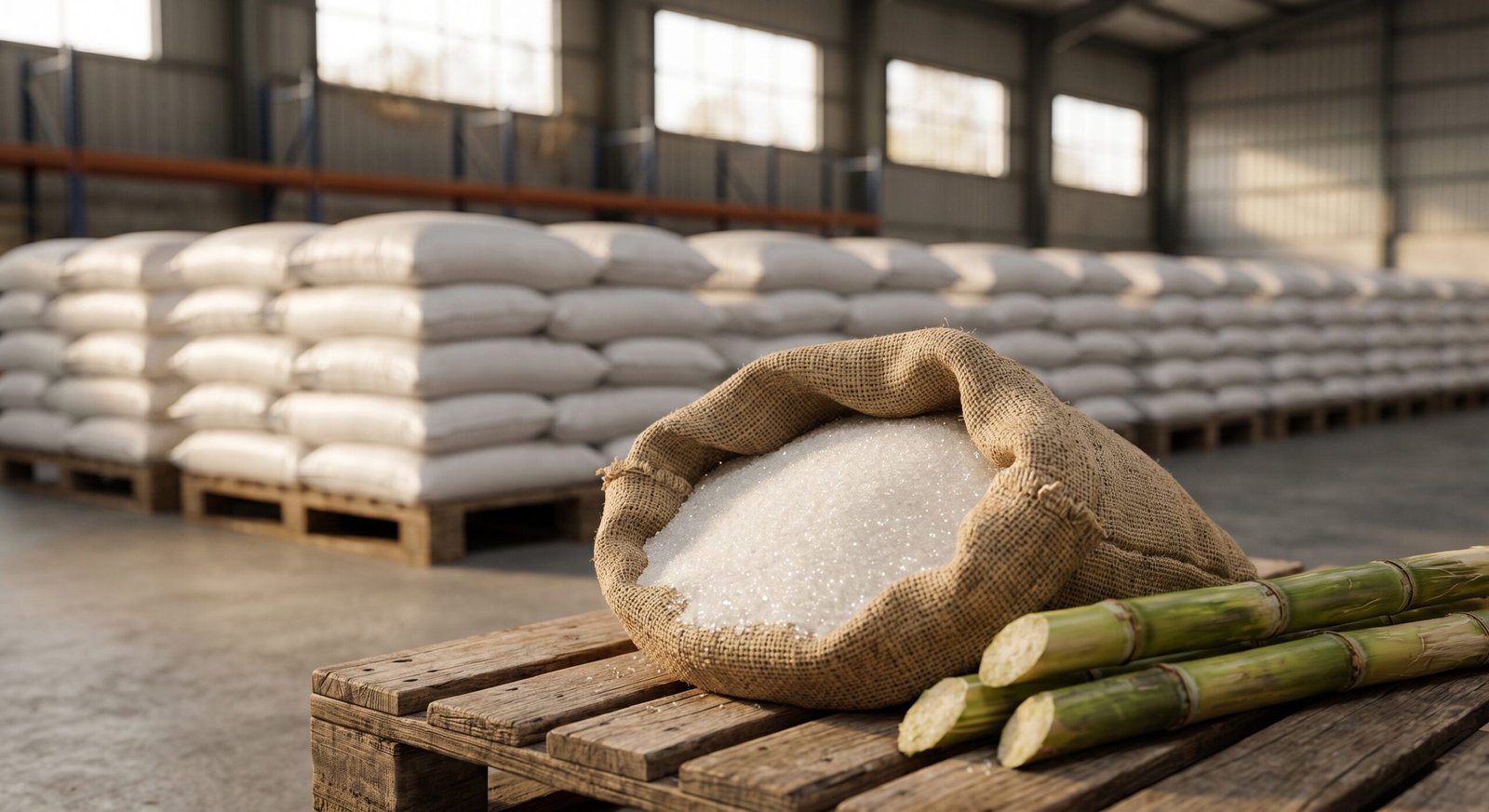
Pakistan’s sugar industry faces a severe working-capital freeze ahead of the upcoming crushing season as 1 million tonnes of unsold surplus inventory—verified by Federal Board of Revenue (FBR) data—ties up bank-financed liquidity required to fund Rs1,000 billion in annual sugarcane procurement.
In a press release issued on November 20, 2026, a spokesperson for the Pakistan Sugar Mills Association (North Zone) stated that official records from the FBR’s “Track and Trace System” as of November 15, 2026, substantiate a 1 million tonne surplus over and above national domestic requirements. This excess stock sits on top of the 200,000 tonnes already authorized for export.
According to the PSMA-North Zone spokesperson, analysis of the FBR data confirms that Pakistan held 7.9 million metric tons of sugar starting November 16, 2025, compared against annual domestic consumption of 6.6 million metric tons. Since the conclusion of the 2025-26 crushing season, millers repeatedly presented these supply-and-demand figures to federal policymakers, only for government officials to reject the estimates—a recurring pattern aimed at delaying exports to keep the local market oversupplied and depress market-driven prices. Officials accepted the accuracy of the stock figures only after the sector incurred heavy financial losses and approached the next crushing cycle.
“A significant portion of Rs.1,000 billion spent annually on procuring sugarcane—the raw material for sugar—is financed through interest-bearing bank loans.”
The resulting inventory overhang has created a direct liquidity bottleneck. Because millers process a perishable sugarcane crop using interest-bearing commercial bank credit, unsold sugar sitting in warehouses locks up borrowed capital. Without clearing existing stocks, mills lack the cash flow required to pay farmers on time for fresh sugarcane deliveries. The association challenged federal policymakers and economists to identify what mechanism or economic “jugglery” could launch a new crushing season while ensuring timely grower payments under these balance-sheet constraints.
The PSMA-North Zone spokesperson noted that domestic sugar prices have remained the lowest in the region over the past year due to the supply glut, even as the federal government levies an 18% sales tax on the ex-mill price—among the highest tax rates on the commodity globally. Comparative ex-mill pricing across regional markets illustrates the gap:
| Country | Ex-Mill Sugar Price (PKR per kg) |
| Pakistan | Rs124 |
| India | Rs179 |
| Sri Lanka | Rs247 |
| Bangladesh | Rs260 |
| Philippines | Rs366 |
Millers argued that had the government acted on industry appeals starting in March 2026, timely exports would have generated foreign exchange, mitigated the sector’s financial losses, and cleared warehouse capacity for the incoming harvest. Addressing official concerns over domestic supply security, the association emphasized that physical infrastructure naturally caps outbound shipments: due to limited seaport capacity, monthly sugar exports cannot exceed 150,000 tonnes, leaving the government with full regulatory authority to halt shipments if domestic stocks tighten.
“A short-term resolution of all these problems is an immediate export of one million tonnes of surplus sugar including through land routes, while a permanent resolution lies in complete deregulation of the sugar sector.”
The association urged the federal government to issue an immediate policy decision authorizing the export of 1 million tonnes of surplus sugar—utilizing both sea and land routes—as a short-term liquidity fix, while pursuing complete deregulation of the sugar industry as a permanent structural solution.