

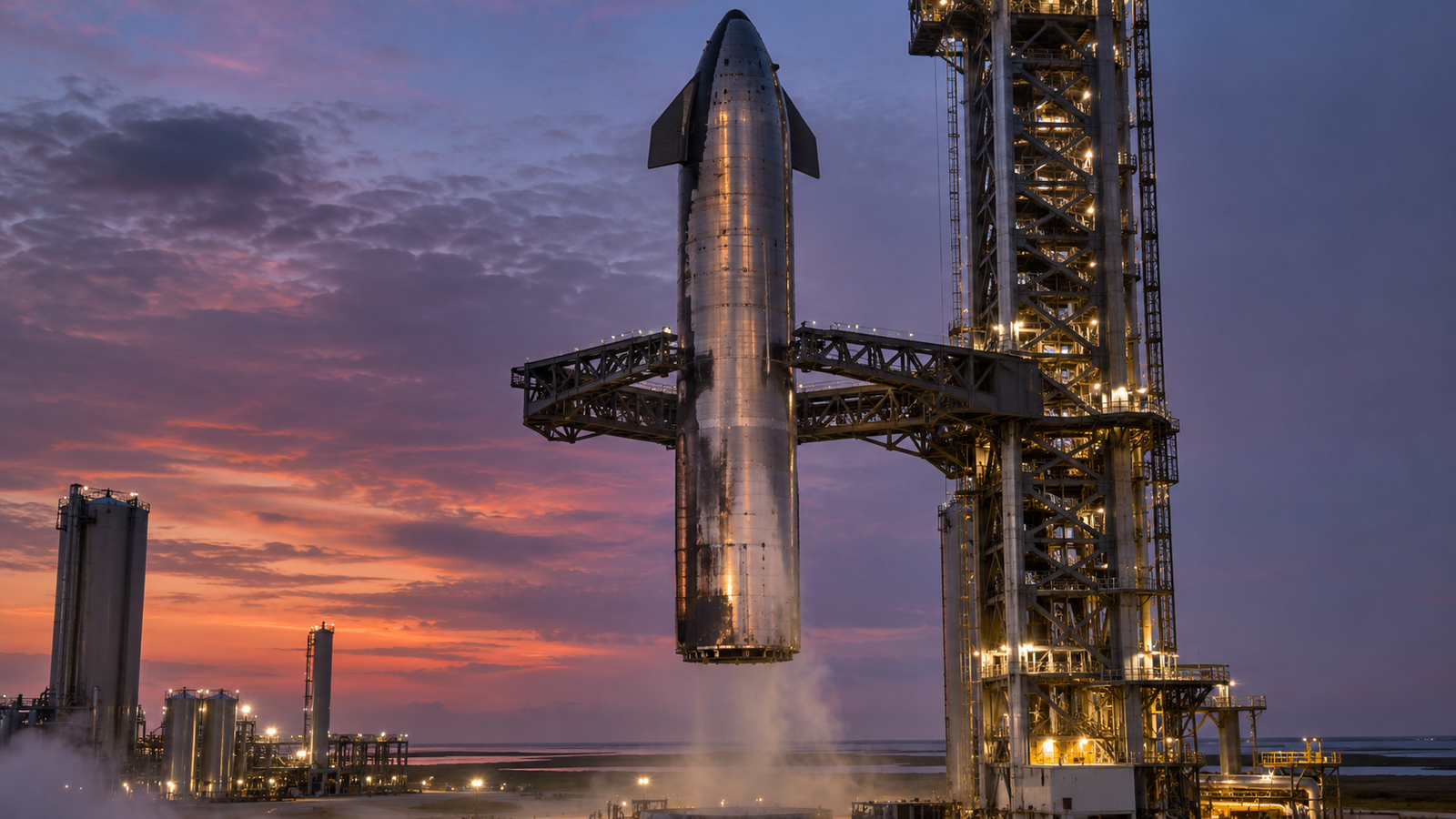
SpaceX’s Starship spacecraft returned on Saturday from a 22-hour voyage in orbit, descending into the grasp of giant mechanical arms at the Texas tower from which it launched a day earlier. The manoeuvre marked a key engineering milestone in the company’s long-term development of a fully reusable rocket system, which billionaire Elon Musk views as the future backbone for the Starlink satellite business, orbital data centres, lunar missions, and eventual interplanetary travel.
During the mission, the Starship upper stage orbited Earth 14 times for 22.5 hours. After deploying 26 Starlink satellites on Friday night while cruising at an altitude of approximately 161 miles or 260 kilometres, the spacecraft fired one of its engines on Saturday to initiate an atmospheric descent above the Pacific Ocean. Travelling at an orbital speed of roughly 17,000 miles per hour, the vehicle faced intense heat during its supersonic free-fall before its aerodynamic fins folded back and fittings near the top hooked onto the launch tower’s mechanical arms.
The towering two-stage rocket system experienced a partial setback when its Super Heavy booster failed to return to the launch pad approximately 10 minutes after liftoff on Friday, preventing SpaceX from recovering both parts of the rocket simultaneously for the first time. SpaceX relies on its workhorse Falcon 9 rocket for current launch dominance, which has completed over 700 flights since 2010. While the Falcon 9 features a reusable first stage, its second stage is discarded into the ocean after each flight.
Financial Investment And Lunar Program Contracts
SpaceX has invested heavily in the initiative, spending more than $15 billion on Starship’s development to date. The programme has also secured significant backing from United States space agency NASA, which has provided $3.2 billion as part of a contract valued at more than $4 billion awarded to SpaceX in 2021. This funding supports the Artemis program objectives to return human crews to the moon using Starship.
NASA currently anticipates that both Starship and a separate lunar lander under development by Jeff Bezos’ Blue Origin will initiate crewed flights to the moon in 2028. However, several challenging technical milestones remain ahead for both spacecraft. For Starship, these requirements include demonstrating complex fuel transfers between tanker rockets in low Earth orbit, which is a critical process required to enable voyages beyond Earth’s orbit toward the lunar surface.