

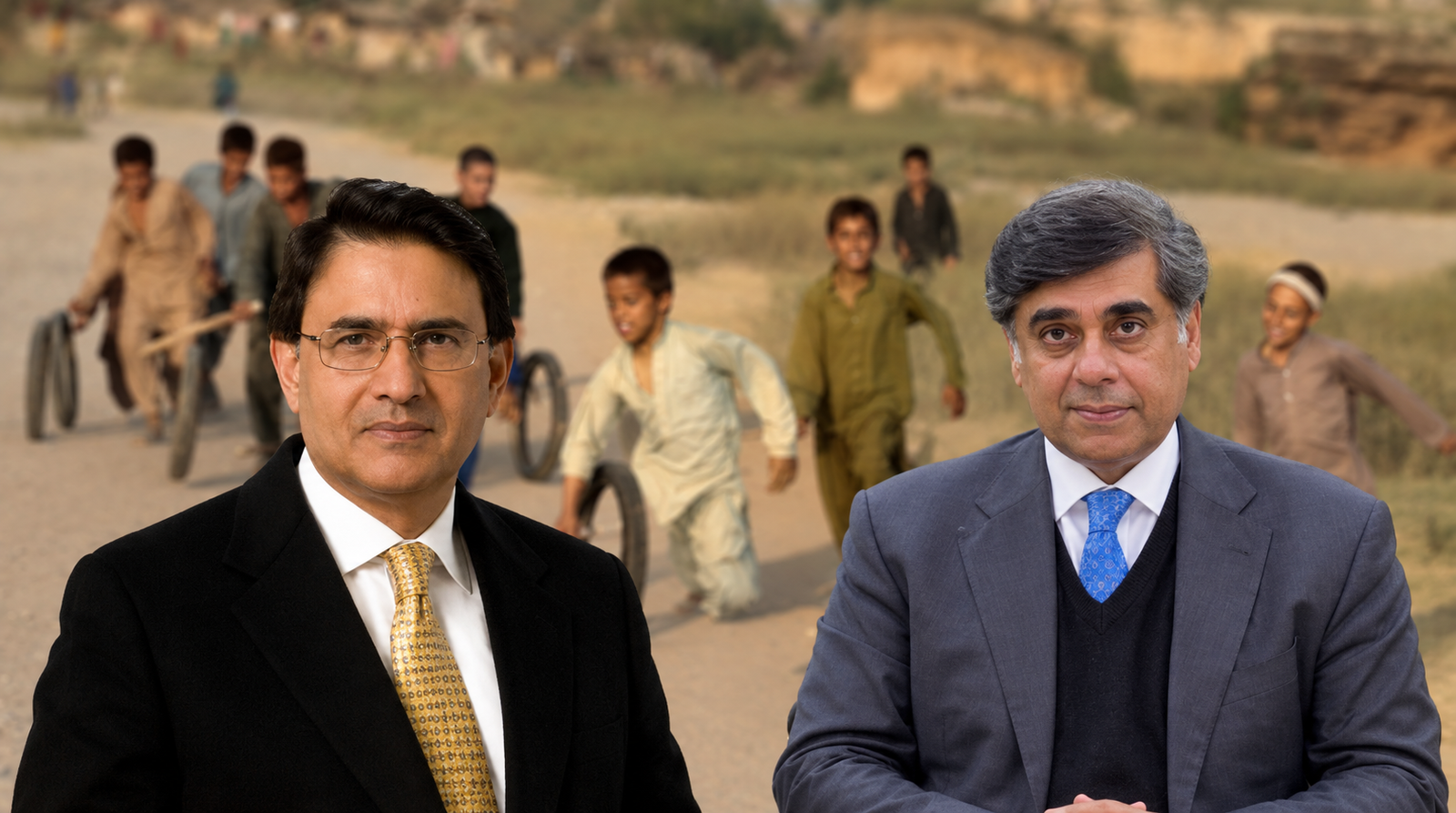
LAHORE, November 15, 2026: In a major private-sector initiative aimed at addressing Pakistan’s deepening education crisis, prominent industrialist and former federal commerce minister Dr Gohar Ejaz has joined hands with US-based educationist and technology entrepreneur Shafiq Khan to launch a nationwide digital education programme targeting out-of-school children across 170 districts of Pakistan, The Scoop has learnt.
A joint venture agreement was signed on Saturday, November 14, between Gohar Ejaz, the driving force behind the newly established Federation Education Foundation (FEF), and Shafiq Khan, founder and chief executive officer of Teach the World Foundation (TTWF).
Under the proposed initiative, the Federation Education Foundation will work towards establishing a network of educational facilities designed to bring children who have never attended school, or have dropped out, into a structured digital learning environment.
The initiative will begin in Lahore, where five schools are scheduled to commence operations within the next four weeks, marking the first phase of what is envisaged as a nationwide expansion.
Five Schools in Lahore to Mark Beginning of Nationwide Rollout
According to information available to The Scoop, the first phase will involve the establishment of five schools in Lahore, with the Federation Education Foundation providing the organisational platform and Teach the World Foundation developing the educational strategy and implementation mechanism.
The Lahore rollout will serve as the initial phase of the new partnership before the model is extended to other districts.
The longer-term ambition is to expand the initiative to 170 districts, creating a decentralised network in which local business leaders take direct responsibility for bringing out-of-school children into education.
The Federation Education Foundation was announced by Gohar Ejaz in October 2026, when he outlined plans to adopt a school in each of Pakistan’s 170 districts.
The agreement with Teach the World Foundation now represents a significant step towards translating that previously announced ambition into an operational education programme.
Chamber Leaders to Become District Governors of Education Initiative
One of the most distinctive features of the proposed arrangement is its district-level governance model, which seeks to bring Pakistan’s business community directly into educational management and community mobilisation.
Under the proposed framework, the chairman of the relevant chamber of commerce at the district level will be designated as the district governor for the education initiative.
The designation is intended to be an organisational role within the Foundation’s education network rather than a governmental office.
These district governors will be entrusted with local ownership and responsibility for ensuring that children who remain outside the formal education system are identified, encouraged and facilitated to attend the schools established under the initiative.
The approach seeks to move beyond conventional philanthropic contributions by assigning local business leadership a continuing role in educational outreach and accountability.
Chamber leaders are expected to become key stakeholders in the programme’s implementation, particularly in mobilising communities and ensuring that educational facilities reach children from disadvantaged backgrounds.
If effectively implemented, the structure could create a network of locally accountable education initiatives supported by the business community while maintaining a common educational framework.
Also Read: Pakistan’s Car Sales Nearly Double In October As Suzuki Drives Market Surge
Federation Education Foundation Establishes Provincial Representation
The Federation Education Foundation has also constituted a board comprising two representatives from each of Pakistan’s four provinces.
The provincial representation is intended to provide a broader governance structure for the initiative as it expands beyond Lahore.
The board arrangement, combined with the proposed appointment of chamber leaders as district governors, reflects an effort to develop a nationwide organisational framework rather than a collection of independently operated charitable schools.
The success of the proposed structure, however, will depend on clearly defined responsibilities, sustainable financing, transparent oversight and measurable educational outcomes.
Teach the World Foundation to Design Digital Learning Strategy
The responsibility for devising the educational mechanism, digital learning strategy and broader implementation framework will rest with Teach the World Foundation, which has experience operating technology-based learning programmes for disadvantaged children.
The organisation’s educational approach is built around its Digital MicroSchool model, which uses tablets, interactive learning applications, gamified lessons and trained facilitators to help children acquire foundational literacy and numeracy skills.
Instead of depending exclusively on conventional classrooms and subject-specialist teachers, the system allows children to progress through structured digital lessons at an individual pace.
The model is designed to operate in comparatively small community-based facilities, reducing some of the infrastructure and staffing requirements associated with conventional schooling.
Teach the World Foundation has developed several learning approaches, including MicroSchools for children outside the formal education system, digital programmes within existing schools and smartphone-based learning initiatives.
Its experience in Sindh is expected to provide an important reference point for the proposed nationwide initiative.
Sindh Model: More Than 25,000 Children Reached Through Digital Education
Teach the World Foundation has already undertaken an extensive digital education initiative in Sindh in collaboration with the Sindh Education Foundation, an institution operating under the provincial government’s education framework.
The partnership was formalised in 2023 under the Accelerated Digital Learning Programme (ADLP), with the objective of reaching children who lacked access to conventional schooling.
The programme introduced community-based digital MicroSchools, allowing children to learn through tablet-based educational applications supported by facilitators.
In April 2026, information shared during a meeting between Sindh Minister Syed Nasir Hussain Shah and a Teach the World Foundation delegation indicated that more than 25,000 out-of-school children had been brought into the education system through approximately 160 digital MicroSchools established over the preceding two years.
The programme also received a significant expansion commitment from the Sindh government in November 2025, when Chief Minister Syed Murad Ali Shah launched the second phase of the Accelerated Digital Learning Programme.
The expansion envisaged 200 additional MicroSchools over two financial years, aimed at extending educational access to approximately 30,000 more out-of-school children.
A reported independent midterm evaluation of the original programme identified improvements in foundational learning among participating children, including encouraging results among girls.
The Sindh experience demonstrates the operational potential of technology-assisted education, although sustained attendance, independent learning assessments and successful transitions into further education remain important measures of long-term effectiveness.
Who Is Shafiq Khan, Founder of Teach the World Foundation?
Shafiq Khan, the founder and chief executive officer of Teach the World Foundation, is a Pakistani-born, US-based technology and business executive who transitioned from a successful international corporate career to educational philanthropy.
Before establishing Teach the World Foundation in 2016, Khan spent more than two decades working in digital transformation and technology-led business development.
He held senior positions at United Airlines and US Airways before joining Marriott International, where he served for approximately 16 years in senior leadership roles covering e-commerce, digital operations and distribution strategy.
According to his professional biography published by the World Bank, Khan played a significant role in developing digital distribution systems and online business models across the global travel and hospitality industries.
His academic credentials include an economics degree from the University of the Punjab and an MBA from Harvard University.
Following his corporate career, Khan established Teach the World Foundation with the objective of using digital technology to address illiteracy and educational exclusion in developing countries.
The organisation subsequently developed programmes in Pakistan, Bangladesh and Malawi, with particular emphasis on affordable, technology-supported learning systems.
His collaboration with Gohar Ejaz brings together two different areas of expertise: industrial and business-community mobilisation on one side, and international digital education experience on the other.
Gohar Ejaz’s Vision: Business Community Takes Responsibility for Education
For Gohar Ejaz, the Federation Education Foundation initiative represents an attempt to mobilise Pakistan’s organised business community around one of the country’s most persistent social and economic challenges.
Ejaz, a prominent industrialist and former federal minister, has maintained close involvement with Pakistan’s textile and wider industrial sectors, including the All Pakistan Textile Mills Association.
His announcement in October that the Federation Education Foundation intended to adopt a school in every district signalled an ambition to establish a coordinated educational platform extending beyond individual corporate social responsibility projects.
The new partnership with Teach the World Foundation introduces a specialised education partner capable of designing a common instructional model while allowing local business communities to assume responsibility for implementation and outreach.
The proposed district-governor structure could also create an additional channel through which chambers of commerce participate in social development rather than limiting their activities to trade, industry and economic policy.
Pakistan’s 25-Million-Child Education Emergency
The initiative comes against the backdrop of one of the largest education-access crises in the world.
According to UNICEF, approximately 25.1 million Pakistani children between the ages of five and 16 remain out of school, representing around 35 per cent of the population in that age group.
Punjab accounts for millions of these children, while Sindh, Khyber Pakhtunkhwa and Balochistan face significant challenges involving access to schools, poverty, infrastructure limitations and educational inequality.
Traditional efforts to expand school infrastructure have struggled to keep pace with the scale of the challenge.
The proposed Federation Education Foundation model seeks to address two connected problems: providing accessible learning facilities and ensuring that children actually enrol and continue attending them.
By involving chambers of commerce at district level, the initiative aims to create local accountability for reaching children who have remained beyond the reach of conventional education programmes.
The Challenge Ahead: Turning a 170-District Vision into Reality
While the agreement represents a significant development, the ultimate scale of the project will depend on its implementation.
The immediate test will be the successful opening and operation of the five proposed schools in Lahore within the announced four-week period.
Several aspects of the national rollout, including the financial commitments, number of schools planned per district, proposed student enrolment targets, operational costs and implementation timetable, have yet to be publicly detailed.
Another important consideration will be the arrangements for assessing educational performance and ensuring that children completing the digital programme can progress into mainstream education or other recognised learning pathways.
The Sindh experience provides a working model, but reproducing it across 170 districts will require coordination among local business organisations, education professionals, communities and relevant authorities.
Nevertheless, the partnership marks an attempt to create a private-sector-led institutional response to an education crisis that cannot be addressed through charitable donations alone.
For Pakistan’s millions of out-of-school children, the critical question will be whether the combination of business leadership, district-level accountability and technology-driven education can deliver measurable results at scale.
With the first five schools expected to become operational in Lahore within four weeks, the Federation Education Foundation and Teach the World Foundation are preparing to put that proposition to an early test.