

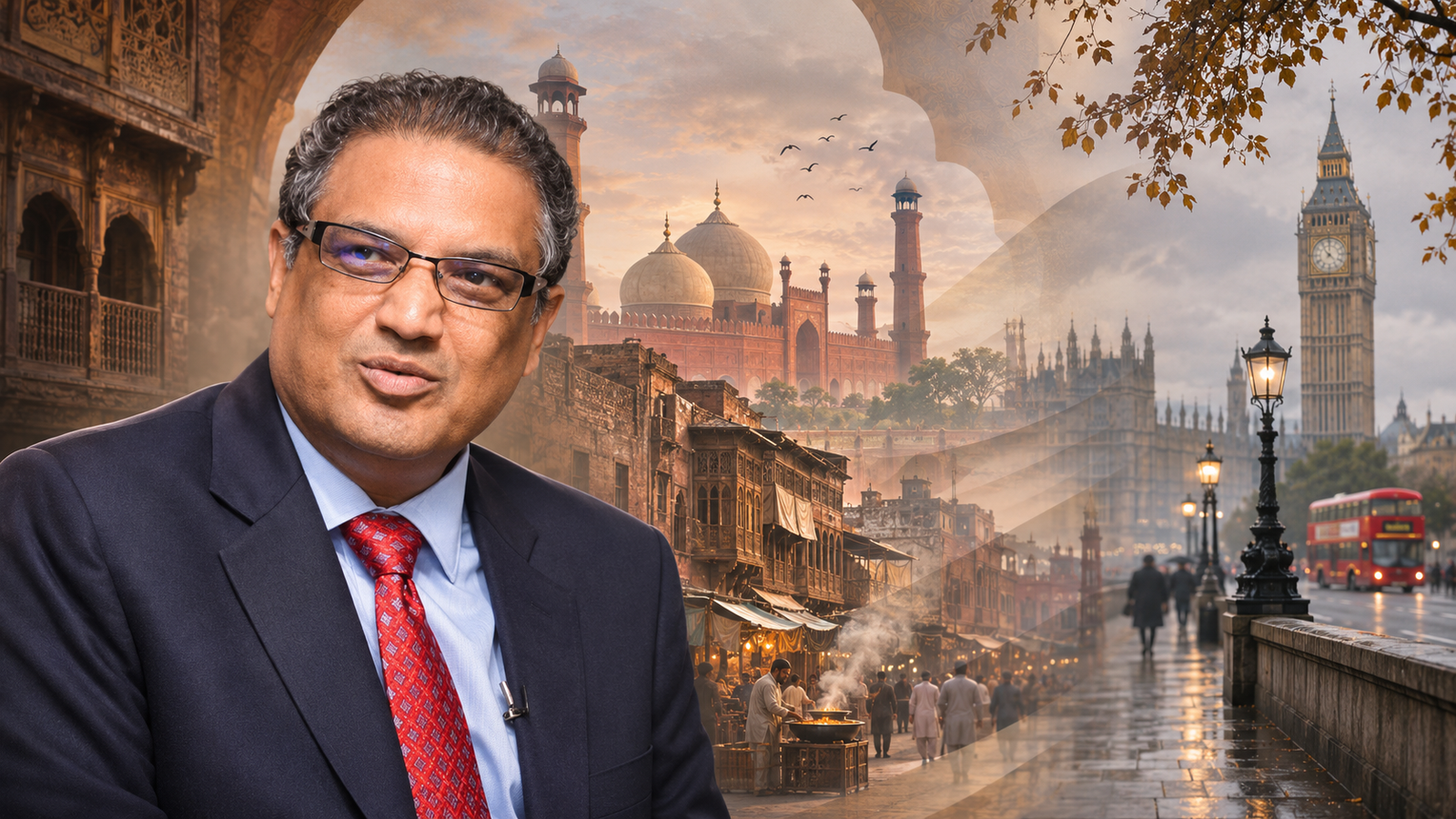
A Piece of Lahore, Thousands of Miles Away
London and Lahore are separated by thousands of miles, oceans and continents. Yet, a few days ago, when a man who embodied the very spirit of Lahore passed away in London, it felt as though Lahore itself had died in the British capital.
That man was Munawar Hayat.
Small in stature, modest in temperament and remarkably unassuming, Hayat had arrived in Britain to pursue qualifications as a chartered accountant. Destiny, however, led him into business, where he achieved considerable success.
At one stage, he operated as many as 20 stores across London. As he grew older, he gradually reduced his retail operations, but one establishment remained particularly close to his heart: the famous Mumtaz Mahal restaurant on Baker Street in central London.
More than a commercial venture, the restaurant became a cultural institution.
It experienced periods of popularity and difficult times when customers were less forthcoming. Yet Hayat remained determined to preserve it, almost like a Mughal emperor protecting a cherished inheritance.
For him, the restaurant was not simply a business. It represented the culture of the subcontinent, an unmistakable Pakistani identity and, above all, a familiar destination for Lahoris visiting London.
The Man Who Carried Lahore Within Him
Born in Lahore in 1938, Munawar Hayat passed away in London at the age of 88.
He was reserved by nature, but Lahore occupied every corner of his existence.
Whenever he learnt that someone from Pakistan, particularly Lahore, had arrived in London, he would make an effort to invite them.
He wanted to hear about Lahore.
He asked questions about its people, neighbourhoods, traditions and changing circumstances. As long as the conversation revolved around his beloved city, an unmistakable sense of satisfaction appeared on his face.
His attachment to Lahore was not an ordinary expression of nostalgia.
Hayat had not visited the city for several decades. Yet physical distance never diminished his affection.
Much like Majnun’s legendary devotion to Layla, his love did not depend upon repeatedly seeing the object of his affection.
Whether Lahore had acquired new bypasses, beautifully maintained flowerbeds or sprawling networks of modern roads mattered little to him.
He loved Lahore without requiring it to dress itself in modern splendour.
His affection was for its soul, not its appearance.
The story of Heer and Ranjha remains immortal because their love transcended temporary beauty and became a symbol of enduring devotion.
Munawar Hayat’s relationship with Lahore possessed something of that same emotional permanence.
He could speak about the city for hours.
Although he belonged to London’s affluent business community and counted prominent personalities, including Ghulam Mustafa Jatoi, among his longstanding friends, he made little distinction between influential visitors and ordinary acquaintances.
He welcomed people like me with the same warmth he extended to celebrated cricketers and prominent figures.
Journalists, in particular, occupied a special place in his affections.
Whenever we met, his face would brighten with a smile. His eyes would sparkle, and an almost electric energy would overcome the limitations of advancing age.
Wealth Was Never His Defining Characteristic
To describe Munawar Hayat merely as a successful businessman or wealthy individual would be to misunderstand his personality.
His most remarkable quality was humility.
That humility was closely connected to his intellectual curiosity and love of reading.
He enjoyed Lahore’s traditional dry fruits, biscuits and sweets, but his attachment to Pakistan went considerably beyond culinary nostalgia.
He regularly arranged for Urdu books to be sent to him from Pakistan, particularly those dealing with politics, society and contemporary developments.
Through reading, he remained intimately connected with a country he had physically left many years earlier.
During our meetings, I invariably found him remarkably well informed about Pakistan’s political situation, social changes and current affairs.
Geography had separated him from his homeland, but intellectual curiosity ensured that he never became a stranger to it.
A Human Metaphor for Lahore
Munawar Hayat was undoubtedly a living, breathing individual. But to me, he was something considerably greater.
He was a metaphor for Lahore itself.
Although he spent most of his life in London, an entire Lahore continued to exist within him.
Just as the literary history of Delhi feels incomplete without Mir Taqi Mir and Mirza Ghalib, certain cities become inseparable from the personalities who preserve their memory and character.
Cairo evokes Naguib Mahfouz.
Istanbul brings to mind Orhan Pamuk.
Dublin remains inseparable from James Joyce.
London carries the literary legacy of figures such as John Milton and William Wordsworth.
These writers transformed cities and their surroundings into literary landscapes, giving streets, buildings and human experiences a significance far beyond geography.
Munawar Hayat was neither a poet nor a novelist. Nor was he a celebrity in the conventional sense.
Yet, for me, he performed a similarly meaningful role.
He represented Lahore in a foreign land.
With his passing, the London I knew has lost something irreplaceable.
The living embodiment of my Lahore is no longer there.
A man who preserved an entire city’s memories in his conversations, gestures and emotions has finally been laid to rest.
Cities Are Built by People, Not Concrete
Human civilisation has evolved around settlements, towns and cities, but the identity of a city cannot be measured merely through its physical infrastructure.
Cities derive their character from history, traditions, architecture, religious practices, intellectual achievements, customs and the collective experiences of generations.
The older a city becomes, the deeper and more distinctive its cultural identity tends to grow.
Throughout history, great urban centres have accommodated the sacred alongside the worldly.
Mosques, temples and other places of worship have stood alongside marketplaces, entertainment districts and establishments reflecting the full spectrum of human behaviour.
Many ancient cities also developed recognised pleasure districts or red-light areas, reflecting social realities that were often contradictory.
In contrast, modern planned cities frequently prioritise roads, residential sectors, commercial districts and administrative convenience without necessarily developing the layered cultural traditions that give older cities their distinctive personality.
Perhaps that is why some modern cities, despite their impressive infrastructure, appear to lack a recognisable soul.
There is a reason people say that Rome was not built in a day.
The Punjabi poet Majid Siddiqui beautifully expressed a similar sentiment: a settlement becomes a fully inhabited community only through the passage of time.
Buildings can be constructed from bricks and stones.
Roads can be laid with gravel and asphalt.
But a city cannot be manufactured through construction contracts alone.
It takes generations of relationships, shared experiences, evolving customs, intellectual exchange and cultural interaction to transform physical structures into a living civilisation.
A city develops its character gradually, sometimes over hundreds or even thousands of years.
Lahore is precisely such a city.
The Many Civilisations That Created Lahore
Lahore’s identity is the result of centuries of cultural interaction.
Persians, Afghans, Eurasians and indigenous communities contributed their traditions, languages, cuisines, customs and ways of life to its development.
Each generation left its mark.
Each community added another layer to the city’s personality.
The result is a cultural landscape that cannot easily be reproduced elsewhere.
Anyone who has truly experienced Lahore understands that the city possesses a distinctive emotional quality.
It leaves an impression upon those who live there, often long after they have departed.
This was the quality Munawar Hayat carried within himself.
Despite spending decades in London, he could never forget Lahore because the city’s character had become part of his own.
As long as he lived, he continued to remember and speak about it.
I am convinced that when Munawar Hayat closed his eyes for the final time, the image of his beloved Lahore must have passed through his thoughts.
Perhaps it was a familiar street.
Perhaps an old neighbourhood.
Perhaps the fragrance of a traditional Lahore morning.
Whatever the image, I cannot imagine that Lahore was absent from his final memories.
Iqbal, Lahore and the Poetry of Belonging
Allama Muhammad Iqbal was born in Sialkot, yet his association with Lahore became so profound that he is widely remembered in Iran and Türkiye as Iqbal Lahori.
The city became an inseparable part of his intellectual and cultural identity.
Iqbal also wrote about Abd al-Rahman I, the Muslim ruler of al-Andalus, who planted a date palm in his adopted homeland as a reminder of the land he had left behind.
That image of a tree growing in foreign soil, its roots connected emotionally to another homeland, is a powerful symbol of displacement, longing and belonging.
Munawar Hayat may never have written a poem about Lahore’s trees, flowers, gardens or gentle breezes.
But in many ways, he himself was a living poem about Lahore.
His life was a tribute to the city.
His personality was an expression of its culture.
His memories were verses from its unwritten history.
There is a famous Punjabi saying:
“Anyone who has not seen Lahore has not truly been born.”
I would offer another observation:
Anyone who has lived in Lahore, even once, can never completely remove Lahore from within themselves.
The Language of Our Cities
Regional identity is not confined to geographical boundaries.
It lives in pronunciation, expressions, habits, cuisine, clothing and countless everyday customs.
Older generations of Lahoris often pronounced Lahore as Lahore with a distinctive Punjabi retroflex sound, rendered as Lahor or Lahorh in transliteration.
Similarly, older linguistic traditions around Gujrat reflected distinctive local pronunciation, with certain consonants acquiring sounds that identified the speaker’s origins.
In Sargodha, the Shahpuri dialect gives Punjabi its particular rhythm and character.
In Sialkot, Punjabi is spoken with a noticeably different accent and cadence.
Even commonplace expressions can reveal the region from which a person originates.
Our accents carry histories that we seldom consciously recognise.
Our choice of words, pronunciation and conversational habits reveal where we come from.
The same is true of regional cuisines.
Every district and city possesses distinctive recipes, traditional sweets, culinary preferences and food customs.
Clothing, embroidery, designs and fashions also reflect the creative diversity of our communities.
Our styles of greeting others, offering hospitality, conducting conversations and observing social etiquette are equally revealing.
We may choose not to introduce ourselves, but our mannerisms frequently disclose our regional origins.
In this diversity lies the extraordinary richness of our collective cultural heritage.
It should become a source of pride rather than division.
The Fragrance of Lahore Remains in London
Munawar Hayat understood, perhaps instinctively, the importance of carrying one’s cultural identity with dignity.
He did not need to abandon Lahore to become successful in London.
Nor did he need to distance himself from his language, memories or traditions to establish his place in British society.
He demonstrated that a person can belong to more than one geographical world without surrendering the emotional foundation of their identity.
He lived in London while keeping Lahore alive within him.
His home, his conversations, his hospitality and his restaurant became extensions of the city he loved.
For decades, Lahore continued to breathe through him in the British capital.
Now that he has departed, that personal connection has been broken.
Yet the memories he preserved and the warmth he extended to others will endure.
Cities ultimately survive not only through monuments and architecture but through people who carry their stories across generations and continents.
Munawar Hayat was one of those people.
He lived in London, but Lahore never left him.
And when he departed this world, he left behind something that neither wealth nor buildings could preserve.
The fragrance of Lahore, scattered forever through the streets and memories of London.
Editor’s note: This is an English-language adaptation of Sohail Warraich’s Urdu column “London Mein Lahore Ki Wafat”, originally published in Daily Jang on 14 November 2026. The adaptation retains the author’s personal perspective and principal reflections.
Disclaimer: The views and opinions expressed in this article are solely those of the author(s) and do not necessarily reflect the editorial position, values or beliefs of The Scoop or its management.
The Scoop firmly believes in freedom of speech, intellectual diversity and the open exchange of ideas. As an independent media platform, we remain committed to providing space for differing perspectives, including those that may challenge or contradict our own views.
Publication does not constitute endorsement. Our commitment to freedom of expression and independent journalism extends beyond opinions with which we agree.