
LAHORE/ISLAMABAD, November 5, 2026: Pakistan is entering the winter of 2026–27 facing a potentially serious energy-security crisis, with disruptions to liquefied natural gas (LNG) supplies, extraordinary increases in liquefied petroleum gas (LPG) prices, expensive electricity procurement and longstanding transmission bottlenecks exposing structural weaknesses in the country’s energy sector.
While the immediate threats stem from international LNG supply disruptions and constraints affecting LPG imports, government documents and independent electricity-market assessments reviewed by The Scoop indicate that Pakistan’s vulnerabilities extend far beyond the availability of imported fuels.
An April 2024 Power Division presentation explicitly acknowledged serious transmission constraints, inefficient generation dispatch, delays in critical infrastructure and substantial differences in electricity-generation costs between southern and northern Pakistan.
More than two years later, an independent November 2026 assessment by energy adviser Asim Riaz identifies continuing south-to-north transmission restrictions, significant fixed electricity procurement obligations and the possibility that additional electricity demand could increase rather than reduce average generation costs.
Meanwhile, the Central Power Purchasing Agency-Guaranteed’s proposed calendar year 2027 power purchase price indicates annual capacity payments of approximately Rs1.914 trillion, even as Pakistan struggles to make electricity affordable for industry and households.
Together, these developments raise fundamental questions about energy planning, infrastructure execution, imported-fuel dependence and the financial burden placed on consumers.
Qatar LNG Disruption Threatens Winter Gas Availability
Pakistan’s winter energy outlook has become increasingly uncertain following QatarEnergy’s reported extension of force majeure affecting LNG deliveries until December 29, 2026.
The disruption, associated with the wider Middle East energy-security crisis, has complicated procurement arrangements for countries dependent on Qatari gas supplies.
For Pakistan, the timing is particularly difficult.
Natural-gas consumption increases during winter as households require additional supplies for cooking and heating, while industrial users, fertiliser manufacturers and power producers continue competing for available gas.
Recent reports indicate that Pakistan may require approximately 20 LNG cargoes during December and January, while efforts are underway to secure alternative supplies following the disruption to contracted deliveries.
The reported requirement includes nine cargoes for December and 11 for January, although the eventual shortfall will depend on confirmed deliveries, alternative procurement and demand-management measures.
Separately, winter planning for the Sui Northern Gas Pipelines Limited network has identified a requirement for approximately 24 LNG cargoes between November 2026 and February 2027.
These estimates cover different periods and supply arrangements and cannot simply be added together.
The immediate concern is that Pakistan may be forced to choose between procuring expensive replacement LNG and imposing additional gas curtailments on selected consumer categories.
Domestic households are expected to receive priority under winter supply-management arrangements, potentially increasing pressure on industry and other commercial consumers.
For an economy already facing weak investment, expensive production inputs and difficulties expanding exports, further energy disruptions could have significant economic consequences.
Replacement LNG Could Cost Billions More
The LNG crisis also carries potentially substantial financial implications.
International market volatility has reportedly pushed indicative replacement LNG cargo costs to approximately $80 million to $90 million, compared with around $30 million under more favourable contracted arrangements.
Although actual procurement costs will depend on cargo size, delivery terms, prevailing prices and negotiated contracts, the difference illustrates Pakistan’s exposure to international fuel-market shocks.
For example, an additional cost of $50 million per cargo would translate into $250 million for five replacement cargoes.
At an illustrative exchange rate of Rs279 to the dollar, this would amount to approximately Rs69.75 billion in additional expenditure.
This is a scenario calculation, not an established government liability.
Nevertheless, it demonstrates how quickly emergency LNG procurement could increase Pakistan’s energy-import bill.
The additional costs could ultimately affect gas tariffs, electricity-generation expenses, industrial competitiveness, government finances and foreign-exchange requirements.
The government must therefore clarify how many replacement cargoes have actually been contracted, their expected delivery dates, procurement prices and the arrangements for recovering additional expenditure.
The central accountability issue is not whether Pakistan could have prevented an international supply disruption.
It is whether sufficient contingency arrangements existed to limit its consequences.
LPG Prices Surge As Households Face Winter Affordability Shock
While the LNG supply outlook remains uncertain, the LPG market is already experiencing serious price pressures.
Federal Petroleum Minister Ali Pervaiz Malik reportedly acknowledged on November 3 that LPG prices had reached approximately Rs700 to Rs800 per kilogramme in some areas, substantially exceeding the official November benchmark of around Rs294 per kilogramme.
At Rs800 per kilogramme, the cost of an 11.8-kilogramme domestic LPG cylinder reaches approximately Rs9,440.
By comparison, the officially notified November cylinder price was approximately Rs3,470.
The difference approaches Rs6,000 per cylinder.
These figures illustrate reported extreme market prices rather than a nationwide average.
For low-income households, particularly those without piped natural-gas connections, such increases could make cooking and heating increasingly unaffordable.
Small restaurants, roadside food businesses and other commercial LPG consumers also face higher operating costs.
The government has linked part of the disruption to restrictions affecting LPG flows from Iran through Pakistan’s western border.
However, the scale of reported price increases also requires scrutiny of distribution margins, supply-chain practices, market concentration and regulatory enforcement.
Whether hoarding, profiteering or other unlawful conduct has contributed to the price surge must be established through evidence and regulatory investigation.
Government Brings State-Owned Companies Into LPG Imports
The federal government reportedly responded on November 3 by announcing plans to involve four state-owned enterprises in LPG imports.
The proposed arrangements involve Pakistan State Oil, SSGC LPG Limited, PARCO Pearl Gas Limited and Pakistan LNG Limited.
The stated objective is to improve supply availability, increase competition and reduce dependence on existing distribution arrangements.
The government has also proposed targeted LPG support for eligible low-income households, with indicative subsidised prices of approximately Rs300 to Rs350 per kilogramme.
A broader transition towards import-parity pricing has also been outlined.
However, the announcement leaves several questions unanswered.
Can the participating state-owned companies arrange sufficient imports before peak winter?
How will subsidised LPG be distributed to eligible households?
What mechanism will prevent diversion of subsidised supplies?
And how will the government protect consumers if international LPG prices rise further?
The effectiveness of the reforms will depend on actual imports, market availability, transparent pricing and enforcement rather than policy announcements alone.
Government Documents Reveal Transmission Problems Were Known In 2024
Perhaps the most consequential finding emerging from documents reviewed by The Scoop is that Pakistan’s electricity-transmission problems were formally identified by the Power Division more than two years before the current winter energy challenge.
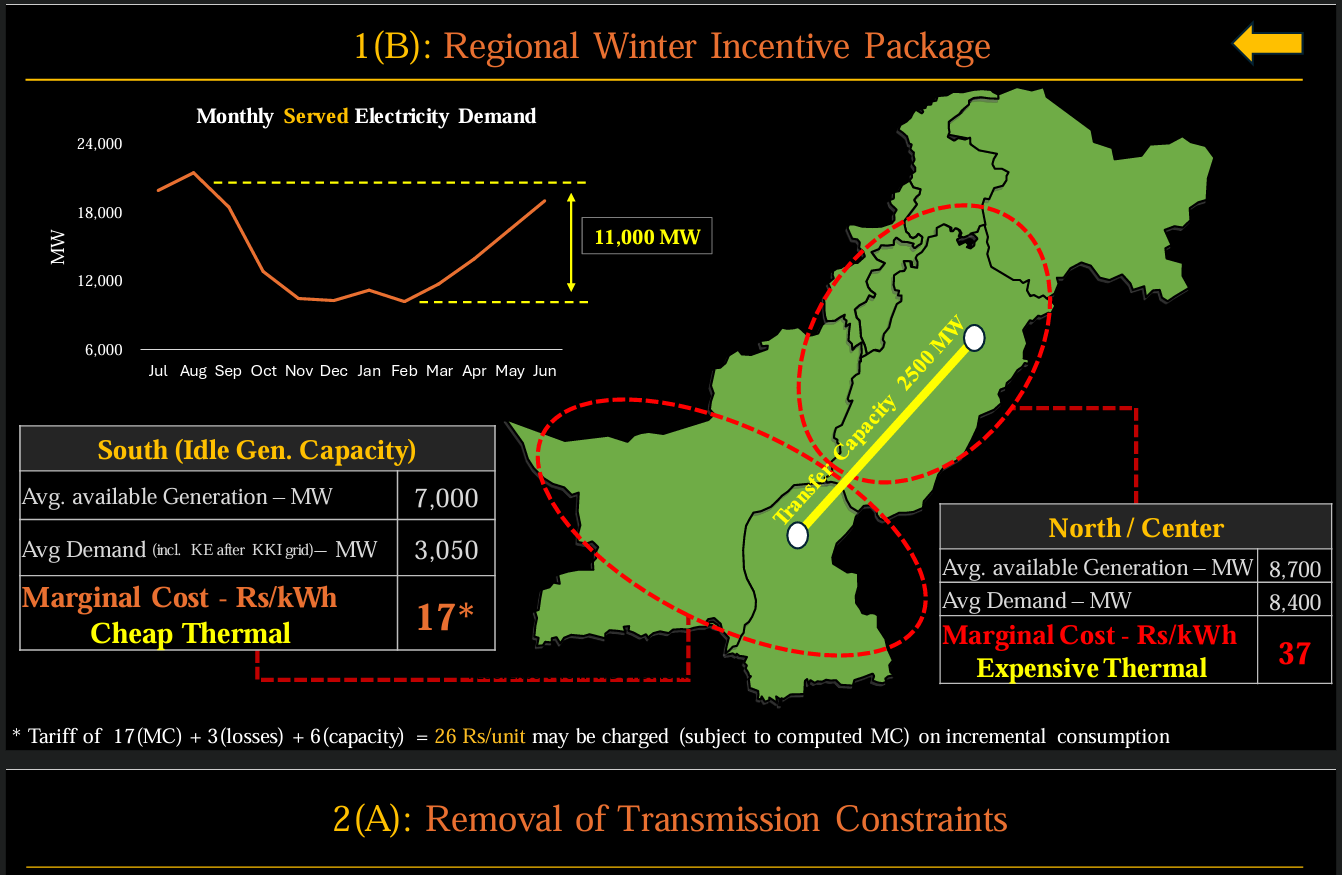
An April 2024 presentation, particularly Slides 20–23, acknowledged long-distance power-transfer restrictions, voltage instability, inefficient dispatch and delays in critical infrastructure.
The presentation illustrated a striking disparity between electricity-generation economics in southern Pakistan and northern demand centres.
According to the document, southern Pakistan had approximately 7,000 megawatts of available generation against average demand of 3,050 MW.
Its indicated marginal generation cost was approximately Rs17 per kilowatt-hour.
By contrast, northern and central regions had approximately 8,700 MW of available generation against average demand of 8,400 MW, with marginal generation costs of approximately Rs37 per unit.
These were the figures used in the 2024 planning presentation, not independently verified current regional generation costs.
Nevertheless, the comparison demonstrated why efficient electricity transmission is economically important.
Where cheaper generation is available in one region but cannot reach consumers elsewhere, the system may need to operate more expensive plants closer to demand centres.
The result can be higher fuel expenditure and less efficient use of available generation resources.
The Power Division’s presentation also identified delays in critical transmission projects and inefficient dispatch of high-cost generation as major sectoral challenges.
The document illustrated historical south-to-centre electricity transfer restrictions of approximately 2,600 MW against a 4,000 MW operating scenario.
A separate historical comparison associated transfer constraints with different average generation fuel costs, highlighting the potential economic consequences of restricted electricity flows.
The presentation does not establish that transmission limitations alone caused the entire difference in those historical costs.
However, it demonstrates that the government was aware of the problem and had identified potential remedies.
Projects Worth Approximately $1.75 Billion Were Identified
The April 2024 Power Division presentation outlined several proposed interventions intended to improve electricity transmission and system stability.
They included a 500 kV Matiari–Rahim Yar Khan transmission line, a 500 kV Ghazi Brotha–Faisalabad transmission line, reactive-power compensation equipment and battery energy storage systems.
The indicative funding requirements shown in the presentation were approximately $675 million, $349 million, $427 million and $300 million respectively.
Together, these amounted to approximately $1.751 billion.
The document also indicated a potential consumer tariff reduction of approximately Rs0.71 per unit from the proposed transmission interventions.
This was an estimated benefit, not a verified saving or proof that the projects would necessarily deliver that reduction under subsequent market conditions.
The presentation contained implementation timelines extending through 2026.
However, the screenshots reviewed by The Scoop do not establish the actual completion status, expenditure or operational performance of each project as of November 2026.
These questions require updated implementation records from the relevant transmission and power-sector authorities.
Nevertheless, the existence of the proposals establishes that the government had identified potential remedies, their indicative costs and their expected economic benefits well before the present crisis.
Lahore North Grid Station Commissioned, Yet Transmission Constraints Persist
Pakistan’s south-to-north transmission constraints remain a major structural impediment to least-cost electricity dispatch, raising questions about the effectiveness of infrastructure investment and the financial burden imposed on consumers.
Despite the reported commissioning of Lahore North Grid Station in December 2025, CPPA-G’s proposed calendar year 2027 procurement forecast continues to assume substantial seasonal limitations on electricity transfers between southern generation centres and northern demand regions.
According to the November 2026 assessment prepared by energy adviser Asim Riaz, the forecast assumes combined high-voltage direct-current and alternating-current transfer capability of approximately 3,200 MW during January and February, 3,600 MW during November and December, and 4,800 MW during summer.
Significantly, the summer assumption remains 200 MW below the 5,000 MW transfer capability envisaged for summer 2026.
The difference raises questions about the effectiveness of completed transmission reinforcements, remaining system-stability constraints and the extent to which infrastructure investments have translated into additional usable transfer capacity.
However, transfer capability is affected by several factors, including network configuration, equipment availability, voltage stability, system-security requirements and prevailing generation and demand patterns.
Consequently, the difference between the earlier target and the subsequent forecast does not, by itself, establish that the completed infrastructure failed to deliver its intended benefits.
A detailed explanation from the transmission authorities is required.
ISMO Assessment Identifies Curtailment Of Cheaper Coal And Wind Power
The financial consequences of transmission congestion could be substantial.
Riaz’s assessment cites the Independent System and Market Operator’s Interim Congestion Disclosure Note dated October 15, 2026, which he says identifies the curtailment of lower-cost coal and wind generation in southern Pakistan alongside out-of-merit dispatch of more expensive regasified liquefied natural gas and furnace-oil power plants serving northern demand centres.
Additional constraints at Rawat, Sheikhupura, Multan, Muzaffargarh, Yousafwala and Jamshoro further restrict efficient generation utilisation, according to the assessment.
Of particular significance is Riaz’s reference to ISMO’s FY2028–29 Southern Variable Renewable Energy assessment.
The assessment reportedly indicates that south-to-north transmission restrictions reduce imported-coal generation dispatch by approximately 35–45% across the modelled scenarios.
This represents a modelled reduction in imported-coal dispatch under the relevant scenarios, not a verified nationwide decline in coal-fired electricity generation or an established financial loss.
The underlying ISMO disclosure and modelling assumptions require examination to determine the baseline, precise scope and monetary implications of the reported reduction.
Nevertheless, the finding highlights the potentially significant operational consequences of transmission congestion.
Pakistan may have lower-cost generation available in southern regions while network constraints prevent that electricity from reaching northern consumers.
The system may consequently be required to operate more expensive imported-fuel plants, even as consumers continue bearing contractual capacity charges associated with generation assets operating below their potential utilisation.
During disruptions affecting LNG supplies and shipping through the Strait of Hormuz, these constraints become particularly important because reliance on expensive imported fuels can increase both electricity-generation costs and energy-security risks.
The central accountability question is therefore not simply whether Pakistan possesses sufficient installed electricity-generation capacity.
It is whether the country’s transmission infrastructure allows that capacity to be utilised efficiently and economically.
The Power Division, National Grid Company and Independent System and Market Operator should disclose the status of transmission reinforcements identified in 2024, the actual operational transfer limits achieved in 2026, the extent of out-of-merit dispatch and the financial cost of generation curtailment.
Without this information, consumers cannot determine whether substantial investments in electricity infrastructure are delivering the intended economic benefits.
Rs1.914 Trillion Capacity Payments Raise Questions Over Power Economics
Pakistan’s electricity procurement projections for calendar year 2027 add another financial dimension.
According to CPPA-G’s proposed forecast, annual electricity purchases are projected at approximately 130.081 terawatt-hours, with total procurement costs of approximately Rs3.552 trillion.
The proposed average power purchase price is Rs27.309 per unit, compared with approximately Rs25.32 for calendar year 2026.
That represents an increase of approximately Rs1.99 per unit, or 7.85%.
Capacity charges alone are projected at approximately Rs1.914 trillion, equivalent to Rs14.717 per unit.
When service-related costs are included, the broader fixed-cost component reaches approximately Rs2.163 trillion, representing 60.9% of total projected procurement expenditure.
These figures are based on the proposal considered at NEPRA’s November 3 hearing and do not represent a final regulatory determination.
The distinction matters because the proposed average purchase price is not the final retail tariff charged to households or businesses.
Nevertheless, the forecast illustrates the scale of fixed contractual obligations embedded in Pakistan’s electricity system.
Such obligations cannot necessarily be reduced merely by generating less electricity.
Consequently, lower grid consumption may leave substantial costs to be recovered from a smaller volume of electricity sales.
Why Increasing Electricity Demand May Not Solve The Problem
A frequently proposed solution to Pakistan’s electricity-sector financial difficulties is to stimulate additional consumption through lower tariffs.
The argument is that greater electricity sales would spread fixed capacity payments across more units, reducing the average cost.
However, Riaz’s assessment warns that the economics depend on the marginal cost of additional electricity.
If greater demand can be met using lower-cost generation that would otherwise remain underutilised, the average procurement cost may decline.
But once inexpensive generation is fully utilised or restricted by transmission constraints, further demand may require expensive RLNG, furnace oil or diesel-based generation.
Under those conditions, additional consumption could increase the average cost rather than reduce it.
The assessment illustrates this through simplified scenarios.
An additional 10 terawatt-hours purchased at Rs11.6 per unit would reduce the average procurement cost to approximately Rs26.19 per unit.
Also Read: Overhaul Of Pakistan’s Energy Grid Projected To Yield $17 Billion In Macroeconomic Savings
By contrast, purchasing an additional 10 terawatt-hours at Rs58 per unit would increase the average to approximately Rs29.50 per unit.
At Rs74 per unit, the average would rise further to approximately Rs30.64.
These are illustrative sensitivities, not forecasts of actual electricity dispatch.
Their significance lies in demonstrating that the cost, location and timing of additional electricity consumption matter as much as the total quantity sold.
Lower industrial tariffs could stimulate productive demand, but the economic benefit depends on whether the additional electricity can be supplied at a commercially viable cost.
Industrial Consumers Face A Double Energy Threat
Pakistan’s industrial sector faces risks from both gas-supply uncertainty and electricity costs.
Textile mills, exporters, manufacturers, food processors and other industrial users require reliable energy to maintain production schedules and compete internationally.
Gas curtailments can force businesses to reduce output or adopt more expensive alternative fuels.
Electricity tariffs, meanwhile, influence the cost of domestic production and the competitiveness of exports.
Riaz’s assessment cites reported industrial electricity rates ranging from approximately Rs33 to Rs41.6 per unit across different categories.
Although international comparisons require adjustments for taxes, voltage levels, exchange rates and other factors, energy affordability remains a significant concern for Pakistani industry.
The combination of uncertain LNG supplies, expensive replacement fuels, transmission congestion and high fixed electricity costs could complicate efforts to revive industrial activity.
The government therefore faces a difficult balancing exercise.
It must protect essential household gas supplies, support productive industrial demand and contain the financial consequences of expensive imported fuels without undermining the electricity system’s long-term viability.
Bangladesh’s Experience Highlights The Changing Energy Landscape
Pakistan’s energy challenges are not unique.
Bangladesh has also experienced serious disruptions linked to LNG availability, with reports of prolonged power shortages and increased demand for solar and battery storage systems.
An analysis compiled by Riaz from Bloomberg reporting highlights how expensive imported LNG and unreliable electricity are encouraging businesses and households in emerging economies to invest in distributed renewable-energy systems.
The assessment cites rising demand for solar panels, batteries and related equipment, particularly among industrial consumers seeking dependable electricity.
The specific market figures in that assessment require verification against the original reporting before being treated as independently established.
Nevertheless, the broader economic development is relevant to Pakistan.
Solar power reduces exposure to imported fuel costs during generation hours, while battery energy storage can shift some electricity into evening periods and provide backup during supply interruptions.
For industrial consumers, properly designed systems can improve energy-price predictability and reduce production losses.
However, solar and batteries are not a complete substitute for natural gas.
Storage duration, seasonal generation patterns, financing costs, grid requirements and backup needs must all be considered.
Gas-fired generation may continue playing an important flexibility and reliability role.
The policy objective should be the lowest sustainable cost of reliable electricity, rather than protecting the utilisation of any particular fuel or generation technology.
The Solar Paradox: Lower Grid Sales, Persistent Fixed Costs
Pakistan’s rapid adoption of rooftop solar also creates challenges for the traditional electricity-market structure.
When consumers generate more electricity independently, their purchases from distribution companies may decline.
However, the grid continues carrying substantial capacity-payment obligations, infrastructure costs and other fixed expenses.
If these costs are recovered primarily through electricity-unit charges, lower grid sales can increase the average burden on remaining consumers.
Higher tariffs may then encourage further self-generation.
This creates a difficult financial cycle for distribution companies and policymakers.
Riaz’s assessment argues that Pakistan requires electricity-market reform rather than restrictions designed primarily to preserve conventional generation demand.
The necessary changes include transparent fixed-cost allocation, efficient network pricing, competitive industrial electricity arrangements and better integration of distributed generation and battery storage.
Electricity planning must also account for hourly demand, including the reduction in daytime grid purchases caused by solar generation and the continuing need for evening supply.
The Accountability Questions Pakistan Cannot Ignore
The emerging winter crisis raises a series of questions requiring answers from the Petroleum Division, Power Division, CPPA-G, NEPRA, OGRA, gas utilities and transmission authorities.
How many LNG cargoes are firmly contracted for December 2026 and January 2027?
What quantities remain exposed to QatarEnergy’s force majeure?
What replacement procurement arrangements have been completed, and at what prices?
What gas curtailments are expected for industrial, commercial and other consumers?
How quickly will the government’s new LPG import arrangements translate into physical supplies and lower market prices?
Why have LPG prices reached several times the official benchmark in some areas, and what enforcement action has been taken?
Which transmission projects identified in the April 2024 Power Division presentation have been completed, delayed or revised?
What additional transfer capacity has actually become available following the commissioning of Lahore North Grid Station?
Why does the proposed 2027 summer transfer assumption remain below the earlier 5,000 MW target?
What explains the reported 35–45% reduction in imported-coal dispatch under ISMO’s modelled transmission-constrained scenarios?
How much electricity has been curtailed because of transmission congestion, and what has been the resulting cost of out-of-merit dispatch?
Finally, how does the government intend to reduce electricity-sector costs while maintaining reliable supply and avoiding additional fiscal burdens?
These questions go to the heart of Pakistan’s energy governance.
The available evidence demonstrates that important structural problems were identified years ago. Establishing whether specific delays, procurement decisions or institutional failures caused avoidable losses requires updated official records and responses from the responsible authorities.
Beyond Winter: Pakistan Needs An Energy-Security Reset
Pakistan’s immediate priority is to secure sufficient gas and LPG supplies for winter while protecting vulnerable households and limiting disruption to productive industry.
But emergency procurement and temporary subsidies cannot resolve the country’s deeper energy-sector challenges.
The April 2024 Power Division presentation demonstrates that transmission bottlenecks, inefficient dispatch and infrastructure limitations were already recognised at the highest levels of electricity-sector planning.
The November 2026 assessment by Asim Riaz indicates that many of these issues remain relevant to future procurement costs and fuel-security risks.
Meanwhile, the proposed Rs1.914 trillion annual capacity-payment burden highlights the financial consequences of an electricity system carrying substantial fixed obligations regardless of actual consumption.
The convergence of LNG disruption, LPG price volatility, transmission congestion and expensive electricity procurement should prompt a comprehensive reassessment of Pakistan’s energy strategy.
That reassessment must address imported-fuel diversification, contingency planning, transmission investment, capacity-contract economics, competitive electricity markets and the integration of renewable energy and storage.
For ordinary consumers, the immediate concern is whether they will have sufficient gas to cook and heat their homes at affordable prices.
For industry, it is whether reliable energy will remain available at costs that allow Pakistani businesses to compete.
For policymakers, the challenge is more fundamental.
Pakistan cannot indefinitely rely on emergency fuel purchases and consumer tariff adjustments to compensate for weaknesses in energy planning, infrastructure and market design.
The winter of 2026–27 may prove to be another difficult test of the country’s energy-security arrangements.
But the larger question is whether the government will use the crisis to address the structural problems its own documents identified more than two years ago — or leave consumers and businesses exposed to the same vulnerabilities in winters to come.