

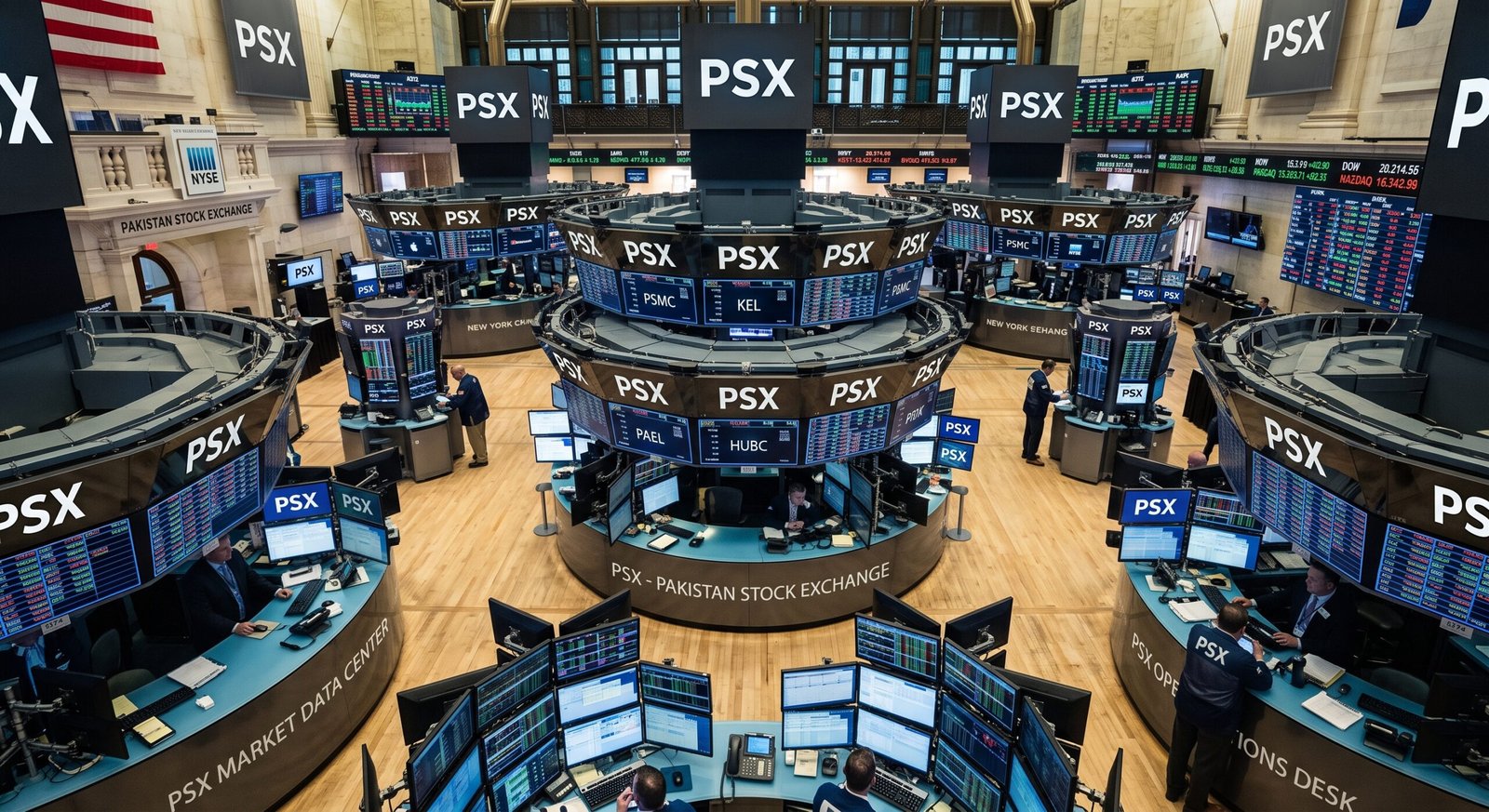
Following a volatile session, the benchmark index shook off early selling pressure to close in the green as the government rolls out a new IMF-backed bond market strategy.
Buying interest returned to the Pakistan Stock Exchange (PSX) on Wednesday, pushing the benchmark KSE-100 Index up by over 350 points to settle at 169,969.32.
The market witnessed a rollercoaster session. The index initially surged, hitting an intraday high of 171,492.52 during early trading hours on the back of strong investor enthusiasm. However, those early gains slowly eroded as the day progressed. The index traded sideways around the 171,000 mark through midday before facing renewed selling pressure in the second half, briefly dipping to an intraday low of 169,872.13.
Here is a quick look at the KSE-100’s performance on Wednesday:
| Metric | Value |
| Closing Index | 169,969.32 |
| Point Change | +368.92 |
| Percentage Change | +0.22% |
| Intraday High | 171,492.52 |
| Intraday Low | 169,872.13 |
Wednesday’s recovery follows a tough Tuesday session where the index shed 825.22 points (0.48%) to close at 169,600.41, driven by a late-session sell-off linked to rising global crude prices and ongoing geopolitical tensions in the Middle East.
IMF-Backed Bond Market Reforms
In a major domestic development, the Ministry of Finance (MoF) unveiled a Strategic Action Plan for Pakistan’s Local Currency Bond Market (LCBM) on Tuesday.
Rolled out under an International Monetary Fund (IMF) program pledge, the plan is designed to clear market bottlenecks. It targets deeper secondary-market liquidity, a broader investor base, and more predictable government borrowing. It also outlines key reforms to the legal, tax, and financial infrastructure governing rupee-denominated securities.
Global Bond Slump vs. Asian Market Resilience
Internationally, global bonds struggled on Wednesday, heading for their worst month in years. Markets have been hit by a heavy mix of deteriorating government finances, a glut of issuances, and rising inflation, with energy costs remaining elevated due to the seven-month-old US-Israeli war on Iran.
Rising borrowing costs remain a primary concern for investors, as sovereign yields act as an anchor for global markets, impacting corporate refinancing and economic growth.
Despite the bond market’s turbulence, Asian stock markets remained largely unfazed. MSCI’s broadest index of Asia-Pacific shares (excluding Japan) rose 0.2% in early trading, tracking toward a mild monthly drop of just over 1%. Meanwhile, Japan’s Nikkei climbed 0.9% to end the month relatively flat, and South Korea’s Kospi headed for a solid monthly gain of 1.4%.
The Scoop desk
The newsroom team behind The Scoop's independent business, economy, technology, and markets coverage.